
Most B2B storefront launches do not fail because the design looks weak.
They fail when a buyer sees one price, operations sees another, and support cannot quickly tell which system is right.
That is why a B2B storefront launch checklist has to focus on operational truth, not just front-end polish.
We have already covered the customer portal vs storefront decision and how big bang vs phased migration changes risk. This article starts after those decisions are made.
It is built for the team that has already chosen the B2B ecommerce storefront path and now needs a go-live plan that works under real operating pressure.
What this article gives you
- A practical launch checklist
- A set of failure scenarios to test before launch
- A first 30-day hypercare plan
Why B2B storefront launches break after successful UAT
A storefront can pass UX review and still fail in week one.
The usual reason is simple: the front end is ready before the operating model behind it is ready.
That gap shows up in pricing, inventory, customer entitlements, approvals, order routing, and post order visibility. Buyers do not experience those as integration issues. They experience them as broken promises.
If your team is still debating which system owns customer specific pricing, who resolves order exceptions, or where inventory truth lives, you do not have a go live plan for a B2B commerce storefront yet.
You have an implementation that is still negotiating basic business rules, which is why ERP and ecommerce alignment before replatforming matters so much.
Launch rule:
If a buyer facing field has no clear owner, assume it will become a launch week problem.
The 12 point B2B storefront go live checklist
Use this as a pass or fail sheet in launch meetings.
If one of these items is still unresolved in the last 10 business days before go live, treat it as an active risk with an owner, deadline, and escalation path.
Use the checklist below as a decision tool, not a documentation exercise.
1. Customer or account master mapping
Primary owner: ERP / CRM
Pass or fail question: Can every launch account map cleanly to the right billing and ship to structure?
Why it matters: Broken mapping blocks buying or exposes wrong data.
2. Contract pricing ownership
Primary owner: ERP / pricing ops
Pass or fail question: Is there one trusted source for contract, tier, and quote derived pricing?
Why it matters: Conflicting prices damage trust fast.
3. Inventory visibility rules
Primary owner: ERP / OMS / ops
Pass or fail question: Can the storefront show the right availability state for priority SKUs and locations?
Why it matters: Buyers act on what they see.
4. Product data ownership
Primary owner: PIM / product team
Pass or fail question: Are attributes, pack sizes, documents, and media complete for launch categories?
Why it matters: Weak product truth hurts search and conversion.
5. Content governance
Primary owner: CMS / marketing
Pass or fail question: Are category, PDP, and help content aligned to the actual buying flow?
Why it matters: Good UX still fails if content misleads.
6. Role and approval logic
Primary owner: Commerce / sales ops
Pass or fail question: Can buyers, approvers, and branch users do only what they should?
Why it matters: B2B workflows depend on permissions.
7. Checkout and payment terms
Primary owner: Commerce / finance
Pass or fail question: Do PO, net terms, tax handling, and freight rules work for real accounts?
Why it matters: Checkout failure becomes revenue failure.
8. Order orchestration
Primary owner: OMS / fulfillment
Pass or fail question: Do orders route, split, backorder, and update correctly after submission?
Why it matters: Many issues appear after checkout.
9. Error handling and monitoring
Primary owner: IT / commerce ops
Pass or fail question: Do failed syncs create alerts, logs, and clear ownership quickly?
Why it matters: Silent failures are expensive failures.
10. Search and navigation readiness
Primary owner: Commerce / product
Pass or fail question: Can buyers find core products, alternates, and category paths without help?
Why it matters: Storefronts must support discovery.
11. Cutover controls
Primary owner: PMO / leadership
Pass or fail question: Are freeze windows, rollback triggers, and launch day approvers defined?
Why it matters: Fast decisions matter more than long documents.
12. Hypercare plan
Primary owner: Commerce / support / IT
Pass or fail question: Is there a daily triage rhythm for the first 30 days?
Why it matters: Go live starts stabilization.
This structure lines up well with Reveation’s ecommerce integration services. Strong B2B storefront solutions depend on reliable sync, clear ownership, and practical execution from day one.
Where teams usually get this wrong
The common mistake is not forgetting integration.
The common mistake is treating every integration as equally important.
In reality, some flows are buyer critical, some are operations critical, and some can safely run on a schedule without hurting launch quality.
That is why launch planning needs prioritization, not just connectivity.
Key warning
A launch plan that treats every integration the same usually misses the flows that actually affect buyer trust.
Real time vs batch: settle this before you debate tooling
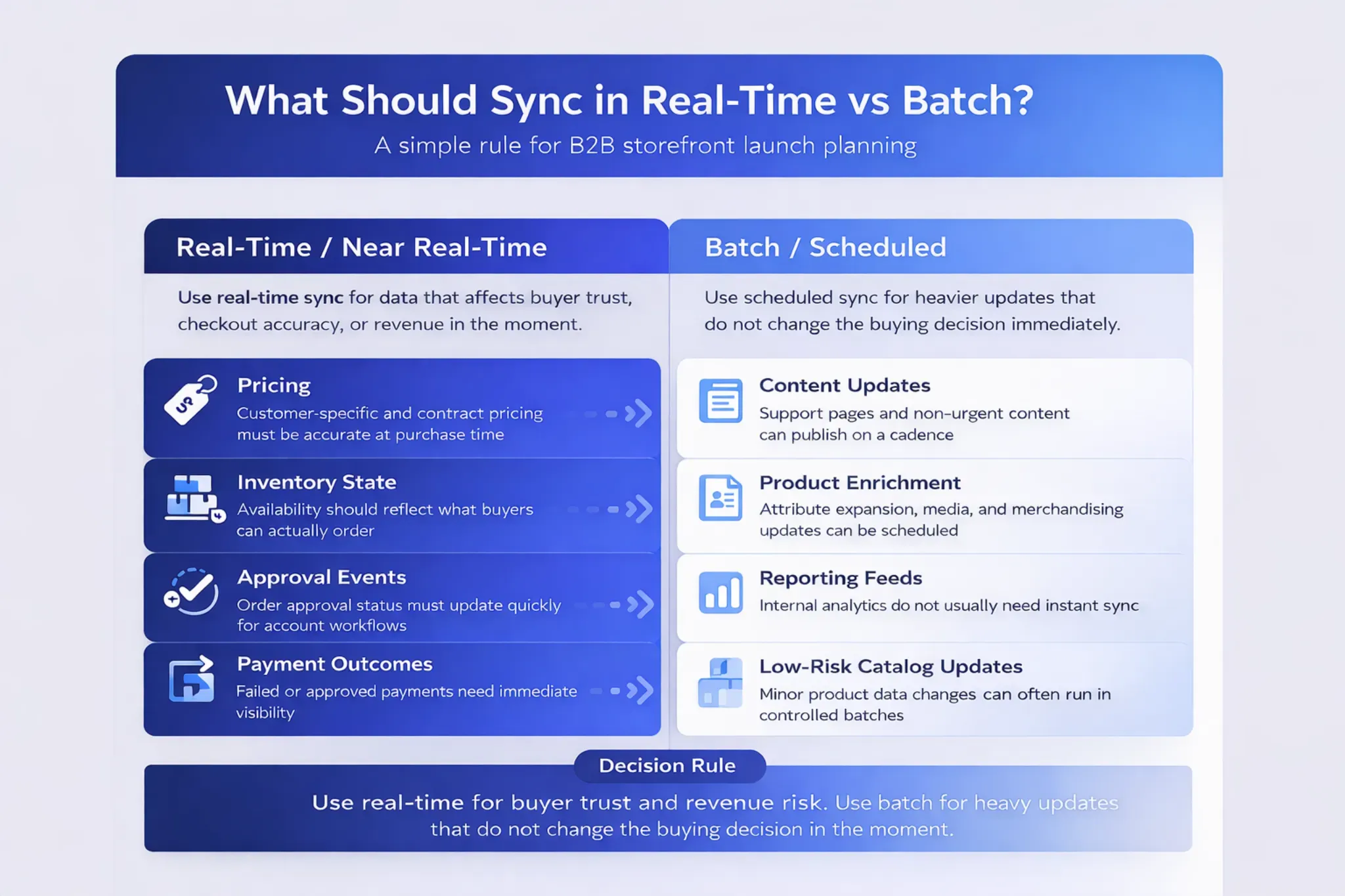
Use real time or near real time for
- Pricing confirmation
- Inventory state
- Approval events
- Payment outcomes
- Order status updates
Do not force real time into
- Heavier content updates
- Enrichment jobs
- Reporting flows
- Anything that does not change the buyer’s decision in the moment
This is where Reveation’s ERP integration and OMS integration framing is useful. The goal is not real time everything. The goal is a sync design that matches business risk, which is essential for any B2B ecommerce storefront.
The simplest ownership model to align around
For many B2B teams, a simple layered model is enough to remove confusion:
ERP
Customer master, contract pricing, credit terms, invoices, and core order and inventory truth
PIM
Attributes, enrichment, product quality, and channel ready product data
CMS
Content that supports buying, onboarding, and category education
OMS or WMS
Order routing, allocation, fulfillment status, and exception handling
Storefront
Search, navigation, cart, checkout, self service actions, and account facing experience
This model does not solve every edge case.
It does make launch conversations faster and more concrete.
It also aligns naturally with Reveation’s PIM services, CMS integration services, and broader B2B ecommerce solutions. This is often where the difference between generic builds and effective B2B storefront solutions becomes clear.
The 10 failure scenarios to test before launch
Most UAT plans are too polite.
They prove the happy path works. They do not prove the business can survive exceptions.
That matters because exceptions are where B2B commerce becomes real.
Contract pricing, approvals, partial shipments, account entitlements, freight rules, and search behavior usually matter more than a clean demo flow.
Test for business stress, not just technical success.
Wrong contract price
What to simulate: Same SKU for two contract accounts
What pass looks like: Each account sees only its valid price, with audit trail
Customer specific catalog mismatch
What to simulate: Restricted catalog account vs public account
What pass looks like: Products follow entitlement rules exactly
Partial shipment
What to simulate: One order split across locations
What pass looks like: Buyer sees accurate fulfillment and status updates
Backorder
What to simulate: Item becomes unavailable after carting
What pass looks like: Expected availability and communication stay accurate
Approval rejection
What to simulate: Approver declines or delays order
What pass looks like: Order state is clear and recoverable
Payment or PO issue
What to simulate: Invalid PO, terms mismatch, or failed auth
What pass looks like: Buyer gets a useful next step path
Tax exception
What to simulate: Nonstandard jurisdiction or exemption case
What pass looks like: Tax logic holds without manual cleanup
Duplicate customer mapping
What to simulate: User attached to wrong account
What pass looks like: Access is blocked or corrected safely
Search failure
What to simulate: Top SKUs return weak or zero results
What pass looks like: Synonyms, attributes, and fallback paths work
Sync interruption
What to simulate: ERP or OMS update arrives late
What pass looks like: Alerts fire, owners are assigned, buyer impact is contained
This is also where Reveation’s B2B ecommerce search perspective matters.
A storefront is expected to support discovery and evaluation, not just reordering. That means launch readiness includes search quality, product findability, and substitute logic in a way older portal projects often did not.
A worked example: industrial distributor launch week
Imagine a distributor selling to branch based accounts with contract pricing, mixed public and account specific catalogs, and multi warehouse fulfillment.
The homepage may look polished, but the real launch risk sits in branch permissions, substitute product logic, partial shipments, freight rules, and whether order status comes back cleanly after routing.
In that environment, a useful test pack should include one contract account, one dealer account, one credit hold account, one punchout customer, and one backorder scenario.
That turns abstract integration testing into business testing.
Better launch question
Not “Did QA pass?” but “Did our highest risk customer scenarios pass?”
Cutover planning: what must be true in launch week
Rollout model is a business risk decision before it is a technical one.
Whether you go big bang, phased, or parallel run, the launch team still needs the same controls: a freeze window, named decision makers, rollback triggers, and a same day path for pricing, inventory, checkout, or account access incidents.
Without that structure, every issue becomes a meeting.
Launch day speed depends less on documentation volume and more on decision clarity.
Minimum cutover RACI
Commerce lead
Owns buyer experience, search, content, cart, and launch communications
ERP or integration lead
Owns source of truth validation, sync health, and pricing or inventory triage
Operations lead
Owns routing, fulfillment, and warehouse exceptions
Support lead
Owns ticket triage, issue tagging, and escalation feedback loop
Executive approver
Owns go or no go, rollback, and same day business tradeoff decisions
If those roles are fuzzy, launch day slows down immediately.
The team may still be strong, but response time will suffer because nobody knows who can make the final call.
At this point in a program, most teams do not need another generic requirements document.
They need a pressure test. That is where our B2B ecommerce consulting and implementation support will help you out. The value is not more strategy. The value is getting outside eyes on architecture, ownership, cutover, and launch risk before those issues become expensive.
First 30 days after go live: the hypercare scoreboard
Go live should not be treated as proof of success.
Stabilization is the proof.
The first month needs its own operating rhythm. The goal is to reduce uncertainty, catch repeat issues early, and stop manual workarounds from becoming normal behavior.
Order exception count
What it tells you: Whether orchestration is holding under real traffic
Target behavior: Declines week over week
Pricing mismatch incidents
What it tells you: Whether commercial truth is stable
Target behavior: Same day fix, no repeat account or SKU issue
Inventory discrepancy incidents
What it tells you: Whether availability sync is trustworthy
Target behavior: Root cause identified within 24 hours
Checkout failure rate
What it tells you: Whether buyers can complete core journeys
Target behavior: Spikes get triaged the same day
Search zero result rate
What it tells you: Whether discovery is working for new buyers
Target behavior: Content and attribute tuning continues
Support tickets tied to self service
What it tells you: Whether the storefront is reducing or creating work
Target behavior: Trend improves after week one
Time to close integration alerts
What it tells you: Whether ownership is real
Target behavior: Critical alerts have named owners and deadlines
Hypercare is not about replacing people with dashboards.
It is about giving the team enough visibility to support buyers without rebuilding the manual workarounds the storefront was supposed to reduce.
If growth also depends on new buyer discoverability, Reveation’s customer portal SEO article and Google can’t index your customer portal article are useful follow on reads for deciding what should stay public versus gated.
Direct ERP integration or a layered model?
There is no universal answer here.
A direct ERP to storefront model can work when the product model is simple, the APIs are reliable, and order orchestration is limited.
Once you add richer product data, more complex pricing, account entitlements, multi warehouse logic, punchout, CPQ, or heavier exception handling, a layered model usually becomes easier to govern.
That may include PIM, OMS, middleware, or other orchestration layers.
Reveation’s service structure reflects that progression. Start with core ERP connectivity, then add supporting layers when complexity makes direct coupling risky. That is a practical way to think about modern B2B storefront solutions.
Use direct integration when
- Simplicity is real
- The product model is manageable
- APIs are reliable
- Order orchestration is limited
Use a layered model when
- Simplicity is only assumed
- Pricing and entitlements are more complex
- Multi warehouse logic matters
- Exception handling will be heavy
A simple decision shortcut
Use direct integration when simplicity is real.
Use a layered model when simplicity is only assumed.
Teams often underestimate complexity until after launch, when change requests start exposing the limits of a tightly coupled stack.
Final takeaway
A new B2B storefront is ready for go-live only when the back office is ready to defend every buyer-facing promise.
That includes price, availability, account access, approval logic, order flow, and post-order visibility.
The most useful checkpoint is still the simplest one: can your team explain who owns each critical truth, how it syncs, and what happens when it fails?
That framing also fits Reveation’s broader content ecosystem.
Across its articles and services, the message is consistent: storefront strategy, ERP alignment, product data quality, search, migration planning, and implementation discipline all have to work together for the experience to feel reliable after launch.
When teams compare the best storefronts for B2B, the real differentiator is not the homepage alone. It is whether the operating model behind the experience can hold up under real buyer pressure.
For a practical next step, keep the launch meeting simple.
- Review the 12 point checklist
- Run the 10 failure scenarios
- Commit to a 30 day hypercare cadence
That is what turns a storefront launch from a website release into an operating model upgrade.