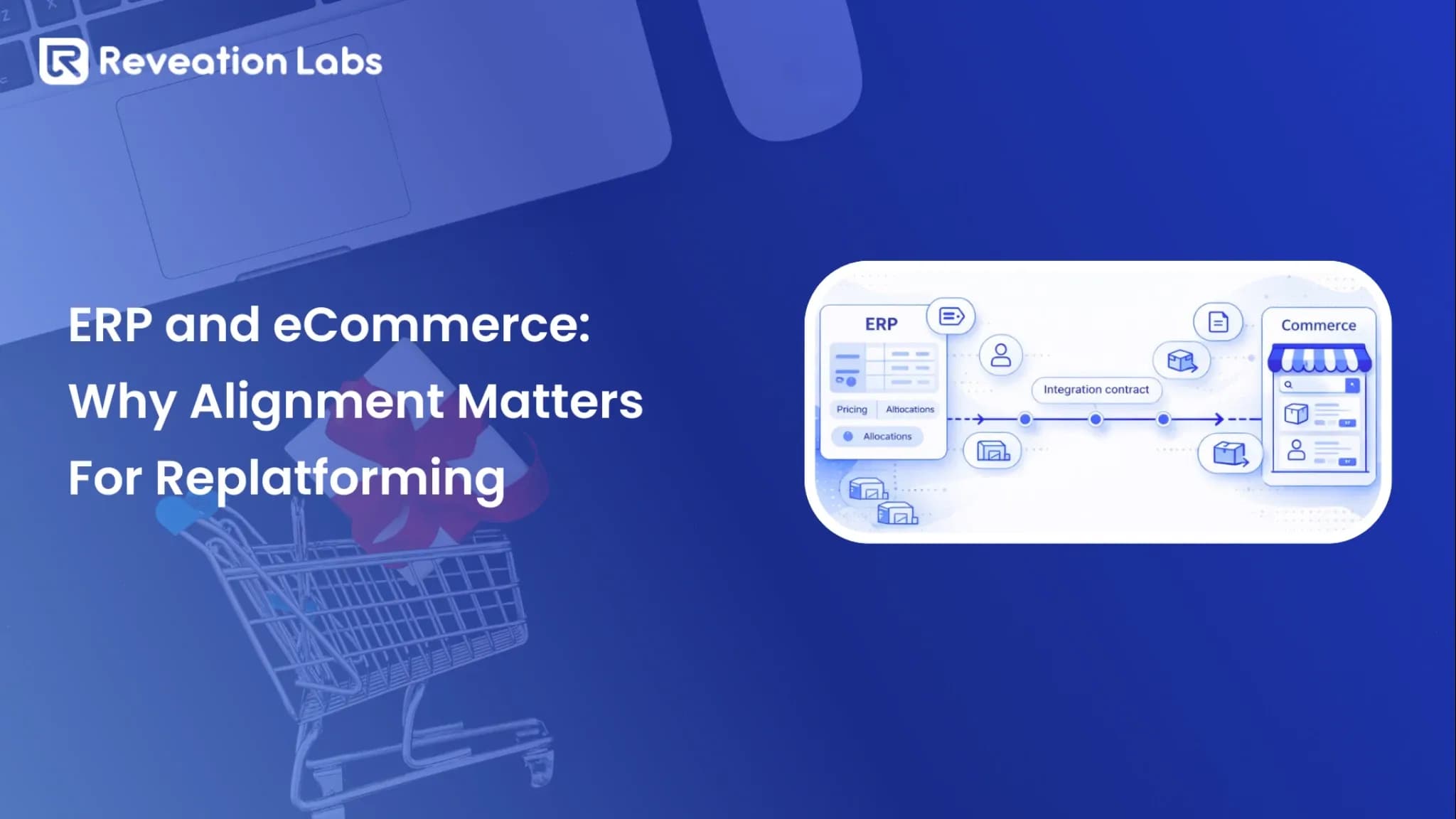

Ecommerce replatforming promises better UX, faster performance, and modern merchandising. But for mid-market distributors and manufacturers with contract pricing, multi-warehouse inventory, and legacy ERP systems, the real risk isn’t the platform. It’s the misalignment between ERP and commerce.
ERP eCommerce alignment during replatforming is not optional in complex B2B models.
When teams skip alignment and jump straight into feature scoping, they often rebuild ERP logic in the storefront, launch with data gaps, and spend the first 90 days stabilizing operations instead of growing revenue.
If you’re planning to replatform B2B commerce, start with integration truth, not theme selection. This is why we treat replatforming as an integration-first initiative, not a front-end project (see how we approach ERP integration for B2B commerce).
In 30 Seconds
- Replatforming does not fix ERP misalignment
- ERP must remain the system of record for commercial truth
- An integration contract should be defined before development begins
- Testing must include real-world B2B scenarios and edge cases
- Governance prevents post-launch drift and duplicate logic
Why ERP eCommerce Alignment Matters in B2B Replatforming
Most replatform projects begin with platform comparisons, UX design, and a feature checklist, often overlooking critical replatforming seo considerations. But many B2B performance issues are symptoms of deeper ERP commerce integration complexity: contract pricing rules, allocation logic, credit holds, and order validation requirements. A new platform won’t automatically fix those constraints, it can amplify them by increasing traffic, automation, and data throughput.
A distributor launches a new storefront. Pricing looks correct in staging. After go-live, customers see list price instead of contract pricing. Sales spends weeks manually correcting invoices while support fields “where did my pricing go?” calls. The issue wasn’t the platform, it was contract pricing mapping and ownership clarity.
According to Gartner, integration complexity is a common driver of delays in enterprise digital initiatives. In practice, replatforming without ERP alignment often recreates the same complexity inside a new interface, only faster and at higher volume.
What Goes Wrong Without ERP Alignment
- Contract pricing defaults to list (or the wrong price list)
- Inventory oversells due to stale availability or allocation mismatches
- Orders pass checkout but get rejected in ERP for missing requirements
- Duplicate pricing/availability logic becomes permanent technical debt
- Sales teams lose trust and move buyers back to email/phone ordering
Aligning your ERP with modern B2B eCommerce Solutions ensures real-time data synchronization, accurate pricing, and seamless order management before you replatform. Without this foundation, even the most advanced eCommerce upgrade can fail to deliver operational efficiency and a consistent buyer experience.
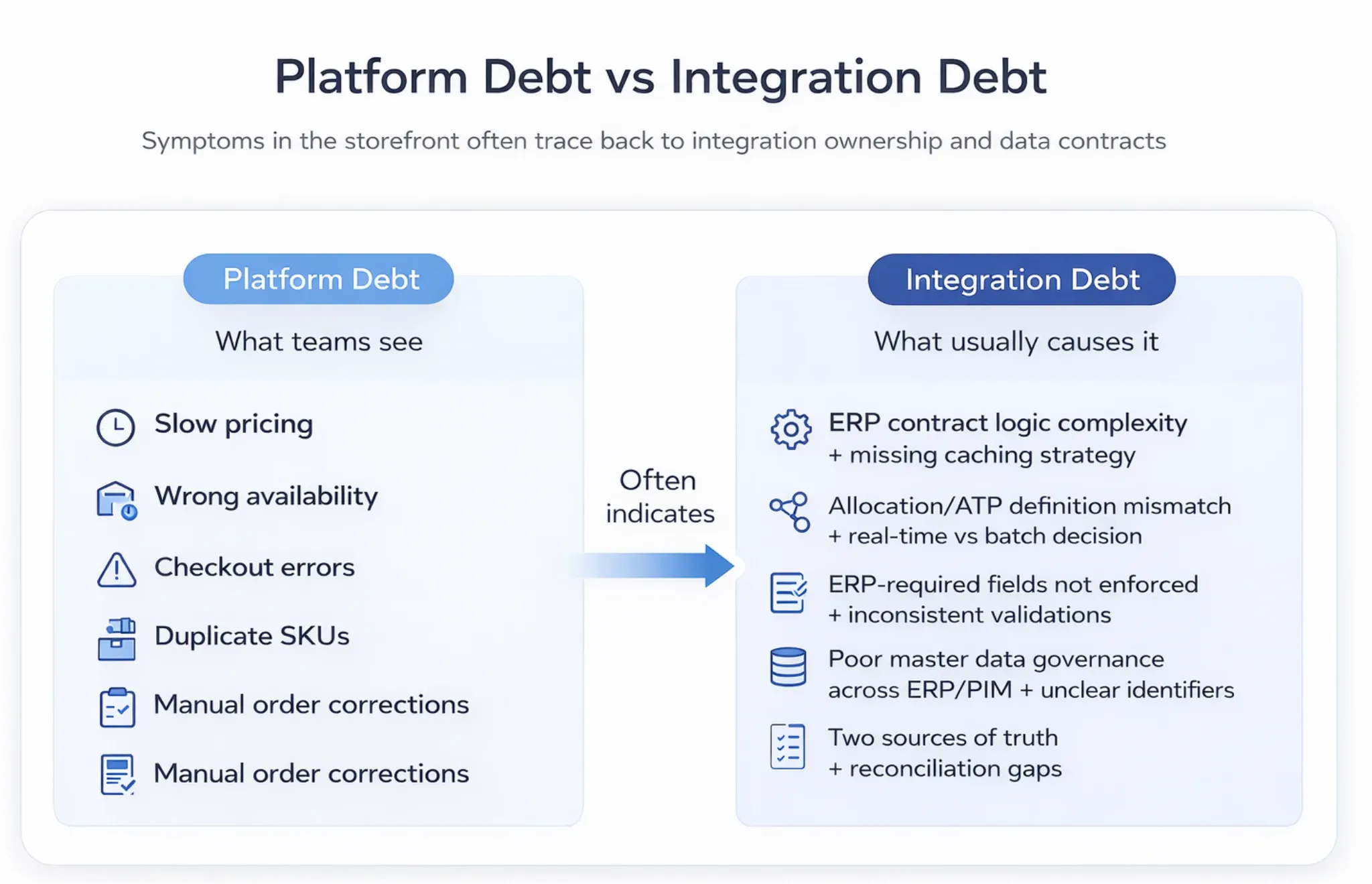
Platform Debt vs Integration Debt
Many B2B teams believe they’re suffering from platform debt. In reality, they’re dealing with integration debt, unclear system-of-record ownership, inconsistent data models, and workflows that don’t match how ERP expects orders to arrive. If you diagnose the wrong problem, replatforming relocates it.
If you're unsure whether you're facing platform limitations or integration debt, see: 4 Signs Your B2B eCommerce Platform Is Holding You Back.
What ERP eCommerce Alignment Replatforming Actually Means
ERP eCommerce alignment replatforming is the structured process of defining system-of-record ownership, object-level governance, process alignment, synchronization strategy, and resilience patterns before development begins. It’s not just “connect ERP to commerce.” It’s deciding what truth is, where it lives, how it moves, and what happens when reality breaks your happy path.
In most B2B environments, ERP remains the owner of customer hierarchies, contract pricing, credit limits, inventory allocations, and financial posting. Commerce presents this truth, it should not redefine it. When commerce becomes a shadow ERP, you get drift, disputes, and manual cleanup.
For a deeper view of how we structure systems integration across B2B commerce stacks, see our eCommerce integration services.
What commerce should own (and what it shouldn’t)
Commerce can own experience-layer decisions like navigation, search relevance, merchandising rules, and session-level cart behavior. But it should not become the owner of commercial truth, contract pricing, credit rules, allocation logic, or mandatory order validation, because that creates drift and “fix it in the storefront” debt. Alignment is simply making those boundaries explicit, so you don’t debate them mid-build.
System of record and field ownership: the decisions that prevent chaos
- Pricing: ERP owns contract rules; commerce may cache results for speed with defined refresh windows.
- Inventory: ERP/WMS owns the availability definition (ATP/allocations/lead times); commerce displays it with agreed latency.
- Customer eligibility: ERP/CRM owns credit holds and ship-to rules; commerce enforces them before checkout.
- Orders: commerce collects buyer intent; ERP validates and becomes the final operational record.
Rule of thumb
If a value impacts fulfillment, invoicing, or revenue recognition, it must have a single owner, and that owner is usually an eERP or an ERP-adjacent system designed for that truth.
Risks of Replatforming Without ERP
Most replatform projects underestimate the integration surface area. Teams plan pages, search, and promotions, then discover late that customer pricing, unit conversions, shipping terms, and order validations require deep ERP decisions. At that point, shortcuts harden into permanent complexity.
Risk 1: Data gaps that show up only after go-live
B2B catalogs are rarely “one SKU, one price.” They include customer-specific assortments, UOM conversions, pack sizes, tiered pricing, and regional restrictions. If those aren’t modeled and mapped early, they become launch-blocking surprises, often discovered only when buyers place real orders at volume.
Risk 2: Duplicate logic that becomes impossible to maintain
Duplicate logic starts innocently: “We’ll calculate pricing in commerce for speed.” Then it grows: “We’ll also do availability rules here.” Now every business change requires updates in two systems, and reconciliation becomes a permanent task. Duplicate logic is usually the hidden reason why “the site works,” but operations don’t trust it.
Risk 3: Go-live operational breakdown
In B2B, launch stability matters more than launch polish. Buyers may forgive a less flashy UI, but they won’t forgive incorrect pricing or unreliable fulfillment signals.
When orders don’t match ERP expectations, you get manual corrections, customer escalations, and rapid channel distrust.
Mini-scenario: the “order rejection” surprise
A manufacturer launches a new checkout with a clean UX. In week one, dozens of orders fail in ERP because mandatory fields weren’t captured (ship-to codes, tax exemptions, PO formatting, freight terms). The storefront wasn’t “broken”; it simply wasn’t aligned with ERP order requirements and validations.
Integration amplifies bad data
Integration doesn’t create quality; it multiplies whatever you already have. If customer records are inconsistent, product attributes are incomplete, or price lists aren’t governed, a new platform will surface those issues faster and at higher volume. Alignment includes data governance and validation, not just endpoints.
Define Interfaces Before Features
Most agencies begin with theme selection and feature parity. Our ecommerce replatforming strategy begins with ERP ownership, object contracts, and order truth. That difference shows up at launch, because teams build on a stable truth instead of discovering it halfway through the project.
Integration-first means defining objects (customer, SKU, price, inventory, order), event triggers, field ownership, performance SLAs, and downtime behavior before development begins. You can see a practical example of this mindset applied to commerce ecosystems here: Virto Commerce Integration with Existing Systems.
Start with an integration contract, not a connector
Treat your erp integration strategy like a contract that engineers and operators can rely on. When the contract is clear, teams build faster with fewer surprises. When it’s unclear, every sprint becomes a negotiation about “what should happen” and “where should this live.”
Integration contract mini-template
- Objects: customer, ship-to, SKU, price, inventory, order, shipment, invoice
- Events: price updated, inventory changed, order placed, order acknowledged, shipped, invoiced
- Ownership: which system writes each field and under what conditions
- SLAs: freshness targets, response times, peak load behaviour
- Failure modes: retries, idempotency rules, queues, reconciliation steps
- Downtime behaviour: browse-only, quote request, or “call for availability” experience
Real-time vs batch synchronization:
Not everything needs to be real-time, but some things absolutely do. Pricing and availability often need to be near real-time when they change frequently or drive purchase decisions. Product enrichment attributes, many CMS updates, and some profile changes may be fine on batch schedules if expectations are clear.
For multi-warehouse businesses, this is especially critical. If you’re trying to support accurate availability across locations, you need a plan for freshness, caching, and warehouse sourcing logic (related: Real-Time Multi-Warehouse Inventory).
Mini-scenario
A distributor syncs inventory every 60 minutes to protect ERP performance. At launch, buyers place orders based on stale availability while ERP allocates stock to other channels. The storefront wasn’t “wrong” technically, it was misaligned on what “available” meant and how fresh that signal needed to be.
Resilience patterns executives should demand
ERP systems are not always optimized for high-frequency storefront reads. Integration-first design includes resilience patterns that protect both buyer experience and ERP stability. The goal isn’t perfection, it’s predictable behavior when reality happens.
- Read caching for pricing and inventory with defined TTLs and refresh triggers
- Asynchronous queues for order submission and status updates to prevent spikes from breaking ERP
- Idempotency + retries so duplicate events don’t create duplicate orders
- Circuit breakers to prevent cascading failures across systems
- Graceful degradation experiences when ERP is slow or down
Practical Steps Before You Build
If you’re preparing to replatform B2B commerce, alignment work should happen before sprint planning. This is the highest-leverage work in the entire program because it reduces rework and stabilizes launch. It also helps you avoid “surprise integrations” that blow up the scope late in the timeline.
If you need custom replatforming paths digital commerce support that prioritizes readiness and stability, see our B2B eCommerce implementation approach.
Step 1: Run an ERP-centered discovery sprint
A productive discovery phase is not generic requirements gathering. It’s a focused sprint that answers practical questions about how ERP works today and what it needs from commerce. This is also where you identify the internal “truth owners” who can make binding decisions about pricing, inventory, customer terms, and order validations.
- What does ERP actually store today (and what does it not store)?
- How are contract prices defined, overridden, and validated?
- What determines availability (ATP, allocations, lead times, substitutions)?
- What order fields are mandatory, and what rejects orders downstream?
- Where do exceptions live (returns/RMAs, partial shipments, backorders)?
Step 2: Host a data model + mapping workshop
Bring stakeholders together and map core objects end-to-end. This workshop should produce canonical object definitions, field-level ownership, and transformation rules (UOM, rounding, tiering). Don’t try to map everything, map what can break checkout and fulfillment first, then expand.
What a good discovery phase produces
- A system-of-record map (field-level ownership for customer, product, price, inventory, order)
- An integration contract draft (objects, events, SLAs, downtime behavior)
- A prioritized edge-case library (credit holds, substitutions, backorders, UOM conversions)
- Golden orders for testing (5–10 representative orders validated end-to-end)
Step 3: Decide API and integration architecture
Should ERP integrate directly with eCommerce? Sometimes yes, especially if your ERP supports modern APIs and you can protect it from read spikes. Often, a middleware or hybrid approach is safer for orchestration, monitoring, and resilience.
Your architecture should reflect ERP capabilities, business tolerance for latency, and the performance reality of peak ordering periods.
If you want help evaluating which integration pattern fits your environment, our systems integration team can pressure-test the tradeoffs quickly.
Step 4: Build a testing plan
ERP-commerce projects fail when teams test happy paths only. You need a testing plan that reflects real buyer behavior and real operational constraints. A strong approach includes golden orders, an edge case library, reconciliation checks, and performance testing that protects ERP stability.
- Golden orders: a small set of representative orders you validate end-to-end repeatedly
- Edge case library: credit holds, partial shipments, substitutions, UOM conversions, backorders
- Reconciliation checks: totals match, taxes/shipping match, status updates flow correctly
- Performance tests: storefront reads under load, cache behavior, ERP response stability
Mini-scenario: the “UOM + packs” break
A distributor sells in units, but ERP inventories in cases. Conversion rules weren’t validated across edge cases, so orders entered ERP with fractional quantities that couldn’t be fulfilled. The fix wasn’t redesigning checkout, it was agreeing on the UOM truth model and enforcing it consistently across systems.
Step 5: Plan cutover and post-launch governance
Cutover isn’t just “switch DNS.” It’s data readiness, freeze windows, rollback planning, and monitoring. Governance matters just as much: pricing rules change, warehouses get added, and customer segments evolve. Without a lightweight governance model, quick fixes create divergence and long-term instability.
- Define data freeze windows and the sequence for migrating customers, catalogs, and pricing
- Agree on rollback criteria and post-launch triage ownership
- Establish a change pathway for pricing rules, availability definitions, and ERP API changes
Pre-Build ERP Alignment Checklist
Conclusion: Avoid a Fragile Replatform
Replatforming does not solve ERP misalignment. It amplifies it. ERP eCommerce alignment replatforming decisions determine whether your launch is stable or chaotic, because they define how commercial truth moves through order-to-cash.
Before you select a new platform, validate ERP alignment first. Define ownership. Define the integration contract. Define real-time vs batch strategy and failure modes, ensuring your ecommerce replatforming seo considerations are met. That’s how you reduce risk and launch with confidence.
Avoid a fragile replatform. See how we structure integration-first initiatives and pressure-test your ERP alignment before you build.