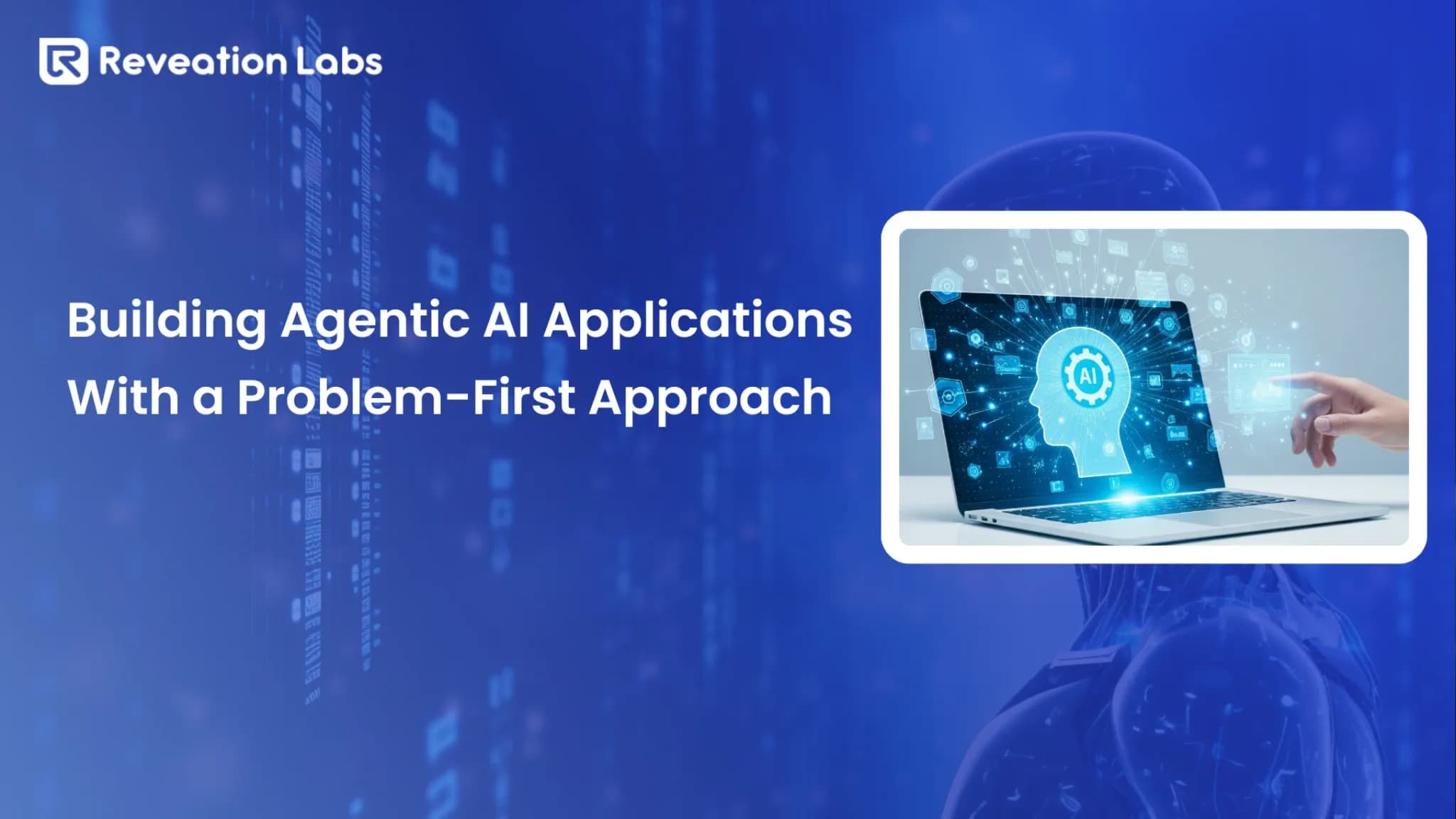

“Agentic AI” is having a moment, and for good reason. When it works, it can coordinate tools, handle multi-step work, and reduce operational drag across teams. But the fastest way to fail is to start with “Let’s build an agent” instead of “What problem are we solving?”
This blog is a practical playbook for building agentic AI applications using a problem-first approach. We’ll focus on outcomes, constraints, and the lightest architecture that gets you to value, without turning your stack into an ungovernable experiment.
Why “agentic” is suddenly everywhere (and why that’s risky) ⚠️
Agentic AI is appealing because it feels like the missing layer between “AI that chats” and “AI that delivers outcomes.” An agent can interpret an intent, plan steps, call tools, and keep going until it finishes (or fails gracefully). That’s powerful in enterprise environments where work is messy and non-linear.
The risk is that “agentic” becomes a design default instead of a design decision. Teams over-automate ambiguous processes, grant too much permission too early, and skip operational basics like observability and evaluation. The result is often a demo that works once and a production system that fails silently.
Mindset shift: autonomy is not the product. Business impact is the product.
When building agentic systems at scale, platforms like Azure AI offer a practical balance between model orchestration, enterprise security, and observability—making them well-suited for problem-first architectures rather than experimental prototypes.
Agents vs automation vs copilots (a simple decision boundary)
Before you introduce an agent, decide what kind of system you actually need. This reduces architectural complexity and keeps costs and risk under control.
Automation (deterministic)
Rules-based workflows, stable inputs/outputs, low variance.
Copilot (assistive)
Drafting, summarizing, recommending—humans still execute.
Agent (goal-seeking)
Multi-step tasks across tools, dynamic paths, exception handling.
A good agent use case typically has all three:
- Multi-step work (not a single API call).
- Tooling across systems (e.g., CRM + email + ticketing).
- Exceptions that require reasoning (missing data, approvals, alternate paths).
The problem-first approach: start with outcomes, not agents ✅
A problem-first approach means you define success before you design autonomy. You clarify the job-to-be-done, map constraints, and identify the minimum system capable of delivering a measurable outcome. This is how you avoid building an agent that’s “smart” but not useful.
Outcome-first: Start with a crisp statement like “Reduce vendor onboarding time from 10 days to 3 days” or “Decrease Tier-1 ticket handling time by 25%”.
Then define what must remain true: security boundaries, governance requirements, cost ceilings, and failure tolerance.
If you’re aligning stakeholders and scope across teams, anchor the initiative in a problem-first AI strategy so the work doesn’t drift into “cool tech” territory.
Map exception paths before you design autonomy 🚩
Most enterprise workflows don’t break on the happy path. They break on exceptions: missing approvals, conflicting data, policy edge cases, and tool failures. Agents are useful because they can handle those exceptions—but only if you design for them up front.
A fast method that works well:
- Define the happy path in 5–8 steps.
- List the top 10 exceptions that happen in reality.
- For each exception, decide: resolve, escalate, or stop.
Rule of thumb: if an exception can cause financial loss, compliance exposure, or customer harm, it needs a guardrail or an approval step.
A lightweight blueprint for agentic AI applications 🧱
A production-ready agentic system doesn’t need a swarm of agents and a new framework every sprint. Most teams succeed with a small, well-instrumented architecture that separates reasoning from execution and makes failure modes visible.
The 4 layers: intent → plan → tools → verification
1) Intent layer
Captures the user goal and context (what “done” looks like).
2) Plan layer
Breaks the goal into steps (a constrained plan, not freeform wandering).
3) Tool layer
Executes steps using approved tools/APIs (with least privilege).
4) Verification layer
Checks outputs, enforces policies, and decides next actions.
This structure is valuable because it makes the system governable. You can log intent, inspect plans, trace tool calls, and measure verification outcomes. That’s how “agentic behavior” becomes something you can operate with confidence.
Agentic applications quickly expose the limits of traditional AI infrastructure, as long-running agents, memory persistence, and tool execution demand systems designed for orchestration, fault tolerance, and cost-aware scaling.
Choosing the right level of autonomy (0 → 3) 🤖
Not every problem needs a fully autonomous agent. Most teams should start with assisted execution and evolve autonomy only after they have stable evaluation, monitoring, and rollback strategies. The goal isn’t Level 3—it’s the lowest level that reliably delivers outcomes.
Guardrails: policies, budgets, permissions, and human-in-the-loop 🔒
Guardrails aren’t “nice to have” in agentic systems—they’re the difference between a helpful workflow and an operational risk. The good news is you can implement guardrails without slowing everything down by making them explicit, testable, and observable.
Least privilege access
Tools are scoped to the minimum needed actions.
Budget controls
Cap tool calls, time, and cost per task.
Policy checks
Block disallowed actions (e.g., exporting data, deleting records).
Approval gates
Require human sign-off for high-impact steps.
Audit logging
Capture intent, plan, tool calls, and outcomes.
If your agent touches multiple business systems, treat the build as part of enterprise digital transformation so ownership, security, and operational readiness are handled early.
Production checklist: what breaks first (and how to prevent it) ✅
1) Observability that matches agent behavior
Many agentic pilots fail because teams can’t see what happened when outcomes go sideways. Track task start/end, success rate, time-to-complete, plan length, step outcomes, tool call latency/errors, and why escalations occurred.
A simple win is storing a “task trace” record per run.
2) Evaluation beyond “it looks right”
Agents need evaluation across task success, safety/compliance, cost, and consistency. Start with a small set of real tasks, run them repeatedly, and only expand when you can explain and reproduce failures.
This prevents “quiet regressions” from creeping into production.
3) Security that assumes tools are the real power 🔒
In agentic systems, tools are where value—and risk—live. Protect secrets, scope access, validate inputs, and make data boundaries explicit.
If the workflow spans ERP/CRM/ticketing, design it as enterprise system integration work rather than an isolated experiment.
Enterprise use cases (and anti-patterns) 💡
Agentic AI shines when work is multi-step, cross-system, and exception-heavy. It struggles when processes are deterministic or easily solved with standard automation. If you’re unsure, start at Level 0 or Level 1 and measure outcomes—you’ll learn faster with less risk.
Good fits ✅
- Sales ops: generate account briefs, draft outreach, update CRM, schedule follow-ups.
- Procurement: validate vendor info, request missing documents, route approvals, update records.
- Customer support: triage tickets, suggest resolutions, pull context, escalate edge cases.
- Finance ops: reconcile discrepancies, prepare exception reports, request approvals.
Anti-patterns 🚩
- Stable processes with clear rules (use automation).
- Low-impact tasks where errors don’t justify monitoring overhead.
- Anything requiring broad permissions before you’ve proven safety.
How Reveation Labs helps teams go from idea → production 🚀
A lot of organizations can build an agent demo. The real differentiator is shipping a system that’s secure, observable, and aligned to business outcomes. We help teams define the problem, select the right autonomy level, design the architecture, and productionize the workflow—without overbuilding.
If you want examples of what this looks like in practice, explore our AI delivery case studies. And if you’re actively evaluating enterprise workflows for agents, our building agentic AI applications services focus can help you move from pilot to production with guardrails in place.
Timelines vary by scope, tool readiness, and governance requirements. The fastest teams ship a narrow workflow with Level 0–1 autonomy, measure outcomes, then expand responsibly once reliability is proven.