Agentic Commerce in B2B eCommerce: UCP vs ACP (and What to Build Now)
Agentic commerce will reroute B2B demand through AI agents. UCP and ACP don’t “compete” as much as they cover different parts of the journey. The winning move is building an agent-ready commerce layer once (product truth, pricing/terms, availability promises, quote-to-order actions, trust/audit), then mapping it to UCP/ACP (and legacy procurement) through adapters. 🤖
- UCP standardizes commerce primitives + capability discovery/negotiation across surfaces. 🔌
- ACP standardizes agent-to-merchant interaction for embedded buying inside assistants. 🧾
- MCP/A2A/AP2 matters because B2B buying needs tools, coordination, and verifiable payment authority. 🔐
- Start with B2B reality: contract pricing, approvals, POs, lead times, substitutions, compliance.
The next “buyer” might not be human 🤖
In B2B, the hardest part of eCommerce isn’t the storefront. It’s everything behind it: contract pricing, lead times, approvals, tax rules, substitutions, and “can you ship this to Plant 12 by Friday?” Leveraging agentic commerce b2b capabilities fundamentally changes who navigates that complexity.
Instead of a buyer clicking through pages, an AI agent can assemble a compliant basket, request a quote, route approvals, and place the order, without ever “visiting” your site in the traditional way.
Gartner’s prediction is a wake-up call: by 2028, 90% of B2B buying may be AI-agent intermediated, pushing over $15 trillion of spend through agent exchanges. That’s not a UX tweak; it’s a demand-shift.
Meanwhile, the market size makes “wait and see” risky. The U.S. International Trade Administration projects the global B2B eCommerce market to be roughly $36T by the end of 2026. When agents route purchases, being “easy for agents to buy from” becomes a competitive advantage, just like being mobile-ready was a decade ago.
If you want a quick primer on how this is already showing up in manufacturers, distributors, and marketplaces, start with Agentic Commerce in B2B eCommerce: Today vs. 2030.
Why B2B is different: “checkout” is really quote-to-order 🧾
In B2C, you can often model buying as product → cart → checkout → payment → fulfillment. In B2B, buying is usually quote-to-order with entitlements, exceptions, and approvals baked into the process.
That includes negotiated pricing, freight terms, tax exemptions, minimum order quantities, substitute rules, and payment terms like Net-30 or credit limits.
That’s why agentic commerce is both exciting and dangerous in B2B. The upside is obvious: agents can compress cycle time for routine reorders and reduce load on sales ops and customer service.
The danger is subtle: if agents can’t reliably interpret your commercial rules, or can’t verify who’s authorized to buy, those agents will route around you to suppliers who are “agent-ready.”
| Common approach | Why it breaks in agentic B2B |
|---|---|
| “We’ll add a chat widget” | Conversation alone doesn’t execute. Agents need structured state + invocable actions (quote, validate entitlements, order, status). |
| “Just publish a product feed” | Feeds rarely cover contract pricing, lead-time promises, substitutes, pack rules, or compliance constraints. |
| “Integrate with one AI platform first” | One-off integrations create an N×N maintenance trap as more agent surfaces emerge. |
| “Let the agent scrape our site” | Scraping can’t reliably represent commercial terms, and it’s fragile when pages or pricing rules change. |
| “We’ll handle agent orders manually” | That defeats the point. Agents will prefer suppliers with reliable automation + confirmations. |
If you’re aligning teams internally, it helps to separate “AI that talks” from “AI that transacts.” We cover practical, B2B-friendly examples in AI in B2B eCommerce: Separating Hype from Reality
The standards landscape: UCP vs ACP (plus the protocols that quietly matter) 🔌
The evolution of agentic commerce b2b isn't converging on a single standard. Multiple protocols are emerging to solve different parts of the journey, discovery, structured buying, consent, payment authority, post-purchase service—and B2B needs almost all of those pieces.
UCP (Universal Commerce Protocol) is an open-source standard designed to establish a common language and “functional primitives” so consumer surfaces, business systems, and payment providers can complete end-to-end commerce journeys. It’s built to work with existing infrastructure, supports multiple integration paths (APIs, A2A, MCP), and is compatible with the Agent Payments Protocol (AP2).
ACP (Agentic Commerce Protocol) is an open standard for enabling a structured conversation between buyers, their AI agents, and businesses to complete a purchase. Agents reason over structured state, invoke your tools step-by-step, and keep customers informed in real time—designed for embedded commerce in assistant experiences.
Then there are the “plumbing” standards that often decide whether B2B implementations are actually production-ready:
- MCP (Model Context Protocol) — an open-source standard for connecting AI applications to external systems (data sources, tools, workflows).
- A2A (Agent2Agent) — an open standard for communication and collaboration between agents, aimed at interoperability across vendors and frameworks.
- AP2 (Agent Payments Protocol) — an open protocol designed to enable secure, interoperable agent-initiated payments, emphasizing verifiable intent and audit trails.
And in B2B specifically, you can’t ignore legacy procurement “standards” that still run enterprise buying: EDI, cXML, and punchout. The future isn’t replacing them overnight—it’s adding agentic layers that can speak both new and old languages safely.
What each standard actually standardizes (B2B view)
| Layer | UCP | ACP | What B2B must also handle |
|---|---|---|---|
| Commerce primitives | Common language + functional primitives for commerce journeys; merchant owns business logic and remains Merchant of Record. | Structured state + tool invocation inside assistant-led flows. | Quote-to-order, contract pricing, entitlements, POs, approvals, compliance. |
| Capability discovery | Agents discover and negotiate capabilities; extensions allow bespoke functionality. | Defines how agents step through a purchase conversation and execute actions reliably. | Enterprise toolchains, supplier networks, and buyer-specific policies. |
| Payments & consent | Compatible with AP2; supports existing payments and “embedded” checkout options. | Delegated payment patterns and embedded checkout flows in assistants. | Net terms, credit limits, PO match, auditability, and dispute workflows. |
| Tooling + interoperability | Supports integrations via APIs, A2A, and MCP. | Emphasizes tool invocation and structured state to keep flows deterministic. | MCP for tool connectivity, A2A for agent coordination, plus legacy procurement standards. |
UCP in plain English: capability-driven commerce primitives
UCP’s goal is to reduce fragmentation by giving the ecosystem a shared language for commerce journeys across surfaces. Google describes UCP as open-source, built on functional primitives, compatible with AP2, and able to integrate via APIs, A2A, and MCP.
For B2B leaders, two design points matter most:
First: UCP explicitly preserves merchant control: you own your business logic and remain the Merchant of Record, with an “embedded option” to keep your checkout experience customized.
Second: UCP’s “capabilities and extensions” approach is a practical way to model real-world complexity without forcing one rigid schema on everyone.
Shopify’s architecture write-up explains how core primitives sit beneath independently versioned capabilities, and how extensions can capture domain-specific needs.
ACP in plain English: structured conversations that can transact
ACP is designed for embedded buying inside assistant experiences, where the agent maintains a structured state, invokes merchant tools, and keeps the user informed step-by-step. OpenAI describes ACP as an open standard for the agent-to-business interaction model.
The reason B2B teams should care is simple: buyers are already using copilots and internal assistants to streamline work. Once procurement teams trust the rails, they’ll expect agents to request quotes, validate contract terms, confirm lead times, and place repeat orders with approvals handled automatically.
The trap: picking a “winner” instead of building a durable layer 🚦
If you’re hoping one protocol wins and simplifies everything, that’s unlikely. Even summaries of the UCP vs ACP debate emphasize that multiple protocols are emerging in parallel, tackling different moments from discovery to checkout and post-purchase support.
There’s also a practical B2B reality: your customers’ buying agents may not live in public assistants at all. Many will run inside enterprise environments, procurement suites, ERP copilots, private marketplaces—where governance and auditability are non-negotiable.
Don’t bet your architecture on one protocol. Build an agent-ready commerce layer once, then map it to UCP, ACP, and legacy procurement integrations through adapters.
This is where a lot of “agentic” initiatives fail. Gartner has also warned that a large share of agentic AI projects could be scrapped due to cost and unclear value, often because teams try to layer agents on top of brittle data and fragmented workflows.
What to build now: the agent-ready commerce layer 🛠️
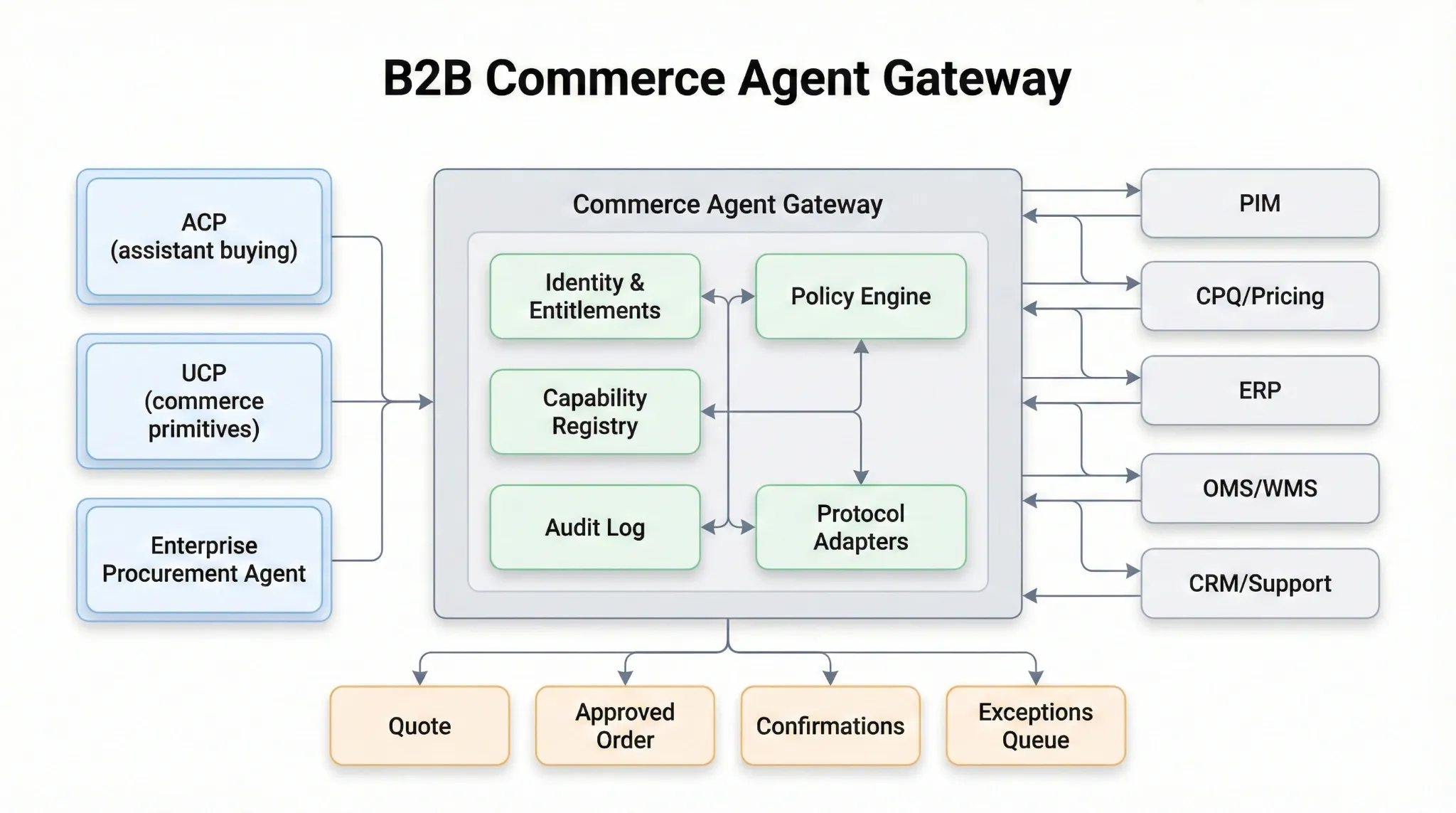
Think of the agent-ready commerce layer as a thin, durable “truth layer” above ERP/PIM/OMS/CPQ.
Building an agent-ready commerce layer is a meaningful infrastructure decision — and for many organizations, it also becomes the catalyst for evaluating whether their current platform can support it at all; if you're at that crossroads, the guide on b2b ecommerce replatforming covers how to reduce risk and gain the architectural flexibility that agentic workflows will eventually demand.
It exposes what agents actually need: structured product knowledge, contract pricing and entitlements, availability promises, quote-to-order actions, and a provable audit trail. Then you implement protocol adapters (UCP/ACP) without duplicating your core logic for every new surface.
If you want a practical example of how this comes together, Agentic Commerce Automation is essentially this pattern applied to real B2B workflows—policy-aware execution, human-in-the-loop when needed, and system integrations that hold up in production.
1) Make product data machine-decidable (not just human-readable)
B2B catalogs aren’t pages, they’re decisions. Agents need normalized attributes (units, tolerances, compatibility, substitutes, regulatory flags), not PDFs and tribal knowledge.
Start with the top SKUs that drive repeat volume, and standardize the attributes that decide purchase fit.
2) Treat pricing as an entitlement decision (contract-first)
In B2B, price is policy: customer eligibility, negotiated tiers, volume breaks, freight terms, and approval thresholds. Expose pricing and terms as deterministic services: “given buyer identity + cart context, return eligible price, terms, and constraints.” If you’re modernizing quoting, 7 Generative AI Solutions to Solve B2B Pricing and Quoting Challenges is a helpful starting map.
3) Turn inventory into a promise (with confidence)
Agents can’t work with “maybe.” They need available-to-promise, ship-from options, delivery windows, and substitution rules.
Model inventory as a promise plus constraints, not a snapshot. This is where extensions and capability negotiation (a core UCP design idea) can represent complex fulfillment realities without breaking the protocol.
4) Standardize quote-to-order actions (tools agents can invoke)
This is where “chat” becomes “commerce.” Your layer should expose a small set of invocable actions: create quote, validate entitlements, reserve inventory (if applicable), convert quote to order with approval state, retrieve order status, and initiate RMAs. ACP’s model explicitly assumes agents invoke tools step-by-step over a structured state.
If your actions sit behind complex systems, you’ll typically need integration and workflow engineering—not just prompts. That’s why agent work often pairs with foundation programs like eCommerce Implementation and Agentic & Autonomous AI.
5) Add trust, consent, and auditability as product features 🔐
B2B buyers will demand proof: who requested the order, what data was used, what rules were applied, and who approved the final commit.
Build role-based permissions, delegated authority, consent checkpoints for high-risk actions, and tamper-evident logs of tool calls and decisions.
This is also why AP2 emphasizes verifiable intent and non-repudiable audit trails for agent-initiated payments.
Practical rule: If an agent can’t answer “why did we do that?” with data + policy (not vibes), it’s not production-ready.
- Low-risk: reorder suggestions, quote drafts, status updates (often safe with oversight).
- Medium-risk: quote creation and PO assembly (needs entitlements + approvals).
- High-risk: committing orders, credit actions, payment authority (needs explicit consent + audit).
How to sequence adoption: a B2B decision matrix
Use this to decide what you pilot first. The goal is not exclusivity—it’s minimizing rework while you learn.
| If your demand is mainly… | Prioritize | Why |
|---|---|---|
| Search & shopping surfaces | UCP adapter + structured product/checkout primitives | UCP is designed to power agentic shopping across surfaces; Google has a reference implementation for its conversational experiences. |
| Assistant-led buying flows | ACP-style tool contracts + structured state | ACP is built for embedded commerce where agents invoke tools step-by-step. |
| Enterprise procurement ecosystems | Commerce gateway + policy/audit + legacy integration | Your customers will require governance, approvals, and interoperability with EDI/cXML/punchout. |
If you want help sequencing without overbuilding, B2B eCommerce Consulting is typically the fastest way to translate standards noise into a practical roadmap that fits your stack and buying motion.
Implementation playbook: 30 / 60 / 90 days
| Timeline | What you do | What you ship |
|---|---|---|
| 0–30 days | Pick 1–2 agentable journeys (reorder, quote request, order status). Inventory required data + APIs + policy constraints. | Blueprint for your agent-ready commerce layer + gaps list. |
| 31–60 days | Normalize SKU attributes for chosen journeys. Wrap pricing and availability as services. Define invocable actions and error contracts. | Working commerce gateway endpoints: product, price/terms, availability, quote creation. |
| 61–90 days | Add identity/entitlements, audit logs, and human-in-loop approvals. Build one protocol adapter (UCP or ACP) for a pilot surface. | Production-grade pilot with governance, monitoring, and measurable outcomes. |
Readiness checklist: can an agent safely buy from you today?
| Capability | “Good” looks like | Typical B2B gap |
|---|---|---|
| Product truth | Clean attributes, compatibility, substitutes, units, compliance flags | Specs trapped in PDFs and tribal knowledge |
| Contract pricing & terms | Deterministic pricing/terms API with entitlement checks | Pricing logic spread across spreadsheets + reps |
| Availability promises | ATP, lead times, ship-from options, delivery windows | Inventory is a snapshot, not a promise |
| Quote-to-order actions | Quote, approve, convert, status, RMA via safe tool contracts | CPQ/ERP workflows aren’t exposed safely |
| Identity & authority | Delegated permissions + approval thresholds | “Anyone with a login can order” |
| Audit + observability | Log decisions/tool calls; monitor exceptions; prove intent | No traceability when something goes wrong |
Conclusion: protocols are the new channels
The future of agentic commerce b2b will reward suppliers who are easiest to buy from—according to agents, not humans. UCP and ACP are two important standards shaping how that future works, but neither replaces the hard B2B requirements around pricing, approvals, and trust. The durable strategy is building an agent-ready commerce layer once, then connecting to the ecosystems that matter to your buyers as they emerge.
If your 2026 roadmap includes modernizing self-serve buying, start with the foundations: product truth, contract truth, fulfillment promises, and policy-aware quote-to-order execution. When you’re ready to implement it on top of your current stack, eCommerce Implementation plus Agentic & Autonomous AI programs are the practical way to get to production without rebuilding everything.