
Agentic Commerce vs Agentic AI: 90% of Buyers Choose Wrong
Half the "agentic commerce" platforms we evaluate aren't actually agentic. They're automation tools that got a marketing refresh.
The other half? They're using real agentic AI, but calling it "commerce" when it's really just one narrow workflow.
The problem: if you don't know the difference between agentic AI vs agentic commerce, you can't tell which one you're looking at. And that confusion is expensive.
Let's make sure that doesn't happen to you.
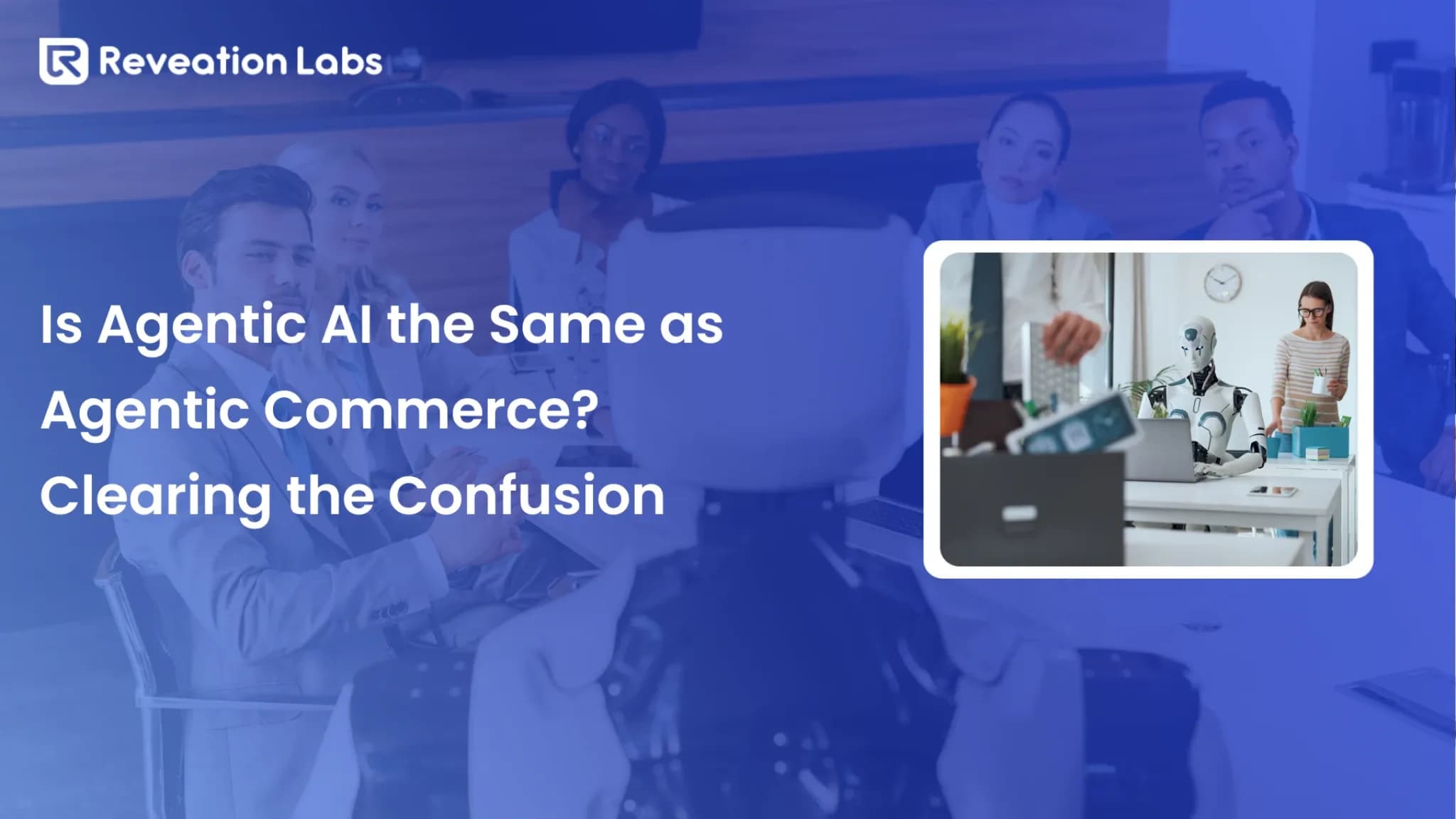
Agentic AI vs Agentic Commerce
Agentic AI
The technology that can make goal-driven decisions autonomously.
Agentic commerce
That same technology, but specifically solving commerce problems (pricing, inventory, quotes, customer service).
Think of it this way:
- "Computer vision" is technology
- "Self-driving cars" is the application
Why This Actually Matters
Your CEO just approved a budget for "agentic commerce." Your vendor is demoing "agentic AI capabilities." Are you buying the same thing?
Maybe. Maybe not.
The problem: Vendors are slapping "agentic" on everything from basic automation to advanced chatbots. Without knowing the difference between the underlying tech and the application, you can't tell what you're actually buying.
⚠️ Real consequence: We've seen companies pay $300K for "agentic commerce platforms" that were just workflow automation with an LLM wrapper. Nice automation. Not agentic. Definitely not worth $300K.
What Actually Makes AI "Agentic"
Before we talk about commerce, let's get the tech straight. Real agentic AI in ecommerce (or anywhere else) has four non-negotiable traits:
1. Autonomy
It acts without someone clicking "approve" every five seconds.
❌ Not agentic
"System recommends reorder quantity, awaiting approval"
✅ Agentic
"Inventory reordered from supplier B because supplier A's lead time increased and demand forecast jumped 23%"
2. Goal-Orientation
It works toward business outcomes, not just task completion.
❌ Not agentic
"Process return request per policy 3.2"
✅ Agentic
"Customer returning defective batch. Issue credit, flag QA, check if other customers got same lot, send proactive outreach"
3. Perception
It monitors multiple data sources and understands context.
❌ Not agentic
Checking one database field
✅ Agentic
Watching inventory, supplier portals, demand signals, competitor pricing, shipping delays, and seasonal trends simultaneously
4. Reasoning
It plans multi-step actions and can explain why.
❌ Not agentic
Following a decision tree you programmed
✅ Agentic
"Customer wants NET-60 terms. Their payment history is perfect, but this order is 3x normal size. I'm approving NET-45 as compromise and flagging the account manager because the volume spike might signal a bigger partnership opportunity"
⚠️ The test: Ask the system "Why did you do that?" If it can't explain with business logic and data, it's not agentic.
Now Add "Commerce" to the Mix
Agentic commerce is what happens when you take that decision-making capability and point it specifically at commerce operations.
In B2B ecommerce, that means:
- Quote generation that negotiates within your parameters
- Inventory management that doesn't just hit min/max triggers but optimizes for carrying costs, demand volatility, and supplier reliability
- Dynamic pricing that reasons through customer relationships, margin requirements, and competitive positioning
- Order routing that coordinates across warehouses, carriers, and delivery windows
- Customer service that resolves issues end-to-end, not just answers questions
It's not making recommendations for humans to act on. It's making decisions AND taking action.
Here's Where the Confusion Starts
Most "agentic commerce" platforms in 2026 are actually one of these three things:
Example time: Let's say a customer requests 5,000 units at NET-60 terms.
Level 1 (automation pretending to be agentic):
IF customer_tier = "gold" AND amount < $50K
THEN approve
ELSE send_to_manager
Level 2 (semi-agentic, common now): AI analyzes credit history, order patterns, risk factors. Recommends: "82% confidence to approve based on payment history and margin."
You still click the button?
Level 3 (actually agentic, still emerging): System sees: Perfect 2-year payment history, but order is 2.5x their average. NET-60 is unusual (normally NET-30). Margin stays healthy at volume.
- System reasons: "Low customer risk, higher cash flow exposure. Volume suggests possible expansion."
- System decides: Approve NET-45 (compromise), flag AM to explore partnership potential, log decision.
- System acts: Sends approval, creates AM task, updates CRM.
Notice the difference? The third one is how agentic AI works in ecommerce, it's achieving a goal (approve good business, manage risk, capture opportunity) not executing rules.
A Real Example: Klarna's AI Assistant
Klarna deployed an AI assistant in 2024 that handled two-thirds of their customer service conversations within the first month. That's the equivalent work of 700 full-time agents.
But here's what makes it relevant: it wasn't just answering FAQs. It resolved refund requests, managed payment disputes, handled complex multi-step issues across 35 languages.
The system could:
- Perceive customer history and context
- Reason through policies and edge cases
- Take action to resolve issues (not just recommend actions)
- Operate autonomously within defined parameters
That's agentic AI applied to customer service commerce operations. The results? Improved resolution times and satisfaction scores compared to human-only service.
Not because it replaced human judgment entirely, but because it could handle the reasoning-intensive work that basic chatbots fumble.
The Questions That Expose What's Real
When a vendor pitches you on agentic commerce vs agentic AI capabilities, ask these:
"Show me a decision audit trail from your system."
✅ Real agentic: Shows reasoning process, factors weighed, why option A won over B
❌ Fake agentic: Shows inputs and outputs, black box in between
"What happens when the system is uncertain?"
✅ Real: "It escalates with explanation of what info it needs"
❌ Fake: "It follows escalation rules" (that's not reasoning, that's a rule)
"Walk me through a scenario your system has never seen before."
✅ Real: "It reasons through similar patterns and applies logic"
❌ Fake: "It escalates anything outside training data"
"What AI models are you actually using?"
✅ Real: Names specific tech (GPT-4, Claude, custom frameworks)
❌ Fake: "Proprietary AI" or vague "machine learning"
During the demo, interrupt and ask: "Why did it choose that option?"
If they can't explain the reasoning in real-time, you know what you're dealing with.
Understanding Agentic AI vs Generative AI
Quick sidebar because this comes up: agentic AI vs generative AI aren't opposites, they're different capabilities.
Generative AI creates content (text, images, code). Think ChatGPT writing an email.
Agentic AI makes goal-driven decisions and takes action. It might USE generative AI to draft that email, but the agentic part is deciding WHO to email, WHEN, and WHY based on business objectives.
Most agentic commerce systems use both. The generative piece creates the quote or email. The agentic piece decides the pricing, terms, timing, and whether to send it at all.
Do You Actually Need Agentic Commerce?
Honest assessment time.
✅ You need it if:
- Complex decisions require weighing multiple factors
- The "right answer" changes based on context
- Volume is too high for human review
- Speed is competitive advantage (quotes in hours not days)
- You need systems that adapt without constant reprogramming
❌ You don't need it if:
- Your workflows are simple if-then logic
- Volume is manageable for human review
- Your processes rarely change
- You just need better reporting (that's BI, not AI)
Reality check on pricing:
- Traditional automation: $20K-$100K
- Advanced predictive analytics: $50K-$250K
- Actually agentic systems: $100K-$500K+
⚠️ If someone’s selling autonomous AI agents at automation prices, it’s probably automation.
What This Means for B2B eCommerce
Here's why this matters specifically for B2B eCommerce consulting and implementation:
B2B commerce has inherent complexity that's perfect for agentic approaches:
- Custom pricing by customer/volume
- Credit terms and payment negotiations
- Multi-location inventory coordination
- Complex quoting with many variables
- Account-based service expectations
🚩 But it also has higher stakes. One wrong auto-approval could cost six figures. One bad automated email could kill a relationship.
That's why the distinction between "recommends actions" and "takes actions" matters so much in B2B.
At Reveation, we've seen the best implementations start narrow:
- Pick ONE painful workflow (usually quoting or inventory)
- Integrate it properly with your ERP/OMS
- Run shadow mode for 4-6 weeks
- Set clear approval thresholds
- Go live with low-risk volume first
- Expand based on what you learn
That's AI process automation done right. Not a big-bang transformation. Not hoping the system figures it out. Controlled deployment with measurable outcomes.
The Bottom Line (What You Actually Need to Know)
Agentic AI is goal-driven decision technology. Agentic commerce is that technology applied to commerce operations, including B2B eCommerce solutions.
They're related but not the same. Like saying "is a car the same as transportation?" Sort of, but you need to know which one you're buying.
The real question isn't "What's the difference?"
It's "Can this system explain its decisions, act autonomously within my guardrails, and adapt without me reprogramming rules every quarter?"
If the answer is no, you're not buying anything. You're buying automation with better marketing.
Use the questions in this article. If vendors can't answer clearly, you've got your answer.
Ready to talk about what agentic commerce actually looks like in your B2B operation?
We start with one workflow, prove it works, then expand. No transformation theater. Just measurable improvements.