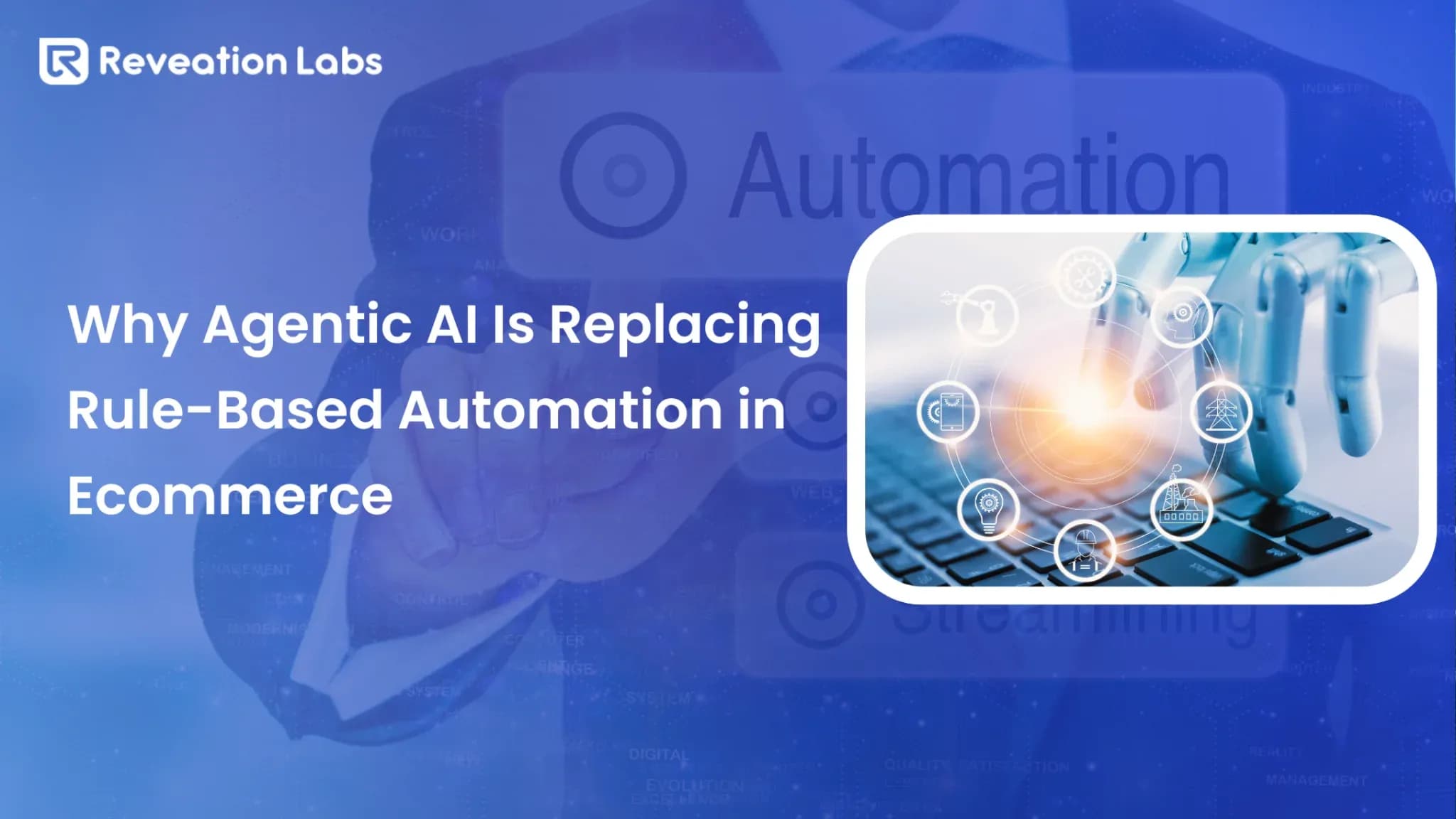

Rule-based automation helped ecommerce teams scale for years. But once promotions stack, inventory shifts, and exceptions flood in, “if/then” logic turns into brittle spaghetti. That’s why more operators are moving toward agentic AI, understanding how to use AI in ecommerce effectively, not to remove controls, but to automate outcomes while keeping guardrails in place.
If you’re responsible for operations, CX, or platforms, and wondering how automation improves customer experience metrics, here’s the simplest way to think about it: Automation in eCommerce is evolving from “execute steps” to “resolve situations.” The difference shows up most clearly in exceptions, where rules usually break first, illustrating how is AI changing ecommerce dynamics.
The ceiling of rule-based automation (and why it keeps showing up in ecommerce)
Ecommerce is an exception-driven business, and understanding how AI is changing the retail industry is crucial for success. Backorders, substitutions, price mismatches, address changes, partial shipments, and return abuse are normal, especially at scale.
Teams usually respond by adding more rules. Over time, those rules become expensive to maintain, risky to change, and easy to break with a single “temporary” exception. Advanced solutions, such as those seen in AI personalization ecommerce examples, can offer more flexible alternatives.
Stop automating steps. Start automating outcomes—inside constraints.
| What you’re automating | Where rules/RPA struggle | What it looks like in real ops |
|---|---|---|
| Pricing/promotions | Edge cases, intent-based decisions | Escalations, margin surprises |
| Order exceptions | Too many branches | High-touch fulfillment |
| Returns/refunds | Fraud signals + policy nuance | Over-approval leakage |
| Support operations | Cross-system context gathering | WISMO waves, missed SLAs |
6 ecommerce workflows where agents outperform rules
Agentic AI tends to deliver ROI fastest where work is repetitive and context-heavy, and understanding the ROI of using an an AI automation agency can further accelerate these benefits.
1) Order exception handling
For teams looking into how automated order processing can enhance efficiency, agentic AI streamlines tasks like:
- Pulls order context from OMS + ERP
- Checks substitution constraints
- Proposes fulfillment options
- Executes approved actions
The practical migration path (rules → agentic)
- Find exception hotspots
- Wrap existing rules
- Agent proposes actions
- Auto-execute under thresholds
- Scale orchestration
Conclusion
Rule-based automation still matters, but mostly as constraints and compliance boundaries.
Agents reason and orchestrate, showcasing the potential of AI in procurement orchestration, while rules constrain and protect, and humans approve high-risk actions.