
Updated: February 6, 2026 • By Pratik Panwar
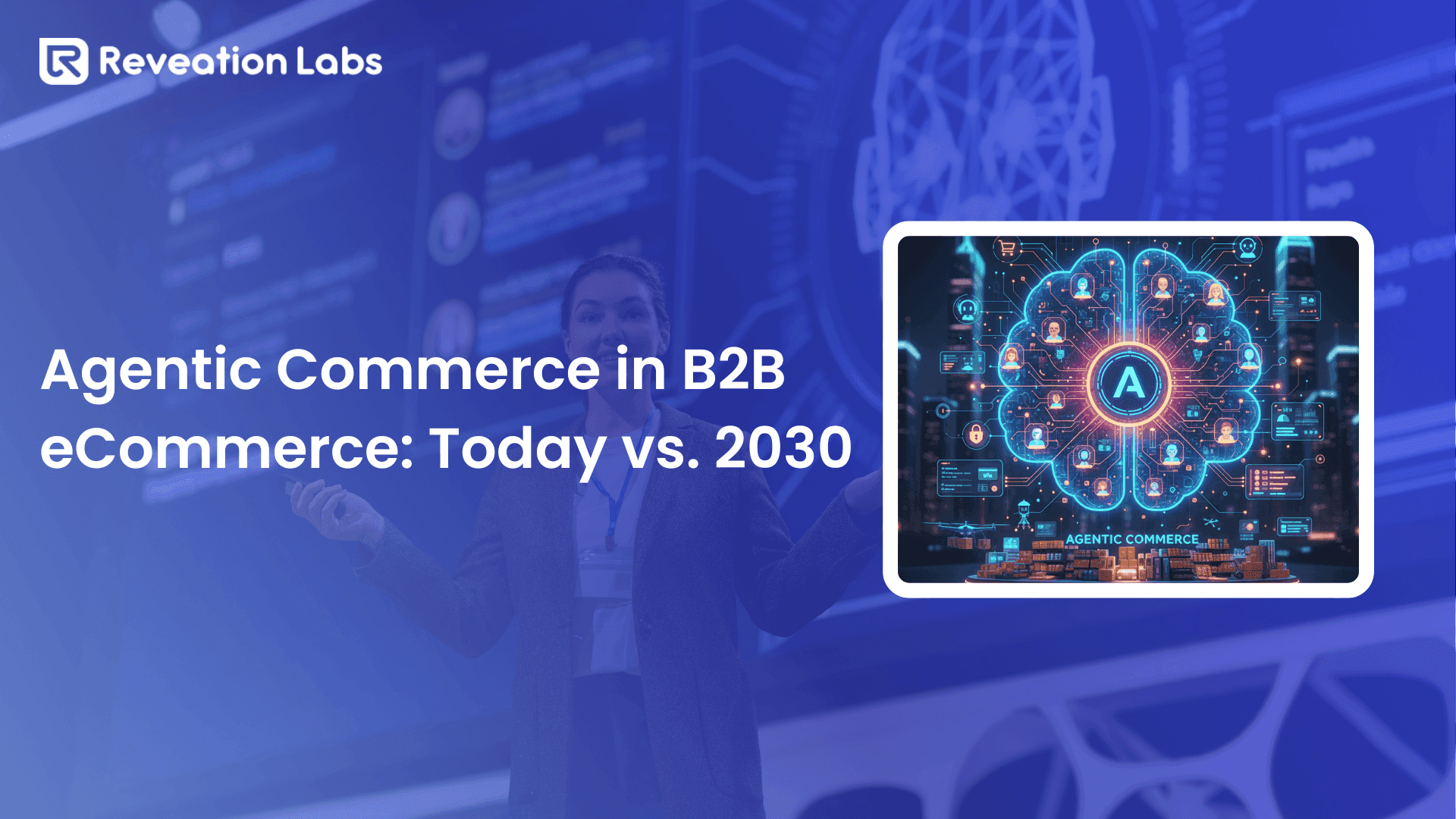
Agentic Commerce in B2B eCommerce: What’s Real Today and What’s Coming by 2030
Agentic AI is shifting procurement from “humans clicking through steps” to “systems that plan, act, and audit” within guardrails. This guide breaks down what agentic commerce means for B2B leaders, where it’s already showing up, and how to prepare now.
What if the next purchase order could write itself?
Imagine a purchase order that drafts itself, verifies pricing, checks supply, negotiates within your rules, places the order, and leaves a clean audit trail without anyone chasing emails. That’s the practical promise of agentic commerce in B2B. Instead of AI “assisting” at a single step, agents can coordinate multiple steps end-to-end then document what happened.
Quick definition (the executive version)
Agentic commerce uses AI agents that can take action—not just recommend—within defined guardrails (budget, vendors, approvals, policies), while keeping an auditable record.
What agentic commerce means in B2B eCommerce
In B2B, buying isn’t just “add to cart.” It includes brand preferences, product requirements, contract pricing, budgets, approvals, delivery constraints, and compliance checks. Agentic systems can interpret those constraints and execute tasks like product search, comparison, negotiation (when allowed), ordering, and post-purchase actions, significantly enhancing agentic commerce decision-making in digital transactions.
Agents vs. bots (in one minute) ⚡
Basic bots respond to prompts and follow a fixed script.
Workflow automation executes predefined rules with limited flexibility.
Agents plan and execute multi-step tasks, choose tools, escalate exceptions, and log decisions—within guardrails.
If you’re evaluating where to start, begin with the foundation: clean data, secure integrations, and a workflow that’s narrow enough to control. That’s exactly what teams build through eCommerce integration services so agents can safely read, act, and record across ERP, PIM, CRM, and commerce.
What’s real today: where most B2B teams start
Most agentic deployments today are still pilots or tightly scoped workflows. The common pattern is “assist first, then automate within limits.” Teams typically start with product Q&A, routine reorders, PO drafts, order tracking, or returns then expand autonomy once trust and controls are proven.
A practical starter workflow
- Inventory dips below threshold → agent proposes reorder.
- Agent validates contract pricing and vendor eligibility.
- Human approves (initially) → agent places order and logs details.
- Over time: auto-place orders under a spend cap; escalate exceptions.
If you want this approach without rebuilding everything, start with an automation layer designed for agentic workflows. Agentic Commerce Automation helps teams operationalize multi-step tasks with governance, orchestration, and auditability—so autonomy doesn’t become chaos.
Platform landscape: enabling autonomy without losing control
Major commerce platforms are moving toward agentic capabilities but not all at the same pace. When you evaluate an enterprise ecommerce software company like Adobe on agentic commerce, it's crucial to note that some platforms emphasize guardrails and review checkpoints, while others push agent-led experiences faster. For B2B leaders, the key is to align platform direction with your risk tolerance, data maturity, and governance model. 🧭
| Platform group | What’s common today | What it suggests by 2030 |
|---|---|---|
| Guardrail-first ecosystems | AI assistance grows, but checkout autonomy is constrained by policy. | Approved, auditable agent flows—autonomy expands when controls are proven. |
| Agent-forward suites | More agent tooling across commerce and service workflows. | Higher autonomy across ordering, support, merchandising, and operations. |
| Composable + API-first platforms | Open APIs become the strategy; agents depend on clean data access. | Multi-agent interoperability; agents negotiate and transact across networks. |
If your commerce stack is fragmented, this is where B2B eCommerce consulting becomes practical. It helps with key decisions, such as a comprehensive Adobe enterprise ecommerce software agentic commerce evaluation, ensuring you’re not just picking tools but designing the guardrails, data flows, and approvals that let agents operate safely.
Industry use cases you can pilot now
Industrial & manufacturing supplies (MRO and parts)
Large catalogs and tight margins make procurement slow and error-prone. An agent can monitor usage signals and propose reorders before downtime hits. The value is not just speed—it’s continuity: the right part arrives at the right time.
Medical & pharmaceutical procurement
Healthcare workflows are unforgiving: stockouts can’t happen. Agents can forecast usage, propose replenishment, and enforce strict rules on approved items. In this category, explainability and audit trails are mandatory, not “nice to have.”
Wholesale electronics and hybrid distributors
Electronics buying is specification-heavy and often time-sensitive. A shopping agent can validate compatibility, apply pricing rules, confirm terms, and place complex orders. Done right, you reduce returns by catching issues before checkout.
Guardrails checklist (minimum viable) 🔐
Spend caps + approval thresholds
Approved vendor + SKU eligibility rules
Contract pricing validation
Exception escalation (humans-in-the-loop)
Auditable logs (who/what/why/when)
Forecast to 2030: the next wave (what changes, not just what’s possible)
The biggest shift won’t be “better chat.” It will be autonomous orchestration across steps that currently require handoffs, spreadsheets, and manual follow-up. This shift is also being accelerated by innovative agentic commerce startups. Think: specialized agents coordinating sourcing, compliance, pricing, and ordering as one workflow.
Fully autonomous procurement (source-to-pay)
Over time, more of the source-to-pay loop can be automated: need detection → supplier selection → order → payment → audit. In mature deployments, one orchestration agent may coordinate smaller “specialist” agents. The constraint won’t be ambition it will be data quality, controls, and trust.
Dynamic negotiation and deal optimization
Agent-led negotiation becomes feasible when terms are machine-readable and boundaries are explicit. Agents can propose price tiers, delivery windows, or substitution options within rules your team defines. Humans stay focused on high-stakes exceptions and relationships.
Interoperability across vendors and marketplaces
The agent ecosystem will reward openness. If partners can’t access product, price, availability, and ordering via secure APIs, your business becomes harder to buy from. That’s why many teams invest early in B2B eCommerce solutions that prioritize API-first architecture.
Business impact: why leaders care
- Efficiency & cost: Agentic payments can drive significant B2B payment automation and friction reduction, compressing multi-step workflows from days to minutes.
- Risk & compliance: rules are enforced consistently, with logs for audits.
- Experience & revenue: faster answers, fewer errors, smoother buying journeys.
- Workforce shift: people move from clerical work to strategy and exceptions.
- Data flywheel: every interaction produces structured learning for better decisions.
If you want to go deeper on how these systems are built, Reveation’s perspective on agentic commerce vs. agentic ai helps clarify what’s “true autonomy” versus automation with a chat interface.
Challenges ahead: what can break agentic commerce
Agentic systems magnify whatever foundations you already have. If data is fragmented, permissions are weak, or policies are unclear, autonomy becomes risk. Treat these as prerequisites, not afterthoughts.
Integration & data quality
Agents can’t act on data they can’t access or trust. Catalog attributes, pricing rules, inventory signals, and approval policies must be machine-readable and consistent. This is where integration and catalog governance create leverage.
Security, fraud, and trust
Granting purchasing power introduces new risks: stolen credentials, spoofed vendors, and unauthorized actions. Strong identity, least-privilege permissions, and transaction controls are essential. Most teams also require explainability plus escalation for exceptions.
Preparing now: A practical 90-day starter plan
The safest path is staged: build foundations, run “assist mode,” then expand autonomy under clear thresholds. This approach helps you prove ROI without compromising control. If you need a partner to design the rollout, Agentic & Autonomous AI services can help define guardrails, architecture, and pilots.
| Timeline | What you do | Output | KPI to track |
|---|---|---|---|
| Weeks 1–2 | Pick one workflow; define spend caps, vendors, and approval thresholds. | Pilot scope + guardrails checklist | Baseline cycle time; error rate |
| Weeks 3–6 | Clean the required data slice; expose secure APIs for read/action. | Catalog readiness + API access | Data completeness; API reliability |
| Weeks 7–10 | Deploy in assist mode (draft POs, recommend reorders, log decisions). | Assist workflows + audit trail | Time saved; approval speed |
| Weeks 11–13 | Expand limited autonomy under thresholds; escalate exceptions. | Auto-actions within limits | Exception rate; compliance incidents |
Soft next step ✅
If your goal is to pilot safely, start by mapping one workflow end-to-end and identifying the minimum data + approvals needed. Then decide whether you need orchestration support, integrations, or both.
Closing: the companies that experiment early set the pace
Agentic commerce will reward readiness more than rhetoric. The teams that clean their data, build agent-ready APIs, and operationalize guardrails will move faster without losing control. If you want help turning strategy into a pilot, start with an agent-ready foundation and scale from there. 🚀
FAQs
1) What is agentic commerce in B2B eCommerce?
Agentic commerce uses AI agents that can plan and complete actions—like drafting POs, validating pricing, and placing orders within guardrails. The emphasis is on controlled autonomy plus auditability, not “AI doing whatever it wants.”
2) How is an agent different from a chatbot?
Chatbots answer questions. Agents execute multi-step tasks using tools, policies, and workflow logic—and they can escalate exceptions when they hit a boundary.
3) Which workflows should we automate first?
Start with repeatable, controlled workflows: reorder assistance, PO drafting, order tracking, returns, and product Q&A. These deliver measurable ROI without requiring full autonomy on day one.
4) What guardrails are essential for autonomous purchasing?
Spend caps, vendor/SKU eligibility, contract pricing validation, approval thresholds, and audit logs are the basics. Most teams also add escalation rules and exception routing to keep humans in control.
5) What data foundations matter most?
Clean catalog attributes, reliable pricing rules, real-time inventory signals, and secure APIs for order actions. If the data is inconsistent, the agent either hesitates or makes the wrong call.
6) What are the biggest risks, and how do we mitigate them?
The biggest risks are security/fraud, compliance mistakes, and low transparency. Mitigate with strong identity controls, least-privilege permissions, clear approval thresholds, and explainable audit trails.
7) How do we measure ROI from an agent pilot?
Track cycle time, error rate, exception rate, approval speed, and user satisfaction. The strongest early signal is usually time saved in high-frequency workflows (reorders, PO drafts, order status).