
AI for B2B pricing helps pricing and sales teams recommend, approve, and apply prices using customer context, commercial rules, historical transactions, costs, contracts, and market signals.
The AI model does not replace the pricing engine, ERP, CPQ, or pricing team. A reliable system combines rules, optimization, workflow automation, integrations, explanations, and human approval.
In this article, we explain how AI for B2B pricing works, what a B2B pricing engine does, how dynamic discount management operates, and how pricing software connects with ERP, CRM, CPQ, ecommerce, and order systems. We also show which decisions teams can automate and which decisions should remain under human control.
What Is AI for B2B Pricing?
AI for B2B pricing uses data and models to support pricing decisions for specific customers, products, quantities, locations, contracts, channels, and transactions. The system may identify margin leakage, estimate deal risk, recommend a price range, flag an unusual discount, explain a recommendation, or route an exception for approval.
AI pricing in B2B differs from consumer dynamic pricing. B2B prices often depend on negotiated agreements, account hierarchies, units of measure, rebates, freight, credit terms, regional rules, product eligibility, quote history, and sales authority.
A business should not allow one model to overwrite those commercial controls. It should place AI inside an established pricing workflow where rules define the allowed action, systems supply current data, and accountable people review significant exceptions.
Analyze
Find margin leakage, discount variance, price inconsistency, and unusual deal behavior.
Recommend
Suggest a price corridor, discount range, alternative term, or approval path.
Explain
Show which customer, cost, contract, volume, and deal factors influenced the recommendation.
Orchestrate
Route approvals, collect missing information, update systems, and record the final decision.
We use process automation to connect recommendations with approvals, exception queues, system updates, and human review instead of leaving pricing insights inside a dashboard.
Key distinction: AI can recommend a price. The pricing engine and commercial policy determine whether the business may use it.
What Does a B2B Pricing Engine Do?
A B2B pricing engine evaluates commercial rules and transaction context to return the eligible price for a specific buyer and purchase. It can support ecommerce, sales-assisted quotes, customer service, procurement channels, renewals, and account negotiations.
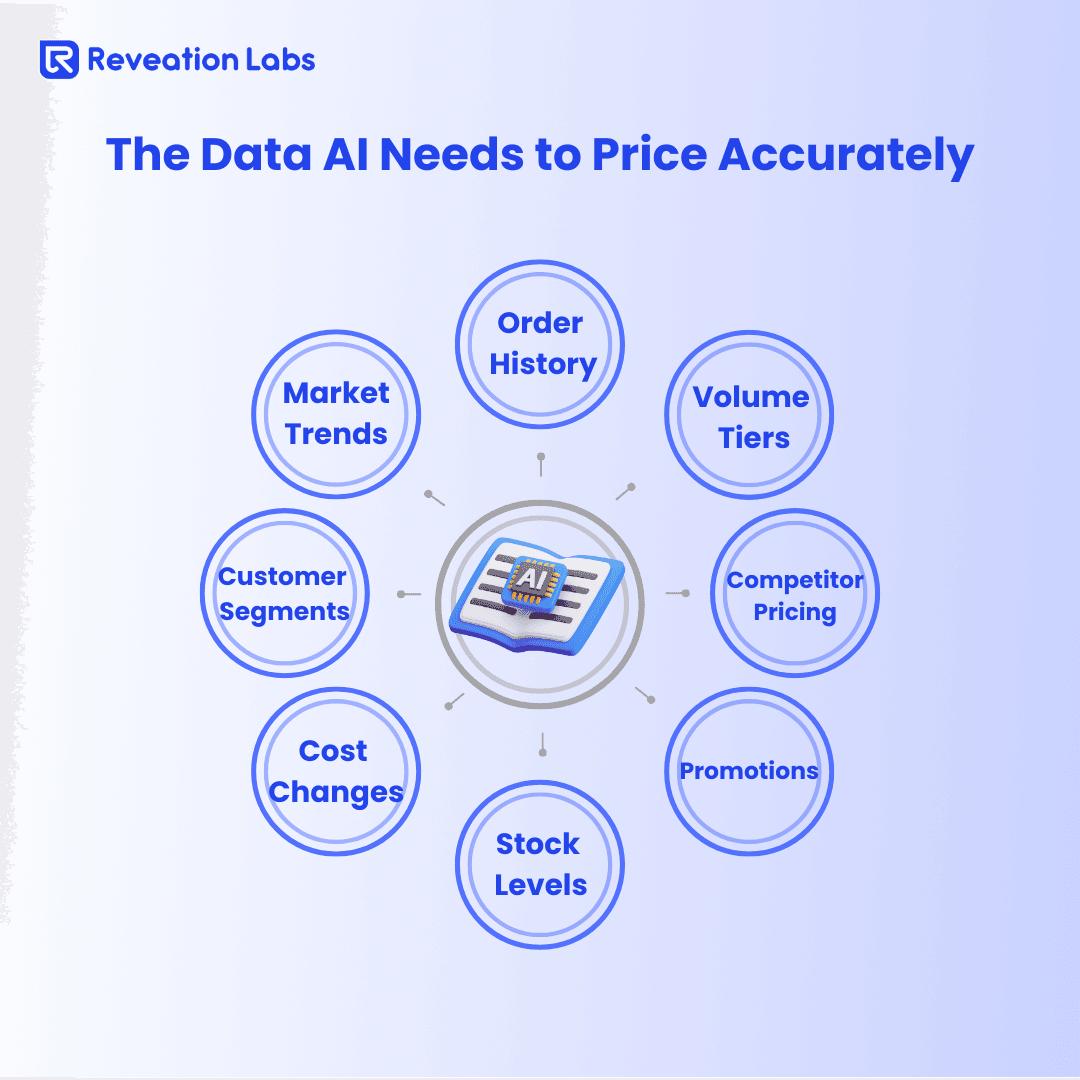
The engine needs more than a product and a list price. It may need the customer account, contract, branch, location, product, quantity, unit, currency, channel, cost, freight, rebate, inventory position, payment terms, promotion eligibility, and approval level.
| Pricing-engine layer | Responsibility | Example |
|---|---|---|
| Data layer | Supplies customer, product, contract, cost, order, and market context | ERP costs, CRM account tier, CPQ quote history, ecommerce demand |
| Rules layer | Enforces eligibility, floors, contracts, tiers, exclusions, and authority | Do not discount below the approved margin floor |
| Model layer | Estimates deal risk, elasticity, acceptance, or likely outcomes | Estimate how a price change may affect win probability |
| Optimization layer | Recommends a price or discount within the permitted range | Suggest the best price inside the approved corridor |
| Workflow layer | Routes approvals, exceptions, corrections, and system updates | Send a low-margin quote to finance for review |
| Explanation layer | Shows the factors, rules, and data that shaped the recommendation | Explain that cost, quantity, account tier, and contract status affected the range |
| Monitoring layer | Tracks adoption, outcomes, overrides, drift, and policy violations | Compare accepted prices with recommendations and margin targets |
The pricing engine should not create a second source of truth. It should read approved information from operational systems, apply documented rules, return a recommendation or eligible price, and write the approved result back to the correct workflow.
Our data integration work connects PIM, CPQ, OMS, ERP, commerce, and pricing flows so teams can maintain clear ownership across catalogs, quotes, prices, and orders.
Rules, Optimization, Generative AI, and Automation Play Different Roles
AI for B2B pricing works best when each technology performs a defined job. Teams create risk when they ask a generative model to enforce contracts, calculate final prices, or approve discounts without deterministic controls.
| Capability | Appropriate role | What it should not own alone |
|---|---|---|
| Rules engine | Enforce contracts, floors, tiers, eligibility, and approval thresholds | Predict buyer behavior or explain complex deal context |
| Predictive model | Estimate acceptance, risk, elasticity, churn, or deal outcomes | Override contracts or commercial authority |
| Optimization model | Recommend a price or discount within defined constraints | Publish unapproved high-impact prices |
| Generative AI | Summarize deal context, explain recommendations, extract requests, and draft quote language | Calculate the official price without validated tools and rules |
| Workflow automation | Route approvals, update systems, create tasks, and manage exceptions | Choose commercial strategy without defined policy |
| Agentic workflow | Coordinate data retrieval, pricing tools, validation, approvals, and updates | Bypass permissions, policy, or accountable decision owners |
A 2026 BCG analysis makes a similar point. Companies need to redesign pricing processes and integrate AI into commercial workflows rather than attach a model to an unchanged process.
Where AI Improves B2B Pricing
AI for B2B pricing creates the most practical value when it improves a decision that occurs frequently, uses identifiable data, follows commercial constraints, and produces a measurable result.
Discount variance
Compare discounts across similar customers, products, regions, and deal types to identify off-policy behavior.
Price recommendations
Recommend a price range that considers margin, contract rules, quantity, deal context, and likely acceptance.
Deal scoring
Flag deals with unusual terms, low margins, inconsistent pricing, or a high likelihood of escalation.
Contract compliance
Check account eligibility, contract dates, product access, volume tiers, and approved exceptions.
Renewal analysis
Compare cost, usage, service history, prior concessions, and account risk before proposing renewal terms.
Exception routing
Send deals to the correct approver with the context needed to make a timely decision.
Selection principle: Start with a pricing decision that creates visible delay, inconsistency, margin risk, or manual review. Do not start with unrestricted price changes.
How Generative AI Supports Dynamic Discount Management Software
Dynamic discount management software controls how sales representatives request, justify, approve, and apply discounts. Generative AI can improve the workflow by summarizing deal context, explaining the recommended range, drafting approval notes, and presenting alternatives.
The B2B pricing engine should still enforce floors, target margins, contract rules, rep authority, approval thresholds, rebate implications, and prohibited combinations.
1. Assemble context: Retrieve the customer, opportunity, contract, cost, product, quantity, history, freight, terms, and requested discount.
2. Apply policy: Check the margin floor, account rules, product restrictions, rep authority, renewal policy, and required approvals.
3. Recommend a range: Use optimization and predictive signals to suggest a target, acceptable corridor, and lowest permitted level.
4. Explain the recommendation: Show which factors influenced the range and which rules prevented a larger discount.
5. Route the exception: Send unusual, low-margin, strategic, or high-value deals to the correct approver.
6. Record the outcome: Store the approved price, reason, approver, override, expiration, and commercial result.
In our LinkedIn pricing article, we describe the same progression from discount recommendations and deal scoring to contract checks, margin-risk flags, exception routing, and suggested alternatives. We also state that teams should retain human approval for unusual or high-value deals.
Our article on agentic pricing shows how a pricing workflow can retrieve account context, validate contract rules, suggest a permitted discount, and route an exception without granting the system unlimited authority.
Discount warning: A model should never invent a commercial floor or approval rule. The pricing policy must supply those constraints.
How Does B2B Price Optimization Software Integrate With ERP and CRM Systems?
AI for B2B pricing needs current information from several systems. The pricing layer should not copy every record and become another uncontrolled database. It should retrieve approved context, apply pricing logic, and return the recommendation or final approved result to the right workflow.
| System | Likely responsibility | Pricing data or action |
|---|---|---|
| ERP | Operational and financial source of truth | Costs, base prices, contracts, rebates, customer master, inventory, invoices, and credit |
| CRM | Account and opportunity context | Segment, relationship history, opportunity stage, sales activity, renewal risk, and strategic status |
| CPQ | Configuration and quote workflow | Valid product combinations, quote versions, approvals, terms, and proposals |
| Pricing engine | Rules, recommendations, and optimization | Eligible price, discount corridor, margin risk, and approval requirement |
| Ecommerce | Digital buying experience | Display eligible pricing, request a quote, capture orders, and present account terms |
| OMS | Order lifecycle and fulfillment context | Order state, allocation, routing, returns, and fulfillment status |
| Data platform | Historical analysis and model features | Transactions, outcomes, market signals, model inputs, evaluation, and reporting |
The architecture also needs to define direction, timing, and failure behavior. Some decisions need a synchronous API response during a quote or cart interaction. Other data can move through scheduled feeds or events. Every integration needs timeouts, retries, monitoring, reconciliation, and an exception owner.
In our workflow post, we explain that commerce, CPQ, ERP, and service systems need to exchange reliable information. A B2B pricing engine cannot produce trustworthy recommendations when those systems disagree on the customer, contract, product, cost, or order context.
Our ERP pricing checks outline the ownership questions teams should answer for customer-specific pricing, quote overrides, contract rules, volume breaks, surcharges, units, and system disagreements.
Integration principle: Decide which system owns the final sell price, which system recommends it, which system approves exceptions, and which system records the commercial result.
AI-Assisted Quote Intake and Quote Creation
Generative AI can help sales teams process quote requests that arrive through email, spreadsheets, PDFs, portal forms, or sales notes. It can extract requested products, quantities, specifications, locations, delivery dates, and commercial terms into a structured draft.
The system still needs validated tools before it can produce a commercial quote. It must identify the correct products, normalize units, confirm customer eligibility, retrieve contract pricing, check availability, calculate freight, apply tax, evaluate credit, enforce margins, and route required approvals.
Safe first step
Extract and structure the request, then create quote-ready line items for review.
Next step
Validate products, entitlements, pricing, quantities, and availability through approved systems.
Controlled action
Create a draft quote and route exceptions or overrides to the responsible person.
Final action
Send, publish, or convert the quote only after the required validation and approval.
Our sales automation article maps this workflow from RFQ intake through product validation, contract checks, draft creation, approvals, quote-to-cart conversion, and order submission.
Quote warning: Document extraction can reduce manual entry, but it cannot prove product fit, price accuracy, inventory availability, or commercial approval by itself.
Explainability, Governance, and Human Approval
AI for B2B pricing affects margin, contracts, customer trust, and financial controls. Pricing teams and sales representatives need to understand why the system recommended a price and which rules shaped the permitted range.
A useful explanation should identify the approved data sources, relevant account and product context, pricing rules, cost position, quantity, contract status, commercial limits, and confidence level. It should not present hidden model reasoning as an audit record.
Pricing controls to implement
- Named owners for pricing rules, models, data, approvals, and outcomes
- Least-privilege access to customer, contract, cost, and transaction data
- Documented floors, corridors, authority levels, and exception rules
- Approval requirements for unusual, strategic, low-margin, or high-value deals
- Logs for recommendations, inputs, policy checks, approvals, overrides, and final prices
- Monitoring for drift, stale data, unusual recommendations, and policy violations
- A process for sales feedback, disputed recommendations, and corrected records
- A stop condition when required data or system responses remain unavailable
Teams should measure whether users follow the recommendations, why they override them, how approvals perform, and whether accepted prices improve the intended commercial outcome. High adoption does not prove value when margins, win rates, or policy compliance deteriorate.
Automated Pricing in B2B: What Should Run Automatically?
Automated pricing in B2B should expand in stages. Most companies should begin with analysis and recommendations, then automate low-risk workflow steps before they allow the system to apply prices directly.
| Automation level | System action | Suitable starting use | Human role |
|---|---|---|---|
| Insight | Identify leakage, variance, unusual discounts, and pricing patterns | Pricing analysis and management reporting | Review findings and choose corrective action |
| Recommendation | Suggest a price, discount corridor, or alternative term | Sales-assisted quotes and renewals | Accept, adjust, or reject the recommendation |
| Workflow | Route approvals, collect context, update records, and notify users | Discount exceptions and quote reviews | Approve high-impact decisions |
| Controlled execution | Apply an approved price inside a narrow policy boundary | Low-risk segments, renewals, or predefined ecommerce scenarios | Monitor performance and manage exceptions |
| Adaptive execution | Adjust prices within defined constraints based on current signals | Only mature, observable, reversible, and well-governed workflows | Own policy, monitor outcomes, and suspend the system when needed |
Our recommendation: Automate data collection, policy checks, explanations, routing, and record updates before automating high-impact price decisions.
How to Evaluate B2B Pricing Tools
B2B pricing tools vary widely. Some focus on price management, some on optimization, some on CPQ, and others on workflow automation or analytics. The strongest product demonstration may still fail when the tool cannot represent the company’s real contracts, accounts, units, approvals, and system boundaries.
Pricing fit
Can the tool represent contracts, tiers, units, rebates, freight, currencies, renewals, and customer-specific rules?
Integration fit
Can it read from and write to ERP, CRM, CPQ, ecommerce, OMS, and the data platform?
Control fit
Can teams configure floors, corridors, authority, approvals, exclusions, and stop conditions?
Explanation fit
Can users understand the data, rules, and factors behind each recommendation?
Operating fit
Can pricing and sales operations manage routine changes without constant developer support?
Measurement fit
Can the tool connect recommendations and overrides to margin, win rate, cycle time, and policy compliance?
Teams should test B2B pricing tools with real customers, products, contracts, cost structures, quotes, approvals, overrides, and integration failures. A generic demonstration cannot prove operational fit.
Build, Buy, or Extend an Existing Pricing Engine
AI for B2B pricing does not always require a new standalone platform. A company may extend its current CPQ or pricing engine, buy a specialized product, or build a focused layer around existing rules and systems.
| Approach | Best fit | Main advantage | Main risk |
|---|---|---|---|
| Extend | The current engine or CPQ already owns reliable pricing rules and workflows | Preserves established controls and reduces system duplication | The existing platform may limit model, explanation, or workflow flexibility |
| Buy | A pricing product covers most commercial requirements and integrations | Provides packaged capabilities, administration, and support | The business may force unique requirements into an unsuitable operating model |
| Build | The company has distinctive pricing logic, data, workflows, and technical ownership | Creates precise control over models, workflows, integrations, and user experience | Requires long-term engineering, monitoring, governance, and product ownership |
| Hybrid | The business needs packaged pricing with custom orchestration or specialized models | Balances proven controls with differentiated capabilities | Integration and ownership can become unclear without a target architecture |
We build connected AI agents when a pricing workflow needs to retrieve context, call pricing and contract tools, explain results, collect missing information, and route decisions across systems.
How to Pilot AI for B2B Pricing
A useful pilot tests one pricing decision inside a real workflow. It should not attempt to rebuild every contract, quote, approval, market, and product rule at once.
1. Select the decision: Choose discount recommendations, renewal pricing, margin-risk detection, quote approval, or another bounded problem.
2. Record the baseline: Measure current margin, quote cycle time, approval time, override rate, error rate, and policy exceptions.
3. Define ownership: Name the pricing, sales, finance, data, integration, security, and model owners.
4. Connect trusted data: Use approved customer, contract, cost, product, quote, and transaction sources.
5. Start with recommendations: Keep users responsible for the final price while the team evaluates accuracy, usefulness, and adoption.
6. Test exceptions: Include missing costs, expired contracts, unusual quantities, strategic accounts, low margins, stale data, and integration failures.
7. Make a scale decision: Expand only when the pilot improves the intended outcome without weakening control, trust, or operational reliability.
Pilot principle: Measure margin quality, quote speed, approval performance, policy compliance, user adoption, and override reasons. Do not measure success by the number of AI recommendations.
AI Pricing Readiness Checklist
Use this checklist before you approve an AI for B2B pricing implementation.
- We defined the pricing decision and measurable business outcome.
- We identified the system that owns final sell price, costs, contracts, accounts, and approvals.
- We documented pricing floors, corridors, tiers, exclusions, authority, and exception rules.
- We confirmed that ERP, CRM, CPQ, ecommerce, and order data agree on stable identifiers.
- We validated data freshness, completeness, access, and correction ownership.
- We defined which steps provide insights, recommendations, workflow automation, or controlled execution.
- We require human approval for unusual, high-value, strategic, or low-margin decisions.
- We can explain the approved data, rules, and factors behind each recommendation.
- We log recommendations, approvals, overrides, final prices, and commercial outcomes.
- We can stop the workflow when required data or system responses remain unavailable.
- We funded monitoring, model evaluation, rule maintenance, integration support, and user training.
Conclusion
AI for B2B pricing works when the business connects models to a reliable B2B pricing engine, commercial rules, trusted systems, clear approvals, and measurable outcomes. Generative AI can improve explanations, quote intake, workflow context, and user interaction, but it should not replace deterministic pricing controls.
Strong teams begin with one pricing decision, define system ownership, connect ERP and CRM data, preserve human authority, test real exceptions, and expand automation only after the workflow proves reliable.
We use agentic AI to connect pricing tools, data, approvals, and enterprise systems around bounded workflows that teams can observe and control.