
Agentic AI architecture gives an AI system the structure it needs to pursue a goal, maintain context, select tools, take bounded actions, evaluate results, and choose what to do next.
The model generates possible responses and actions, but the architecture controls execution. It defines what the agent can access, which actions it can take, when it must stop, and where a person must intervene.
In this blog, we explain what makes an AI system agentic, break down the core components of agentic AI architecture, show how an agentic AI system operates, and outline the controls that production systems require. We also explain when deterministic workflow automation offers a simpler and safer choice.
What Is Agentic AI Architecture?
Agentic AI architecture describes the system design that allows an AI agent to work toward an objective across multiple steps. It connects the model to context, state, memory, business rules, tools, applications, evaluation logic, and human controls.
An AI agent forms only one part of the wider system. A complete agentic AI system also includes the interface that receives the request, the orchestrator that manages execution, the data layer that supplies context, the tools that create real-world effects, and the controls that limit those effects.
We do not treat maximum autonomy as the goal. We design agentic and autonomous AI systems around useful autonomy: enough flexibility to handle variable work, but enough control to protect data, operations, customers, and employees.
AI assistant
A person asks for help, reviews the response, and decides what happens next.
Best for drafting, summarization, research support, and one-step assistance.
Workflow automation
Rules and triggers move work through predefined steps.
Best for stable processes with known inputs, decisions, and outcomes.
Agentic AI system
The system interprets the goal, selects actions, uses tools, evaluates results, and adjusts its next step.
Best for variable, multi-step work that requires bounded reasoning and tool selection.
What Makes an AI System Agentic?
An AI system becomes agentic when it does more than generate a response. It receives an objective, maintains enough state to track progress, selects among possible actions, uses approved tools, evaluates the outcome, and chooses whether to continue, retry, stop, or escalate.
The system does not need unlimited freedom. Strong agentic AI architecture narrows the action space and gives the agent clear operating boundaries.
Goal: The system receives a defined objective and measurable completion criteria.
Action selection: The agent chooses a suitable next step instead of following only one fixed path.
Tool use: The agent calls approved APIs, workflows, databases, or business applications.
State: The system tracks the current task, previous actions, results, and unresolved issues.
Evaluation: The system checks whether an action succeeded, failed, or produced an unacceptable result.
Boundaries: Policies, permissions, budgets, approvals, and stop conditions constrain every action.
Production principle: Agency comes from the complete decision-and-action loop, not from the language model alone.
The Core Components of Agentic AI Architecture
A useful AI agent architecture diagram should show more than a model connected to several tools. It should show how the system receives a request, gathers context, plans an action, executes it, evaluates the result, updates state, and applies controls throughout the cycle.
We organize agentic AI architecture into eight practical components. A specific platform may combine several components, but each responsibility still exists somewhere in the system.
1. Input and interface
Receives a request from a person, application, event, message, sensor, or scheduled process.
2. Model and reasoning layer
Interprets the objective, weighs available context, and proposes the next action.
3. Planning
Breaks the objective into bounded steps and adjusts the plan when the system encounters new information.
4. State and memory
Tracks the active task and retrieves relevant facts, histories, preferences, or prior outcomes.
5. Tools and integrations
Give the agent approved ways to query data, call APIs, trigger workflows, or update business systems.
6. Orchestration
Coordinates the execution sequence, routes tasks, applies policies, and manages retries, timeouts, and handoffs.
7. Evaluation and observability
Records state changes, source references, tool requests, outcomes, latency, cost, errors, and policy violations.
8. Identity, governance, and human control
Limits access, defines approval points, protects sensitive actions, and assigns accountability.
The tool layer connects reasoning to operational work. We often apply AI process automation patterns here so agents can use existing workflows without bypassing established business rules.
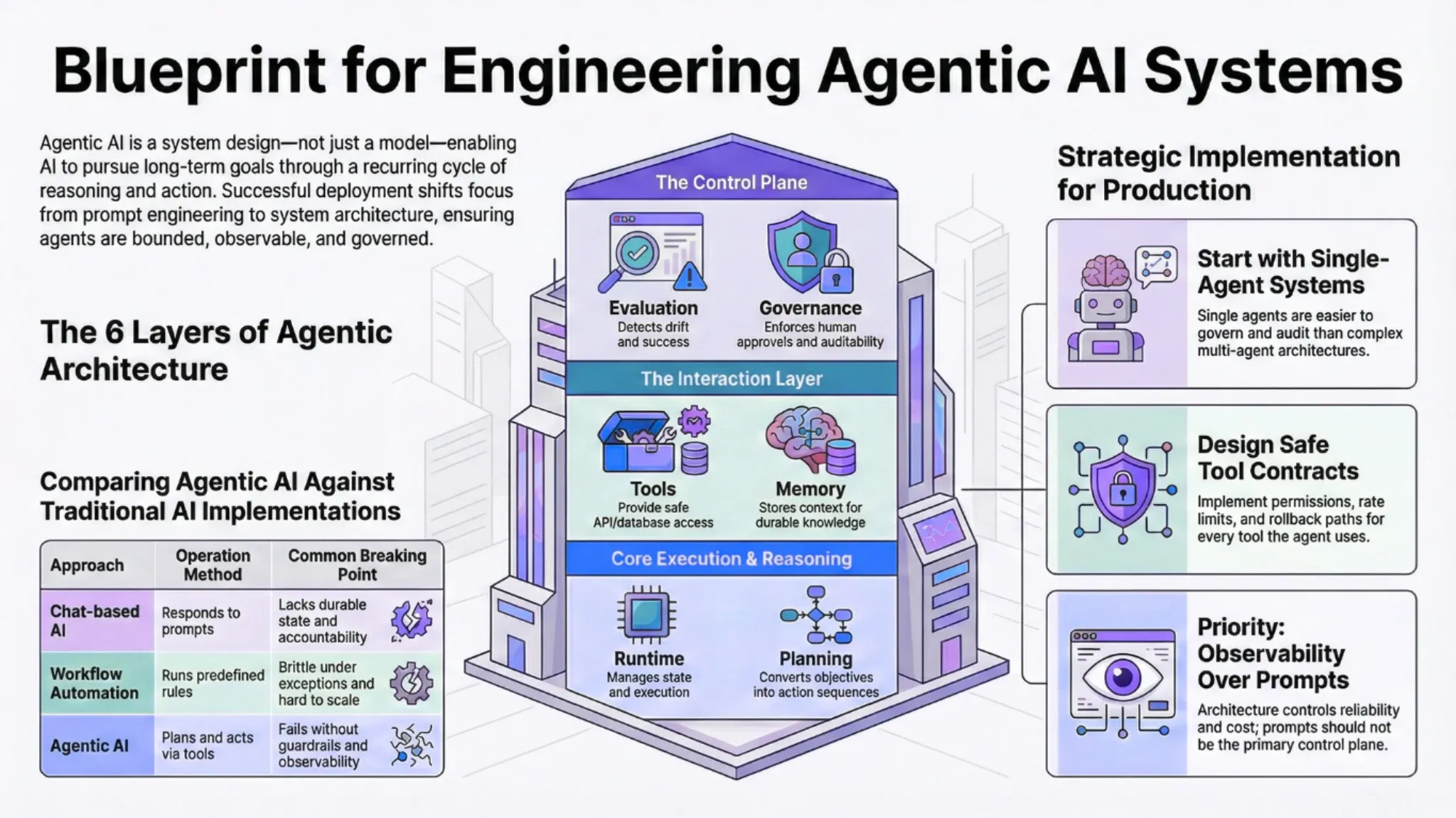 A simplified blueprint for engineering agentic AI systems. Production designs may separate additional responsibilities such as identity, orchestration, human approval, and business-system integration.
How to read the architecture: A request enters the system, the agent gathers context, the planner proposes a bounded action, the orchestrator applies policy, an approved tool performs the action, and the evaluation layer determines the next step.
How an Agentic AI System Works
An agentic AI system operates as a controlled loop. The system does not need to create a complete plan and execute every step without review. In most production settings, agentic AI architecture works more reliably when the system takes one bounded action, checks the result, and then chooses the next step.
Step 1 — Receive: The system receives a goal, request, event, or exception.
Step 2 — Ground: The system retrieves the policies, records, history, and context that the task requires.
Step 3 — Plan: The agent selects a next action that fits the goal and current constraints.
Step 4 — Authorize: The orchestrator checks identity, permissions, policy, budget, and approval requirements.
Step 5 — Act: An approved tool queries, creates, updates, routes, or triggers something.
Step 6 — Evaluate: The system checks the output, detects errors, and compares the result with the success criteria.
Step 7 — Decide: The system continues, retries, changes direction, asks for approval, escalates, or stops.
This loop separates an agentic AI system from a one-time model response. It also gives engineering and operations teams clear places to add controls and measure performance.
Our blog on AI agents in business automation provides practical examples of where businesses can apply this kind of multi-step, tool-enabled execution.
Production reality: Short action horizons make agents easier to test, observe, approve, and recover. Long plans increase the number of points where context, tools, or assumptions can fail.
Planning, State, Memory, and Learning Are Different
Teams often group planning, state, memory, and learning together, but each component plays a different role in agentic AI architecture.
Planning determines the next action. State tracks the current workflow. Memory retrieves information from earlier interactions or enterprise knowledge. Evaluation measures the result. Learning changes future behavior through updated instructions, models, rules, retrieval data, or feedback processes.
Planning
What should the system do next?
State
Where does the active task stand now?
Memory
Which previous facts or interactions matter now?
Learning
How should the system change future behavior?
More memory does not automatically improve an agent. The system must retrieve the right information, respect access boundaries, identify freshness, and avoid contaminating future decisions with unreliable outputs.
Teams often need scalable retrieval, vector storage, monitoring, and lifecycle controls to support this layer. Our AI infrastructure services address those foundations for systems that rely on semantic search, retrieval, observability, and production operations.
Architectural question: Do not ask how much information the agent can remember. Ask which information the agent should retrieve, who can access it, how long it remains valid, and how the system detects errors.
Tools and Business-System Interaction
Tools give agents operational power. A tool may query a database, call an API, create a support case, calculate a quote, update an order, trigger a workflow, send a message, or request human approval.
Safe agentic AI architecture treats each tool as a controlled contract. The contract specifies valid inputs, permitted identities, expected outputs, side effects, timeouts, retry behavior, transaction limits, and error handling.
- Use least privilege: Give the agent only the access that the current task requires.
- Separate reading from writing: Let an agent retrieve information without automatically granting permission to change it.
- Treat external content as untrusted: Prevent documents, messages, websites, and tool results from silently overriding system policies.
- Protect high-impact actions: Require approval for financial, contractual, customer-facing, destructive, or irreversible steps.
- Design for retries: Prevent duplicate orders, messages, payments, or updates when a tool call repeats.
- Plan recovery: Give operations teams a way to cancel, reverse, correct, or contain failed actions.
Strong tool design: The agent knows what the tool does, the orchestrator knows whether the agent can use it, and the operations team can trace the outcome.
Orchestration and Human Control
The orchestrator coordinates the agentic AI system. It routes work, applies policies, supplies context, manages state, selects tools, tracks budgets, handles timeouts, and determines when the system needs human input.
We prefer explicit orchestration for critical business processes. An explicit controller gives the team a stable place to enforce policies and inspect failures instead of asking another autonomous agent to control every decision.
Human oversight works best at decision boundaries. Requiring approval after every low-risk step removes most of the value. Allowing every action without review expands the risk. The architecture should place approvals where errors create meaningful operational, financial, legal, or customer impact.
Agent decides
Low-risk tool selection, information retrieval, categorization, and reversible preparation steps.
Human approves
Customer commitments, policy exceptions, high-value transactions, sensitive disclosures, and destructive actions.
System stops
Missing permissions, conflicting data, repeated tool failure, budget limits, or uncertain high-impact decisions.
Observability, Evaluation, and Governance
Observability explains what the agent did, which approved sources it used, which tools it called, how long each step took, and what result the workflow produced. Evaluation tells the team whether that behavior met the expected standard.
Teams should measure the complete business outcome, not only the quality of one model response. An agent may produce an accurate summary but still fail the workflow when it selects the wrong customer record, exceeds the cost budget, repeats an action, or misses an escalation.
The logging layer should capture state transitions, tool requests, source references, policy checks, approvals, failures, and final outcomes. It should avoid storing unnecessary sensitive data or exposing hidden model reasoning as though it were a reliable audit record.
- Completion rate
- Exception and escalation rate
- Tool-call success rate
- Time to successful outcome
- Cost per successful outcome
- Policy and permission violations
- Human correction and override rate
Governance connects those measurements to accountability. It defines who owns the workflow, who approves changes, which data the agent can use, how the team investigates incidents, and when the organization should reduce or suspend autonomy.
In our LinkedIn post on responsible AI adoption across industries, we explained why speed without control creates fragile operations and why automation without context damages trust. Agentic AI architecture must address both problems from the start.
Red flag: When the team cannot reconstruct an agent’s state changes, tool use, policy checks, and final outcome, the system lacks the observability that production accountability requires.
Single-Agent vs Multi-Agent Architecture
A single-agent architecture gives one agent responsibility for a bounded objective and a controlled set of tools. A multi-agent architecture divides the workflow among specialized agents and introduces coordination between them.
Multi-agent design can help when a workflow contains genuinely distinct roles, knowledge domains, permissions, or evaluation responsibilities. It can also add latency, cost, duplicated reasoning, conflicting decisions, and harder-to-trace failures.
| Architecture | Best fit | Main advantage | Main risk |
|---|---|---|---|
| Single agent | Bounded workflows with one clear objective and a limited toolset | Simpler testing, permissions, observability, and cost control | One agent may accumulate too much context or responsibility as scope grows |
| Multi-agent | Work that separates cleanly into specialized roles or independently governed domains | Specialization and parallel execution | Coordination failures, duplicated work, higher cost, and unclear accountability |
Our recommendation: Start with one constrained agent. Add specialist agents only when measurement shows that one agent cannot manage the workload safely or effectively.
Agentic AI Architecture vs Workflow Automation
Agentic AI architecture does not replace deterministic automation. Each approach solves a different class of problem, and many production systems combine them.
A predictable process with known rules often benefits from standard workflow automation. A variable process that requires context, judgment, tool selection, and adaptation may justify an agentic layer.
| Approach | Best fit | Behavior | Control model |
|---|---|---|---|
| AI assistant | Drafting, summarizing, answering, and analysis support | Responds to a request | The user reviews and acts |
| Workflow automation | Stable, repeatable processes with defined rules | Follows a predetermined sequence | Rules and exception paths control execution |
| Agentic AI | Variable, multi-step work that requires context and action selection | Chooses the next bounded action based on the current state | Policies, permissions, evaluation, and human boundaries control execution |
Simple decision rule: Use deterministic automation when rules can handle the process. Add agentic reasoning only where variability or exceptions require it.
Common Agentic AI Architecture Mistakes
Treating prompts as system logic
Prompts influence behavior, but code, policies, permissions, and tool contracts must control high-impact actions.
Granting broad tool access
Excessive permissions increase the impact of bad context, injected instructions, and incorrect plans.
Adding memory without controls
The system may retrieve outdated, irrelevant, unauthorized, or agent-generated information as though it were reliable.
Choosing multi-agent design too early
Coordination complexity can hide basic workflow, tool, and evaluation problems.
Measuring model output alone
The team may overlook failed actions, repeated work, exceptions, latency, cost, and human corrections.
Skipping rollback and escalation
Operations teams need a safe response when tools fail or the agent reaches an uncertain decision.
How We Implement Agentic AI Architecture
We start with one bounded workflow, one accountable owner, and one measurable business outcome. We map the current process before we choose the model, framework, or number of agents.
We then identify the safe actions the system can take, the data it needs, the tools it can call, the decisions that require approval, and the conditions that should stop execution.
1. Define the outcome: Specify the business result, baseline, completion criteria, and failure conditions.
2. Bound the workflow: Limit the first implementation to one process, one team, and a manageable exception set.
3. Design the tools: Define permissions, inputs, outputs, side effects, retries, and approval thresholds.
4. Add controls: Implement identity, policies, budgets, logs, evaluation, escalation, and stop conditions.
5. Test exceptions: Test missing data, conflicting instructions, tool failure, unauthorized requests, and repeated actions.
6. Expand deliberately: Increase autonomy, tools, users, or agent specialization only after the system produces stable results.
This approach matches the practical direction we shared in our LinkedIn post on starting AI initiatives with clean data and one narrow workflow. We define one use case, agree on meaningful measures, test it under realistic conditions, and make a clear scale-or-stop decision.
Teams that need help turning this architecture into an operating solution can use our generative AI agent solutions to connect models, data, tools, applications, evaluation, and governance around a defined workflow.
Implementation checkpoint: Do not increase autonomy until the team can measure success, explain failures, contain impact, and operate the controls.
When Agentic AI Architecture Is the Right Choice
Agentic AI architecture adds value when a workflow requires several decisions, variable inputs, context retrieval, tool selection, and adaptation to exceptions. It adds unnecessary complexity when a simple rule or fixed workflow can produce the same result.
Use this decision checklist
- Does the work require several dependent steps?
- Do inputs, exceptions, or decisions vary from case to case?
- Must the system select among several tools or actions?
- Can the team define safe actions and clear permissions?
- Can the team measure success, failure, cost, and human correction?
- Does the workflow include clear approval and escalation points?
- Would a deterministic workflow solve the problem more simply?
Simple test: When the team can define safe actions, measurable outcomes, and operational controls, it can test a constrained agent. When it cannot define those elements, it should improve the workflow before adding autonomy.
Conclusion and Agentic AI Architecture Checklist
Agentic AI architecture turns a model into a controlled operating system for goal-directed work. It connects reasoning to state, memory, tools, orchestration, evaluation, identity, governance, and human judgment.
Strong teams do not begin by maximizing autonomy. They begin with one valuable workflow, limit the action space, design safe tools, measure the complete outcome, and expand only after the controls work.
Production architecture checklist
- Define the objective and completion criteria in business terms.
- Map the input, reasoning, state, memory, tools, and orchestration layers.
- Give every tool a narrow contract and least-privilege access.
- Define approval, escalation, stop, retry, and rollback conditions.
- Log state changes, source references, tool calls, policy checks, and outcomes.
- Measure workflow results, not only response quality.
- Expand autonomy only after the team can explain and contain failures.
When you need to turn this blueprint into a production system, our autonomous AI agent services help connect agentic AI architecture, integrations, governance, and measurable workflow outcomes.