
If your team already understands the basics of agentic systems, the next challenge is operational: where can an agent safely take action inside quote-to-order without risking margin, compliance, or customer trust?
This blog focuses on execution patterns for agentic ai b2b ecommerce, including the workflows to automate first, the controls that keep Finance comfortable, and the KPIs that prove value fast.
Automate the work between systems, not just tasks
In B2B commerce, deals rarely slow down because teams cannot generate a quote or place an order. They slow down in the handoffs: contract eligibility, customer entitlements, approvals, substitutions, pack sizes, and ERP-specific rules. Agentic automation works best when it connects systems and enforces policy in the messy middle.
If you want a deeper primer, see our blog on agentic AI in ecommerce and our overview of agentic AI for B2B ecommerce. In this article, we assume that the foundation and focus on the operating model that drives measurable outcomes.
Practical rule: if the workflow is mostly fixed paths, standard automation is enough. If the workflow depends on context, exceptions, and policy checks across multiple tools, agentic execution is often the better fit.
The 7 highest-ROI agentic workflows B2B teams are deploying now ✅
These use cases tend to show value quickly because they reduce cycle time and rework in high-volume processes. For each workflow below, define the trigger, required tools, allowed actions, guardrails, and KPIs before you build. That discipline helps avoid “agent washing” and keeps scope tied to outcomes.
1) RFQ intake to structured quote-ready line items
- Trigger: Customer sends an RFQ via email, spreadsheet, or PDF.
- Tools: Email, document parsing, PIM, CPQ, CRM.
- Actions: Extract SKUs and quantities, normalize units, validate availability, draft a quote.
- Guardrails: Draft-only permissions, approvals required for pricing overrides or substitutions.
- KPIs: Quote cycle time, RFQ-to-quote rate, manual entry hours eliminated.
If this is a priority, our post on turning RFP PDFs into instant quotes covers the operational details and common parsing pitfalls.
2) Contract pricing and entitlement validation before quotes
- Trigger: Customer requests pricing or adds items to cart.
- Tools: ERP pricing and contract tables, customer master, CPQ rules.
- Actions: Verify eligibility, apply tiers, enforce customer-specific restrictions.
- Guardrails: Overrides require approval, log policy and rules used.
- KPIs: Margin leakage reduction, pricing exceptions, approval turnaround time.
3) Approval coordination with audit-ready context
- Trigger: Quote requires finance, legal, or product approval.
- Tools: CRM, approval workflows, policy store, email or messaging.
- Actions: Route approvals, summarize requested changes, track status and SLA.
- Guardrails: No unilateral term changes, approvals must be explicit and recorded.
- KPIs: Approval cycle time, quote aging reduction, win rate on approved deals.
4) Quote-to-cart conversion with compliant substitutions
- Trigger: Buyer accepts a quote or requests matched pricing.
- Tools: CPQ, ecommerce cart, PIM, inventory.
- Actions: Convert quote lines to cart, validate MOQs, suggest alternates when needed.
- Guardrails: Substitutions must follow the equivalency policy, buyer confirmation required.
- KPIs: Quote-to-order conversion, cart abandonment reduction, fewer order errors.
5) PO capture and order creation with exception routing
- Trigger: Customer emails a PO or uploads it.
- Tools: PO parsing, OMS, ERP, CRM.
- Actions: Match PO to contract or quote, validate ship-to, draft sales order.
- Guardrails: Two-step commit, draft, then validate, then final submit.
- KPIs: PO processing time, touchless order rate, exception resolution time.
6) Reorder and replenishment agent for repeat buying
- Trigger: Customer reorder pattern or low-stock signal.
- Tools: Order history, inventory, customer constraints, and ecommerce.
- Actions: Recommend reorder, enforce pack sizes, pre-fill carts, suggest bundles.
- Guardrails: Buyer confirmation required, thresholds per account, no auto-submit by default.
- KPIs: Reorder frequency, AOV, time-to-reorder, retention.
7) Order status and exception handling agent
- Trigger: Backorder, delayed shipment, partial fulfillment, or ETA change.
- Tools: OMS, carrier updates, inventory, SLA rules.
- Actions: Proactively notify, propose alternatives, support split shipments, update ETAs.
- Guardrails: Never promise unreserved inventory, approval required for sensitive substitutions.
- KPIs: First-contact resolution, ticket deflection, CSAT.
A clear mapping from workflow to systems
Leaders get traction faster when the scope is explicit. This quick table helps align Sales, IT, and Operations on tool access and safe automation boundaries.
| Workflow | Core systems used | Safe automation boundary |
|---|---|---|
| RFQ to quote draft | Email, PIM, CPQ, CRM | Draft quote only, rep approves |
| Contract pricing validation | ERP pricing, CPQ rules | No override without approval |
| Approvals and routing | CRM, approvals, policy store | Agent routes, humans approve |
| Quote to cart | CPQ, ecommerce, PIM | Substitutions require confirmation |
| PO to order | Parser, OMS, ERP | Two-step commit plus exception queue |
| Reorder agent | History, inventory, ecommerce | Buyer confirms, thresholds enforced |
| Exceptions and ETAs | OMS, logistics, customer rules | No “phantom” promises, policy-first |
The agentic layer blueprint for sales and ordering
A production-grade agentic setup is less about a single model and more about an execution layer. That layer should call your tools, obey policy, record decisions, and escalate safely when risk increases. If you want a commerce-first reference architecture, see Agentic Commerce Automation.
Pattern 1: Agent plus tools plus policy engine
Agents should rely on your systems of record through APIs and connectors, not invented actions. Policies define what is allowed, including pricing thresholds, eligibility, substitution rules, and credit constraints. This is where many teams combine orchestration with a policy layer to keep decisions consistent across channels.
Pattern 2: Permission modes that match risk
Permission modes reduce risk while still delivering speed. Common modes include read-only for recommendations, draft-only for quotes and orders, and commit-with-approval for final submission. This model helps teams scale agentic ai b2b ecommerce workflows without sacrificing control.
Pattern 3: Traceability as a first-class requirement
Every meaningful action should be logged with inputs, tools called, rules applied, and outcomes. Traceability turns agent behavior into something Finance, Compliance, and IT can audit and improve. For additional background on how agents drive operational efficiency, see AI agents and business automation.
If your team is also evaluating platform and integration strategy, our B2B ecommerce services page outlines common modernization paths for manufacturers and distributors.
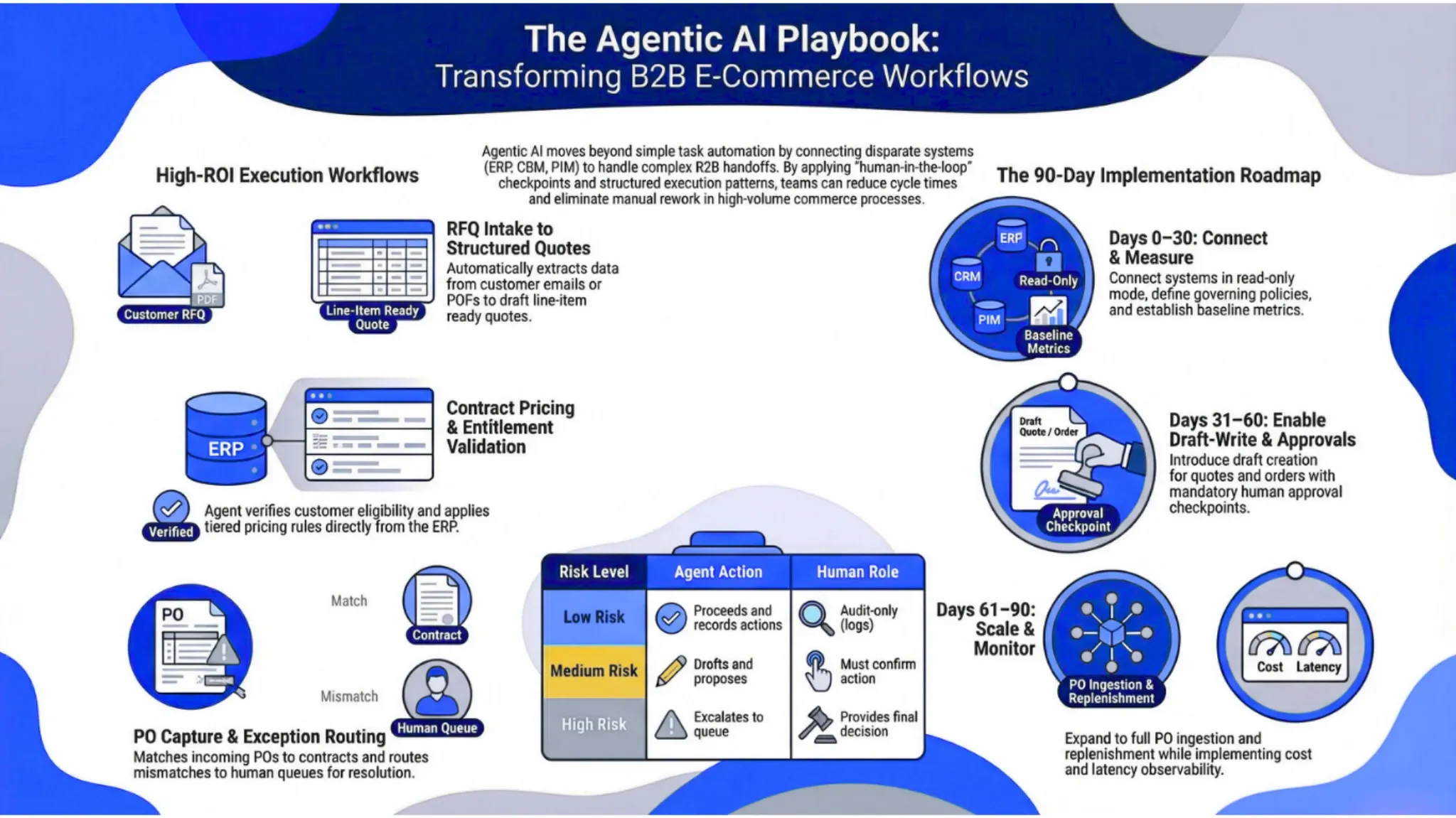
Human-in-the-loop checkpoints that protect margin and compliance ✅
Some decisions should remain human-owned, especially when they affect margin or regulatory exposure. Typical checkpoints include pricing overrides, special terms, credit adjustments, restricted SKUs, and changes to customer master data. When teams define these checkpoints early, they can automate more aggressively everywhere else.
⚠️ Practical framing: define confidence + risk, then choose the right handoff.
- High confidence, low risk: Agent proceeds and records actions (for example, order status updates).
- Medium confidence or medium risk: Agent drafts, then requests confirmation.
- Low confidence or high risk: Agent escalates to an exception queue with recommended next steps.
A practical safety mechanism is a two-step commit for orders: create a draft order, validate against policy and ERP rules, then request final approval before submission. This approach makes automation safer while preserving speed.
What good looks like in an end-to-end flow
Scenario: a buyer emails a PO.
The agent extracts line items, ship-to, requested dates, and terms, then validates contract pricing and availability. It builds a draft sales order and routes mismatches, such as pack-size errors or discontinued SKUs, into an exception queue with recommended fixes.
When validation passes, the agent requests approval or buyer confirmation, submits the order, and sends a clean acknowledgment. This is the difference between automation that saves minutes and automation that changes throughput.
A 30/60/90 implementation roadmap that avoids pilot fatigue 🧭
Days 0 to 30: Constrain scope, connect read-only tools, measure baselines
Start with two workflows that reduce friction quickly, such as RFQ to quote draft and order status plus exceptions. Connect systems in read-only mode first and define the policy set that governs what “good” looks like. Establish baseline metrics for cycle time, error rate, and ticket volume.
Days 31 to 60: Add draft-write actions, approvals, and exception queues
Enable draft creation for quotes and orders, then introduce approval checkpoints for riskier steps. Build a structured exception queue so humans can resolve edge cases quickly and teach the system over time. This is where many teams see meaningful time savings without taking on outsized risk.
Days 61 to 90: Expand to PO ingestion and reorders, add monitoring and cost controls
Add PO capture and reorder flows once policies and handoffs are stable. Implement observability for cost, latency, error rates, and escalation volumes so Finance and IT can manage scale.
If you are building a broader agent program, align architecture to the patterns in UCP vs ACP to keep the agent layer consistent across channels.
When teams want help moving from pilot to production, our agentic and autonomous AI services focus on architecture, governance, and integration that stand up to enterprise controls.
KPIs to prove ROI in 90 days 📈
Pick three to five KPIs for the pilot so the outcome is obvious. You can expand the dashboard later once the operating model is stable. Tie every KPI to a specific workflow so owners and levers are clear.
Revenue
- Quote cycle time
- Quote-to-order conversion
- Reorder frequency
- Average order value
Operations
- Touchless order rate
- Order error rate
- Rework hours
- Exception resolution time
Customer experience
- Response time
- First-contact resolution
- CSAT
A quick checklist to spot real agentic automation ✅
A real agentic workflow uses tools, executes multi-step plans, and enforces policy with auditability. A chatbot experience that only generates text will not deliver the same operational lift. Use this checklist to keep your program grounded.
Signs you have real agentic execution
- Tool use across ERP, CRM, CPQ, PIM, OMS, and ecommerce.
- Validation gates and exception routing, not a single “answer.”
- Explicit permissions and policy enforcement.
- Action logs that are replayable and auditable.
- ROI definition before build, with KPIs tied to workflows.
Red flags 🚩
- No action logs or traceability.
- No permission model.
- Unexplained decisions without policy evidence.
- Undefined scope, unclear owners, or missing success metrics.
How Reveation Labs helps teams automate sales and ordering safely
The hard part is rarely building a prototype. The hard part is aligning systems, policies, and change management so Sales, Finance, and Operations trust outcomes.
Reveation Labs helps teams design an agentic commerce layer, integrate core systems, and implement governance so automation scales without surprises.
If you want a concrete view of what this looks like in production, start with Agentic Commerce Automation and map it to your top two quote-to-order bottlenecks.
Conclusion
Competitive advantage will go to teams that automate safely, then expand quickly. Start with high-volume workflows, enforce policy, instrument outcomes, and scale in phases. That is how agentic ai b2b ecommerce moves from concept to compounding operational leverage.