
Agentic AI is showing up everywhere in commerce conversations—but B2B leaders have a fair question: what does it actually do, and will it move real metrics? This blog makes agentic ai for ecommerce easy to understand, with practical B2B use cases, a reference architecture you can visualize in minutes, and a simple ROI model you can take into budget planning.
If you want a quick backdrop on how AI is evolving in B2B commerce, you can also explore AI in B2B eCommerce: Separating Hype from Reality and Agentic Commerce in B2B eCommerce: Today vs. 2030.
Agentic AI can take steps toward outcomes (not just answer questions)
The best B2B wins come from ERP/OMS/PIM/CRM-connected workflows, not standalone chat
Start with draft-first + approvals, prove ROI, then expand autonomy
Why “agentic” is different from “AI features” in B2B commerce
Many ecommerce platforms already include AI-driven search, recommendations, or support chat. Agentic AI is different because it can plan and execute steps—like preparing a quote draft, validating customer entitlements, or initiating an RMA workflow. In B2B, that only matters when the agent is connected to systems of record and governed with approval controls.
Simple definition: Agentic AI is “AI that can do,” but in B2B it must do it safely, audibly, and within policy.
A helpful way to understand the shift is to compare agentic workflows to older approaches like rule-only automation. This is explained clearly in Why Agentic AI Is Replacing Rule-Based Automation in Ecommerce.
The problem: B2B ecommerce still looks digital… but runs manual
B2B commerce is full of exceptions: customer-specific pricing, contract terms, restricted SKUs, multi-ship-to logistics, and procurement rules. That’s why “self-serve” often still requires people behind the scenes—especially in quote-to-cash and post-order changes.
| Workflow | What customers experience | What teams do manually | Business impact |
|---|---|---|---|
| Quote-to-cash | “Can you quote this today?” | Build quotes, validate pricing, chase approvals | Slow conversion, lost deals |
| Pricing & entitlements | “Why can’t I see my products/prices?” | Verify contract rules, tiers, access rights | High support volume |
| Order changes | “Split ship / substitute / expedite” | Re-key changes across systems | Errors, rework, margin leakage |
| Returns/RMA | “Am I eligible? What’s next?” | Validate warranty, issue labels, route cases | Longer cycle times |
| Procurement policy | “We must follow compliance rules” | Validate PO rules, approvals, punchout constraints | Slower buying, drop-offs |
The solution: agentic AI patterns that actually work in B2B ecommerce
The simplest mental model is this: an agent is a goal-seeking assistant that can understand a request, plan steps, call tools, and stop for approvals. In B2B, the most reliable deployments start as draft-first agents, then gradually earn the right to execute actions as governance matures.
If you want more example ideas to spark internal workshops, you can reference 10 Agentic AI Examples for Ecommerce and adapt them into B2B-ready, ERP-connected workflows.
Agentic AI vs chatbot vs RPA
- Chatbot: answers questions and routes requests. Usually does not change systems of record.
- RPA / rules: follows predefined paths. Works best when inputs are clean and workflows are stable.
- Agentic AI: can handle messy requests, decide next steps, and coordinate tools—with guardrails.
A simple framework for safe agents: “SAFE”
To keep agentic AI production-ready, especially in B2B, use a framework your teams can actually operationalize:
| SAFE pillar | What it means | What you implement |
|---|---|---|
| Scope | What the agent is allowed to do | Allowed actions list (read/write), workflow boundaries |
| Authority | Who/what it can act on | Entitlements, roles, approval thresholds |
| Failsafes | How it stops bad outcomes | Draft vs execute, confidence checks, human-in-loop |
| Evidence | How it proves what it did | Audit logs, source record references, replayable traces |
For teams thinking about how agents “buy” or act on behalf of users, the autonomy lens in Agentic Commerce in B2B: UCP vs. ACP is a practical way to frame scope and approvals.
High-ROI B2B use cases (super easy breakdown)
Below, each use case follows the same pattern: Problem → What the agent does → Systems touched → Guardrail → ROI metric. This keeps conversations grounded and helps you avoid pilots that feel “cool” but don’t move outcomes.
1) Quote creation + guided discounting (CPQ-lite behavior)
- Problem: Quotes are slow because data lives in too many places.
- Agent does: Asks a few clarifying questions, builds a quote draft, suggests a discount within rules.
- Touches: CRM (account), ERP/pricing engine (price lists), PIM (product specs), CPQ (if you have it).
- Guardrail: Discounts above a threshold require approval; the agent can draft but not send.
- ROI metric: Quote cycle time ↓, conversion ↑, pricing errors ↓.
To make this business-case friendly, tie it to the metrics approach in The ROI of Generative AI in B2B eCommerce Growth.
2) Contract pricing + entitlement verification (the “why can’t I see it?” killer)
- Problem: Customers can’t see the right catalog or contract prices.
- Agent does: Verifies entitlements and explains visibility rules, then creates a fix request when access is wrong.
- Touches: CRM (account attributes), ERP (contracts/price lists), PIM (catalog rules), IAM/roles.
- Guardrail: The agent cannot grant new permissions; it can request approval or open a change task.
- ROI metric: Tickets per order ↓, self-serve success ↑.
3) Procurement assistant (policy-friendly ordering)
- Problem: Procurement teams need compliance: PO rules, approvals, preferred items.
- Agent does: Checks policy early, flags violations, routes for approval before checkout fails.
- Touches: Punchout/EDI layer, ERP (vendor rules), catalog (preferred items), approvals workflow.
- Guardrail: High-value orders require approvals; the agent can prepare and route, not bypass policy.
- ROI metric: Procurement cycle time ↓, drop-offs ↓, compliance exceptions ↓.
4) Order modifications + exception handling (where support burns time)
- Problem: Post-order changes require manual coordination and re-keying.
- Agent does: Validates order status, proposes options (split ship, substitute, expedite), drafts the change.
- Touches: OMS (order state), ERP (inventory/ATP), shipping systems, CRM (case history).
- Guardrail: Restricted SKU substitutions or shipping changes require approval.
- ROI metric: Cost-to-serve ↓, error rate ↓, CSAT ↑.
5) Returns/RMA triage + warranty validation
- Problem: Returns require policy checks, evidence gathering, and careful approvals.
- Agent does: Collects evidence, validates eligibility, generates an RMA draft with next steps.
- Touches: ERP (invoices), OMS (shipment), warranty rules, ticketing/case management.
- Guardrail: Refunds above a threshold require finance approval; agent drafts but does not finalize.
- ROI metric: Time-to-resolution ↓, return leakage ↓.
Reference Architecture for Agentic Commerce (the “see it in 30 seconds” version)
You’re not “adding magic.” You’re adding a coordinator who can safely use tools across your stack. Think of it as 4 layers + 2 overlays—designed to keep actions controlled, traceable, and measurable.
- Layer 1 — Channels: Portal, chat, email, sales inbox, procurement/punchout.
- Layer 2 — Agent orchestration (“the brain”): Understands intent, plans steps, calls tools.
- Layer 3 — Tools (“hands”): Search/RAG, quote builder, pricing engine, workflow/ticketing, connectors.
- Layer 4 — Systems of record (“source of truth”): ERP, OMS, PIM, CRM.
- Overlay A — Guardrails: Entitlements, approvals, policy checks, action limits.
- Overlay B — Observability: Audit logs, evaluations, monitoring, replay/rollback.
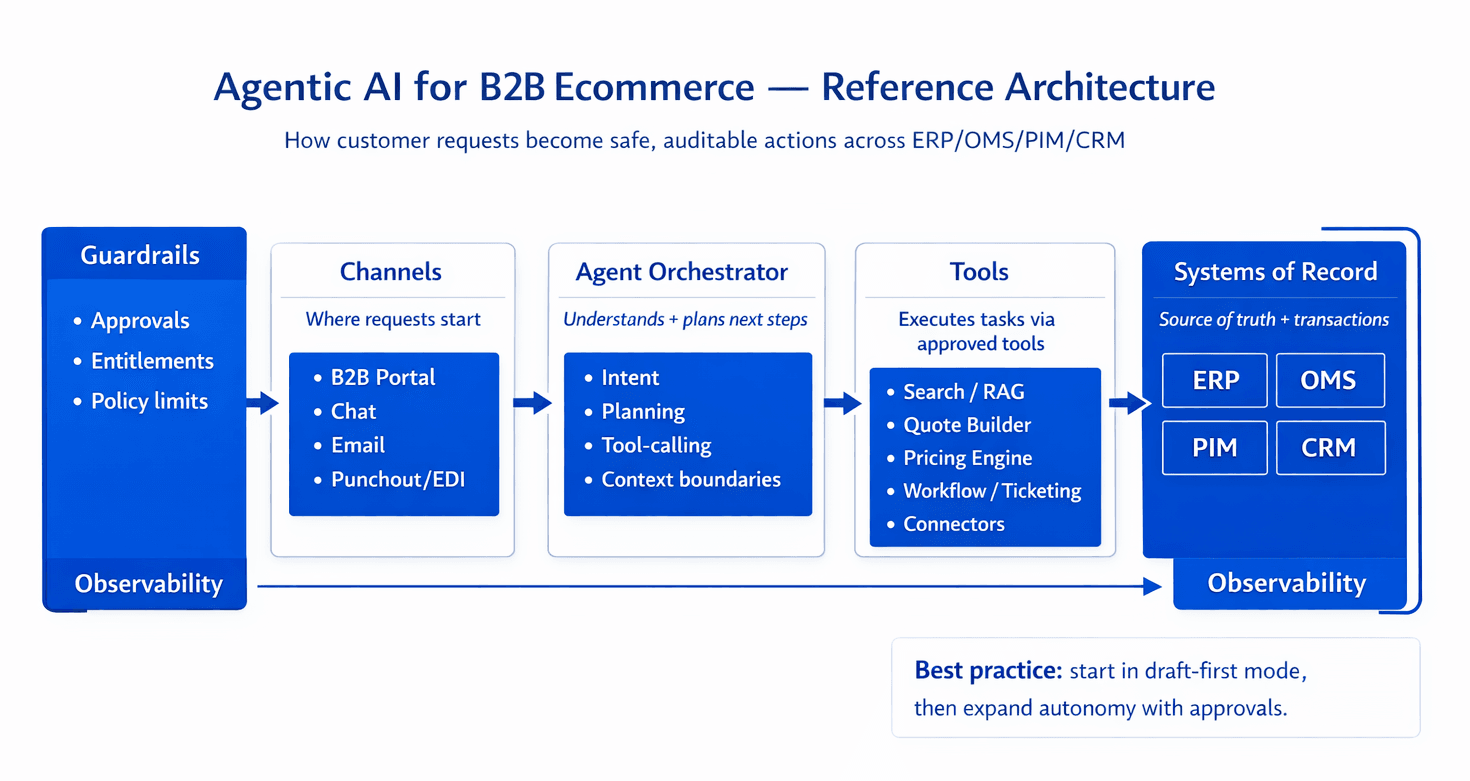
When this is implemented well, the agent reads from systems of record and only writes when it’s allowed—and every action is traceable. If you’re exploring an implementation approach, you can reference Agentic Commerce Automation for an outcome-focused view of how orchestration and controls come together.
Implementation roadmap: pilot → scale
You don’t need a moonshot. You need one workflow, one risk boundary, and one KPI dashboard. Start narrow, prove value fast, then expand autonomy only when trust is earned.
Step-by-step (simple and practical)
- Pick one workflow: quotes, entitlements, order changes, or returns.
- Define permissions: what the agent may read, draft, and execute.
- Connect the minimum tools: avoid “boiling the ocean.”
- Set approval thresholds: discounts, margin floors, order value, restricted SKUs, refunds.
- Instrument everything: logs, traces, evaluation, and a KPI scoreboard.
If you need stakeholder confidence, pair the pilot with clear proof points and outcomes. Examples can help shape that narrative: Reveation Labs Success Stories.
Business impact: an ROI model executives can actually use
Agentic AI ROI becomes easy to communicate when you keep it to three buckets: Speed, Cost, and Quality. Each use case should map to one primary KPI and one secondary KPI so “value” isn’t subjective.
ROI scoreboard
- Speed: quote cycle time, time-to-order, time-to-resolution
- Cost: tickets per order, cost per ticket, manual touches per order
- Quality: pricing/fulfillment errors, compliance exceptions, return leakage
Back-of-the-napkin ROI logic (how value shows up)
- If quote time drops, you respond while the buyer is still engaged → conversion improves.
- If support touches drop, cost-to-serve falls → margin improves.
- If pricing/entitlement errors drop, disputes and rework shrink → leakage reduces.
For a deeper ROI framing that’s already tailored to B2B ecommerce, you can pull language and metrics thinking from The ROI of Generative AI in B2B eCommerce Growth.
Common failure reasons (and how to avoid them)
Many agent pilots fail for predictable reasons: disconnected systems, unclear ownership, and weak governance. If you address these early, your program becomes far more scalable and defensible.
- No system-of-record integration: the agent can talk, but it can’t actually complete work.
- Messy product/pricing data: bad data becomes bad actions—fast.
- Unclear guardrails: teams don’t trust outcomes, so adoption stalls.
- No observability: without logs and traces, you can’t debug or improve safely.
What to do next (in priority order)
If you want the shortest path to real business impact, focus on one workflow that’s both high-volume and exception-heavy. Then implement draft-first automation with approvals, measure the lift, and expand.
| Quick win | What you implement | KPI to watch |
|---|---|---|
| “Draft quote” agent | Draft-first quoting + approval thresholds | Quote cycle time |
| Entitlement checker | Contract pricing + catalog visibility verification | Tickets per order |
| Order change assistant | Draft changes + policy checks | Manual touches |
| RMA triage agent | Warranty validation + RMA draft | Time-to-resolution |
If your team is exploring “what good looks like” for agentic commerce automation, this is a helpful reference point: Agentic Commerce Automation. And if you want examples of how transformation translates to outcomes, you can browse our success stories.
Clean product data (PIM), accurate pricing/contract rules (ERP/CPQ), and reliable customer entitlements (CRM/IAM) are essential. If these are messy, treat the first pilot as both automation and a structured data-quality improvement effort.