
Ecommerce operations rarely break because people aren’t trying. They break because small problems stack up faster than teams can handle.
A late carrier scan becomes a wave of “Where is my order?” tickets. A stock mismatch causes cancellations. Returns pile up, refunds slow down, and fraud creeps in.
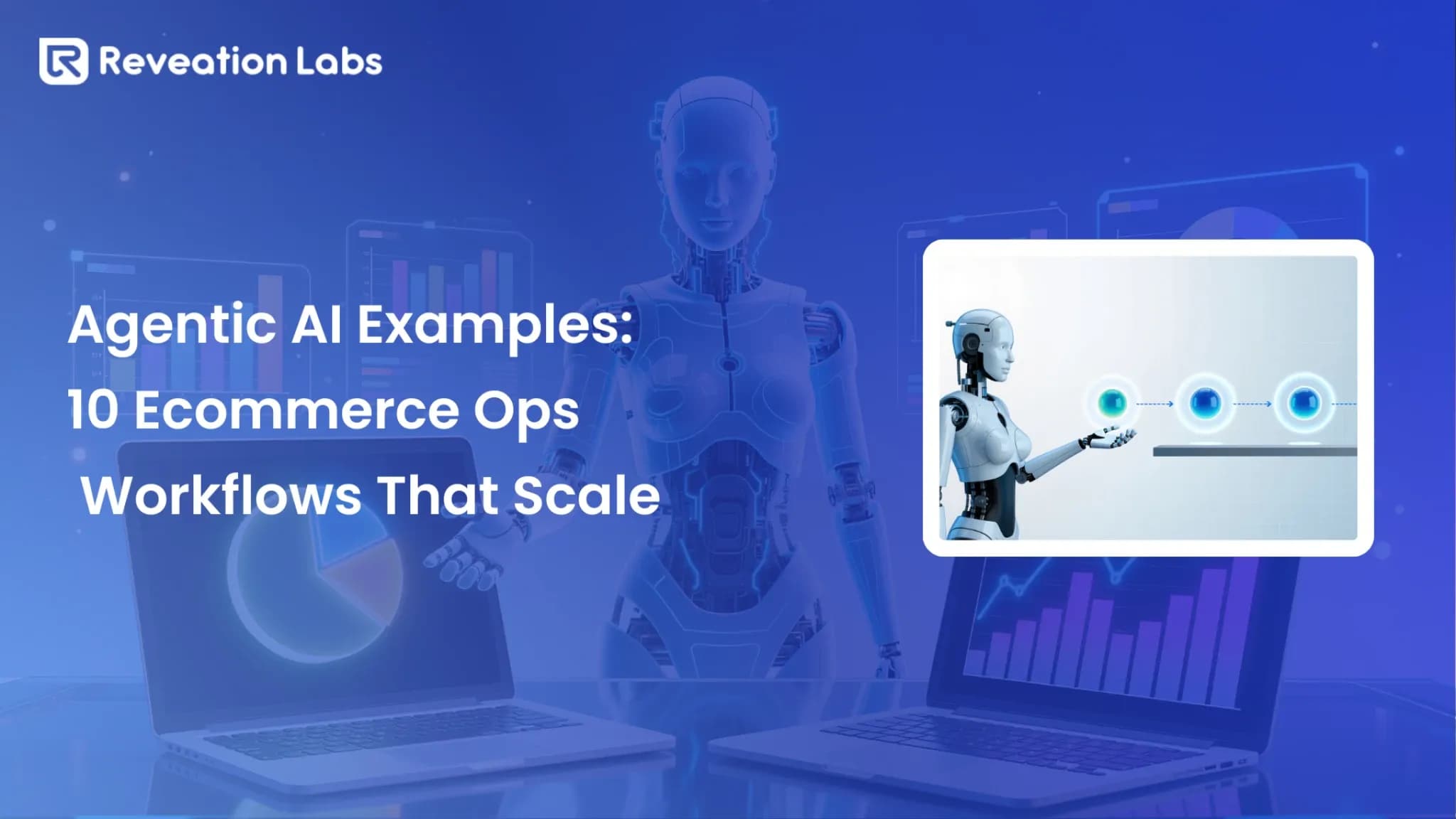
This is where agentic AI examples matter. Not as a chatbot that talks. As an agent that can check systems, follow policy, take actions, and leave an audit trail, with clear limits.
If you want the simplest definition before we jump in, Reveation Labs has a clear primer on what agentic AI in ecommerce means and a deeper breakdown of how agentic AI works inside ecommerce systems.
Why Ecommerce Ops Breaks at Scale
Most ops work is exception work. Not the happy path.
Teams usually try three fixes:
- More macros in support
- More rules in the OMS/helpdesk
- More people during peaks
Those help, but they hit a wall. Rules become brittle. Macros lack context. Hiring doesn’t fix inconsistency.
A Fluent Commerce survey summary reported that 70% of retailers are trialing or starting to implement agentic AI, while only 8% say it’s fully deployed across operations.
What teams try vs what breaks
| What teams try | Why it breaks | What agentic AI changes |
|---|---|---|
| Support macros | Same response for different reality | Agent pulls order + carrier + policy context first |
| Manual exception queues | Slow and inconsistent | Agent triages and drafts actions, then routes approvals |
| Hard-coded rules | Edge cases explode the rules | Agent reasons across signals and requests missing info |
Agentic AI is most useful when it can do work across tools, not just generate text.
The Ops-First Agentic AI Pattern
Most “real” ops agents follow the same pattern:
- Sense: gather context from systems
- Decide: apply policy and choose a path
- Act: run tool actions with scoped permissions
- Prove: log what happened and why
McKinsey’s State of AI 2025 notes 23% of respondents report scaling an agentic AI system somewhere in their organizations, and 39% report experimenting with AI agents.
Pattern + guardrails
| Stage | What the agent does | Guardrail | What to measure |
|---|---|---|---|
| Sense | Pulls OMS, carrier, WMS, CRM context | PII masking, least-privilege | time-to-context |
| Decide | Applies policy and thresholds | confidence limits + rules | decision accuracy |
| Act | Executes API steps | approvals for money/risk | cycle time |
| Prove | Writes an audit trail | logs + QA sampling | compliance pass rate |
If you’re evaluating vendors, Reveation also has a practical piece on separating real agentic systems from “LLM + automation” in Agentic Commerce vs Agentic AI.
10 Real-World Agentic AI Workflows for Ecommerce Operations
These are not “prompts.” They are workflows teams are implementing today using helpdesks, OMS/WMS tools, carrier APIs, and fraud systems.
Each example includes:
- Trigger
- Tools touched
- Actions
- Human-in-the-loop
- KPIs
1) WISMO Resolution Agent (Order Status)
Trigger: “Where is my order?” ticket, delayed scan, late-delivery risk
Tools touched: helpdesk, OMS, carrier tracking, notifications
Actions:
- Pulls order + shipment status
- Compares promise date vs current ETA
- Sends a clear update and next step
- If delay crosses a threshold, offers policy-approved options (reship/refund/credit)
Human-in-the-loop: required above a refund threshold or for VIP rules
KPIs: ticket volume, first response time, repeat contacts, CSAT
✅ Safe start: keep the first version “read + message,” then add write-actions later.
2) Address Change / Delivery Intercept Agent
Trigger: address change request after checkout
Tools touched: OMS, carrier tools, fraud checks, CRM
Actions:
- Checks intercept eligibility (timing + carrier rules)
- Runs risk checks (high value, mismatch signals)
- Submits intercept/reroute if allowed
- Logs the reason and updates the customer
Human-in-the-loop: required for high-risk/high-value orders
KPIs: intercept success rate, fraud loss from reroutes, time-to-resolution
3) Late Shipment Agent (Warehouse vs Carrier)
Trigger: “label created, no movement,” missed pick SLA, carrier exception
Tools touched: WMS, OMS, shipping system, helpdesk
Actions:
- Identifies where the order is stuck (pick/pack/manifest/carrier)
- Opens the right internal task (warehouse or carrier escalation)
- Sends the customer a status update that matches what the systems show
- Updates internal SLA state (so support doesn’t guess)
Human-in-the-loop: recommended during rollout
KPIs: late shipment rate, no-scan aging, WISMO follow-ups
4) Support Triage Agent (SLA Protection)
Trigger: backlog spike, peak season, promo-driven volume
Tools touched: helpdesk, CRM, OMS context
Actions:
- Prioritizes tickets using rules: delivery risk, order value, customer tier
- Suggests the next best action (refund vs reship vs reassurance)
- Drafts a response for an agent to review and send
Human-in-the-loop: yes (humans send)
KPIs: SLA compliance, handle time, escalation rate
Returns and Refunds: Where Agents Must Be Careful
Returns are high volume and high risk.
Reuters reported returns fraud is about 9% of refunds and costs US retailers roughly $76.5B annually, and that UPS-owned Happy Returns is testing an AI tool (“Return Vision”) to flag suspicious returns.
NRF also reports 9% of all returns are fraudulent in its 2025 returns research.
Wired reported Forter estimates AI-doctored images in refund claims increased by more than 15% since early 2024.
⚠️ Rule: agents can speed up refunds, but they must also protect you from refund abuse.
5) Return Eligibility Agent (Approve, Deny, or Route)
Trigger: return started
Tools touched: returns portal, OMS, catalog, policy engine
Actions:
- Validates eligibility (window, category rules, condition rules)
- Chooses the right method (label/pickup/drop-off)
- Explains decisions in plain language
- Routes exceptions to manual review
Human-in-the-loop: required for high-risk categories or repeated patterns
KPIs: approval time, dispute rate, completion rate
6) Refund Orchestration Agent (Proof-First)
Trigger: return received scan, inspection complete, refund requested
Tools touched: WMS, OMS, payments, finance notes, helpdesk
Actions:
- Confirms receipt/condition
- Issues refund per policy and thresholds
- Sends confirmation with reference IDs
- Updates internal notes so future tickets resolve faster
Human-in-the-loop: required for partial refunds, missing items, edge cases
KPIs: refund cycle time, repeat contacts, refund error rate.
7) Returns Abuse Agent (Assist First, Don’t Auto-Deny)
Trigger: suspicious pattern signals
Tools touched: returns portal, CRM, fraud tool, order history
Actions:
- Flags patterns and summarizes why it looks risky
- Requests stronger proof if needed
- Routes to an investigation queue
Human-in-the-loop: yes (final decision should be human early on)
KPIs: fraud loss reduction, false positives, complaint rate
Returns workflow risk guide
| Workflow | Automation level | Risk | Best guardrail |
|---|---|---|---|
| Standard returns | High | Medium | receipt + scan confirmation |
| High-value electronics | Medium | High | inspection + approval |
| Suspected abuse | Low | Very high | investigation queue + evidence rules |
Inventory and Fulfillment: Agents That Prevent Cancellations
8) Stockout Prevention Agent
Trigger: sell-through spike, inbound delays, low safety stock
Tools touched: inventory, OMS, supplier ETA feed, merchandising flags
Actions:
- Identifies SKUs at risk
- Suggests rebalancing across nodes (if available)
- Recommends safe responses (pause promos, adjust promise dates)
- Creates replenishment tasks
Human-in-the-loop: required for promise-date/promo changes
KPIs: stockout rate, cancellation rate, revenue protected
9) Backorder Promise-Date Agent
Trigger: supplier ETA change, backorder created
Tools touched: supplier feed, OMS, storefront messaging, notifications
Actions:
- Recalculates delivery window using updated ETAs
- Updates post-purchase messaging and internal support visibility
- Sends proactive updates to reduce WISMO
Human-in-the-loop: recommended during rollout
KPIs: WISMO rate, cancellation rate, late-delivery complaints
Promise dates are trustworthy. Treat them like a product feature.
10) Pick-Pack Exception Agent
Trigger: “cannot pick,” location mismatch, damaged stock discovered
Tools touched: WMS, OMS, substitution rules, customer messaging
Actions:
- Chooses the best policy path: split, substitute, reroute, or cancel line
- Checks margin/policy before suggesting substitutions
- Creates warehouse tasks and updates the customer when needed
Human-in-the-loop: required for substitutions or value-changing decisions
KPIs: exception resolution time, split shipment rate, cancellation rate
This is where integration matters. If your OMS/WMS/helpdesk doesn’t share reliable data, the agent will struggle. Reveation’s ecommerce integration services page outlines the typical systems teams connect first.
It's also worth noting that agentic workflows are only as effective as the platform infrastructure beneath them — teams running on rigid legacy systems often find that b2b ecommerce replatforming is a prerequisite before agents can reliably connect to OMS, WMS, ERP, and helpdesk data in the way these workflows require.
Real “In the Wild” Signals That Agentic Commerce Is Moving Fast
Two recent examples show where this is heading:
- Google launched the Universal Commerce Protocol (UCP) as an open standard meant to help agents work across the shopping journey, from discovery to post-purchase support.
- Klarna reported its AI assistant handled two-thirds of customer service chats in its first month (2.3M conversations) and did the equivalent work of 700 full-time agents, with a reported 25% drop in repeat inquiries.
What to Implement First (Safe Rollout Plan)
Start where risk is low and learning is fast:
- WISMO resolution (read + message)
- Support triage (recommend, humans send)
- Refund orchestration (proof-first + thresholds)
- Returns abuse detection (assist-first)
- Pick-pack exceptions (high value, more systems)
Quick wins
| First workflow | Why it’s a safe start | What improves first |
|---|---|---|
| WISMO resolution | low financial risk | fewer tickets, faster replies |
| Support triage | recommends, not executes | SLA and handle time |
| Refund orchestration | policy + proof gates | faster refunds, fewer contacts |
If you’re deciding whether you need “agentic commerce” or just better automation, this article is worth reading: Agentic Commerce vs Agentic AI.
Conclusion
The best agentic AI examples in ecommerce operations have the same traits:
- They focus on exceptions.
- They use real tools (not just text).
- They follow policy.
- They log decisions and actions.
If you build with those rules, agents can reduce backlog, speed up resolutions, and protect margins without creating chaos.