Introduction
AI adoption in B2B eCommerce is reshaping long-standing business models, but it’s not just about flashy demos. Unlike B2C, B2B transactions involve large orders, long sales cycles, and multiple stakeholders. As one analyst notes, “B2B companies are in it for the long haul.”
Their deals are bigger, cycles longer, and “AI in B2B eCommerce acts more like a behind-the-scenes strategist,” focusing on demand forecasting, streamlined logistics, and complex operations rather than impulse-driven sales.
In practice, B2B buyers prioritize ROI, detailed data, and trust; they demand evidence that AI tools cut costs or boost efficiency. Industry experts warn that AI must “cut costs, increase revenue, or improve efficiency” to be worthwhile; otherwise, it’s just buzz.
Artificial Intelligence is transforming B2B operations, but only a few know how to apply it effectively. With B2B eCommerce consulting, companies can identify where AI truly adds value—beyond the hype.
This means B2B sellers should focus on practical, ROI-driven AI use cases. Using predictive analytics to personalize catalogs, companies can separate hype from reality and capture measurable value with AI in B2B eCommerce.
Personalized Buying Experiences for Complex B2B Needs
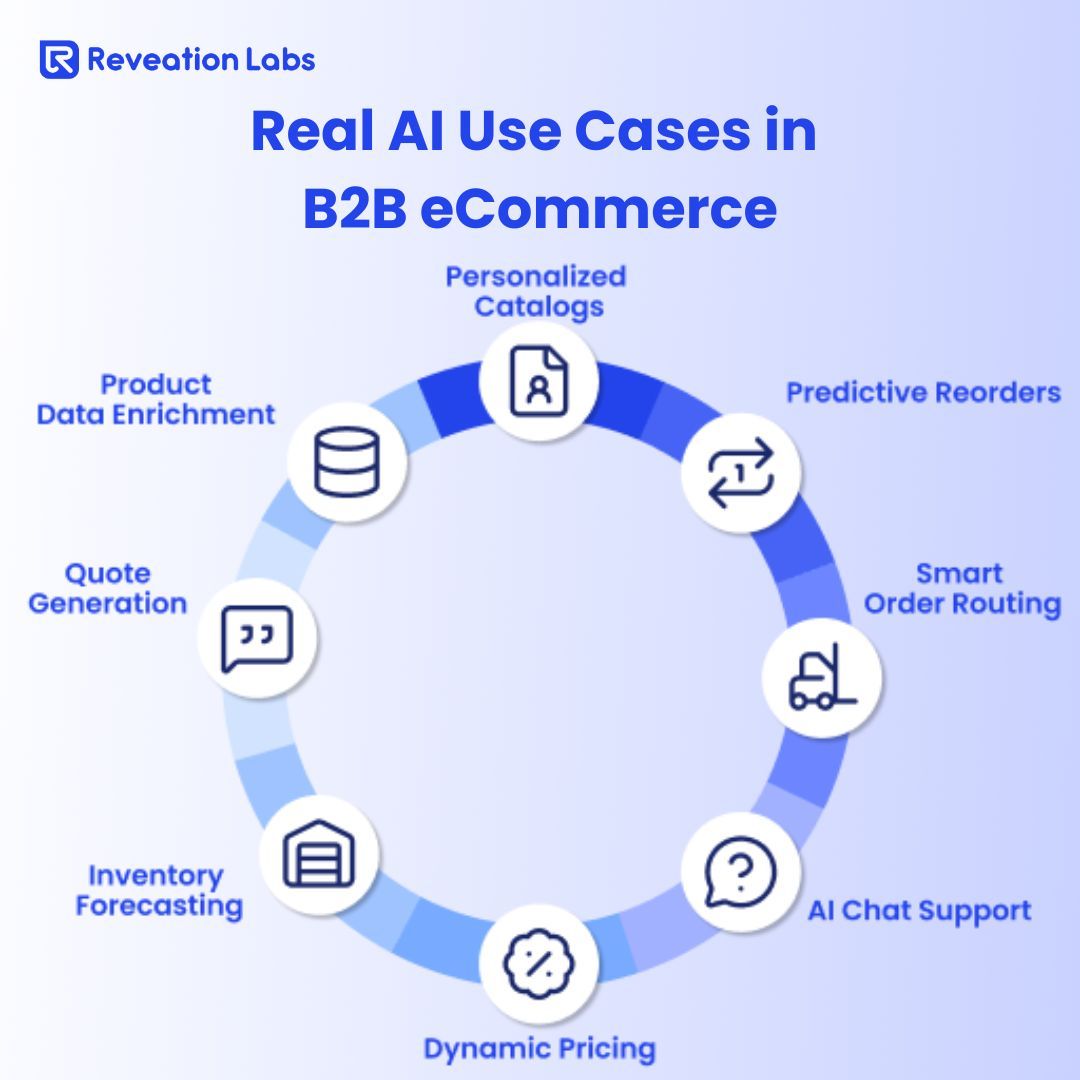
One of the most powerful AI use cases in B2B eCommerce is next-level personalization. Here, AI analyzes account details, buyer roles, order history, and real-time behavior to tailor the shopping experience.
For example, machine learning models can segment business customers into cohorts (by industry, company size, or past purchases) and then surface the most relevant products or content for each segment.
A recent study found that 72% of B2B buyers expect highly personalized engagement during their buying cycle, so AI-driven product recommendations and custom catalogs are now table stakes.
Behind the scenes, these systems often draw on rich customer data platforms (CDPs) and CRMs. When a CRM knows the buyer’s role or past order sizes, AI can, for example, suggest a bundled offer or show only the products that fit that customer’s profile.
In practice, “AI in B2B sales” tools are enhancing sales growth by linking predictive analytics with personalization.
By analyzing historical data and customer signals, AI creates bespoke solutions that “enhance customer experience” and increase conversions.
The result is a more intuitive B2B interface: a procurement manager logging into a portal sees a curated catalog, custom pricing, and relevant product recommendations, making the complex buying process feel easier, more guided, and more customer-centric.
Predictive Demand and Inventory Planning
AI isn’t just for shopping carts; it’s revolutionizing inventory and supply chain management in B2B eCommerce. By analyzing years of sales history, seasonality, market trends, and external signals, AI can forecast demand with far greater accuracy than manual methods.
As one vendor puts it, AI-driven forecasting “examines historical sales data, current market trends, and seasonal fluctuations to forecast future product requirements,” helping businesses avoid costly stockouts or overstock situations.
In practice, this means distributors and parts suppliers can use AI to predict when a client will need a restock, so they can proactively adjust orders and production.
For example, an AI model might learn that a certain industrial part sees a 40% demand jump in the spring or whenever a related component is bought. The system can then alert the inventory planner to increase stock ahead of the rush. AI can even suggest substitutions when items are unavailable, ensuring sales don’t stall.
One report notes that with AI assistance, companies no longer wait for batch ERP updates – instead, “AI models can predict stock-outs and suggest substitutions in real-time.” The upshot is fewer emergency rush orders and less capital tied up in excess stock.
Optimize B2B supply chains in this way, AI helps companies keep critical items on hand while avoiding waste – a real boost to both customer satisfaction and the bottom line.
AI-Powered Chatbots and Virtual Sales Assistants
Even in high-touch B2B sales, AI bots are taking on more routine tasks. Modern chatbots and AI assistants can handle many customer questions and RFQs (requests for quotes) without human help.
They’re not just the simple chat widgets of old – next-gen systems understand technical language, pull data from catalogs/ERP, and can guide customers through complex orders.
For instance, a B2B chatbot can answer inventory queries (“How many units of part 123 do we have at Warehouse A?”) or process bulk orders (“Create an order for 500 units with priority shipping”) instantly.
According to BigCommerce, AI can provide “B2B buyers with 24/7 self-service support through AI-powered chatbots,” trained on the company’s own catalog and order history.
More advanced “virtual sales assistants” even integrate with CRM and purchase history. They can recall a customer’s last conversation, suggest products based on that client’s industry or past projects, and even generate draft quotes.
As one marketing analyst explains, these AI assistants “leverage real-time data, integrate with CRM systems, [and] analyze customer intent,” acting like a highly trained sales rep that remembers every detail. This means customers often get fast, contextual answers without waiting for an email or call. The result? Faster response times and a more continuous buying experience.
Buyers still want human help for final negotiations, but AI bots smooth out the preliminaries, reducing dependency on phone calls and emails. By turning FAQs, order tracking, and spec lookups over to AI, sales teams can focus on closing deals while routine queries get handled immediately online.
How to Start Small with AI in B2B eCommerce
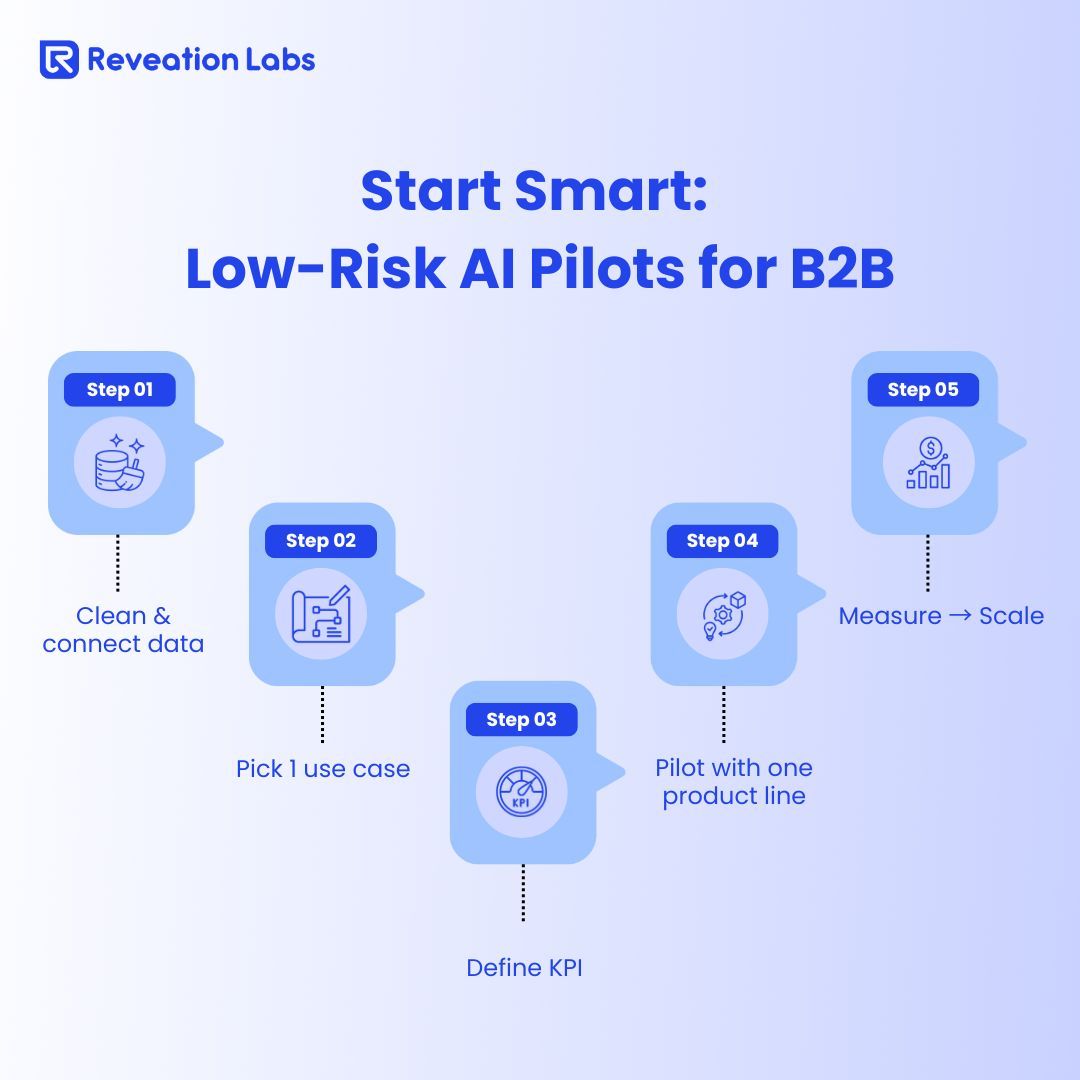
You don’t have to overhaul your entire platform overnight. The key is to pick low-risk, high-impact pilots that prove value quickly. Start by identifying a specific pain point: for example, cleaning up product data or generating quotes.
BetterCommerce advises beginning with use cases “tied directly to revenue or cost,” such as catalog enrichment or intelligent pricing models. Concretely, you might start by using AI to auto-fill missing SKUs or enrich product descriptions (catalog enrichment). This improves site search and reduces cart abandonment at minimal cost.
Or build a small pilot of dynamic pricing: feed a slice of your past sales into an AI pricing tool to suggest price bands for different customer tiers. Another quick win is “smart order routing,” where AI recommends the optimal warehouse or shipping method for each order to cut delivery costs.
These focused pilots each have a clear metric (better search, higher margins, lower shipping spend) and can show ROI in a matter of months.
Before launching any pilot, ensure your data is ready. Clean, unified product and customer data is the fuel for AI. Experts say data readiness is the “smooth, stable runway” for AI success – yet only about 8.6% of businesses are fully ready today. Take time to integrate your ERP, CRM, and eCommerce systems so information flows seamlessly.
AI tools become far more effective when they can access up-to-date pricing rules, inventory levels, and customer profiles. When systems are connected, AI can automatically pull from the “single source of truth.” According to one source, AI-driven platforms now link ERP, CRM, and commerce data “so information flows in real-time,” giving a unified view that fuels insights.
Finally, work cross-functionally: involve both business and IT teams, define clear KPIs (like % faster quotes or % higher conversion), and pilot with a small segment (a product line or customer group) before rolling out company-wide.
Quick Checklist: Start by choosing a narrow use case with a clear benefit, ensure data hygiene (clean and integrated data), and launch a small-scale pilot. Measure results, then scale up what works.
Leading B2B eCommerce solutions are now integrating AI capabilities to enhance product recommendations, automations, and deliver more personalized buying experiences.
What’s Next for AI in B2B eCommerce?
AI’s role in B2B eCommerce is still evolving, but the trajectory is clear: more personalization, smarter pricing, and smoother fulfillment. Soon, expect “hyper-personalization” to become standard – every B2B customer will see a feed tuned to their needs. Advanced predictive analytics will continuously adjust cross-sell offers and reorder reminders.
Voice assistants, AR catalogs, and generative AI may even simplify complex product configurations. Industry surveys show that a majority of B2B leaders plan to make AI central to their digital strategy; one report found 60% say AI will drive most of their customer experience investments in 2025.
To keep up, companies will need a flexible, “future-proof” commerce stack. That means modular, headless architectures with a robust product information management (PIM) system and integrated data platforms.
For example, AI-enabled dashboards and predictive analytics will help supply chain teams foresee disruptions before they happen. And as buyers increasingly expect B2C-like ease, tying together all these AI capabilities into one coherent experience will be crucial.
By focusing on real use cases, keeping data primed, and viewing AI as an ongoing investment rather than a one-time project, B2B sellers can use AI to drive better customer experiences, smarter decisions, and long-term growth in the digital era.