What if you could turn a long, complex RFP document into a quote that was ready to send in a matter of minutes instead of days, thereby streamlining the entire **rfp process**? What if your quoting system worked all the time, taking care of requests while your competitors were sleeping? AI-powered automation is the future of B2B sales.
New B2B e-commerce tools are redefining how organizations handle tricky negotiations. The best thing about it is that it can provide you with quick, accurate quotes from RFP documents—understanding **what is an rfp** is key—by using seamless APIs to combine document AI, configure-price-quote (CPQ) logic, and real-time ERP data.
In 2025, B2B buyers expect the same self-service convenience they get as consumers. They want composable technology stacks that adapt quickly to their needs and AI-enhanced pricing that makes sense of complex product configurations.
This solution delivers on all three expectations while boosting profit margins, increasing response speed, and keeping you ahead of slower competitors.
Why Your Next Competitor Won't Be a Person
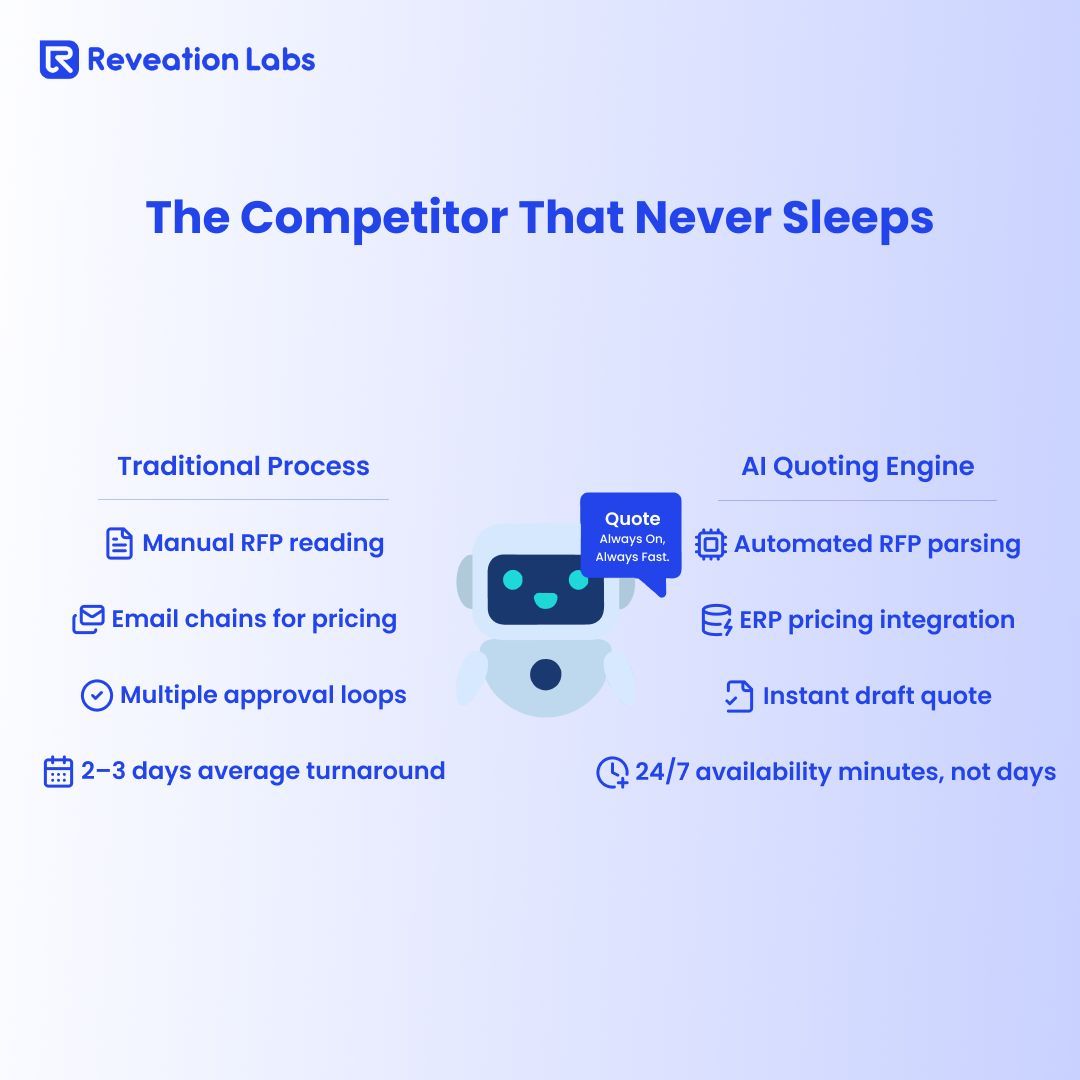
The truth is that your next big competition won't be a company with better salespeople or lower prices. It never sleeps, never makes mistakes when it comes to calculations, and answers to RFPs at 2 AM on Sunday with the same accuracy as 2 PM on Tuesday.
With current B2B ecommerce systems that use AI to automate quoting, businesses can respond to opportunities faster, more precisely, and on a larger scale than with traditional sales operations.
While your competitors are setting up follow-up meetings to talk about prices, you're sending estimates that are ready to be signed.
Early adopters are already seeing big changes, such as shorter sales cycles, more accurate quotes, and better win rates. The change goes beyond just speed. B2B ecommerce ERP integration ensures quotes reflect real inventory levels and current costs. Advanced B2B ecommerce features provide customers with self-service tools they actually want to use.
Buyer Behavior Has Changed Dramatically
The B2B buying landscape looks completely different today. By 2025, 85% of B2B enterprises will have e-commerce sites, up from 68% the previous year.
Most B2B companies now have e-commerce sites that enable customers to perform various tasks independently and receive quotes automatically.
Companies that have been around for a while and have self-service storefronts aren't just following trends; they're achieving real results.
Businesses that introduce self-service eCommerce often see their existing accounts make 15–30% more money. Giving buyers the power to receive estimates when they want them is just as crucial because it speeds up the deal cycle.
When buyers can configure products and request quotes 24/7 without waiting on sales reps, deals move ahead more quickly.
Buyers want to research, configure, and even purchase complex products without waiting for sales calls or email exchanges.
They expect to upload their requirements, knowing the **rfp meaning business** relevance, and receive professional quotes quickly, just like ordering products online.
The Tech Stack Revolution
We're moving away from old monolithic systems and toward new headless, composable MACH (Microservices, API-first, Cloud-native, Headless) solutions. These new B2B e-commerce tools integrate great with AI services, ERP systems, CPQ tools, and CRM platforms.
You may update pieces, add new features, and link to other systems with this composable way without having to start over from scratch.
It's easy to connect your B2B ecommerce ERP when your systems all use the same API language. Companies can plug in best-of-breed services and have them work seamlessly together via APIs.
Competitive Pressure Is Real
Companies are using AI to set prices that change, provide guided selling suggestions, and give quotes automatically at a scale and pace that people alone can't do. Industry experts say that by 2028, quoting in B2B sales will be completely automated, able to make predictions, and able to have conversations.
AI-powered CPQ systems can already look at your needs, understanding the underlying **rfp meaning**, and find the best solutions right away. Customers can quickly make accurate quotes on their own via self-service CPQ portals. AI checks to make sure the results are right. Companies that don't include these features will fall behind competitors who can respond faster and more accurately.
What "Instant Quotes from RFP PDFs" Really Means
Let's talk about what this procedure involves and why it's good for your business, considering various **rfp examples** to illustrate its benefits.
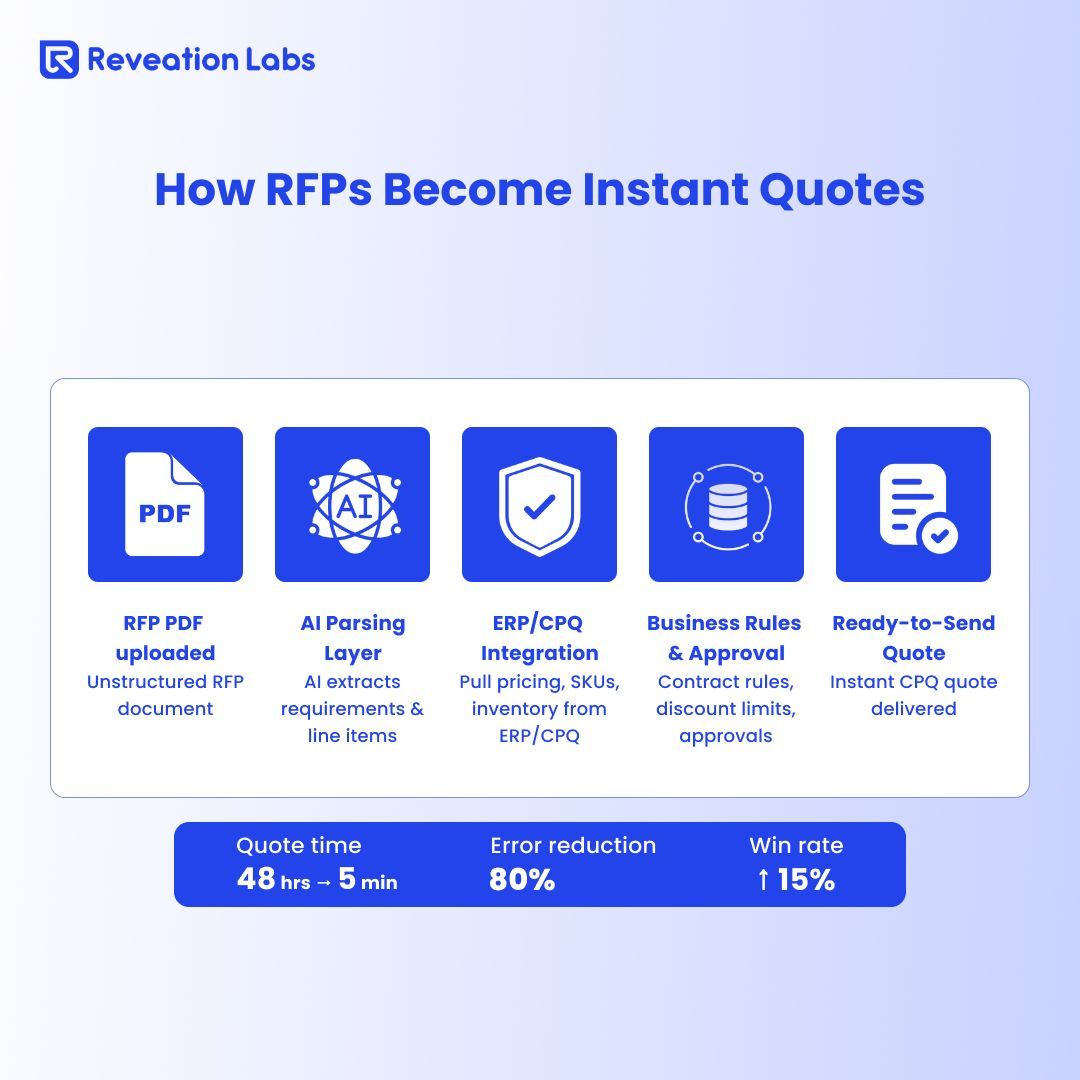
You obtain PDF versions of unstructured RFPs, RFQs, or tender documents, potentially from a **marketing rfp database**. There are a lot of pages in these papers that list the product specifications, quantity needs, delivery constraints, and contract terms.
Processing: Document AI can read these PDFs just like a competent sales engineer or an **rfp manager** would. It finds the most important pieces of information, works out what the product needs, and knows how much it can cost.
After that, CPQ logic leverages your company's pricing rules and configuration needs to make sure that the quotations are right.
The CPQ engine uses the information it gets to make a real quote that follows your company's rules for prices, product combinations, and discounts.
Output: Your customer gets a professional quote that is ready for them to use. It includes real-time pricing, inventory availability, and approvals that are provided automatically. This isn't just a rough estimate; it's a quote sheet ready for the customer that shows real-time prices and availability retrieved from the ERP system. Things that used to take days now happen in minutes.
Practical Walkthrough: From PDF to Quote
Data Preparation and Model Training
Building effective automated quoting systems starts with good data. You need to curate historical RFPs, successful quotes, and pricing decisions as labeled training sets for your AI models, potentially utilizing a **sample software rfp template** for structured input.
There are thousands of examples in a labeled dataset that show how various line items or requirements in RFPs relate to configured goods or prices in quotes.
These examples are from historical RFPs and the quotes or bids that were made in response.
The first step is to divide the papers into logical sections, like the project's scope, the bill of materials, the rules for compliance, and the terms of delivery. After that, you improve document AI for your field by adding OCR (optical character recognition), entity extraction, and constraint detection.
Validation Loop with Human Oversight
Even the best AI needs human oversight, especially when dealing with ambiguous or unclear requirements.
Pure automation might achieve around 80% accuracy on document parsing, whereas having human validators can push accuracy much higher.
For data points that the AI isn't sure about or that it has problems reading in a scanned PDF table, the system features human-in-the-loop checks.
This method makes sure that things keep getting better. The system learns from any changes. If people keep fixing a given field extraction, that feedback retrains and improves the model over time.
Configuration and Pricing Logic Through CPQ
Modern CPQ systems provide guided selling that proposes product bundles that can be made while taking into account dependencies and production limits.
Smart pricing algorithms take into account costs, profit margins, rules for pricing in different areas, and limits on discounts.
AI-powered CPQ systems can even suggest the best discounts that are likely to close purchases without cutting too much into your profit margin.
The system automatically sends quotes to the proper people based on your business rules when they need to be approved for special pricing or terms. An approval workflow starts automatically for any quote that is outside of the established limits.
ERP Integration for Real-Time Accuracy
B2B ecommerce ERP integration ensures your quotes reflect the current reality. During quote generation, the system calls ERP APIs to fetch up-to-the-minute data on current product pricing, inventory levels, and lead times for manufacturing or delivery.
This close connection makes it impossible to quote something that isn't really there or give prices that are out of date.
API-first connectors or integration platform-as-a-service (iPaaS) middleware make this integration fast and reliable, reducing the technical complexity of connecting different systems.
B2B E-commerce Features That Enable This
Self-Service Portals
Some of the advantages of modern B2B ecommerce are secure portals, often initiated through a **software development rfp**, where clients may upload RFPs, get quotations, and turn bids into orders, all on their own.
Crucial features include customer-specific catalogs and contract pricing, quote management areas, and 24/7 access.
Companies with robust self-service portals have seen not only revenue growth but also much faster quote turnaround, which improves customer satisfaction.
Composable Architecture
Headless frontends combined with modular CPQ, ERP, product information management (PIM), and payment services create flexible B2B ecommerce solutions.
In a composable architecture, your system isn't just one big program; it's a group of services that work together through APIs.
You can change the way customers interact with your business without changing the backend systems, or you can change the pricing logic without changing the storefront.
B2B Personalization
AI-powered product suggestions, dynamic catalogs, and experiences personalized to each buyer make B2B shopping feel more like regular shopping.
Dynamic catalogs can show or hide items depending on the customer's industry or what they have bought in the past.
AI-powered customisation has become a big deal in B2B commerce. It makes rapid quotations that are both accurate and easy for customers to understand.
Architecture Reference: How It All Fits Together
Goal: Understand how the different pieces of an automated quoting system work together to turn RFP PDFs into ready-to-send quotes.
1. Layers (Who Does What)
- Document AI → reads RFP PDFs and pulls out data from them.
- CPQ Microservices → Apply configuration and pricing rules.
- ERP System → Gives you up-to-date information about products, prices, and availability.
- Headless Storefront → This is what customers and sales teams see when they utilize the store.
- Middleware for integration → This connects all the parts and keeps the data moving smoothly.
2. Data Flow (Step-by-Step)
- Customer uploads an RFP PDF.
- Document AI extracts requirements, quantities, and terms.
- CPQ applies pricing, configuration, and discount rules.
- ERP checks inventory, lead times, and customer-specific pricing.
- The system combines everything into a professional, ready-to-send quote.
- Status updates and event logs are tracked at every stage for accuracy and compliance.
3. Scalability (Why It Works at Any Size)
It is based on microservices, which means that each part, like quoting or parsing documents, can grow on its own.
Handles hundreds of RFPs at the same time during busy times without slowing down the system.
When traffic drops, it automatically scales back, which keeps the infrastructure running smoothly and at a low cost.
Implementation Roadmap: 90 Days to Go Live
Phase 1 (Days 0-30): Foundation and Planning
Start by assessing your current ERP and CPQ APIs. What integration points do your systems have? Select document AI tools that work with your document types and set up a sandbox integration environment, leveraging an **rfp software comparison** for optimal selection. Define your needs: what kinds of RFPs will you start with, and what does a good quote look like?
Phase 2 (Days 31-60): Training and Building
Build up your CPQ rules, train your extraction models on example RFPs, and build up B2B ecommerce ERP integration in the sandbox. Use your ERP system to map pricing data for each customer and test internal quoting flows with your sales staff. Run example RFPs through the system to check the outputs and make changes based on what you find.
Phase 3 (Days 61-90): Testing and Launch
Allow uploads from the buyer-facing site, turn on approval workflows, and start keeping track of important performance measures. Do a lot of testing with helpful customers and set up role-based permissions. This stage goes from testing the product internally to letting real customers use it with a soft launch.
Reveation Labs offers expert B2B eCommerce Consulting to help businesses transform complex RFP PDFs into instant, accurate quotes.
KPI Dashboard: Measuring Success
Speed Metrics: Track median time from RFP upload to completed quote delivery. Best-in-class automated quoting systems are pushing quote times down to just a couple of hours or less. AI-driven CPQ has been shown to cut the time it takes to make a quote from days to hours.
Accuracy Metrics: Monitor pricing error rates, configuration mistakes, and how often quotes need rework after initial generation. Because people had to enter data by hand, traditional CPQ methods generally had error rates of 15% to 20%. AI-enhanced quoting can lower these rates to roughly 5% or less.
Impact on Revenue: Look at the rates at which quotes turn into sales, the discipline of offering discounts, and the overall shortening of the quote cycle. Faster, more accurate quotations can help close deals by impressing customers and giving sales teams a chance to talk to them when they're most interested.
Security, Governance, and Risk Controls
Data Handling: Implement secure storage for RFP documents, role-based access controls, and comprehensive audit trails across all CPQ and B2B ecommerce ERP integration touchpoints. All documents and extracted data should be encrypted at rest and in transit.
Policy Enforcement: To stop mistakes in pricing or breaking the rules, set up approval thresholds, margin floors, and compliance templates. The CPQ will let you know if a quote's discount is too high or if a proposed configuration breaks the standards for compliance.
Vendor Strategy: To lower the risk of integration and ongoing maintenance, choose platforms that have proven ERP adapters, API-first integration capabilities, and governance mechanisms.
Build vs. Buy Considerations
Looking Ahead
AI-powered quoting is rapidly becoming table stakes for B2B ecommerce solutions. By 2025 and beyond, buyers will simply expect that when they send in a request, they get an instant, intelligent response. Companies that use these features now will have an edge over their competitors that will be harder to beat as the technology gets better.
AI technology and human expertise will work together in the future of B2B sales. Your salespeople aren't going away; they'll still be there to help with strategy, building relationships, and coming up with creative solutions to problems. Their AI partners will take care of the boring tasks like making quotes and crunching data.
The question isn't if AI will change how B2B sales work, but how soon you can use these B2B ecommerce tools to stay ahead of the game. Your clients want quicker answers, your sales staff needs better tools, and your firm needs to run more smoothly.
Today, the technology is available. The integration challenges are solvable. The competitive advantage is available to companies ready to modernize their quoting operations.
The only question left is: will you be the company delivering instant quotes while competitors are still writing emails, or will you be playing catch-up to the quoting engine that never sleeps?