
What if the future of manufacturing procurement no longer happens on Google?
What if your next million-dollar contract is decided inside ChatGPT, Gemini, or Perplexity, where engineers and procurement teams are already asking detailed technical questions like “Who can hold ±0.0002 tolerances on Inconel 718 with full AS9100D traceability and delivery under 10 days?”
89% of B2B buyers now use generative AI at some point in their buying journey, and 55% of final decision-makers say they actively trust AI recommendations when choosing suppliers.
The shift isn’t coming. It’s already here.
If your company isn’t the one being named when those AI tools answer, you’re invisible exactly where the biggest deals are now being made.
That’s why Generative Engine Optimization (GEO) exists, and why it matters more than traditional SEO ever did.
What Is GEO and Why Does It Change Everything
If you manage digital marketing or digital strategy for a manufacturing company, you have probably noticed that traditional SEO no longer delivers the same results it once did. Buyers are no longer clicking through pages of search results.
Instead, they are turning to AI tools for quick, direct answers. This shift has given rise to a new approach called Generative Engine Optimization, or GEO.
So, What Exactly Is GEO?
Generative Engine Optimization is a set of strategies designed to make your company the go-to source that AI tools reference when answering buyer questions.
Unlike traditional SEO, which focuses on getting your website to rank high in a list of links, GEO ensures your company is mentioned directly in the AI’s response.
For example, imagine a procurement manager asks an AI tool: “Which suppliers provide CNC machining with AS9100D certification and delivery in under 48 hours?” The AI does not return a list of websites.
It generates a clear answer that names a few trusted companies. The goal of GEO is to position your company as one of those named sources.
How Does GEO Work? The Three Main Pillars
GEO is built on three straightforward pillars that any manufacturer can implement.
The first pillar is semantic footprint expansion: This means creating a group of interconnected web pages that cover an entire topic, rather than just one keyword.
Instead of having a single page about “CNC machining,” you build a complete set of pages that address every question a buyer might have.
These pages could include details on achievable tolerances, compatible materials, quality certifications, realistic lead times, and equipment maintenance. When the pages are logically linked, AI systems recognize your website as the most comprehensive and authoritative resource on the subject.
The second pillar is fact-density: AI tools prefer sources that provide clear, verifiable information instead of vague marketing claims. A simple statement like “We offer fast turnaround” will be ignored.
However, a detailed explanation such as “We achieve 93% same-day fulfillment for orders placed before 2 PM EST, with five distribution centers and active certifications including ISO 9001:2015, IATF 16949, and RoHS 2.0” stands out.
The more specific facts, statistics, and third-party references you include, the more likely AI is to quote your content directly.
The third pillar is structured data: This involves adding special code (called schema markup in JSON-LD format) to your website. Structured data clearly labels your information so AI tools can understand and extract it easily.
For instance, it tells the AI exactly what your tolerances are, which certifications you hold, and what materials you work with. When your data is properly labeled, AI systems can use it confidently in their answers.
Why Generative Engine Optimization Best Practices Matter Right Now
The shift to AI-driven procurement is happening faster than most people realize. In 2025, the global GEO market reached $848 million and is now growing at 50.5% per year. By 2034, it will hit $33.6 billion. AEO careers have taken over the job market.
Traditional SEO was about getting clicks. You ranked high, someone visited your site, maybe they filled out a form.
Generative Engine Optimization is different. It’s about being the source AI cites. When an AI tool quotes your tolerances, references your certifications, or recommends your company by name, the buyer arrives already pre-qualified and trustworthy.
Those AI-referred leads convert 40% better than regular search traffic. Companies that get GEO right are cutting cost-per-lead by 30–50% compared to paid advertising.
Right now, the vast majority of industrial manufacturers are still optimizing only for the old Google algorithm. Only a small group of early adopters is building the deep topic clusters, fact-dense content, structured data, and authority signals that make AI systems pick them as the trusted answer.
That gap is creating a rare early-mover advantage.
The manufacturers in aerospace, automotive, chemical processing, and medical devices who lock in authority with AI systems in 2025 and early 2026 will become nearly impossible to displace by Q3 2026.
The window is open today. The company that shows up in the AI answer wins the deal. Get cited, or get left behind.
1. Build Your Semantic Footprint (Topic Clusters + Internal Linking)
Make AI see you as the deepest authority in your niche.
- Identify your 5–8 core topic clusters (example for precision machining: CNC capabilities, material compatibility, aerospace certifications, quality standards, lead times, equipment maintenance).
- Use AnswerThePublic and Semrush to find every real semantic variation procurement teams actually search.
- Create one pillar page of 2,000+ words with 3–5 H2 headers that overviews the entire cluster (e.g., “CNC Machining Services: Capabilities & Specifications”).
- Build 800–1,200-word supporting pages for each sub-topic (e.g., “Tolerance Ranges & Achievable Precision Levels,” “Material Compatibility: Aluminum, Steel, Titanium, Exotic Alloys,” “Quality Standards & Certifications,” “Lead Times by Volume & Complexity”).
- Link everything with descriptive anchor text (never “click here”). Example: “Learn about our ISO 9001 aerospace machining capabilities.”
- Benchmark: 3–5 topically relevant internal links per page.
2. Add Fact-Density So AI Wants to Cite You
Generic content is ignored. Fact-rich content becomes the source.
- Turn every vague claim into hard numbers and standards.
- Weak → “We stock stainless steel fasteners with quick turnaround.”
- Strong → “We stock 304 and 316 stainless steel fasteners (ASTM F593 & F594 certified) for marine environments. 304-grade withstands chloride concentrations up to [X] ppm per NIST testing; 316-grade extends to [Y] ppm. We maintain [exact number] SKUs across 5 distribution centers with 93% same-day fulfillment for orders before 2 PM EST. Certifications: ISO 9001:2015, TS 16949, RoHS 2.0. Lead times: stock items 24 h, custom 48–72 h. Volume pricing starts at [X] units/month.”
- Target 5–7 verifiable facts per 500 words.
- Include at least 3 authoritative external citations per page (ISO standards, regulatory docs, independent research).
- Bold only 2–3 key differentiators per 300 words.
- Add structured comparison tables (Material × Tolerance Capability × Industry Application × Lead Time).
3. Implement Structured Data AI Actually Extracts
No schema = invisible to most generative answers.
- Product schema on 100% of product pages with 15+ properties: Name, Description, Brand, MPN, GTIN, SKU, Price, Availability, Specifications (dimensions, materials, tolerance class, certifications + validity dates), Compatibility.
- Organization schema (company name, logo, certifications, industry associations, social profiles).
- TechArticle schema on technical docs and guides.
- FAQ schema on question-answer pages.
- Compliance schema for certifications and regulatory approvals.
- Use JSON-LD only (never inline microdata).
- 100–500 products → Yoast / HubSpot plugins. 5,000+ SKUs → automated data-feed tools with real-time price/stock/certification updates.
- Validate 100% of pages with Google Rich Results Test + Schema.org validator (zero errors).
- Update dynamic fields daily or weekly.
4. Organize Content Exactly How AI Parses It
AI has token limits and scans for facts, don’t make it hunt.
- Front-load authority in the first 100 words (e.g., “ABC Precision Manufacturing specializes in IATF 16949-certified CNC machining of aerospace-grade components with 20+ years in [specific applications]”).
- Use real buyer questions as H2 headers (“What tolerances can you hold?”, “Do you machine exotic alloys?”, “Are you aerospace-qualified?”).
- Answer each question in 40–60 words first, then expand.
- Short paragraphs (max 3–4 sentences), heavy bullet points, tables, and white space.
- Heading hierarchy: 1 H1, 3–5 H2s, 2–3 H3s per page.
- Target page length: 1,000–1,500 words + visuals.
5. Build Authority Signals AI Cross-References
AI trusts third-party validation far more than self-claims.
- 100% entity consistency: exact same company name, services, and certifications on your site, Thomasnet, GlobalSpec, Alibaba, social profiles, and certification databases.
- Secure 2–3 mentions per quarter in trade publications (Manufacturing Today, Industrial Distribution, Aerospace Composites, etc.).
- Collect verified reviews on G2, Clutchuite, Clutch, and industry platforms.
- Earn topical backlinks with relevant anchor text.
6. Technical SEO Foundations for AI Crawlers
If the crawler can’t access or load your page fast, you don’t exist.
- Page load <2 seconds, all Core Web Vitals green (test with PageSpeed Insights).
- Fully mobile-responsive.
- Allow GPTBot, Google-Extended, Bingbot in robots.txt.
- No noindex tags on money pages.
- 100% HTTPS.
7. Content Freshness & Ongoing Maintenance Cycle
Static = dead to AI.
- Monthly review of pillar pages, quarterly for the rest.
- Replace outdated stats, fix broken links, add new facts.
- Visible “Last Updated” date on every page + update schema markup.
- Benchmark: 70% of pages updated in the last 6 months.
- Publish 1–2 new pieces per month.
- Maintain zero broken links.
Measuring Generative Engine Optimization Best Practices Success
Track four essential metrics:
AI-Generated Visibility Rate measures the percentage of tracked queries where your brand appears in AI-generated responses.
Target range: 15-25% for competitive industrial sectors. Manually monitor key queries across ChatGPT, Google Gemini, and Perplexity monthly.
AI Engagement & Citation Rate measures how often AI systems cite your content. Target: 8-15% of relevant AI outputs mention your brand.
AI Referral Traffic shows visits from ChatGPT, Gemini, and Perplexity sources (separate these in Google Analytics with custom UTM parameters). Conversion Rate from AI referrals often runs 2-3x higher than traditional search, indicating higher-quality leads.
Monitor semantic relevance by comparing your content structure against competitors. Target 75-90% semantic relevance score.
Expect month-by-month improvement: baseline in months 1-2, 50-150% ROI months 3-4, 200-400% ROI months 5-6, and 400-800% ROI for mature generative engine optimization best practices programs.
8 Mistakes in Generative Engine Optimization Best Practices Implementation
Mistake one: confusing GEO with traditional SEO and creating keyword-dense content targeting search volume instead of semantic clusters addressing buyer intent.
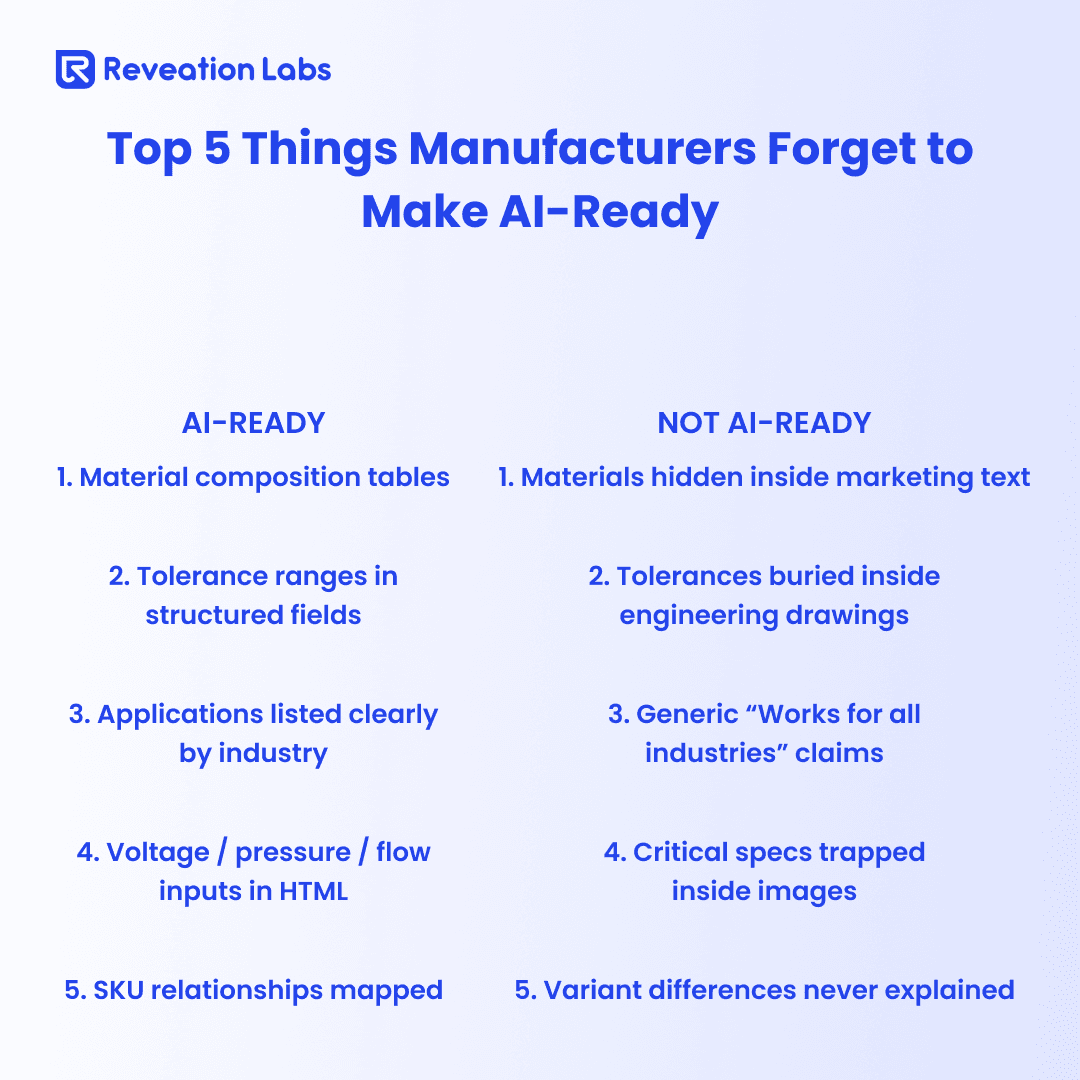
Mistake two: not implementing structured data, assuming AI can understand unstructured content like humans do.
Mistake three: burying critical information in PDFs or deep navigation instead of front-loading certifications and capabilities in crawlable HTML.
Mistake four: ignoring topic clusters and creating disconnected pages without semantic relationships.
Mistake five: treating content as "set and forget" instead of refreshing pages monthly or quarterly with updated statistics and links.
Mistake six: focusing on clicks instead of citations, measuring success by traffic rather than citation frequency and quality.
Mistake seven: inconsistent entity information across your website, directories, social media, and certifications.
Mistake eight: relying only on owned content instead of building earned media through industry publications, certifications, and third-party mentions. These errors can derail even well-intentioned generative engine optimization best practices initiatives.
Your 6-Month Generative Engine Optimization Best Practices Roadmap
Month 1: Audit your semantic footprint, establish baseline metrics for AIGVR and citation rates, assess structured data readiness, and identify content gaps.
Month 2: Design semantic topic clusters, create your content calendar, plan schema implementation, and identify authority opportunities.
Month 3: Launch pillar pages, implement Product and Organization schema, enhance fact-density on existing content, and publish first thought leadership pieces.
Month 4: Launch cluster sub-pages, optimize existing content for GEO, expand schema to all product pages with automation, and secure directory listings.
Month 5: Target industry publication placements, enhance citations through case studies and testimonials, refine content based on performance, and establish monthly maintenance cycles.
Month 6: Conduct full metric assessment, calculate ROI, adjust AEO strategy based on data, and plan Year 2 expansion.
The Competitive Advantage Waiting in Your Data
Your manufacturing company has competitive advantages already embedded in your data. You have certifications, compliance documents, technical specifications, and customer case studies that prove your authority.
Generative engine optimization best practices simply structure this existing knowledge so AI systems recognize and cite you as the authoritative source.
The manufacturers implementing generative engine optimization best practices now aren't waiting for the strategy to mature. They're establishing unassailable authority positions with AI systems before competitors catch up. The window for early-mover advantage closes quickly in this space.
Start building your semantic clusters, densifying your facts, structuring your data, and establishing authority signals now. By Q3 2026, your company will either dominate AI procurement searches or wonder why competitors got there first.
Reveation Labs can step in and handle the entire GEO buildout for you: topic clusters, structured data, fact-density upgrades, authority mapping, and AI visibility engineering, so your brand becomes the one these systems trust and quote.