Introduction
What is a B2B Buyer Portal? In simple terms, it’s a secure online portal where business customers log in to manage purchases and account information with a supplier. It is like your personal e-commerce site for business: you can browse a catalog tailored to you, place orders, and track everything without calling a sales rep.
Over the past few years, there’s been a rise of self-service in B2B commerce – buyers want the convenience of handling tasks themselves, on their own schedule. Now add AI into the mix.
Today’s AI-powered interactions (like chatbots and smart recommendations) are taking these portals to the next level. Generative AI is enabling more conversational, personalized experiences that mimic having a helpful sales assistant available 24/7. This matters for 2025 and beyond because B2B buyer expectations are higher than ever.
The companies that harness Generative AI in eCommerce will deliver faster, smarter self-service and gain a competitive edge, while those stuck with old interfaces risk falling behind. In short, B2B buyer portals augmented with GenAI are becoming a key strategic asset for future-ready businesses.
Traditional Buyer Portals: What They Do Today
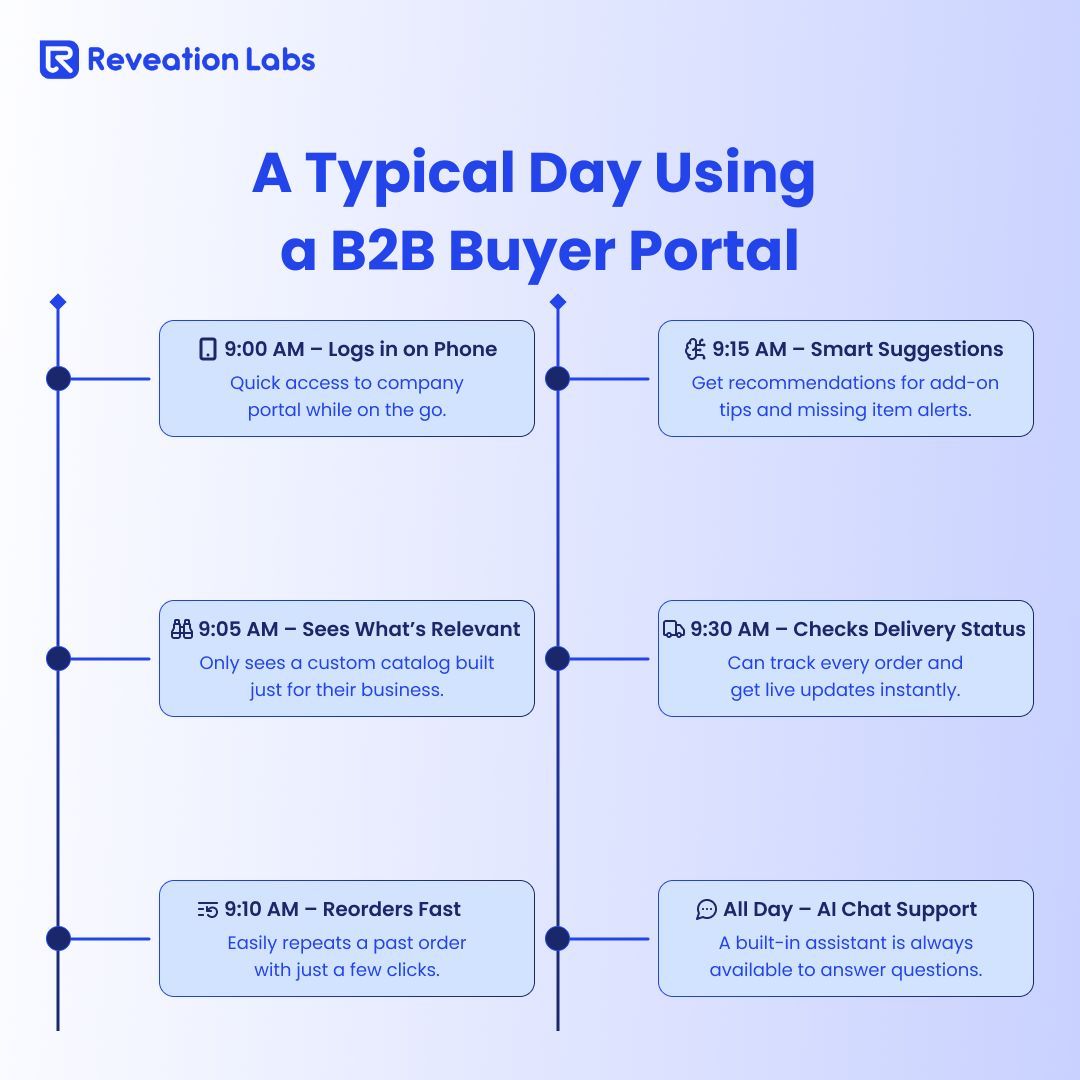
Let’s start with what B2B buyer portals offer today. A typical portal is all about making repeat purchasing easy for business customers. Key features usually include:
- Purchase History & Easy Reorders: Buyers can see past orders and quickly re-order the same items. For example, a maintenance supervisor can pull up last month’s order and add all those items to the cart again with one click, instead of manually re-entering each product.
- Account-Specific Pricing & Catalogs: Each customer sees their negotiated prices and relevant product selection. When you log in, the portal might show a custom catalog just for your company (hiding items you don’t buy), and all prices reflect your volume discounts or contract terms. You’re not seeing generic list prices; you see your prices.
- Order Approvals and Payment Options: Portals support the B2B workflow where multiple people might be involved in a purchase. For instance, a junior buyer can create an order that a manager has to approve online. The portal can route the order for approval and notify the approver. Likewise, payment isn’t always by credit card – the portal may let you place orders on account, use purchase orders, or choose from agreed payment terms (net 30, etc.).
- Shipment Tracking and Self-Service Support: After ordering, buyers can check order status and track shipments from the portal. It’s like tracking an Amazon package, but for a pallet of industrial supplies. Good portals also let customers download invoices, initiate returns, or contact support if there’s an issue – all without sending an email or making a call.
These capabilities have made B2B commerce more efficient. However, traditional portals also have limitations. Many have rigid interfaces that aren’t very user-friendly – if the portal is hard to navigate, buyers get frustrated.
Search functionality is often static and literal: the site only matches exact keywords, so if you type a part number slightly wrong or search in everyday language (“need heavy-duty bolts for outdoor use”), you might get zero useful results.
There is usually very low personalization beyond basic account info – the portal might not actively recommend products or adapt to each user’s behavior.
Many current portals feel like one-size-fits-all websites, which can lead to buyers reverting to old habits (like phone orders) when the experience online is too cumbersome. This is exactly why GenAI is so exciting – it promises to make buyer portals far more intuitive and tailored to each user.
Boost your business with Reveation Labs’ B2B eCommerce consulting and scalable solutions.
How GenAI Is Transforming Buyer Portals
GenAI can power smarter search and product discovery. In fact, our post Is Your Search Bar Costing You Millions? shows how optimized B2B search boosts conversions by up to 50%.
They’re injecting brainpower and flexibility into what used to be static systems. Here are four emerging use cases showing how GenAI is redefining B2B buyer portals:
Conversational Ordering
- Imagine an AI chat assistant integrated into your portal that functions like a virtual sales representative. Instead of clicking through menus, a buyer can simply type or ask, “I need to reorder 50 of product X and 30 of product Y,” and the AI chat will build the cart instantly.
- It can also handle questions in natural language – “Do I still get a bulk discount if I add 20 more?” – and respond with the relevant info.
- Conversational AI makes reordering as easy as texting a colleague. It’s like having a personal sales rep available 24/7, ready to take orders or look up information. This not only saves time but also feels more human and convenient than filling out rigid forms.
Also read: What is Gen AI and how is it different from ChatGPT
Smart Search & Product Discovery
- GenAI is making searches on buyer portals dramatically smarter. Instead of relying on exact keywords, AI-powered search understands the intent behind your query.
- For example, you could type “show me fasteners for aluminum,” and the portal will interpret what you need; perhaps it will surface corrosion-resistant screws suitable for aluminum fixtures, even if you didn’t use the exact product terms.
- The AI can correct spelling, suggest related terms, and ask clarifying questions (“Do you mean for aluminum sheet metal or extrusion frames?”) to get you to the right item. This feels less like using a website search bar and more like asking an experienced store associate for help.
- Buyers discover products faster because the search adapts to them, rather than expecting the user to adapt to the search. In short, smart search and AI filters turn a once-frustrating hunt into a smooth, guided discovery process.
AI Copilots for Procurement Teams
- Beyond product search, Generative AI can act as an on-demand guide or co-pilot for buyers using the portal – especially useful for new team members or complex purchases.
- Think of a procurement AI assistant that knows your company’s purchasing rules and the portal’s workflows. If you’re a new buyer unsure how to submit an order for approval, the AI can walk you through it step by step (“Next, add your manager in the approval field – here’s how”).
- It might also answer policy questions like, “What’s our free shipping threshold?” or “Can I split this order across two POs?” without the user digging through a manual.
- For complex products, the AI co-pilot can retrieve relevant specifications or compatibility information on the fly (“This machine requires a 240V power supply – make sure you have the right plug adapter. Would you like to add one to the order?”).
- Essentially, AI copilots turn the portal into a knowledgeable assistant that helps buyers navigate both the system and their internal processes. This reduces errors and training time, and empowers buyers to self-serve even in tricky scenarios.
Proactive Suggestions
- One of the most powerful GenAI capabilities is to analyze behavior and proactively recommend actions or products, just like a smart sales rep might.
- The new wave of B2B buyer portals can nudge users with helpful suggestions such as, “Customers who bought X often buy Y – add Y to your order?” or “It’s been 60 days since your last order of cleaning supplies, do you need a refill?”.
- It is like Amazon’s “Frequently Bought Together” feature, but tuned for industrial and enterprise use cases. For instance, if you’re buying an electrical circuit breaker, the portal might prompt: “Do you also need the mounting hardware kit that fits this model?” This not only saves the buyer from forgetting something important, but it also drives larger basket sizes.
- These AI-driven suggestions can be based on your specific purchase history, broader buying patterns, seasonal trends, or equipment compatibility. It feels like the website is looking out for you, ensuring you have everything you need and even alerting you to opportunities (e.g., “Ordering 3 more units would qualify you for a volume discount – interested?”).
- Proactive recommendations make the buying experience smoother and more personalized, increasing customer satisfaction and loyalty over time.
Where Can It Be Used In 2025
To make this concrete, let’s look at a few mini-scenarios of how B2B buyer portals with GenAI might work in 2025 across different industries:
Electrical Distributor
An electrical supplies distributor has thousands of SKUs (wires, connectors, breakers, etc.) and serves contractors who often aren’t product experts. A construction foreman logs into the portal to find a specific type of connector for aluminum wiring.
Instead of manually filtering through categories, he just asks the AI assistant, “Which connector is best for 220V aluminum wire?” The AI quickly suggests the proper aluminum-rated lug and even points out, “Make sure to use the anti-oxidant compound for aluminum connections. Add a tube of compound to your cart?” This buyer also tends to reorder consumables like cable ties every few months.
The portal notices it’s been a while and proactively reminds him to stock up, with a one-click option to reorder his usual quantity. In this scenario, AI helps the buyer identify the right parts and avoid missing related items, making the experience feel like he has an expert helping him shop.
Pharma Supplier
A pharmaceutical materials supplier uses a GenAI-powered portal to help labs and pharma companies order sensitive products. A procurement manager is ordering a batch of temperature-sensitive vaccines via the portal. Upon adding the vaccine to the cart, the AI pops up with a critical suggestion: “This product requires cold-chain shipping. We recommend adding an insulated shipping container and cold packs. Shall I add that to your order?”
It also reminds the buyer about regulatory compliance: “Ensure you have the proper import permit for biomedical materials for the destination country. Need to see the guidelines?” The buyer can ask the AI for packaging options and compliance documents right within the chat.
By guiding packaging and regulatory steps, the GenAI co-pilot ensures the pharma buyer doesn’t overlook crucial requirements, preventing costly mistakes. The result is a smoother checkout that builds trust – the buyer feels the supplier is proactively helping them meet strict pharma regulations.
Aviation Parts Marketplace
In an aviation parts marketplace, maintenance engineers for airlines source spare parts from various suppliers. Here, downtime is critical (an aircraft on the ground costs a lot of money), and orders often involve complex approvals.
A maintenance manager using the portal can describe what they need in plain language: “We’re servicing a Boeing 737’s landing gear – need the hydraulic valve, I don’t have the part number.” The AI understands the context, asks a couple of clarifying questions about the aircraft model and component, then pulls up the exact valve and compatible alternatives.
As the manager adds it to the cart, the AI co-pilot notes: “Orders over $50k require internal approval. Shall I forward this for approval to your maintenance director now?” It also suggests adding a seal kit that is usually replaced alongside the valve (preventing an oversight).
Once the order is placed, the AI can even track if the part is shipped and keep the user updated, e.g., “Your urgent order is in transit and will arrive in 18 hours.” In this scenario, the GenAI-driven portal functions like an expert colleague and an expediter, ensuring the maintenance team gets the right parts quickly and follows all necessary steps with minimal friction.
Our work with aviation distributors, detailed in How Aviation Suppliers Can Build a Digital Commerce Channel, shows how GenAI improves part matching and compliance workflows.
These examples show how AI enhancements turn buyer portals from passive order-taking systems into active, intelligent assistants across industries. The experience becomes more conversational, error-proof, and tailored to each specific scenario – whether it’s recommending a complementary product, handling an approval workflow, or providing domain-specific advice in real time.
What This Means for Your eCommerce Roadmap
So, what should B2B leaders do to prepare? Embracing GenAI in your B2B buyer portal isn’t a simple plug-and-play; it requires strategic planning. Here are key considerations for your digital roadmap:
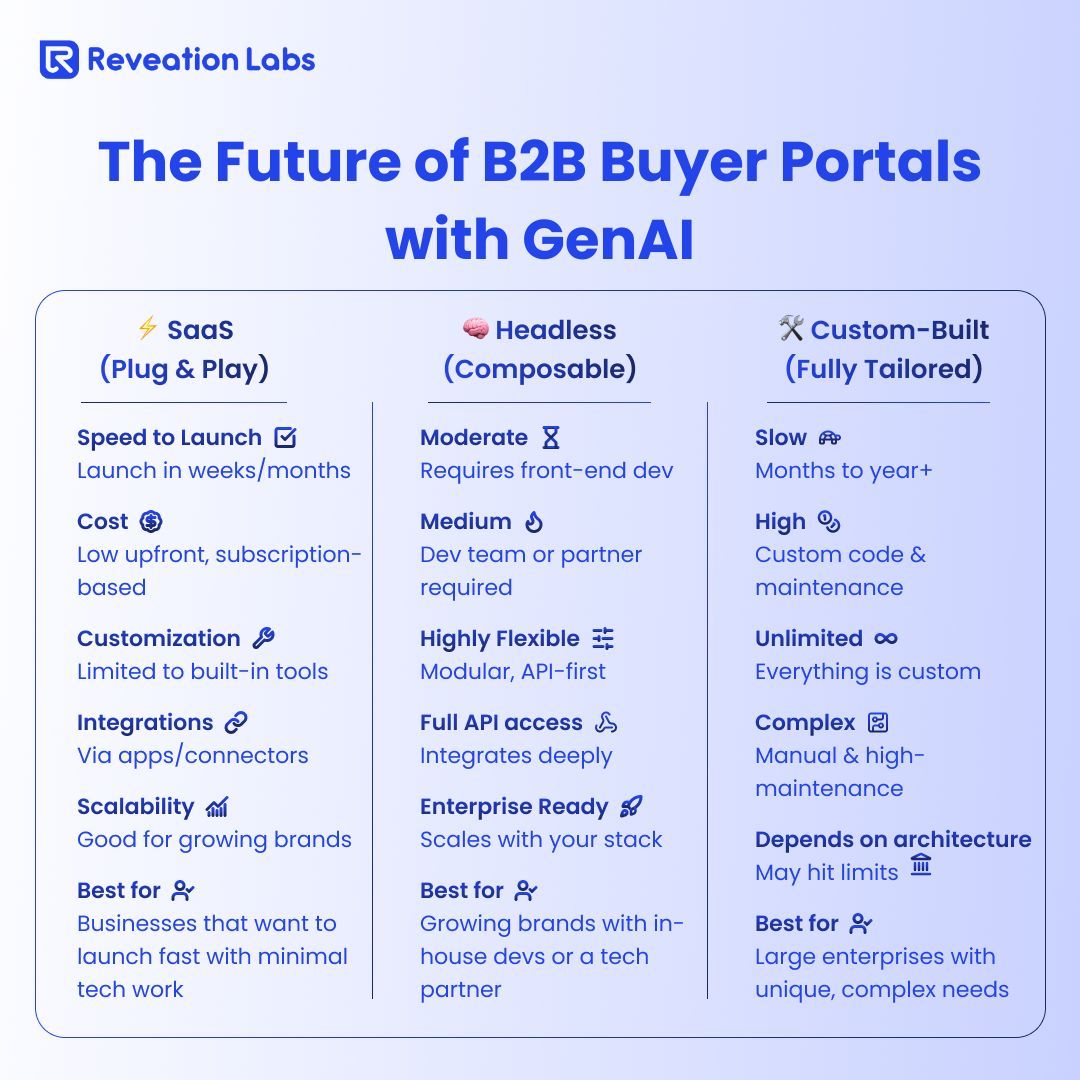
Ensure Your Platform Is API-First and Flexible: To leverage GenAI features, your eCommerce platform needs to play well with others. An API-first architecture is essential – it allows you to easily integrate AI services (chatbot frameworks, recommendation engines, semantic search APIs) into your portal. If your current system is a monolithic, inflexible platform, consider moving towards a more modular or headless architecture. This way, you can add or upgrade AI capabilities without overhauling the entire site. In short, build a tech foundation that’s ready to plug in AI innovations as they emerge.
Plan for AI Copilots, Not Just Static Search Bars: When mapping out improvements, think beyond basic search and filters. Envision your portal with an AI copilot or chatbot embedded on the page – one that customers can ask anything, anytime. This could be a virtual agent that guides ordering, answers FAQs, and provides personalized advice. Designing your UX with space for conversational interfaces or AI-driven widgets will set you up to deliver next-gen experiences. The goal is to move from users typing in a search box and clicking links to users having a dialogue with your system. Allocate budget and time for experimenting with conversational UI and AI-driven features, rather than only incremental tweaks to the old interface.
Treat Data as Fuel for AI: Generative AI and machine learning thrive on quality data. To get meaningful results (like accurate recommendations or chat responses), you need well-organized data behind the scenes. That means cleaning up your product catalog (rich descriptions, attributes, compatibility info), consolidating customer purchase history, and maintaining up-to-date inventory and pricing data. It’s also wise to develop robust buyer profiles or personas. All this structured data is the fuel that powers AI insights. If your data is siloed, outdated, or messy, even the fanciest AI will produce poor results. Invest in data management and integration now – it will pay off when you deploy AI features that rely on that data to deliver value.
Side Tip: GenAI isn’t a standalone product you buy off the shelf – it’s an upgrade layer on your structured data. The better your underlying systems and data quality, the better your AI-driven portal enhancements will perform.
Our B2B eCommerce Solutions services cover API‑first systems, headless architecture, and GenAI‑ready deployments for scalable, modern portals.
Final Thoughts
The future of B2B buyer portals is undeniably exciting. As we head into 2025 and beyond, self-service portals will become smarter, more conversational, and more personalized – blurring the line between a simple website and an interactive advisor.
For B2B leaders, the takeaway is clear: don’t view GenAI as hype, but as a practical toolkit to future-proof your digital customer experience. Upgrading your portal with generative AI capabilities can boost customer satisfaction, increase efficiency, and set you apart from competitors who stick to the status quo.
Adopting these technologies is not a one-time project, but a continuous journey of improvement. Start small if needed (maybe an AI chatbot pilot or an intelligent search module), but start soon – the sooner you learn how AI can enhance your specific business, the better positioned you’ll be as the market evolves.
Ready to explore how GenAI can enhance your buyer portal? Book a GenAI Readiness Consultation with Reveation Labs and let our experts help you chart a roadmap toward an AI-augmented, future-ready B2B portal. The companies that act now will lead the pack in the new era of B2B eCommerce. Don’t get left behind!