The aviation spare-parts world has unique demands. Buyers need complete traceability of parts (down to serial numbers and certificates) and must meet strict regional compliance rules (FAA, EASA, etc.). They also expect real-time inventory and pricing – no one can afford a grounded aircraft due to a delayed part.
For instance, Airbus recently integrated 5 million parts onto a single digital marketplace, consolidating OEM, surplus, and used inventory into one modern portal. Customers now expect that same B2C-level convenience – easily searching for and buying parts, seeing all the details, and even tracking their order end-to-end, simplifying where to buy aircraft parts.
In short, traditional catalogs and slow email quotes won’t cut it for global operations. Let’s explore a customized digital commerce architecture for aircraft parts suppliers, demonstrating how to address these challenges and expand globally.
Industry-Specific Challenges in Aviation Commerce
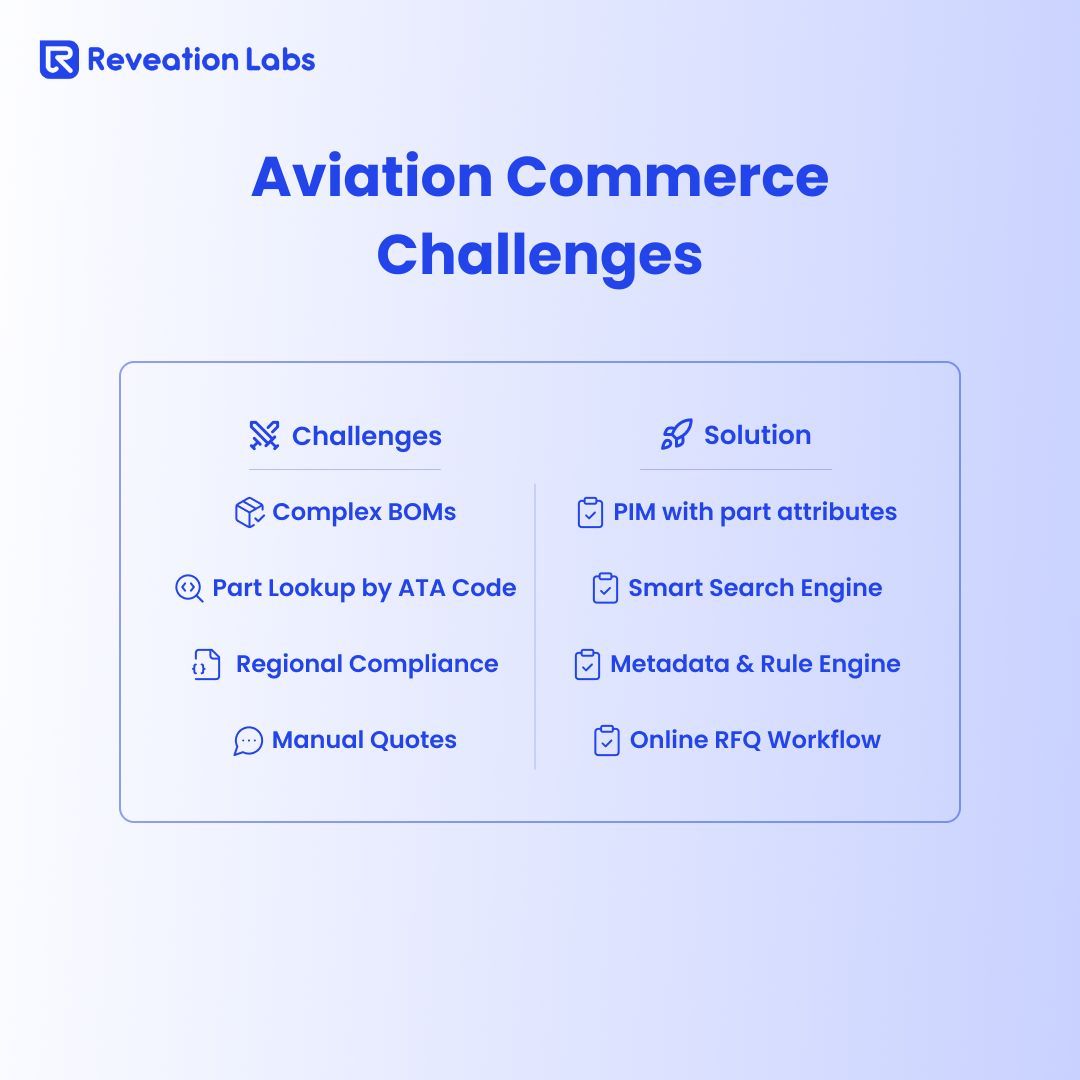
Aviation parts commerce has several hard problems:
- Vast, complex catalogs: An average aircraft parts distributor might manage tens or hundreds of thousands of SKUs, many with multiple revisions and complex BOM (Bill of Materials) relationships. For example, De Havilland Aircraft of Canada (DHC) had over 110,000 unique parts in its aftermarket catalog. To present this online, you need advanced data management (custom attributes, part interchangeability, compatibility logic, etc.), an illustrated parts catalogue aviation, and a robust aircraft parts catalog search engine that understands aviation part numbers and ATA codes.
- Strict certification/compliance: Every part sale must carry the right certificates (COC, Airworthiness, etc.) and comply with FAA/EASA rules. Systems must store and retrieve regulatory metadata, trace lots/serials, and ensure only compliant parts are sold. This often means integrating a compliance document repository (for example, linking each part to its authorized certificates via APIs) and gating sales until all paperwork is verified. (Automation here is key to avoiding human errors in approvals.)
- Regional taxes and logistics: Selling globally involves differing export regulations, taxes, and shipping rules. A part that is non-critical in one jurisdiction may be restricted in another. Your digital platform needs geo-specific logic (e.g., calculating duties, shipping constraints, export licenses).
- Real-time availability & MRO links: Maintenance teams (MROs) need to see if a part is in stock at nearby depots or through partner networks, often integrated with planning systems. This means syncing live inventory from multiple warehouses or parent ERP/MRP systems. Availability isn’t just “in-stock/out-of-stock” – it’s often whether a part can be cannibalized or repaired in time.
- Quote-driven sales: In B2B aerospace, many transactions begin as requests for quote (RFQs) rather than instant cart-checkouts. Buyers often negotiate on price and terms, especially for bulk orders or critical AOG (Aircraft on Ground) situations. So your solution must include a quoting engine and negotiation workflow, not just a “buy now” button.
Put bluntly, a simple off-the-shelf shopping cart (like a standard Shopify store) can’t handle these needs. You need an aviation-grade architecture that can manage massive catalogs, dynamic pricing, and multi-user workflows.
Solution Blueprint: Key Capabilities Needed
To address the above challenges, an aviation digital commerce platform should have these core capabilities:
- Modular B2B Platform: Start with a flexible, headless, or API-driven commerce platform built for B2B. For example, Virto Commerce (an enterprise B2B solution) was used to power DHC’s online parts store. It handled their vast catalog and enabled extensibility. Whatever platform you choose, it must allow custom modules (for quotes, approvals, contract pricing, etc.) without hardcoding everything.
- Integration-First Design: The e-commerce layer is just the storefront. Behind it, you need tight integration with ERP and inventory systems. Think “middleware” or iPaaS that syncs: product master data (part numbers, descriptions), multi-warehouse stock levels, pricing tiers, and even order status back to the ERP. In the DHC example, every price and stock update in their IFS ERP flowed to the storefront in near-real-time. This ensures buyers always see up-to-date info.
- Role-Based Access & Pricing: The platform must support multiple user roles with different views and pricing. An OEM rep may see different catalog items and prices than an MRO customer, and an internal inspector might have a read-only view of compliance docs. Implementation usually means user groups with assigned catalogs, price books, and permission levels.
- Advanced Quoting and Custom Pricing: Build in a quote & negotiation module. Buyers should be able to “add to RFQ” items, request a quote on demand, and receive quotes based on contract pricing (which may vary by customer or region). Similarly, the system should support bulk pricing, special deals, or customer-specific price lists. For example, the DHC portal implemented “on-demand retrieval of customer-specific pricing and inventory” from the ERP, so every quote reflected true contract rates.
- Multi-language & Multi-currency Support: For global reach, the storefront must display content in local languages and currencies. Behind the scenes, this also means handling VAT/GST rules per region and local payment/terms customs (e.g., net-30 invoicing vs. escrow).
Together, these capabilities form the solution blueprint. The goal is a self-service digital sales channel where a buyer (say, an MRO in Europe) can log in, find the exact part (perhaps by ATA code or part number), see its description, certifications, price, and stock at the nearest depot, and either place an order or submit a quote.
Platform Architecture: How to Set It Up
- PIM System (Product Information Management): Centralize your complex catalog here. PIM holds all aviation-specific attributes: part number, manufacturer, OEM references, BOM links, technical specs, quality tags, and supports an illustrated parts catalog aviation. The e-commerce platform pulls from PIM for rich product pages.
- E-Commerce Platform: This is your core. It handles the storefront UI, shopping/quoting cart, and user accounts, and ties everything together. We recommend a composable, API-driven platform so you can plug in specialized modules. Key commerce modules include:
- Search Engine: An advanced search (e.g., Elasticsearch or Azure Search) tailored to parts. It should support free-text and part-number search, ATA category filtering, and “smart” compatibility checks. Some solutions even encode “condition codes” (like new, refurbished, serviceable, scrap) as searchable attributes.
- Quote & Negotiation Module: A workflow engine for RFQs. It lets buyers submit requests and sellers respond with prices/lead times. It can also automate simple approvals.
- Checkout & Workflow: Since many B2B transactions need multi-step approval, your checkout can deviate from a simple cart. It might allow “Submit for internal approval” or require purchase order numbers and attach compliance docs.
- Support Portal & Ticketing: Even self-service sites need live support. Embed a helpdesk or ticketing system so buyers can ask questions about parts, request manual overrides, or escalate AOG orders.
- Regulatory Compliance Repository: A secure storage (with APIs) for all certificates, test reports, and compliance documents. Each part record can link to its Certificate of Conformance (CoC) PDF, Maintenance Release, etc. The commerce system enforces that only parts with valid documents are sellable, and can automatically attach the right documents to orders.
- Integration Layer: Under the hood, you’ll have connectivity to:
- ERP/MRP (e.g., SAP, Oracle, IFS, etc.): Sync product data, stock levels from multiple depots, pricing, and send back orders. In our DHC example, every time ERP stock or price changed, the online store reflected it immediately.
- Supply Chain & Logistics Tools: For end-to-end visibility, integrate any supply-chain modules (like IATA shipping services or 3PL inventory feeds) to show transit times or depot allocations.
- Payment Gateway / Finance: Configure for B2B (e.g. invoice payment, credit terms, or escrow for big deals).
- Localization Services: Tax/VAT APIs (or built-in tax engine) for each sales region.
- Authentication/SSO: Connect to corporate directories if needed (e.g., allow customer companies to use single sign-on).
An architecture diagram (illustrative) could place the e-commerce storefront at the center, with arrows to ERP, PIM, Search, and third-party services.
With the right B2B eCommerce consulting, aviation suppliers can streamline global parts fulfillment, ensuring a seamless digital commerce channel that meets industry-specific demands.
Integration Considerations
In practice, integration is half the battle:
- ERP Systems: The backbone for inventory and pricing. Many suppliers use industry-specific ERPs like SAP Aerospace and Defense or Oracle's aviation suite. Ensure your platform can push/pull data from these via middleware (e.g., MuleSoft, custom .NET/Java connectors, or iPaaS). Keep in mind master data management – you may need to clean and enrich ERP data (for example, augment it with marketing descriptions in the PIM).
- Supply Chain Visibility: If you belong to airline consortia or use IATA/ICAO standards, your commerce channel can incorporate their data feeds. For instance, displaying ATA chapter references helps buyers find parts by aircraft system, including specialized aircraft wing parts. Also, connect to any 3PL or customs systems to auto-calculate shipping/delivery times.
- Payment Gateways: B2B often uses purchase orders and net terms, but you still need a payment engine (even if only for credit card deposits or escrow). Choose a gateway that supports invoicing and large-amount transfers. Consider integrating an option for fast AOG payments (like express wire transfer support).
- Compliance Document APIs: Some regulators or marketplaces offer APIs for validating part authenticity. In complex workflows, you might call third-party services that check the tracking of serialized parts, crucial for aerospace parts manufacturing compliance. Keep all compliance records easily accessible via API so that the storefront can automatically bundle (or require) the necessary paperwork when an order is placed.
Every integration should be real-time or near-real-time, where possible. The moment inventory changes in your warehouse or an MRO finishes a refurbishment, the portal should reflect it.
Real-Time Pricing & Availability Logic
Aviation parts pricing is rarely flat. You’ll often compute the price shown to a buyer from multiple factors:
- Contract/Tiered Pricing: Many customers have negotiated price lists or volume breaks. The system should look up the specific buyer’s contract (or customer group) and apply that price.
- Current Inventory: If the part is in stock in a cheap depot, the price may be lower than if it needs to be air-shipped from a remote location. Connect your price engine to inventory: for example, show “$5,000 (stock at NYC), $5,500 (stock at Hong Kong)” if multiple warehouses hold the part.
- Special Deals / Spot Quotes: Sometimes the price is “quote-on-demand.” For those, allow the buyer to submit an RFQ, which triggers a manual or semi-automated quote workflow.
- Additional Fees: Include options for AOG express fees (as PartsBase highlights, AOG delays can cost ~$150k per hour, so offering expedited shipping at an extra cost can be critical).
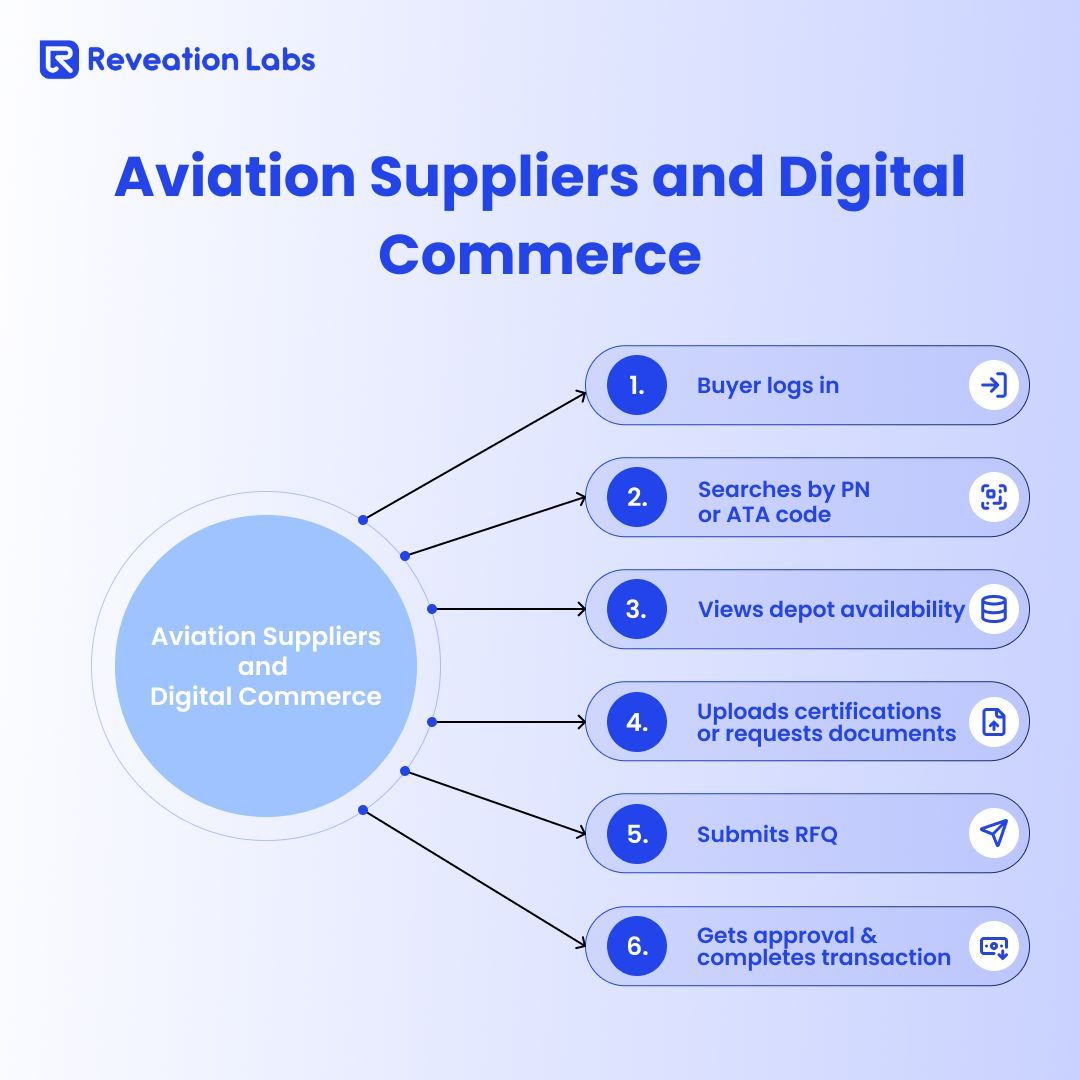
Sample flow: A buyer logs in → searches by ATA code or part number → sees search results with a thumbnail, condition code, and a price. If multiple sellers exist, the marketplace display shows competitive pricing. They click the part to view details (including a compliance doc icon). The site then queries the ERP to show live availability (“15 in stock at Dallas, 20 incoming at Frankfurt”) and uses a pricing API to display their contract price. The buyer can then “Add to Quote” or “Buy Now” depending on company policy.
Behind the scenes, the system must cache some data for speed (e.g. static part attributes in the PIM) but always validate stock and price at the moment of quote. In practice, we often build the integration so that at the “view price” action, the platform calls the ERP. In DHC’s solution, they implemented on-demand retrieval of customer-specific pricing and inventory from the ERP to ensure global buyers always saw current info.
Example: A Regional Aviation Parts Distributor
Imagine a regional MRO parts distributor serving Asia. Before digital, the team juggled phone, email quotes, and spreadsheets. Each part quote takes days. Inventory lives in siloed depots. Customers outside the region can only call once they locate part numbers.
Problem: Long quote cycles, high manual cost, limited reach.
Solution: The distributor builds a digital sales portal:
- Buyers log in and see only their relevant parts (custom catalog view) and local currency.
- They can search by part number or by aircraft model/ATA chapter.
- The portal pulls live stock from all depots (both local and partner networks) and displays consolidated availability.
- Each user has a role: e.g., MRO buyers see price lists plus a “Request Quote” button; inspectors can view compliance certs; admins can adjust contract pricing.
- Complex pricing rules (bulk discounts, special deals) are encoded in the system.
- Once an order or RFQ is submitted, it flows back into the ERP seamlessly.
Result: Quotes that used to take 2–3 days now take hours. The digital storefront opens up new markets, demonstrating where to sell aircraft parts efficiently – a buyer in Europe can discover this distributor’s parts 24/7, whereas before they had no visibility. Over time, the company sees massive efficiency gains (for example, internal pilots show quote cycles dropping by ~60%). They also report “global buyer reach” – customers on three continents can now connect online. Inventory turns increase since stock is visible to all, and urgent AOG shipments are flagged and expedited via the system.
This scenario mirrors real transformations – for instance, Reveation Labs helped DHC achieve exactly this with their Virto-based solution, handling 110K+ parts and delivering a streamlined order process.
Final Thoughts
In summary, aviation parts distributors need a purpose-built B2B commerce channel, not a consumer plugin. The stakes are high: aircraft downtime is costly, so speed, accuracy, and compliance are paramount. By adopting a modular e-commerce platform, building in ERP connectivity, and focusing on aviation-specific features (like condition codes and quoting workflows), suppliers learn how to sell airplane parts effectively and go global without reinventing the wheel for every region.
With the right digital architecture, you turn catalog chaos into a self-service marketplace: flight-line managers and MRO planners can instantly find, price, and order the parts they need. Compliance data and contracts are built in, so buyers trust the system. This reduces operational overhead and unlocks new markets, benefiting even aircraft OEM suppliers and their distribution networks.
To learn more about how to approach an aviation e-commerce build, see the DHC case study above or explore services from firms like Reveation Labs, an aviation parts specialist which excels in aerospace B2B commerce. They demonstrate how a modern commerce engine, combined with deep integration and domain knowledge, can transform your parts fulfillment channel.