
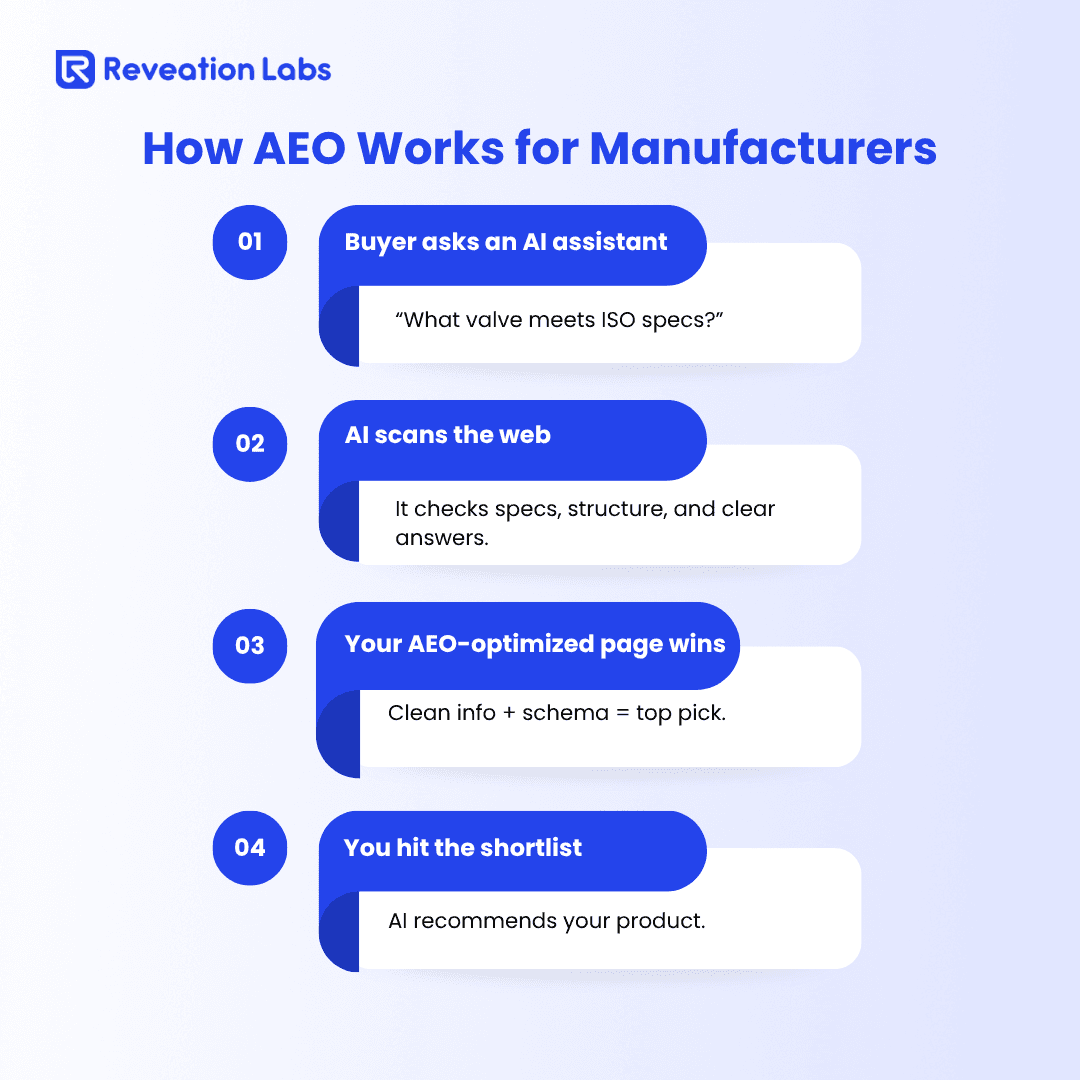
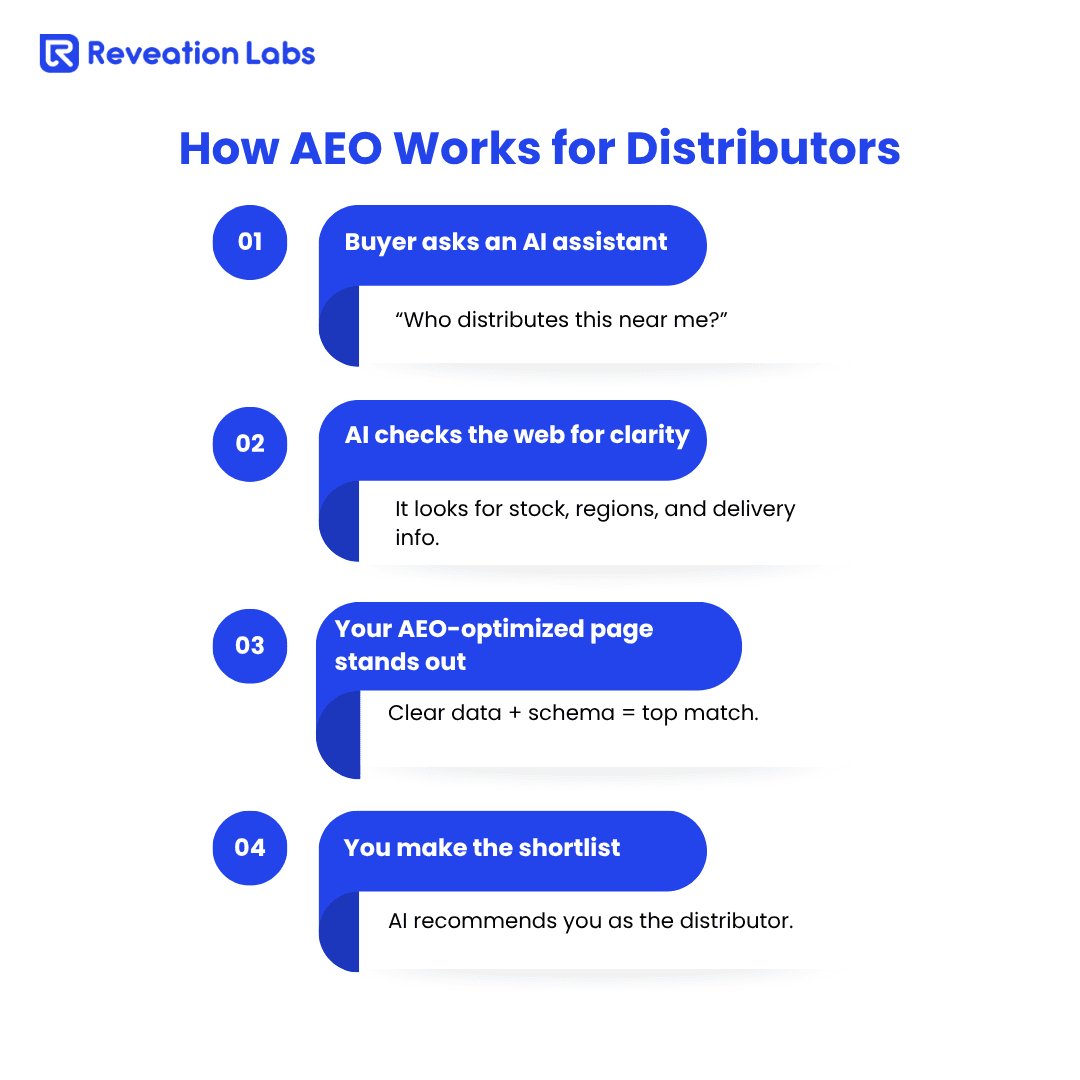
B2B buyers don't always start their research on a supplier's website. They might ask ChatGPT to compare industrial equipment, use Google's AI Overviews to understand a technical requirement, or turn to Perplexity when evaluating software vendors.
That changes how manufacturers, distributors, and other B2B companies need to present information online. A page that ranks well for a broad keyword might still fail to answer the specific question a purchasing manager or technical buyer is asking.
What Is an AEO Strategy?
An AEO strategy, or Answer Engine Optimization strategy, focuses on making useful, accurate information easier for search engines and AI-powered systems to discover, understand, and reference. It builds on SEO rather than replacing it.
For B2B sales, the opportunity goes beyond appearing in an AI-generated answer. Your content needs to help buyers determine whether your products, services, or capabilities match their requirements before they contact sales.
Here are eight ways to approach AEO, along with practical steps for putting those ideas to work.
How to Build an AEO Strategy for a B2B Company
Before changing your website, find out what your buyers actually want answered. A manufacturer evaluating an automation solution will have different questions from a distributor looking for a commerce platform. Their search behavior should shape your content priorities.
If you're building an AEO strategy from scratch for a B2B brand, start with these five steps:
- Collect real buyer questions. Review sales calls, customer support tickets, search queries, RFPs, and conversations with your account managers. Look for questions that repeatedly come up before a purchase.
- Check what your website already answers. Review relevant product, service, industry, and comparison pages. Identify questions with missing, outdated, or difficult-to-find answers.
- Prioritize questions tied to buying decisions. Focus on compatibility, technical requirements, integrations, implementation, pricing structures, and supplier capabilities rather than publishing every possible question.
- Improve existing pages before creating new ones. Add clear explanations, accurate specifications, relevant examples, and supporting evidence where buyers need them.
- Measure and improve. Track organic search performance, identifiable AI referrals, qualified inquiries, and changes in the questions your sales team receives.
The best AEO strategy for B2B companies isn't necessarily the one that produces the most content. It's the one that makes important buying information easier to find and verify.
For example, an industrial equipment manufacturer might start with product compatibility and compliance questions. A wholesale distributor might prioritize inventory availability, ordering requirements, and how its products compare with alternatives.
Once you know which questions matter, the following eight strategies can help you improve how your website answers them.
Top 8 AEO Strategies for B2B Sales
Strategy 1: Answer Specific Buyer Questions Clearly
Buyers looking for technical products or B2B services rarely want a long introduction before getting an answer. They want to know whether a product fits their requirements, how a solution works, or what they should consider before choosing a supplier.
Start by reviewing your important pages. Can someone find a useful answer without reading the entire page?
Consider a manufacturer selling automated packaging equipment. A general statement about improving productivity tells buyers very little. They may want to know which packaging formats the equipment supports, whether it integrates with their existing production line, or what affects installation time.
Answer those questions where they're relevant instead of directing every buyer to contact sales.
Useful improvements include:
- Use descriptive headings that reflect the question or topic being addressed.
- Give a direct answer before adding technical details or examples.
- Explain limitations and requirements instead of presenting every capability as universally applicable.
- Use comparison tables when buyers need to evaluate several options.
- Keep specifications and supporting information consistent across related pages.
Short answers work well for simple questions, but complex B2B topics often need more explanation. Don't cut important information just to meet an arbitrary word count.
For example, a question about whether an ecommerce platform supports customer-specific pricing may require an explanation of customer accounts, contract pricing rules, ERP integration, and how prices appear during checkout.
Give buyers enough detail to understand the answer and determine what they need to investigate next.
Strategy 2: Use Buyer Questions to Improve Product and Service Pages
Many B2B websites describe what a company sells without fully addressing what customers need to know before buying it.
A distributor may list product dimensions and part numbers but leave out compatibility information. A software provider may describe its integration capabilities without explaining which systems it connects to or what the integration involves.
These gaps matter because buyers often search using detailed questions rather than broad product names.
For manufacturers and distributors, useful questions might include:
- Will this replacement part work with our existing equipment?
- What information do we need before requesting a custom configuration?
- Can this system connect to our current ERP?
- Does the product meet the standards required for our application?
- How are bulk pricing and account-specific purchasing terms handled?
Use these questions to improve the relevant page, whether that's a product description, technical specification section, service page, or an existing FAQ.
For example, if buyers frequently ask whether an industrial component fits a particular equipment model, a compatibility table may be more useful than adding another paragraph of marketing copy.
Questions about implementation may belong on a solution page, while detailed specifications should remain close to the relevant product.
The goal is to make the answer available where someone would reasonably expect to find it, not to add the same questions across every page.
Strategy 3: Make Product Information Easier to Understand with Structured Data
Clear content matters, but search engines also benefit from information presented in a consistent, machine-readable format.
Structured data, commonly implemented using schema markup, helps search engines identify information about products, organizations, articles, and other page elements.
For manufacturers and distributors, Product schema can be particularly useful when the page and its content meet the applicable requirements.
Relevant product information may include:
- Product name and brand
- SKU, manufacturer part number (MPN), or GTIN where applicable
- Product description and technical characteristics
- Price and availability when publicly available and applicable
- Supported product variants
For example, a distributor selling replacement motors might maintain a consistent manufacturer part number, model information, and product identity across its catalog. That makes it easier for buyers to identify the correct item and helps search systems interpret the page.
JSON-LD is a commonly recommended format for implementing structured data. However, adding schema doesn't guarantee an AI citation, featured snippet, or higher ranking. Search systems still evaluate the page's actual content and other signals.
Structured data should also match what buyers can see on the page. If your markup lists a product as available while the storefront shows it as out of stock, fix the underlying information rather than treating schema as a separate SEO task.
For companies managing large catalogs, consistent product data is especially important. The more product records, variants, and updates you manage, the harder it becomes to maintain accurate information manually.
Strategy 4: Address Compliance, Compatibility, and Technical Requirements
B2B purchases often involve more than one decision-maker. Procurement teams care about supplier qualifications, engineers need technical information, and operations teams want to understand how a product or system will fit into existing processes.
Your content should help each of these buyers find the information relevant to their role.
Consider an industrial manufacturer selling electrical enclosures. Buyers may need to check environmental ratings, materials, dimensions, applicable certifications, and compatibility with their intended installation.
A generic claim such as "built for demanding industrial environments" doesn't answer those questions.
Instead, explain the product's actual specifications, applicable ratings, tested capabilities, and limitations. Only claim certifications or compliance where you can support them.
Enterprise buyers may require additional information before considering a vendor, including:
- Supported ERP and business system integrations
- Security and access management capabilities
- Deployment and hosting options
- Implementation responsibilities and dependencies
- Support arrangements and service commitments
An AEO strategy for enterprises should also account for information spread across multiple product lines, departments, and regional websites. Buyers shouldn't find conflicting technical requirements or capabilities depending on which page they visit.
Assign responsibility for important content, review it when products or systems change, and keep supporting resources accessible from the pages buyers use.
For manufacturers and distributors, accurate technical content can improve the research experience even when the buyer doesn't contact sales immediately. It helps them determine whether your business belongs on their shortlist.
Strategy 5: Build Visibility Beyond Individual Search Results
Answer Engine Optimization and Generative Engine Optimization (GEO) are closely related. AEO focuses on making content useful and accessible for answer-focused search experiences, while GEO generally focuses on how brands and information appear in AI-generated search responses.
For B2B companies, both depend on having information that buyers and search systems can understand and verify.
Publishing more AI-generated articles isn't a GEO strategy by itself. A company may publish dozens of pages explaining the same general topic without answering anything its competitors haven't already covered.
Original information gives buyers a stronger reason to use your content. That might include:
- A detailed explanation of how a particular integration works
- A comparison of purchasing workflows across different business requirements
- Technical insights from completed projects that your business can substantiate
- Product selection guidance based on real compatibility requirements
- Clear explanations of implementation trade-offs and limitations
For example, a B2B commerce provider could explain the differences between implementing customer-specific pricing through an ecommerce platform and retrieving it directly from an ERP. That information is more useful to a buyer evaluating a platform than another general article about the benefits of digital transformation.
The same approach works for B2B SaaS companies. Buyers researching software may ask about API limitations, data migration, integrations, or how a product compares with competing solutions. Answering these questions accurately helps them evaluate the product without relying entirely on a sales demonstration.
When building an AEO strategy for a B2B SaaS company, prioritize product and integration pages, useful comparisons, implementation guidance, and regularly updated technical information.
For manufacturers and distributors exploring AI within their own operations, Reveation also covers practical generative AI solutions for manufacturers and distributors.
The important distinction is that creating content with AI and making your business discoverable through AI search are different activities. Focus on the quality and usefulness of the information, regardless of how you produced the first draft.
Strategy 6: Use Search Data and Buyer Feedback to Improve Content
An AEO strategy needs ongoing attention, but that doesn't mean rewriting your website every week.
Start by monitoring which pages attract relevant visitors, which questions buyers continue to ask, and whether important product or service information has changed.
Google Search Console can help identify search queries and pages that need attention. Analytics tools may also show referral traffic from AI platforms, although not every AI-assisted visit can be identified or attributed accurately.
You can also review how selected questions are answered in tools such as ChatGPT, Perplexity, and Google's AI search experiences. Treat those checks as observations rather than permanent rankings because answers can vary by query, context, and time.
For a manufacturer or distributor, a practical monthly review could include:
- Checking whether important product and service pages are receiving relevant search traffic
- Reviewing new questions raised by sales and customer support teams
- Updating specifications, availability details, integrations, or purchasing information that has changed
- Finding important questions your competitors answer more clearly
- Checking whether AI-referred visitors are taking meaningful actions, where tracking is available
For example, a distributor may notice that customers repeatedly ask whether inventory shown online reflects the nearest warehouse. Rather than publishing a broad article about inventory management, the company could explain how stock availability works directly on its ecommerce site.
Review results alongside qualified inquiries and sales outcomes. An increase in AI referrals may be interesting, but it matters more if those visitors are reaching relevant pages and moving forward in the buying process.
Update content when you have a useful reason to change it. A new integration, product specification, buyer question, or identified content gap is a better trigger than an arbitrary publishing schedule.
Strategy 7: Connect AEO with Your Broader B2B SEO Strategy
AEO works best when the rest of your website is technically sound and useful to visitors.
A well-written answer won't help much if the page is blocked from crawling, difficult to navigate, missing from important internal links, or filled with information that contradicts other pages.
That makes technical SEO, content structure, product data quality, and website architecture part of the same conversation.
For larger manufacturers and distributors, common priorities include:
- Making important product and solution pages accessible to search engines
- Improving navigation between product categories and related technical resources
- Managing duplicate or near-duplicate catalog pages appropriately
- Keeping page information consistent with connected business systems
- Reviewing canonical tags, indexing rules, and redirects
- Making important content accessible without requiring a login
Consider a distributor with thousands of parts listed across several categories. If product descriptions are nearly identical, important specifications are missing, and category pages offer little guidance, adding a few question-based headings won't solve the underlying problem.
The business needs to improve how its product information is organized and presented.
When evaluating an outside partner, ask how they approach ecommerce SEO, technical website issues, content accuracy, and measurement. AEO shouldn't be treated as a standalone service that ignores those foundations.
It also helps to establish clear responsibilities. Marketing may manage content structure, product teams verify specifications, and IT handles technical changes. Without coordination, information can become outdated even when the content itself reads well.
Strategy 8: Optimize Your B2B Ecommerce and Marketplace Content
For manufacturers and distributors selling online, AEO should extend beyond blog articles and service pages. Product categories, individual listings, and B2B online marketplaces can contain some of the most useful information buyers need.
For manufacturers and distributors, an ecommerce AEO strategy should focus on the information buyers need to select and order products. That includes accurate specifications, equipment compatibility, customer-specific pricing, and stock availability. When these details are easy to find on product and category pages, buyers can make purchasing decisions without having to contact sales for basic information.
Start with the questions buyers ask while selecting and ordering products.
For example, an industrial parts distributor may need to explain:
- Which equipment models a replacement part supports
- Whether alternative or superseding part numbers are available
- How quantity breaks or customer-specific prices work
- Whether stock availability differs by warehouse or branch
- What information is required when requesting a quote
These details can influence whether buyers feel confident placing an order or need to contact support first.
The same principle applies to marketplace listings. Use accurate product titles, complete specifications, useful compatibility information, and consistent identifiers wherever the platform supports them.
However, don't assume that every marketplace supports your preferred schema markup or content layout. Work within the platform's capabilities and keep the information aligned with your own storefront.
For B2B ecommerce, the challenge often extends to the systems that supply this information.
If product details come from a PIM, account pricing comes from an ERP, and inventory depends on multiple warehouses, the storefront needs reliable ways to retrieve and display that data.
Otherwise, a well-optimized product page may still give buyers incomplete or outdated information.
Businesses evaluating B2B ecommerce solutions should consider these data and integration requirements alongside SEO and AEO improvements.
Making product information easier to discover is valuable. Making it accurate and useful when buyers arrive is just as important.
What Should B2B Companies Prioritize First?
You don't need to implement every AEO tactic at once. Start with the pages and questions most closely connected to buying decisions.
For manufacturers, that may mean improving technical specifications, product selection guidance, compatibility details, and verified compliance information.
For distributors, product data, category navigation, stock availability, and ordering requirements may deserve attention first.
Enterprise companies should also check whether information stays consistent across departments and business systems. B2B SaaS businesses can focus on integration questions, product capabilities, comparisons, and implementation requirements.
Once those foundations are in place, review what buyers still struggle to find. Use search data and conversations with customers to guide the next round of improvements.
AEO isn't a replacement for B2B digital marketing or traditional SEO. It gives companies another reason to make their product knowledge, capabilities, and technical information easier to access.
For manufacturers and distributors, Reveation Labs helps connect digital commerce experiences with the product data and business systems behind them. If your website struggles to present accurate product information or support complex B2B buying requirements, those are useful places to begin improving the experience.
Improve Your B2B Digital Experience
Talk to Reveation Labs about your next steps.