Your manufacturing team just spent three hours manually updating inventory forecasts, your equipment broke down again without warning, and your distributor called asking why their shipment is mysteriously delayed.
Meanwhile, your competitor down the road seems to have their act together, orders flowing smoothly, machines humming predictably, and customers actually happy.
Here's what they're probably not telling you: they've moved beyond hoping their old systems will somehow work better tomorrow. They're using generative AI solutions to deal the exact problems that keep you awake at 2 AM.
But when manufacturers and distributors search for generative AI solutions, they're not looking for sci-fi demos or flashy presentations. They want answers to very specific, very expensive business problems.
After analyzing what companies are actually typing into search bars and the conversations happening in boardrooms across the country, a clear pattern emerges.
Real Search Intent Behind "Generative AI Solutions"
When a plant manager searches for generative AI solutions at 11 PM on a Tuesday, they're probably not researching the theoretical capabilities of artificial intelligence. They're likely dealing with a crisis.
Maybe their demand forecasting is so far off that they're sitting on $2.4 million worth of excess inventory while simultaneously running out of their bestsellers. Or their "predictive" maintenance program failed to predict another $125,000 breakdown that brought their entire production line to a halt.
These aren't technology searches, they're emergency searches.
The companies that understand this distinction are the ones winning business from desperate manufacturers and distributors who need solutions that work next quarter, not next decade.
They're focusing their content and solutions on B2B eCommerce for manufacturers, solving immediate, costly problems rather than explaining how artificial intelligence works.
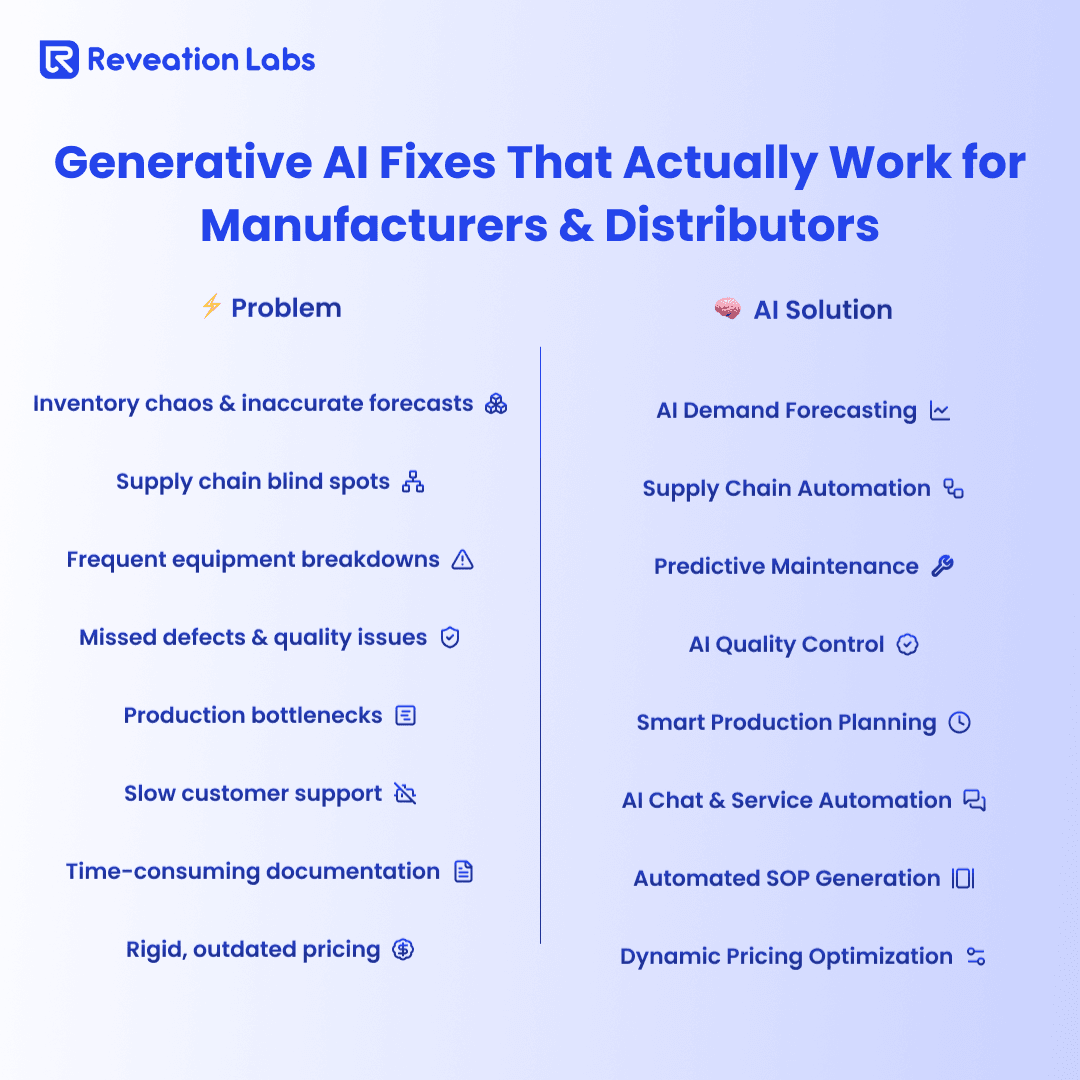
Pain Point #1: Inventory Chaos Is Costing Millions
Here's a number that should make every CFO uncomfortable: most distributors and manufacturers list demand forecasting as their absolute top priority when searching for AI solutions.
Why? Because traditional forecasting methods are failing spectacularly.
The average manufacturer spends $2.4 million annually on manual planning inefficiencies. They're using spreadsheets and gut instincts to predict what customers will want six months from now, then watching those predictions crumble when market conditions shift.
Generative AI solutions for demand forecasting don't just analyze historical sales data, they synthesize information from market trends, weather patterns, economic indicators, and even social media sentiment.
Companies using these systems report 20-30% reductions in inventory levels, offering an AI performance guarantee for inventory while improving fill rates by 5-8%.
Amazon's predictive inventory system exemplifies this approach, achieving 35% fewer stockouts and 10-15% lower carrying costs. But you don't need Amazon's resources to see similar results.
Pain Point #2: Equipment Failures Are Profit Killers
When manufacturing equipment breaks down unexpectedly, it costs the average plant $125,000 per hour in lost production; the goal is always to reduce manufacturing downtime, as every hour of unplanned downtime literally burns money.
This is why most manufacturing searches for AI solutions focus specifically on predictive maintenance capabilities.
Traditional maintenance schedules, whether reactive or preventive, can't compete with generative AI solutions that continuously analyze equipment data to predict failures before they happen. These systems don't just prevent breakdowns; they optimize maintenance timing to minimize production disruption.
Siemens reduced machine downtime by 20% using AI-powered predictive maintenance. Toyota achieved similar results, cutting downtime by 25% and saving $10 million annually. The technology works by analyzing patterns in vibration data, temperature fluctuations, and performance metrics that human technicians might miss.
For smaller manufacturers, the entry point is simpler than you might expect. Start with your most critical equipment, the machines that cause the biggest headaches when they fail.
Pain Point #3: Supply Chain Blindness
Remember the great toilet paper shortage of 2020? For manufacturers and distributors, supply chain surprises like that happen regularly on a smaller scale.
The problem isn't just disruptions, it's the complete lack of visibility into when disruptions will occur. 70% of manufacturers still rely on spreadsheet-based supply chain planning, creating blind spots that cost an average of $184 million annually in disruptions.
Generative AI solutions for supply chain management provide real-time visibility, predictive alerts, and enhanced gen AI supplier performance management.
DHL's AI-powered supply chain optimization delivered 15% improvements in on-time deliveries. Walmart's autonomous inventory management achieved 25-30% reductions in inventory costs and 15% fewer stockouts.
Supply chain AI isn't about replacing human decision-making, it's about giving humans better information to make decisions with.
Pain Point #4: Quality Control Is Becoming Impossible at Scale
As production volumes increase and customer quality expectations rise, manual quality control processes are breaking down. Traditional inspection methods miss defects that AI-powered systems catch easily.
Manufacturing companies using AI-driven visual inspection report over 40% reductions in defect rates compared to manual processes. The technology works by analyzing thousands of images to identify patterns and anomalies that human inspectors might miss, especially during long shifts or high-volume periods.
Generative AI solutions for quality control, including gen AI direct materials quality management, don't just detect defects; they can identify the root causes and suggest process improvements.
Computer vision AI (systems that can "see" and analyze visual data) combined with machine learning algorithms creates powerful quality control systems. Electronics manufacturers implementing these systems see dramatic improvements in customer satisfaction and significant reductions in returns and warranty claims.
Pain Point #5: Customer Support Is Drowning in Complexity
B2B customers now expect 24/7 support availability and immediate responses to complex technical inquiries. For manufacturers and distributors dealing with hundreds or thousands of products, specifications, and compatibility issues, traditional customer support models are unsustainable.
This is where generative AI solutions shine brightest. AI-powered conversational systems and chatbots can instantly access product databases, technical specifications, and compatibility information to provide accurate answers in seconds rather than hours.
Companies implementing AI customer support report 40% reductions in response times, striving for the best customer satisfaction scores.
Modern conversational AI systems can understand natural language queries and provide detailed technical responses, making them invaluable for B2B environments where customers need specific product information or troubleshooting assistance.
Pain Point #6: Document Processing Is Creating Administrative Nightmares
How much time does your team spend manually processing work orders, invoices, quality reports, and compliance documents? If you're like most manufacturers, it's probably more hours than you'd care to admit.
Generative AI solutions for intelligent document processing can automatically extract information from various document types, categorize them, and route them to the appropriate systems or personnel, driving significant GPT procurement transformation.
These systems use a combination of optical character recognition (technology that converts scanned documents into editable text), natural language processing (AI that understands human language), and machine learning to handle everything from purchase orders to safety reports automatically.
Manufacturers implementing intelligent document processing report 60-80% reductions in manual data entry time and significantly fewer processing errors, making gen AI procurement operations outsourcing a viable option.
Pain Point #7: Production Planning Is Still Based on Guesswork
Even with ERP systems and sophisticated software, many manufacturers struggle with production planning. Manual scheduling creates bottlenecks, and suboptimal resource allocation leads to missed deadlines and higher costs.
Generative AI solutions for production planning analyze historical data, real-time machine status, inventory levels, and demand forecasts to generate optimized schedules in minutes rather than hours.
When unexpected events occur, machine breakdowns, rush orders, or material shortages, the AI systems automatically adjust schedules to minimize disruption and keep high-priority jobs on track.
Manufacturers using these systems report 20-30% efficiency gains and significantly improved resource utilization.
What Companies Are Actually Typing Into Search Bars
The search behavior patterns reveal something important: manufacturers and distributors use problem-focused language, not technology-focused language.
Instead of searching "artificial intelligence for manufacturing," they're typing:
- "Stop inventory chaos with AI"
- "Prevent equipment failures"
- "Reduce supply chain disruptions"
- "Fix production scheduling problems"
- "Automate quality control"
- "Process documents automatically"
They're also searching for ROI-focused terms:
- "AI manufacturing ROI calculator"
- "Cost savings from AI automation"
- "Manufacturing AI success stories"
- "AI implementation timeline"
This search behavior tells us that generative AI solutions need to be positioned as business solutions first and technology solutions second.
Reveation Labs: AI Solutions Focused on Manufacturing Needs
For companies ready to move beyond the research phase, we at Reveation Labs provide practical generative AI solutions designed specifically for manufacturing and distribution challenges.
Rather than offering generic AI tools, we focus on solving the exact problems that keep industrial leaders searching for answers at midnight.
Our platform addresses the specific pain points outlined above through several specialized AI services:
Autonomous AI agents that can handle complex multi-step workflows, from inventory management to customer service interactions. These agents work independently to complete tasks that would normally require human intervention.
Computer vision AI that transforms visual data into actionable intelligence. Whether you need automated quality control inspections or equipment monitoring, our image and video analytics systems provide real-time insights.
Conversational AI and chatbots that handle customer inquiries, technical support, and internal communications. Our systems understand industry-specific terminology and can access your product databases to provide accurate, immediate responses.
Intelligent document processing that automatically handles work instructions, compliance reports, and administrative paperwork. Our systems use advanced language models to understand, categorize, and process documents without manual intervention.
LLM-powered AI solutions (large language model technology that understands and generates human-like text) for generating reports, creating documentation, and analyzing complex data sets. These systems can produce comprehensive work instructions, safety protocols, and training materials automatically.
AI infrastructure services including vector databases (specialized storage for AI data) and semantic search capabilities that make your existing information more accessible and useful.
We also provide platform-specific services optimized for popular industrial systems, ensuring seamless integration with your existing workflows and delivering measurable results within realistic timeframes.
What Searchers Really Want
When distributors and manufacturers search for "generative AI solutions," they want three things:
Quantifiable ROI: They need to see exact cost savings, efficiency improvements, and revenue gains. Vague promises about "digital transformation" don't cut it when CFOs are demanding justification for every technology investment.
Implementation roadmaps: They want step-by-step guidance on how to move from their current processes to AI-enabled operations without disrupting existing production or customer commitments.
Peer validation: They need to see case studies from similar companies that have successfully made the transition and achieved measurable results.
The companies that understand this search intent, and deliver content that directly addresses these practical concerns, capture the attention of decision-makers who are ready to invest in AI solutions that actually work.
The Bottom Line
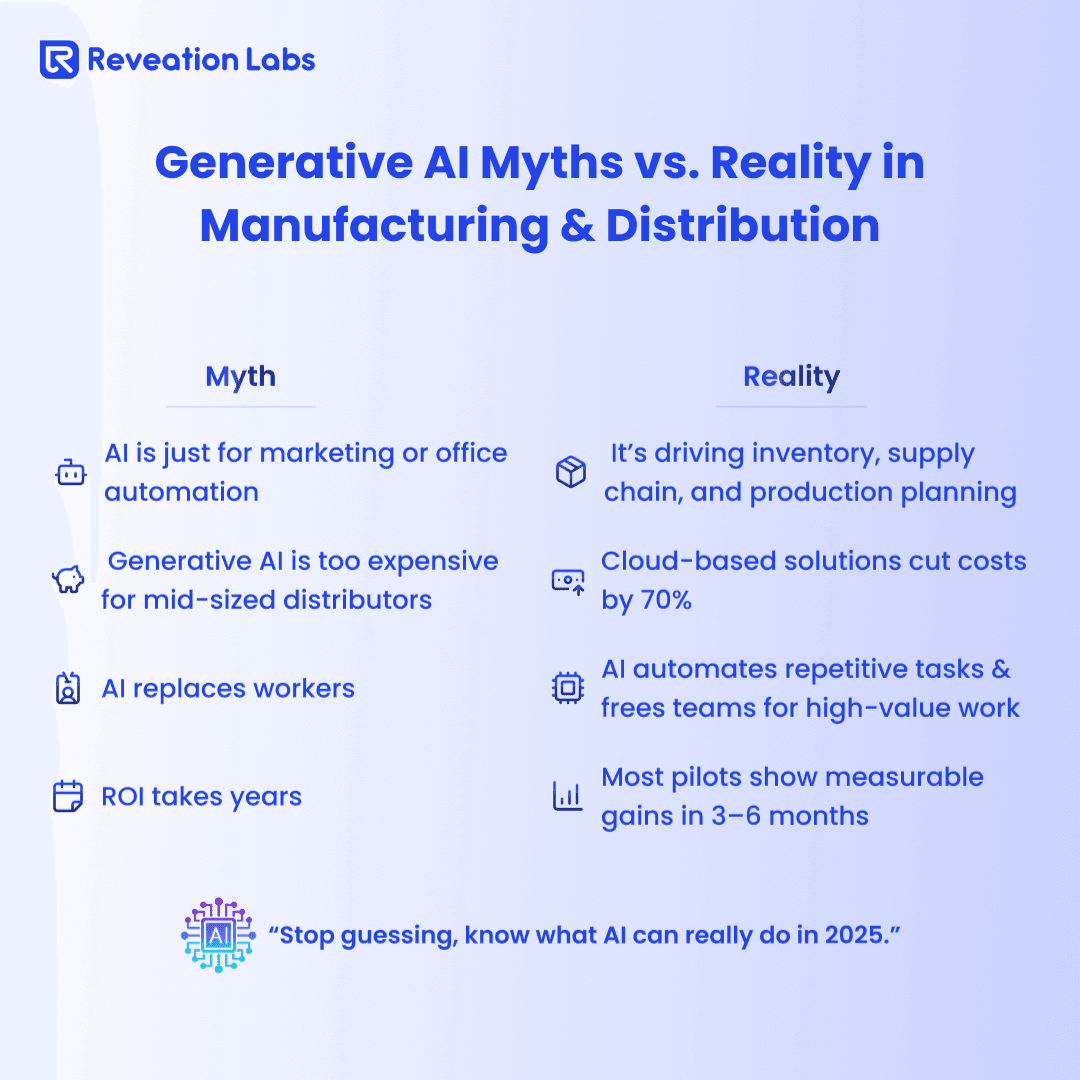
The window for competitive advantage is narrowing. Industry data shows that 37% of B2B manufacturers already report significant benefits from generative AI solutions, and early adopters are seeing an average ROI of 41% in the first year.
Companies that delay implementation risk falling permanently behind competitors who are already capturing these advantages.
The question isn't whether to implement generative AI solutions, it's how quickly you can get started and how effectively you can execute.
Your competitors aren't waiting. The technology is proven. The ROI is clear.
The only question left is: are you ready to stop searching and start implementing?