
GenAI is changing B2B product search and discovery by moving the experience beyond keyword matching and toward intent interpretation, guided evaluation, and more natural buyer interactions.
Buyers increasingly expect to describe needs in plain language, compare options faster, and get useful direction before speaking with sales.
That shift matters because B2B search has never just been about returning results.
It has always been tied to product complexity, catalog quality, buyer confidence, and the ability to connect discovery with business context like compatibility, substitutes, pricing logic, and account-specific constraints.
Key point: In our work, we see the same pattern repeatedly: teams want AI-powered discovery, but the real blocker is usually not the absence of AI. It is weak product data, inconsistent taxonomy, poor search UX, and disconnected systems that force buyers to do too much translation on their own.
How Buyer Behavior Is Changing
GenAI changes buyer behavior by making question-based discovery feel normal.
Instead of searching only by exact part number or product name, buyers can describe a need, environment, issue, or desired outcome and expect the system to respond intelligently.
That is especially important in B2B, where buyers often know the problem before they know the precise product.
This is one reason we have emphasized the importance of B2B ecommerce search that understands your industry. Buyers do not always use your internal naming conventions. They search with the language of the field, the plant, the job site, the procurement workflow, or the application itself.
GenAI also raises expectations earlier in the buying journey.
Buyers want to narrow options, understand tradeoffs, and build confidence before they contact sales. If discovery is slow, gated, or confusing, they leave with the impression that the rest of the buying process will be equally difficult.
What GenAI Changes In B2B Product Discovery
The biggest change is that discovery becomes less about retrieving a matching string and more about understanding intent.
A buyer can ask for a compliant replacement, a product suitable for a harsh environment, or a part compatible with an existing setup. That makes discovery more useful, but it also makes weak catalogs much easier to expose.
GenAI also changes what buyers expect from the experience itself. They are not just looking for a results page. They want help comparing options, filtering by relevance, understanding fit, and moving toward the next step with less uncertainty.
This is closely related to themes we have already explored in our article on GenAI product discovery and agentic AI in B2B commerce. The difference here is practical: once GenAI becomes part of discovery, the operational demands on your catalog, UX, and data model increase immediately.
Traditional Search
Strongest when buyers already know exactly what to type.
GenAI Discovery
More useful when buyers search by need, context, use case, or desired outcome.
From Keyword Matching To Intent Interpretation
Traditional search is strongest when buyers already know what to type.
GenAI is more useful when they do not. In B2B environments, that often means searching by use case, environmental condition, performance need, substitute logic, or compatibility requirement rather than exact title.
This is why natural language search matters so much. If a buyer searches for “food-safe motor for a humid packaging line,” discovery should not depend on exact phrase matching. It should connect buyer language to structured product reality.
From Static Catalogs To Guided Evaluation
GenAI makes buyers expect more than access to information.
They expect help using it.
That means good discovery should support guided comparison, better narrowing, and clearer explanations of why a product is relevant.
This is particularly valuable in categories with technical complexity, product overlap, or high risk of wrong selection.
Filters and facets still matter, especially for technical users and repeat buyers. But they should now work alongside better query interpretation, stronger relevance, and more conversational paths to evaluation.
Why Many Current B2B Search Experiences Fall Short
Many B2B teams are trying to add AI on top of search experiences that were originally designed for known-customer ordering.
Those systems may work well enough for exact SKU retrieval, but they break when buyers search by symptom, application, constraint, or desired outcome.
This problem gets worse when product details are hidden too early. We have written before about why account requests cost you buyers during product discovery. If buyers cannot evaluate relevance before hitting a gate, GenAI does not solve the issue. It simply sits on top of the same friction.
| Failed Approach | Why Teams Choose It | Why It Fails |
|---|---|---|
| Add a chatbot before fixing the catalog | It feels like the fastest AI win | The system cannot ground answers in reliable product information |
| Optimize only for exact keyword or SKU search | It works for repeat buyers | New buyers cannot search by problem, use case, or intent |
| Hide too much product detail too early | It seems safer operationally | Buyers cannot qualify fit early enough to stay engaged |
| Treat search as only a storefront widget | It appears to be a front-end issue | The deeper constraints are usually data, taxonomy, and system context |
A replacement-parts catalog is a simple example.
The business may know that Product B is the best substitute when Product A is discontinued, but if that relationship is not modeled in the catalog, discovery will still fail. The same is true for compatibility, environmental ratings, or customer-specific product availability.
What GenAI Now Requires From Product Data And UX
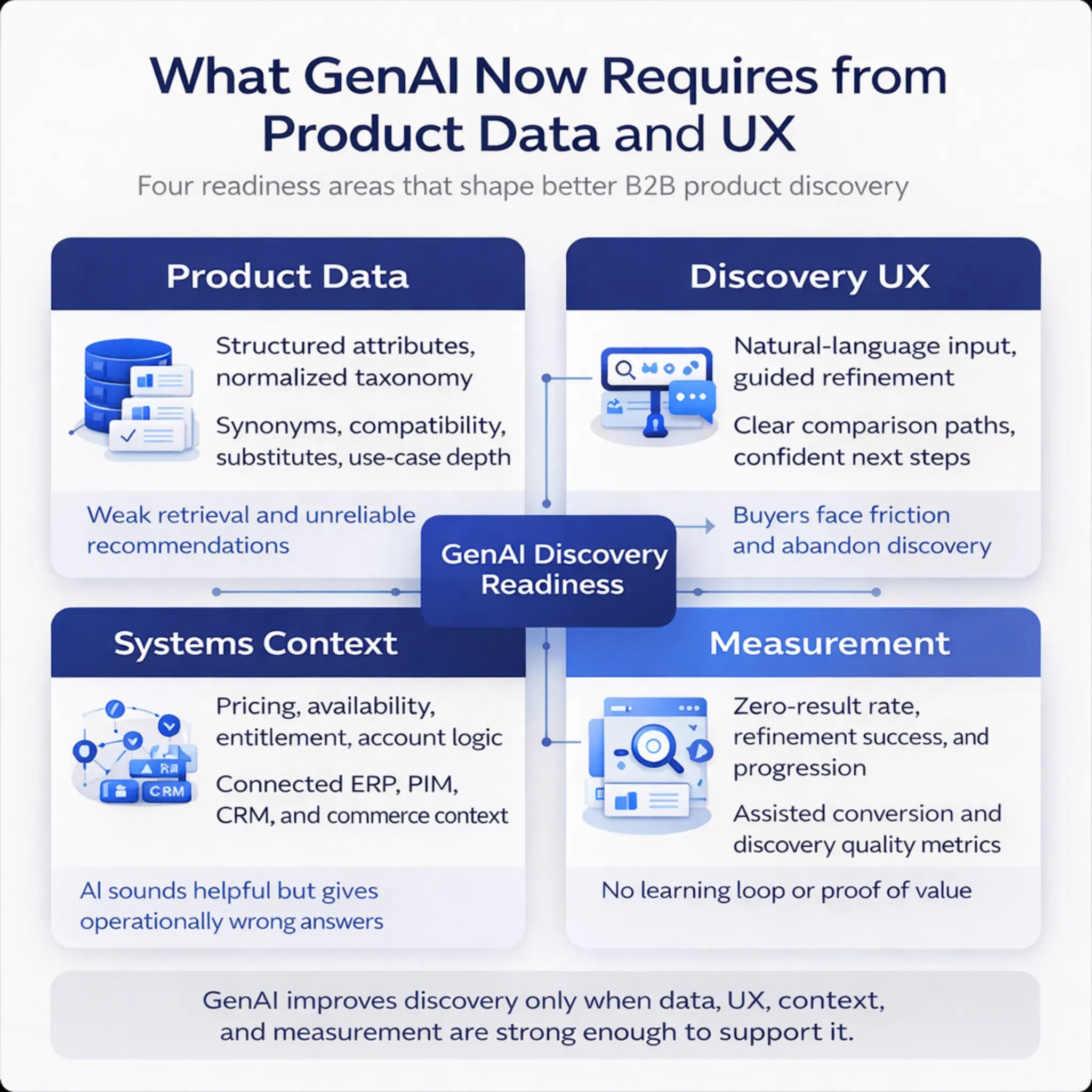
Once GenAI becomes part of the discovery layer, product data quality matters much more.
Strong product titles are not enough. Teams need structured attributes, normalized taxonomy, synonym coverage, product-family logic, compatibility relationships, substitute paths, and use-case language that reflects how buyers actually search.
UX requirements change too.
Search can no longer assume that buyers will navigate a fixed path or speak your internal language. The experience has to support plain-language entry, guided refinement, useful comparison, and clear next steps. That is one reason our work in UI/UX design for ecommerce often starts with buyer tasks and decision flows rather than page elements alone.
Business context also matters more. In B2B, discovery often depends on pricing rules, entitlements, inventory realities, and account-specific logic that live outside the storefront. If those systems are disconnected, AI-generated discovery may appear smart while still being commercially or operationally wrong.
| Readiness Area | What Good Looks Like | Common Warning Sign | First Move |
|---|---|---|---|
| Product data | Structured attributes, rich specs, normalized taxonomy, relationship logic | Thin descriptions, duplicate naming, missing metadata | Audit priority categories and normalize high-value attributes |
| Discovery UX | Plain-language input, guided refinement, strong comparison paths | Exact-match dependence and dead-end results | Redesign around buyer tasks instead of site structure |
| Systems context | Relevant access to pricing, availability, substitutions, and account logic | Search operates in isolation from business rules | Prioritize integrations that affect discovery quality first |
| Measurement | Clear metrics for search success, progression, refinement, and assisted conversion | No baseline or search learning loop | Define KPIs before rollout and review search behavior consistently |
What Leaders Should Do Next
Start where discovery friction is already hurting the business.
That might be replacement parts, technical long-tail categories, configurable assortments, or product lines with high abandonment and repeated support questions. GenAI is most valuable where better interpretation can reduce measurable friction.
Then fix the content model before overinvesting in the interface layer.
In many cases, improving structured product data, taxonomy, attribute logic, and relationship modeling creates more value than launching a visible AI feature too early. That is why our work in B2B ecommerce consulting and ecommerce implementation usually begins with diagnosis rather than surface redesign alone.
Practical Next Step: Review your top discovery categories and ask whether buyers can search by problem, application, compatibility, and substitute need. If not, your GenAI opportunity probably starts with data and UX readiness, not with a chatbot.
For teams that know discovery is underperforming but are not sure whether the root cause is data, UX, platform capability, or integration complexity, a structured diagnostic is often the right first move. Our B2B ecommerce discovery sprint is designed for exactly that kind of planning step.
Conclusion
GenAI changes B2B product search and discovery by making intent, context, and guided evaluation far more important than simple keyword retrieval.
It creates better opportunities for buyers, but it also raises the standard for product data, search design, and operational connectivity.
The teams that benefit most will not be the ones that add the most visible AI layer first. They will be the ones that give AI something reliable to work with: clean catalog structure, richer product relationships, stronger UX, and enough business context to produce useful discovery. That is where better self-serve buying starts.
If your team is evaluating how GenAI should change search, discovery, or catalog strategy, start with a readiness assessment before jumping into feature selection.