
Modern B2B ecommerce search is changing fast, with the underlying ecommerce search engine capabilities becoming crucial. Buyers don’t want to call a rep to find a spec; they want the answer right now, in the search bar. The numbers are blunt: 83% of B2B buyers prefer to place orders online without speaking to a sales rep, and 66% expect full personalization. Treating your site search as “good enough” is now a competitive risk, not just a UX blemish.
At the same time, leaders recognize the role of AI in B2B ecommerce, but adoption is uneven: 84% of B2B companies say AI is strategically important, yet only 41% are fully AI-operational. This gap highlights the potential for advanced ecommerce search solutions.If you invest thoughtfully in AI-powered search, you can leap ahead of slower adopters.
This blog gives you a practical, industry-aware blueprint for a search engine optimization strategy: why keyword-only search fails in B2B, how hybrid retrieval (BM25 + vectors) plus RRF (Reciprocal Rank Fusion) and cross-encoder re-rankers create precision, how PIM + AI enrichment fixes data gaps, what’s new in 2025, and the blind spots to avoid.
Why Search Is Now Your B2B Storefront
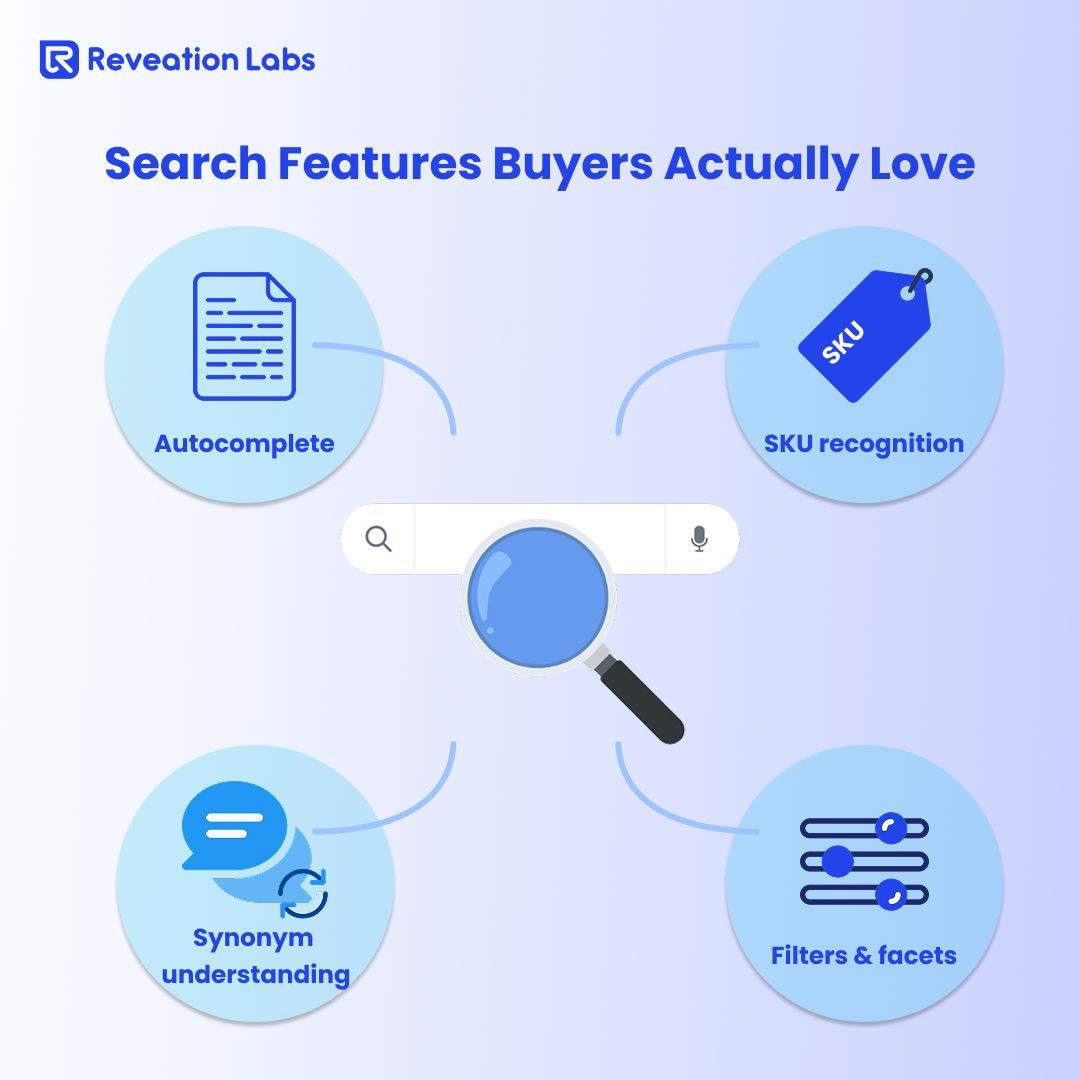
B2B buyers increasingly behave like B2C consumers: they Google, skim, compare, and expect frictionless self-serve. On most sites, roughly a third of visitors use site search ecommerce functionality; those searchers convert up to 50% higher than non-searchers. In other words, if search disappoints, so does your revenue.
Three strategic shifts make search existential for B2B in 2025:
- Self-serve first: Millennial and Gen-Z buyers prefer autonomy, mobile, and instant answers. Show the exact part or spec through effective b2b product search, fast, or they bounce. (Multiple studies now attribute the “rep-free” preference to a majority of buyers.)
- AI’s urgency: Leaders are leaning into AI for search and discovery, but few are “fully operational.” This gap is your window to win.
Agent-ready exposure: AI procurement tools and shopping assistants are starting to query supplier catalogs. If your catalog isn’t structured and searchable, it may be invisible to these agents.
At Reveation Labs, our B2B eCommerce Consulting expertise ensures that businesses integrate AI-powered ecommerce site search tailored to their industry needs.
Why Keyword-Only Search Fails B2B (And How to Fix It)
B2B queries aren’t like “blue shoes.” They’re dense with specs, standards, legacy part numbers, and industry shorthand. Keyword-only engines, which are a basic type of search engine in ecommerce, struggle because they match words, not meaning.
Common Failure Ways
These are the most common ways B2B ecommerce search breaks down:
- Jargon & synonyms: Buyers use industry shorthand, but search engines don’t always understand. For example, “PTFE” vs. “Teflon,” “O-ring” vs. “seal,” or “solenoid valve” vs. “solenoid-operated valve.” Without a synonym map, the system returns “no results” even when the right product exists.
- Units & symbols: A pipe listed as 24″ might not show up if someone searches for “610 mm.” Symbols like ≤100 °C or ±5% confuse keyword search because the system only recognizes one version of the unit.
- Part-number quirks: Product numbers often have dashes, spaces, or suffixes (like “AB-1234” vs. “AB1234B”). On top of that, old SKUs may be replaced by new ones. A basic search engine doesn’t know they’re connected, so buyers think you don’t have what they need.
- Dark data in PDFs/CAD: Many specs live in datasheets, manuals, or CAD drawings. If those details aren’t extracted, search engines miss them completely. A query like “power supply -40 °C” might fail even though the part exists in a PDF.
- Compliance & contract rules: In B2B, not everyone can buy every product. Regional restrictions, contract pricing, or entitlements matter. If search shows products that a buyer cannot purchase, it erodes trust quickly.
Design Principles That Fix These
Here’s how modern AI in B2B ecommerce solves those issues:
- Hybrid retrieval by default: Combine keyword search (BM25) with AI vector search (semantic intent). Then merge the results with RRF so the best matches surface, whether the buyer typed the exact term or not.
- Re-rankers over raw LLMs: After pulling 50–200 possible results, use a cross-encoder re-ranker to put the best products on page one. It’s more accurate than asking a general AI to “sort these.”
- PIM + AI enrichment: Extract attributes from PDFs, normalize units, and fill missing fields so filters (like size or voltage) actually work.
- Business guardrails: Apply rules first: entitlement, inventory, region, hazardous-goods policy, or fitment. Don’t show items that buyers can’t buy.
How Embeddings Help You “Speak the Industry”
Embeddings (AI vectors) map words and phrases into a numerical space where “Teflon” sits near “PTFE,” “24 V” sits near “24-volt,” and “2 inch” sits near “50.8 mm.” Used correctly, embeddings decode jargon, acronyms, and phrasing variations while keeping results accurate.
Five Implementation Patterns That Matter in B2B
To make B2B ecommerce search truly understand your industry, you need to handle the details that trip most systems up. Here are five patterns that work:
- Field-aware vectors (precision by attribute).
Don’t throw an entire product into one big AI vector; it blurs the meaning. Instead, create separate vectors for key attribute families (like material, thread type, voltage, or compliance). That way, when a buyer searches “M12 thread,” the system compares only against the thread field, not random description text. The result: fewer false matches and higher precision. - Unit normalization everywhere.
Buyers search in inches, millimeters, feet, or symbols like ″. If your system doesn’t normalize units, half the catalog becomes invisible. At ingest and query time, translate everything into a standard (for example, mm, kg, psi). A smart trick is to embed both versions: “24 inches (610 mm),” so queries in either unit find the product. Unit mismatches are the number one silent killer of relevance. - Domain synonym graph (learn from your data).
Engineers and buyers use different shorthand: “SS” = stainless steel, “PTFE” = Teflon. Instead of relying on a generic thesaurus, mine your own logs, RFQs, and support tickets to cluster terms. Feed these synonyms into both the keyword index and the AI vectors. Over time, your synonym graph becomes more accurate than any out-of-the-box dictionary. - Multilingual and mixed-language support.
Global buyers often switch languages mid-query, for example, “válvula solenoide 2 inch.” Modern multilingual embeddings can align these concepts, allowing you to avoid duplicating your catalog in every language. The buyer feels like the site “just works” in their own language. - Spec extraction from documents.
A lot of specs hide in PDFs, manuals, or CAD drawings. With OCR and document AI, you can pull out structured fields like “max pressure = 200 psi” or “temperature range = -40°C.” Index both the extracted attributes (for filters) and the raw text (for recall). That way, a query like “FDA-compliant food pump at 200 psi” actually finds the right product.
Cold-start protection.
New SKUs often rank poorly because they lack click history. With embeddings and normalized attributes, relevance comes from the product content itself. That means a brand-new item can surface on day one without waiting weeks for usage data.
Also Read: B2B eCommerce for Manufacturing
What’s New & Notable in 2025
- Hybrid > vector-only: Precision matters in B2B; hybrid retrieval has become the default pattern across platforms.
- RRF everywhere: Simple, parameter-light, and effective for merging ranked lists; now first-class in major engines.
- Cross-encoder re-rankers win page one: Latency trade-offs are worth it at top-k; cache frequent queries and re-rank only the shortlist.
- Agent-ready catalogs: AI agents will pick winners based on data quality and API usability.
- Spec-sheet automation: More teams are converting PDF tables to attributes to shrink zero results and power better filters.
- Compatibility search: Fitment graphs (what fits what) drive conversion and cut returns.
- Merchandising loop: Search analytics now inform category landing pages, bundle suggestions, and facet ordering.
Integrating advanced AI-driven B2B eCommerce solutions ensures your ecommerce search engines deliver accurate, industry-specific results that match buyer intent.
Blind Spots That Quietly Tank Relevance
Even a well-designed B2B ecommerce search can fail if you miss these common pitfalls:
- Unnormalized units and symbols: Buyers type “1/2 inch,” “0.5 in,” or “12.7 mm”, but if your system doesn’t treat them as the same thing, the query returns “no results” even though the right product exists.
- One giant vector for everything: If you mash all product data into a single AI vector, the meaning gets diluted. Field-aware vectors (e.g., one for material, one for voltage) keep matches precise.
- Missing product supersessions: When part A is discontinued and replaced by part B, your search must surface B with a “Replaces A” note. Otherwise, buyers think you don’t carry it.
- Relying too much on offline metrics: Scores like NDCG or MRR are useful, but the real measure is revenue: Are people adding to cart after search? Without live A/B testing, you miss that signal.
- Copilot without safety rails: An AI assistant that invents specs or compliance data is dangerous. It must always cite your real documents and stay grounded in facts.
- No visibility into failures: If you aren’t tracking and fixing zero-result searches each week, the same gaps (units, synonyms, part numbers) keep frustrating buyers and eroding trust.
A Virto Commerce solution provider can help you leverage AI-powered search capabilities tailored to your industry, making product discovery faster and more accurate.
Build vs. Buy: Proven Implementation Patterns
Most teams assemble B2B ecommerce features with a hybrid approach:
- Keyword index: Elastic, OpenSearch, or Solr.
- Vector search: Weaviate, Vespa, Pinecone, or cloud hybrid services.
- Re-rankers: Hosted APIs for speed, or self-host cross-encoders for control.
- PIM integration: Enrichment jobs to normalize units, parse PDFs, and track provenance.
- Governance: Ensure entitlements and security are enforced across tenants.
Agent-Ready Catalog Checklist
Standardized attributes and canonical units
Unit normalization at ingest + query
Entitlement and compliance filters baked in
Search/product API with query + filters, pagination
Provenance stored and exposed
Supersessions modeled, alternates recorded
Document extraction pipeline running
This checklist bridges human usability and AI in B2B ecommerce scenarios where procurement bots evaluate suppliers.
Metrics That Matter (Tie Search to Revenue)
- Zero-result rate: Aim down and to the right, each “zero” is a fixable signal (synonym, unit parsing, data gap).
- CTR after search: If low for a popular query, inspect the fused and re-ranked lists.
- ATC after search: Your “north star” for commerce search.
- Abandonment: Search → no click → exit. Investigate; often a synonyms/units issue.
- Time to first click: Shorter typically means clearer page-one relevance; watch for category nuances.
Executive Angle: Why Leadership Should Care
This isn’t “just” a search project; it’s a revenue and CX transformation.
- Conversion: Search users are higher intent and convert 50% better.
- AOV: Smarter B2B ecommerce features surface accessories and add-ons.
- Retention: Trust compounds when buyers find the right spec reliably.
- Cost to serve: Every clarified query is one fewer support ticket.
- Fewer returns: Fitment/compliance filtering reduces errors.
For leaders (90-day targets)
- 20–40% drop in zero-result rate
- 10–20% lift in CTR after search for top queries
- 5–15% lift in ATC after search
- Lower support tickets, fewer returns
A Concrete Example
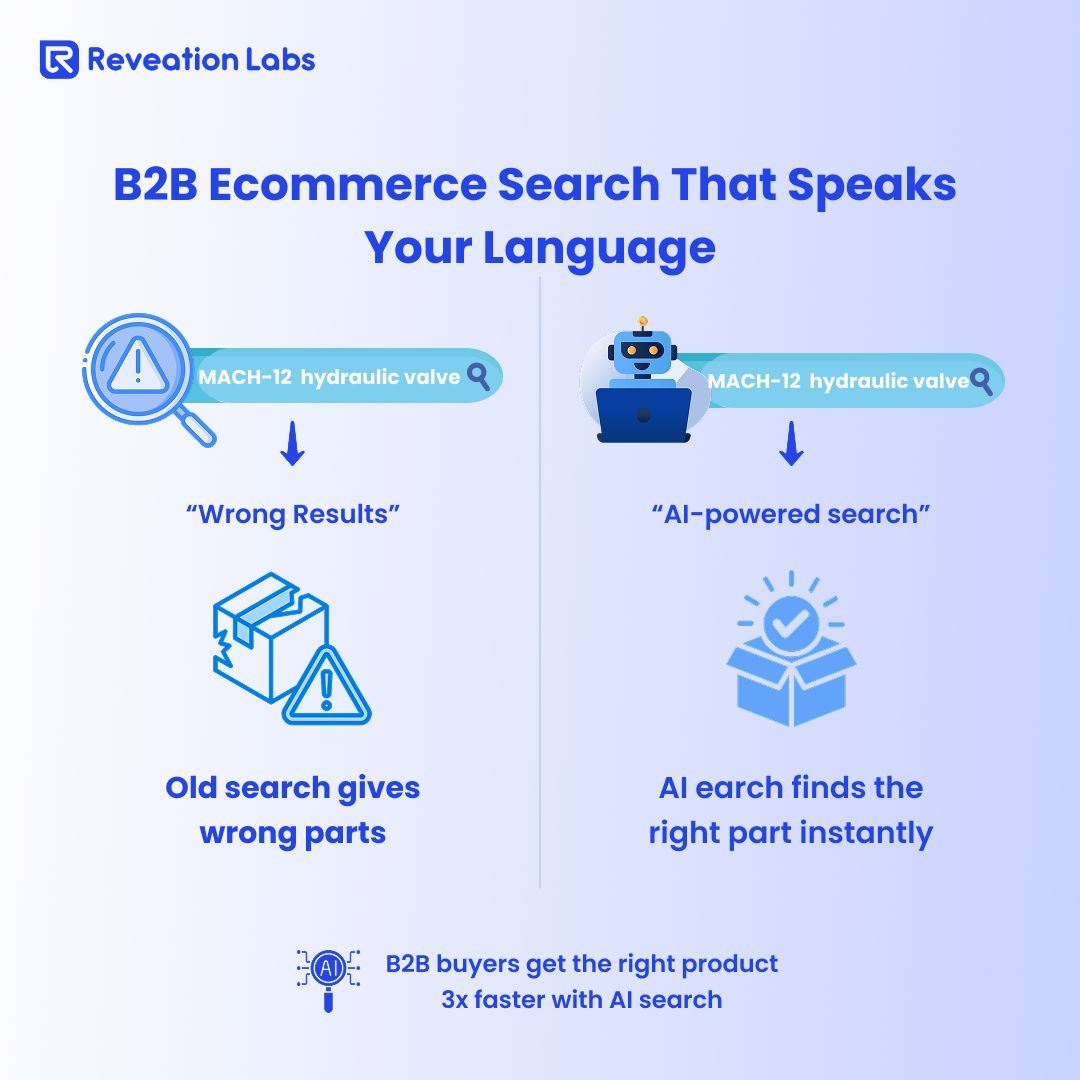
Let's take an example of searching for “24V Solenoid Valve 1/2 inch” in the ecommerce search box. Here’s what happens in a modern B2B ecommerce search engine:
- Preprocessing: The system interprets “1/2 inch” as “0.5 in” or “12.7 mm.”
- Dual retrieval: Keywords match “24 V” and “1/2 in.” Vectors match “24-volt solenoid valve” and “12.7 mm port.”
- Merging with RRF: Top results from both lists rise in a fused ranking.
- Business rules: Ineligible or restricted SKUs are filtered out.
- Re-ranking: A cross-encoder ensures the top 3 are the true best fits.
- Filters: The sidebar shows useful options: voltage, size, material, and certifications.
- Copilot: If asked, “Will this handle 150 psi food-grade?” the assistant cites the spec sheet directly.
Result: The buyer finds the right valve, with confidence that it’s compliant, and zero wasted time.
Make Your Search Speak the Industry
In 2025, the search bar is the front door to your B2B business. The modern baseline is clear:
- Hybrid retrieval (BM25 + vectors)
- RRF fusion to merge signals
- Cross-encoder re-ranking for laser-sharp page-one relevance
- PIM + AI enrichment to expose specs and normalize units
- Business guardrails so results match what buyers can actually purchase
- RAG copilot that cites your own data
- Analytics tied to ATC and revenue, not just offline metrics
Do this and you transform search from a weak link into a growth engine, one that meets buyers where they are: self-serve, specification-driven, and impatient with anything less than precise. Your site becomes the place where an engineer types a line of industry jargon and thinks, “Finally, this supplier gets it.”
At Reveation.io, we build search that understands your industry, hybrid retrieval, AI enrichment, guardrails, and copilots that drive revenue.