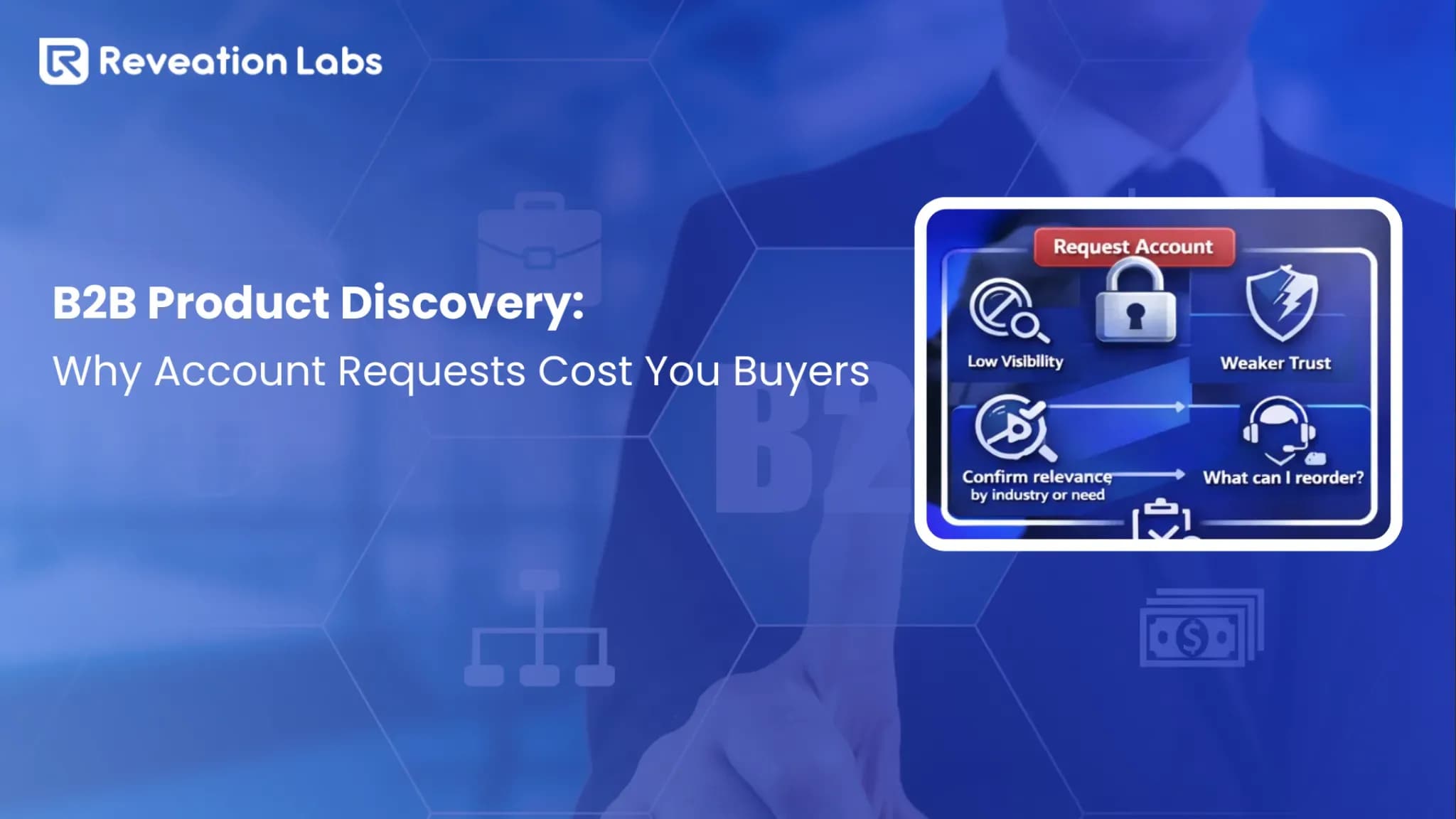

If your digital experience starts with Request an Account, you are asking buyers to identify themselves before they can decide whether you are relevant.
That is not just UX friction. It is a growth problem.
Many B2B portals are excellent for existing customers and weak for discovery.
They support invoices, approvals, reorders, and account-specific pricing, but they often hide the content new buyers need to find, trust, and move forward.
As we explain in Customer Portal SEO: Why New B2B Buyers Still Can’t Find You, a portal can work perfectly for account workflows and still stay invisible to the buyers you want next.
That is why this issue should be framed as B2B product discovery, not just portal design.
The commercial impact is straightforward. Fewer indexable entry points mean weaker self-qualification and more avoidable load pushed back onto sales and support.
When buyers cannot understand fit on their own, they either call late or leave early.
Discovery Friction
Request First
A gated portal creates friction at the worst moment, the first click.
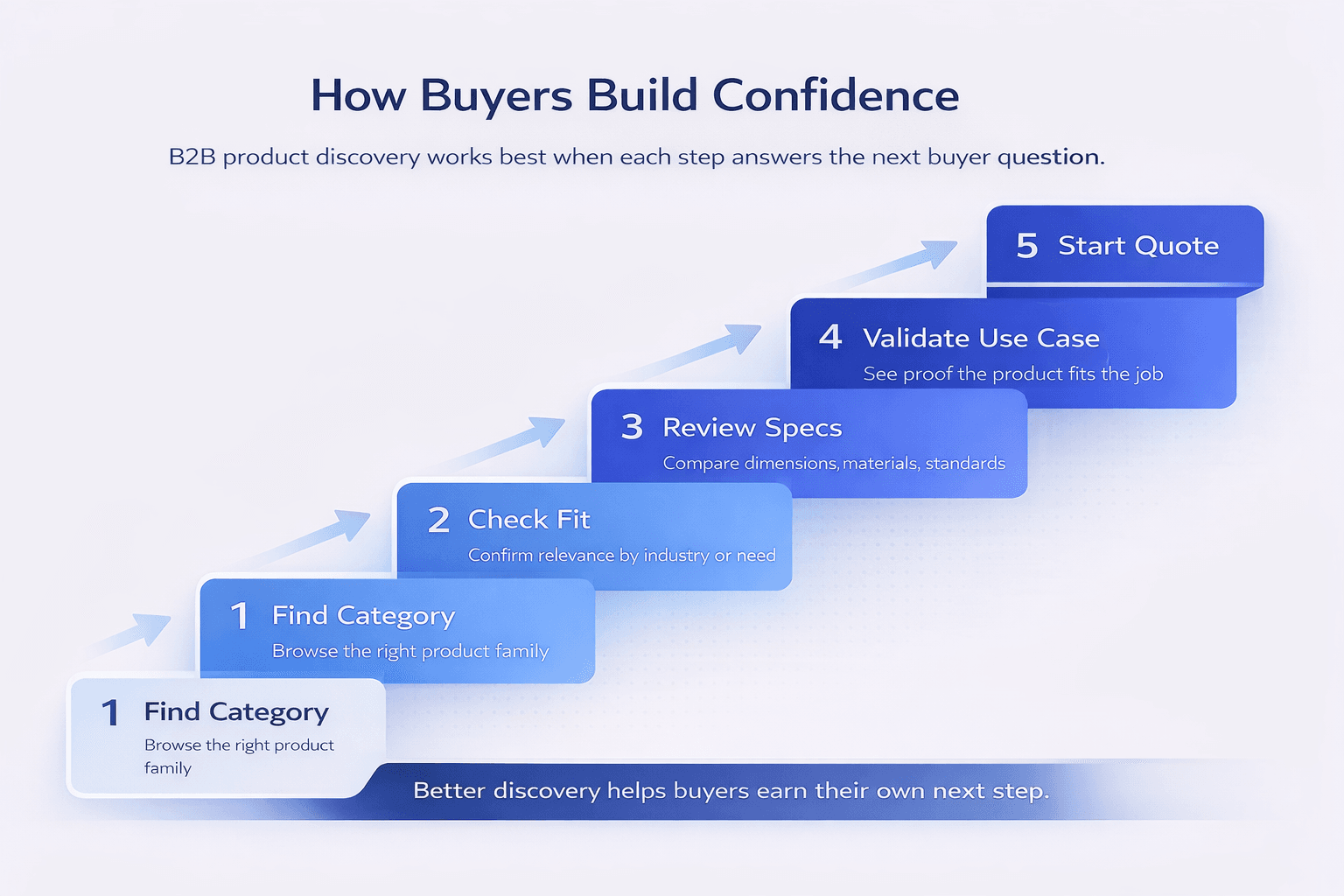
A buyer arrives with a category, part number, spec, or use case in mind and hits a gate before they can confirm basic relevance.
That asks for trust before the site has earned it. For net-new demand, it creates unnecessary drop-off.
Buyers Leave
This is why teams still wonder why buyers fall back to calls and email.
Reveation’s post on why buyers still call instead of ordering online shows that adoption problems often start well before checkout.
The issue is not that buyers reject digital. The issue is that the first digital steps are harder than they should be.
Executive takeaway: This is not a cosmetic issue. A portal-first entry path reduces discoverability, slows self-qualification, and shifts avoidable work back to revenue teams.
Portal Limits
Hidden Pages
Search engines can only rank what they can access and understand.
When product value lives behind login walls, account-request screens, or weak public pages, your strongest commercial content never gets a chance to work.
That is why Reveation’s customer portal vs B2B eCommerce storefront comparison matters. A portal and a storefront can both be useful, but they solve different jobs in the buying journey.
Wrong Job
The mistake is not building a portal. The mistake is asking a portal to do storefront work.
Portals are built for known accounts. They assume the buyer already understands the catalog, the terminology, and the next step.
New buyers do not start there. As Reveation notes in why B2B buyers expect the same experience as B2C, buyers want faster access to relevant information, predictable next steps, and less friction in the early journey.
Discovery Fix
Public First
The fastest improvement is rarely a full replatform.
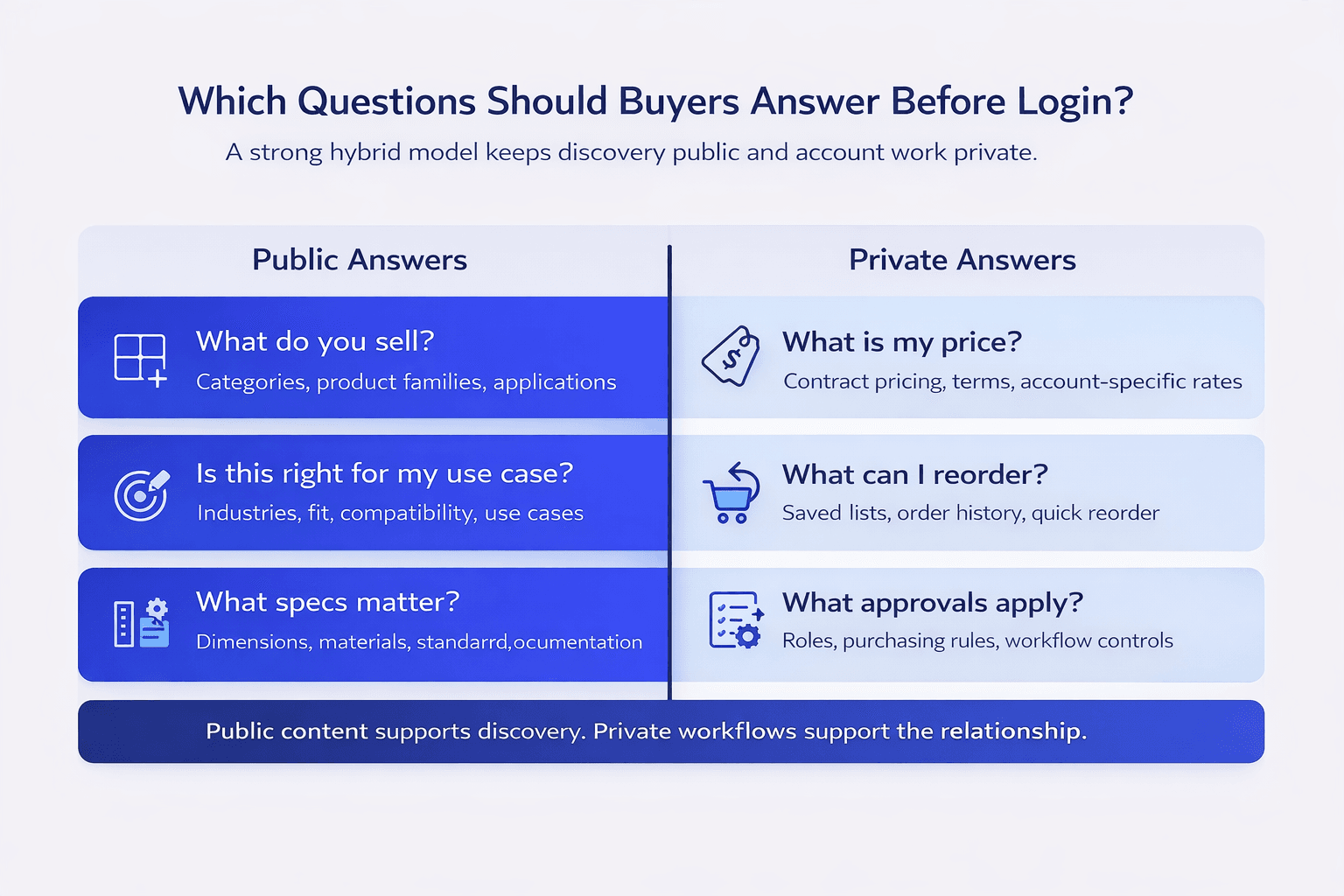
It is publishing a discovery layer buyers can actually use: public category pages, product-family pages, application pages, search-visible specs, and clear next steps.
You do not need to expose every account-specific detail. Contract pricing, entitlements, order history, approvals, and invoices can stay inside the portal while the catalog remains understandable from the outside.
Trust Signals
Public discovery pages need more than product names.
They need signals that help buyers self-qualify: industries served, use cases, technical specs, certifications, documentation, lead-time context, and a clear path to quote or account setup.
Search matters here too. Reveation’s article on B2B eCommerce search that understands your industry is a useful reminder that B2B buyers search with shorthand, standards, dimensions, part numbers, and jargon.
Examples by business type
- Industrial parts distributors: publish part families, compatibility guidance, and spec filters publicly while keeping price and account terms private.
- Manufacturers: publish application pages, certifications, and product-selection guidance before asking buyers to request access.
- Medical or regulated suppliers: keep sensitive purchase workflows gated, but make fit, documentation, and category understanding public.
Hybrid Model
Keep Portal
Your portal still matters. Existing customers need fast reorders, account-specific pricing, order status, invoices, approvals, saved lists, and service history.
Open Catalog
The cleaner model is usually hybrid: public for discovery, private for account work.
Buyers get searchable, indexable, confidence-building content before login. Existing customers get a secure workspace built for complexity.
Why It Fits Now
That pattern also aligns with Reveation’s recent post on the B2B eCommerce trends reshaping 2026, which argues that discovery quality is becoming a bigger differentiator as B2B buying gets more self-serve and AI-assisted.
Next Steps
Publish Basics
Start with the pages buyers need before they are ready to talk.
Publish category overviews, product-family pages, application content, spec summaries, and clear conversion paths. Give search engines something useful to index and buyers something useful to evaluate.
Run Sprint
If your catalog, pricing, or ERP rules are complex, do not guess.
Use a short strategy process to decide what belongs in the public layer, what stays private, and what should change first.
Reveation’s B2B eCommerce consulting, user experience design, and implementation services all support the same core move: remove the friction that keeps qualified buyers from progressing.
Final takeaway: Keep the portal for account work. Build the public discovery layer buyers need before they are ready to identify themselves. If they cannot learn from you first, they will learn from someone else.
Ready to plan your B2B eCommerce Discovery Sprint? 🚀
If your team is unsure what should stay public, private, or phased, Reveation’s Discovery Sprint helps map flows, catalog logic, pricing rules, and integrations into a practical roadmap.