
The bar for B2B customer experience in 2026 isn't "pretty design." It's clarity: fast answers, real self-serve, consistent data, and fewer surprises across every channel.
What you'll learn: what buyers expect today, why expectations rose, where B2B experiences break, and a practical 90-day plan to close the gap without betting the business on a rebuild.
Introduction
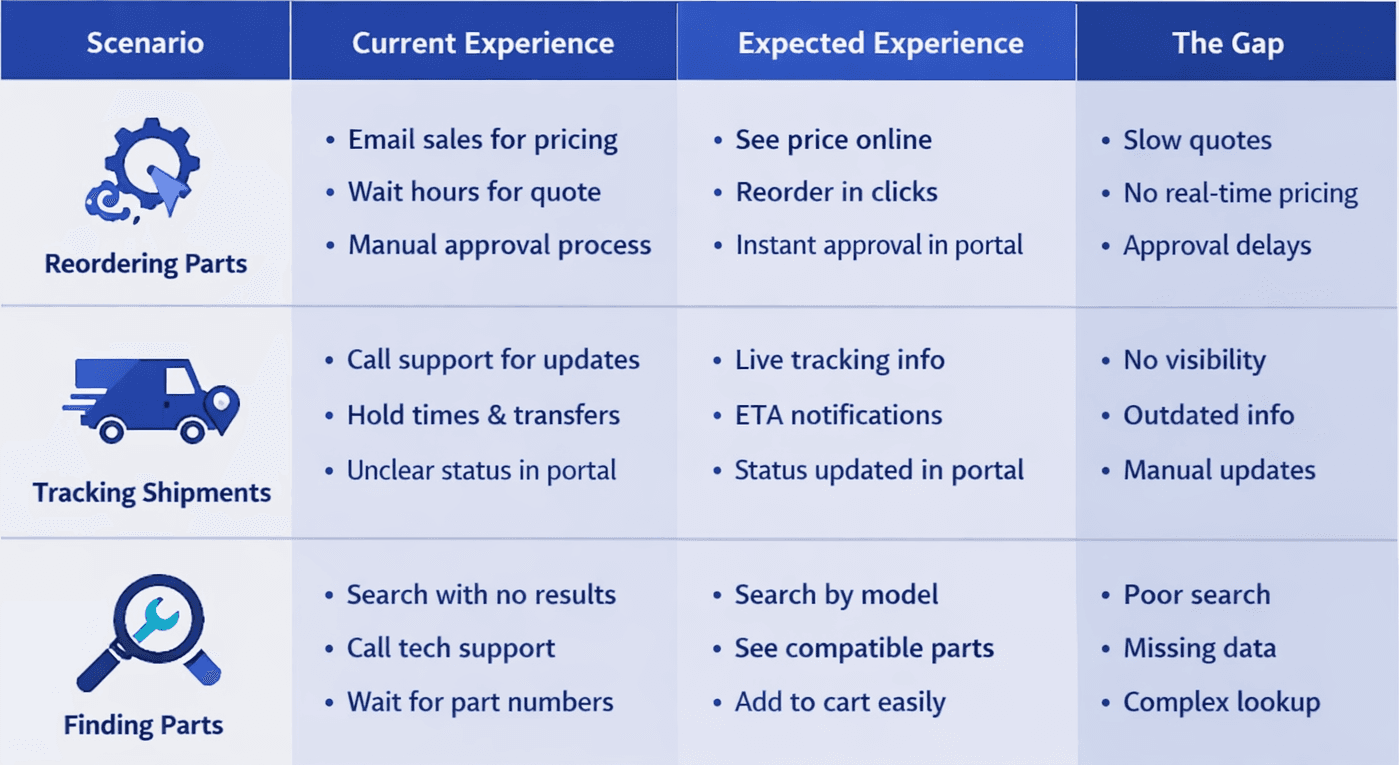
Last Tuesday, your procurement manager logged into your portal to reorder 200 units. Three hours later (after checking the portal, emailing sales, calling support, and getting transferred twice), they still didn't know if the order would arrive on time.
That's not a technology problem. It's an experience gap.
B2B buyers aren't asking for consumer-style one-click checkout. They're asking for something simpler: accurate information, real self-serve control, and predictable outcomes.
When a buyer can check order status on Amazon at midnight but has to wait until 9 am to call your rep for the same answer, the comparison is inevitable.
Here's what buyers actually expect in 2026, why those expectations rose, where B2B experiences typically break, and a practical roadmap to close the gap without rebuilding everything.
Myth vs. reality
Myth: "B2C-like means copying Amazon."
Reality: B2B buyers want consumer-clear journeys: accurate pricing rules, reliable availability signals, and self-serve steps that actually finish the job.
What This Looks Like in Practice
What B2B Buyers Expect Today
Buyer expectations are simple: "Don't waste my time, and don't make me guess." In practice, that translates into four pillars: speed, self-serve, consistency, and transparency. When any one pillar breaks, buyers either escalate to a human (costly for you) or switch to someone who makes buying easier.
Speed
Speed isn't only page load time. It's time-to-reorder, time-to-quote, and time-to-confidence (how quickly a buyer can confirm "this is the right item, at my price, with a realistic ETA"). If the buyer has to email for availability or wait days for a basic quote update, the experience still feels slow.
Self-serve
B2B self-serve means completing a task end-to-end with the right guardrails: reorders, invoice downloads, RMA initiation, quote requests, and approval tracking. If your "portal" is basically a catalog plus a phone number, buyers will keep calling because they have to.
Self-serve isn't anti-sales. It's pro-efficiency: sales shows up when judgment matters (exceptions, negotiation, configuration), not when someone needs an invoice PDF.
Consistency
Buyers don't see departments. They see one brand. When pricing or availability changes depending on whether they're in the portal, on the phone, or talking to a rep, trust drops fast. Consistency usually requires an integration-first commerce foundation, so ERP, PIM, pricing rules, and order status all stay aligned.
Transparency
Transparency is what replaces back-and-forth emails. Buyers want to see order status, shipment events, realistic lead times, and how pricing is being applied (contract vs. tier vs. promo). Sana Commerce's 2025 research highlights how often online buying breaks when underlying systems and data can't keep up, creating frustration and increasing supplier switching risk.
Why the Bar Has Risen
Consumer tech trained everyone on frictionless journeys
Your buyers live in consumer experiences that rarely break: clean search, instant confirmations, transparent tracking, and painless returns.
That becomes the baseline for "how buying should work," even when the product is industrial parts instead of sneakers.
Their tolerance for uncertainty has dropped, and that's reshaping buyer expectations everywhere.
Remote and digital-first buying normalized "rep-free" moments
Gartner's 2025 press release reports that 61% of B2B buyers prefer an overall rep-free buying experience, based on a survey of 632 buyers fielded Aug-Sep 2024. This isn't "no humans ever." It's "let me progress on my own until a human adds value."
The implication is powerful: the early journey must stand on its own. If buyers can't get a confident answer online, they don't "try harder." They reroute to email and phone, then blame your business for being slow.
Generational shift
Digital Commerce 360 (covering Salesforce research) notes that many millennial B2B buyers prefer self-serve tools and progress deep into research before engaging suppliers. For you, that means credibility is built earlier through accurate data, clear UX, and consistent answers.
Omnichannel reality
McKinsey's B2B research highlights how buyers use multiple interaction channels throughout the journey and expect a smooth experience across them. Buyers don't separate "portal," "sales," and "support." They expect one continuous thread.
Where B2B Often Falls Short
Here's what losing a buyer looks like in slow motion:
A procurement manager opens your portal to place a $50K order. The listed price doesn't match their contract terms, so they email their rep. The rep is in meetings. They try chat support.
The agent can't access contract pricing. They call the main line, get transferred, and explain everything again. By hour three, they're wondering if a competitor would make this easier.
You didn't lose on price or product. You lost trust.
Most B2B experiences don't fail catastrophically. They fail gradually through small moments of uncertainty that accumulate until the buyer gives up or routes around your digital channel entirely.
Here's where those moments typically occur:
Self-serve that stops halfway
The portal lets buyers request a quote but not track its status. They submit the request into a black hole, then call two days later to ask, "what happened to my quote?" This isn't self-serve. It's self-submit.
Data mismatches across channels
The ERP shows inventory available, the portal says "contact sales," and the rep quotes a different lead time. The buyer doesn't know which source to trust, so they trust none of them.
Workflows that ignore B2B reality
You've built a beautiful checkout flow, but it doesn't handle ship-to rules, split deliveries, PO requirements, or multi-level approvals. Result: buyers abandon carts and call to place orders manually.
Search that can't think like buyers
A buyer searches "pump seal for XR-400" (their equipment model). Your search returns zero results because you only indexed by manufacturer SKU. They call tech support instead of buying.
Support content disconnected from buying
Installation guides, spec sheets, and compatibility charts live in a separate knowledge base. Buyers bounce between tabs, trying to cross-reference information that should be surfaced right in the product detail.
What teams try vs. what actually works
| What teams try | Why it fails | Better move |
|---|---|---|
| "Let's redesign the storefront." | UI improves, but buyers still can't trust pricing, stock, or ETAs. | Fix the truth layer first, then optimize UX flows. |
| "Add a chatbot." | Chat can't resolve core issues if systems aren't aligned. | Use chat for navigation and triage, not as a band-aid for broken data. |
| "Force everyone to talk to sales." | Buyers want control early; forced contact adds friction. | Offer self-serve for common tasks; route exceptions to humans. |
| "Make everything self-serve." | Some purchases need guidance; poor self-serve increases regret. | Build hybrid journeys: self-serve with fast escalation paths. |
| "One portal for everyone." | Different roles need different views (procurement vs. maintenance vs. AP). | Personalize by role, account, and job-to-be-done. |
To meet rising expectations, businesses must invest in robust B2B eCommerce Solutions that deliver personalized experiences, seamless navigation, and real-time data—mirroring the convenience buyers are accustomed to in the B2C world.
How to Close the Gap: A 90-day execution plan
Good news: you don't need to rebuild everything. You need to fix the right things in the right order.
The pattern that works: map, fix truth, optimize flows, measure outcomes. This isn't a two-year digital transformation. It's a 90-day cycle that you repeat, each time expanding self-serve capability and reducing cost-to-serve.
Here's the sequence:
Step 1: Map journeys
Stop mapping "web journey" vs. "sales journey." Map the jobs buyers are trying to complete, then capture friction, handoffs, and uncertainty moments. Customer journey mapping becomes an operational tool, not a workshop artifact.
- Reorder a known basket (fast, error-free)
- Find compatible replacement parts (even without a SKU)
- Request a quote for a new configuration (and track status)
- Check order status and ETAs across multiple POs
- Download invoices and resolve billing questions
- Initiate an RMA or replacement with visibility
Step 2: Prioritize "self-serve that matters"
Not every feature moves the needle. Buyers will forgive "less personalization," but they won't forgive missing status, unclear delivery expectations, or quote workflows that vanish. Start with workflows that reduce cost-to-serve and increase repeat buying.
| High-impact self-serve | Why buyers care | Common blocker |
|---|---|---|
| Quick order and bulk upload | Makes repeat purchasing fast and reduces errors | Weak SKU hygiene, missing aliases, poor validation |
| Order status and shipment visibility | Replaces "where is it?" calls and builds confidence | Disconnected OMS/WMS events, slow updates |
| Quote creation and tracking | Reduces back-and-forth and speeds decisions | Manual rules, inconsistent pricing logic |
| Invoices and account statements | Solves common AP friction without support tickets | ERP access constraints, security/role design gaps |
Quick wins: Start this week
While you're planning the bigger roadmap, these three changes typically take under 30 days and show immediate impact:
1. Expose order history for top 100 accounts (Let repeat buyers see what they ordered before, even if reordering isn't fully self-serve yet. This alone reduces "what did we order last time?" calls.)
2. Auto-send shipping notifications (Connect your WMS/carrier feed to email notifications. Buyers stop calling for "where's my order" updates, and your support team thanks you.)
3. Surface contract pricing for logged-in users (If you have customer-specific pricing in your ERP, show it in the portal for authenticated users. Removes the number one "contact sales" blocker.)
Each of these requires integration work but not platform rebuilds. Measure the impact (call volume, reorder frequency, portal logins) to build momentum for bigger initiatives.
Step 3: Fix the data backbone
Self-serve only works when the system tells the truth. That typically means clarifying system roles (ERP vs. PIM vs. commerce), then building predictable flows for pricing, inventory/availability signals, order events, and entitlements. If this is your constraint, start with eCommerce integration as a product (measured, versioned, and owned).
Rule of thumb: when buyers don't trust the portal, they don't "try harder." They switch channels, or suppliers.
Step 4: Design UX for complex B2B workflows
B2B UX is workflow-first: roles, approvals, contract catalogs, ship-to rules, and repeat orders. The goal is not "more options," it's fewer decisions for repeat tasks and fewer clicks for known paths. This is where B2B eCommerce user experience design becomes a revenue and cost-to-serve lever.
Step 5: Make channels consistent
Consistency is an operating model choice. A practical target: a buyer should start online, ask one question, and finish the transaction without re-explaining context. When channels share the same data foundation, this becomes achievable rather than aspirational.
Step 6: Measure outcomes
Protect what you improve. Track portal adoption by role, self-serve completion rates for top tasks, quote cycle time, and support deflection for order status/invoices. These metrics connect directly to retention and cost-to-serve.
A simple "what to build first" decision matrix
| Buyer job-to-be-done | Business impact | Buyer urgency | "Truth" data required | Typical owner |
|---|---|---|---|---|
| Reorder common basket | High | High | Pricing, inventory/availability, ship-to rules | eComm + Ops |
| Order status / ETA | High | High | Order events, shipment status | Ops + CS |
| Request a quote (new) | High | Medium | Pricing logic, configuration rules | Sales Ops |
| Find compatible parts | Medium | High | Product data quality (PIM), aliases/specs | Product + eComm |
| Invoices / statements | Medium | Medium | AR data, credit terms | Finance + IT |
What Good Looks Like
If you're improving buyer experience, track these metrics quarterly and watch for these benchmarks:
| Metric | Current (typical) | Target | Great |
|---|---|---|---|
| Portal adoption (regular users) | 15-25% | 40-50% | 65%+ |
| Self-serve order completion | 30-40% | 60-70% | 80%+ |
| "Where's my order?" support tickets | Baseline | -50% | -75% |
| Quote-to-order cycle time | Baseline | -40% | -60% |
| Reorder frequency (digital) | Baseline | +30% | +60% |
The Bottom Line
Your buyers aren't comparing you to other distributors or manufacturers. They're comparing you to every digital experience they use (from banking apps to consumer checkout to SaaS tools). The bar is clarity under complexity: Can I trust this information? Can I complete this task? Will I be surprised later?
When you close the experience gap, three things happen quickly:
- Support costs drop (Fewer "where's my order?" and "what's my price?" calls)
- Reorder velocity increases (Buyers come back more often when buying is predictable)
- Sales time shifts (Reps spend less time on routine tasks, more on expansion and exceptions)
The fastest path forward isn't a platform replacement. It's a disciplined B2B eCommerce solution sequence: map buyer jobs, fix your data backbone, then optimize flows and measure what matters.
Ready to close the gap?
We've helped manufacturers and distributors build buyer experiences that reduce cost-to-serve while increasing digital revenue. Our approach starts with a 90-day diagnostic that identifies your highest-impact opportunities and maps them to your existing systems and roadmap.
Get a free B2B consulting. We'll analyze your buyer journeys, identify friction points, and provide a prioritized action plan.