Introduction
B2B eCommerce promises efficiency and convenience, highlighting the evolving landscape of ecommerce and b2b interactions, along with the fundamental difference between b2b and b2c ecommerce, so why are some of your buyers still picking up the phone instead of ordering online in B2B eCommerce? This disconnect is more common than you might think. In fact, over half of B2B companies report that e-commerce sales account for less than 5% of revenue, underscoring how hard it is to shift customers away from traditional ordering, even in the competitive b2b retail industry. This highlights a key question: what is b2c ecommerce and how does it differ from B2B customer behavior?
These behavior-based reasons B2B buyers avoid online ordering have little to do with technology and everything to do with B2B buyer behavior. Many buyers default to what’s familiar: phone calls, emails, even faxes, leading to manual order entry that companies hoped to eliminate. To reduce dependency on phone orders and increase adoption of online channels, particularly for understanding how to improve b2b sales, we need to understand the psychology at play.
In this post, we’ll explore why B2B buyers don’t order online, and more importantly, how to change that. From the comfort of a human voice to habit loops and decision fatigue, it’s clear that simply launching a b2b order portal isn’t enough. By the end, you’ll have insights into how to shift B2B customers to ordering online through smarter, psychology-informed strategies that encourage online orders and improve the B2B customer experience, embodying a true b2b ecommerce best practice.
Behavior Over Technology: It’s Not Always the Portal’s Fault
It’s easy to blame the platform when customers don’t use it. But often, the problem isn’t the technology – it’s the adoption. Many businesses celebrate a new B2B platform launch, particularly a B2B eCommerce platform, only to find customers reverting to old habits, despite numerous successful b2b ecommerce examples.
According to research, 65% of B2B e-commerce systems underperform post-launch because users stick to legacy channels like phone and email. In other words, buyers often fall back on what’s familiar: calling their rep, emailing orders, or using spreadsheets, instead of ordering online in B2B eCommerce systems, often overlooking the b2b e commerce advantages and disadvantages.
adoption. Many businesses celebrate a new B2B platform launch, particularly a B2B eCommerce platform, only to find customers reverting to old habits.
According to research, 65% of B2B e-commerce systems underperform post-launch because users stick to legacy channels like phone and email. In other words, buyers often fall back on what’s familiar: calling their rep, emailing orders, or using spreadsheets, instead of ordering online in B2B eCommerce systems.
This behavior leads to revenue leakage and frustration on both sides. The key insight is that technology alone can’t overcome ingrained behavior.
Even a user-friendly B2B eCommerce platform won’t succeed if users aren’t mentally on board. Companies must look beyond features and consider B2B buyer behavior, habits, trust levels, and comfort zones. After all, buyers are human; change can feel risky or inconvenient. Before assuming your portal failed, evaluate these human factors.
It might not be a portal issue at all, but behavior-based reasons holding back digital ordering adoption. Recognizing this sets the stage for the real work: addressing why your buyers prefer calling and how to gently guide them toward e-commerce.
The Comfort of a Human Voice
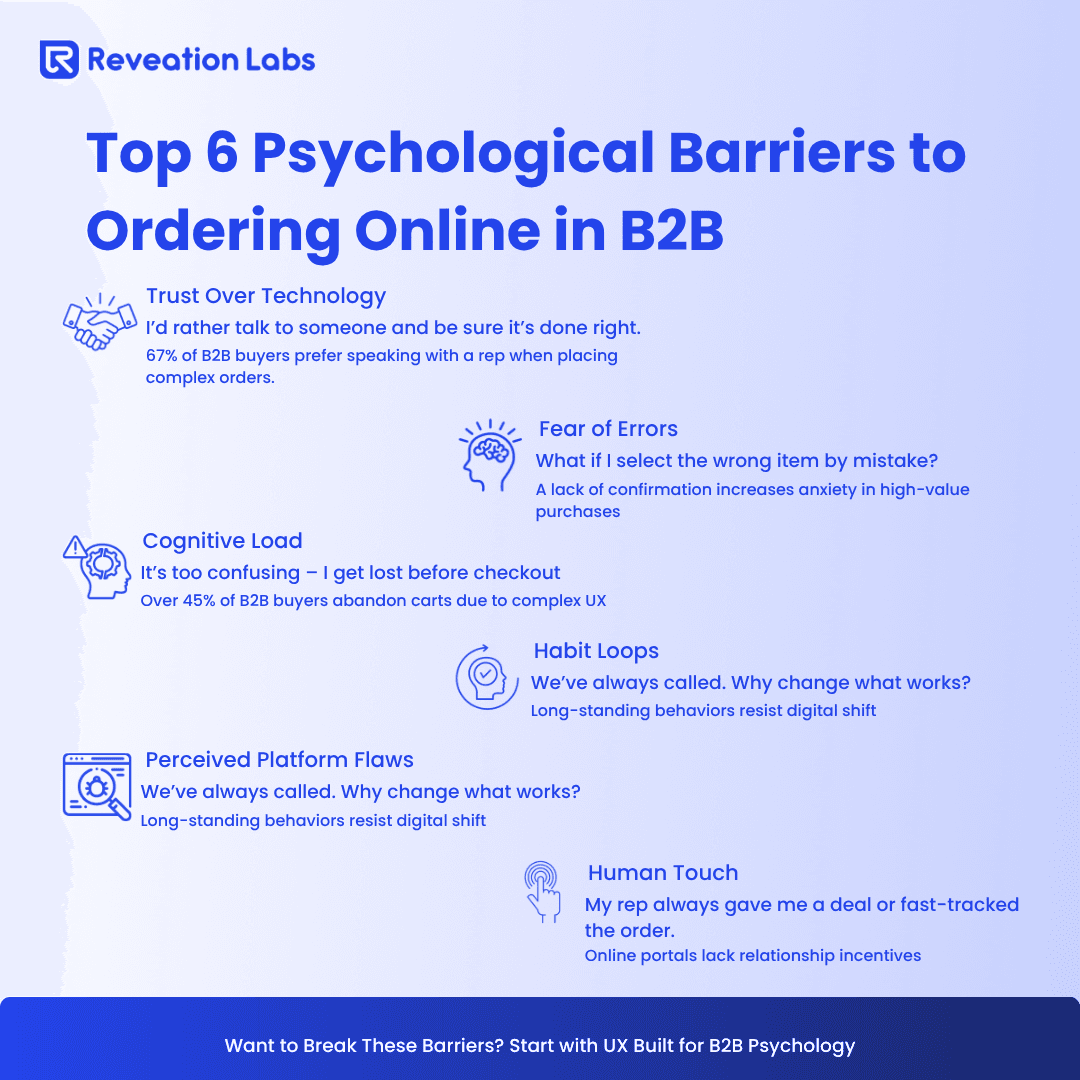
One of the strongest pulls back to the telephone is the simple comfort of a human voice on the other end. B2B transactions often thrive on relationships and trust. Buyers may feel they have more control and confidence dealing with a familiar sales rep, contrasting with the often impersonal nature of b2b cold calling or an opaque website.
There’s an emotional reassurance in calling “my rep” who knows my business and can answer questions on the spot. In fact, some buyers find it much easier to call their trusted rep with quick questions than to hunt for answers online.
This behavior ties into the B2B customer experience: many customers still perceive that speaking to a real person yields faster, clearer results, especially for complex or custom orders.
Additionally, human interaction allows for nuance – negotiating a special price, explaining unique requirements, or just feeling heard – things a standard online form might not easily accommodate.
For buyers who value personal attention, a website, no matter how well-designed, can feel “cold.” As a result, they stick to the phone out of habit and preference.
Understanding this comfort factor is crucial. It’s not that these buyers reject technology; they’re seeking the assurance and familiarity that a conversation provides. Any strategy to encourage online orders must find ways to replicate or compensate for this human touch (for example, via live chat, personalized portals, or dedicated account managers) so buyers feel just as supported ordering online in B2B eCommerce as they do on a call.
Cognitive Load and Decision Fatigue
Another hidden barrier to online ordering is cognitive load – the mental effort required to navigate complex information. Often, b2b ecommerce sites can overwhelm users with dense product catalogs, technical specs, login procedures, and complex pricing rules, requiring careful consideration of b2b ecommerce pricing strategies. If using the portal feels like work, buyers may revert to a quick call, a stark contrast to the effortless experience many expect from consumer-focused b2c sites. High cognitive load can lead to decision fatigue, reduced satisfaction, or even decision paralysis.
Essentially, when faced with too many options or complicated steps online, customers get tired or anxious about making a wrong choice. It’s often simpler to offload that mental work to a sales rep over the phone.
Think about it: a buyer could spend 20 minutes figuring out which part number to order and whether it’s in stock, or they could call their rep and get it done in 5 minutes. If the B2B eCommerce platform isn’t intuitive, the path of least resistance will win.
Studies show that a poor user experience causes over 70% of B2B customers to abandon online carts. Decision fatigue is real – after a long workday, hunting through menus and forms is less appealing than talking to a helpful human.
Moreover, B2B purchases often involve configuration or special terms that can be hard to handle via self-service, adding to the extraneous cognitive load on the buyer. To combat this, businesses should streamline the online experience: clear navigation, saved order templates, and reducing the cognitive overload on buyers.
By simplifying interfaces and guiding choices (for example, highlighting recommended products or providing search filters), you make ordering online in B2B eCommerce less mentally taxing. Remember, the easier and faster the decision process, the more likely buyers will stick with it instead of grabbing the phone.
Habit Loops and Internal Resistance to Change
Humans are creatures of habit. In many companies, procurement people have “always just called John at Supplier X to place orders” – it’s a routine that’s practically muscle memory. These habit loops (cue-routine-reward cycles) are powerful.
The cue might be a low inventory alert, the routine is to phone or email the order, and the reward is the quick confirmation from the rep. Introducing a new eCommerce portal disrupts this loop, and not everyone is eager to change their routine. In fact, opposition to change is one of the biggest challenges in B2B customer adoption.
People stick with what they know because it’s predictable and comfortable. Long-time B2B buyers (and sellers) have established processes and may view the new online system as unnecessary or even a threat. Especially for veteran purchasers or less tech-savvy individuals, changing a familiar process can feel disruptive and even scary. They may worry the new system will complicate things or that they’ll make mistakes. As one industry expert notes, buyers resist change because they know what to expect from the old process, so the new one must be just as predictable.
This internal resistance can also be reinforced by corporate culture; if a company’s leadership or sales team isn’t fully promoting the online platform, customers get the implicit message that the old ways are fine, potentially hindering effective b2b manufacturing online strategies.
Overcoming habit loops requires more than a one-time announcement. It takes change management: reassuring users that the new process is beneficial, training them so they feel competent, and perhaps phasing changes gradually.
For example, you might encourage trying the portal for simple reorders first (low risk) to build confidence. Breaking old habits won’t happen overnight, but with consistent nudges and proof of the new system’s advantages, buyers can form new habits of ordering online in B2B eCommerce systems.
The key is patience and persistence in the face of initial inertia.
With expert B2B eCommerce consulting, businesses can identify barriers in the online buying journey and implement strategies that shift buyers from phone calls to seamless digital ordering, further highlighting why SEO is important for b2b success.
Lack of Confidence in the Platform
Trust is a huge factor in whether buyers embrace online ordering. If customers lack confidence in your eCommerce platform, they’ll default to channels where they feel more in control.
Experiences like that will send them right back to calling a rep to reduce manual order entry errors. According to one report, 85% of B2B buyers have frustrations with online purchasing that lead to abandoned orders.
Chief among those frustrations are missing or inaccurate stock levels, pricing, and delivery information. In other words, when the digital channel isn’t trusted, buyers go offline where they can double-check details in real time.
Additionally, long-time clients may be skeptical of a new digital system’s accuracy, preferring the certainty of a phone call for critical questions. They worry about issues like: Will the online price reflect my negotiated contract rate? Are delivery dates reliable? No customer wants unpleasant surprises due to a glitchy portal. If they don’t trust the data, they won’t trust the order process online.
For example, “You see the same info our reps see!” or “Our site shows live inventory and delivery ETAs.” When buyers trust the platform to get it right, they’re far more likely to use it for ordering online in B2B eCommerce rather than dialing your customer service line.
How to Nudge Digital Adoption (Psychologically Smart Tips)
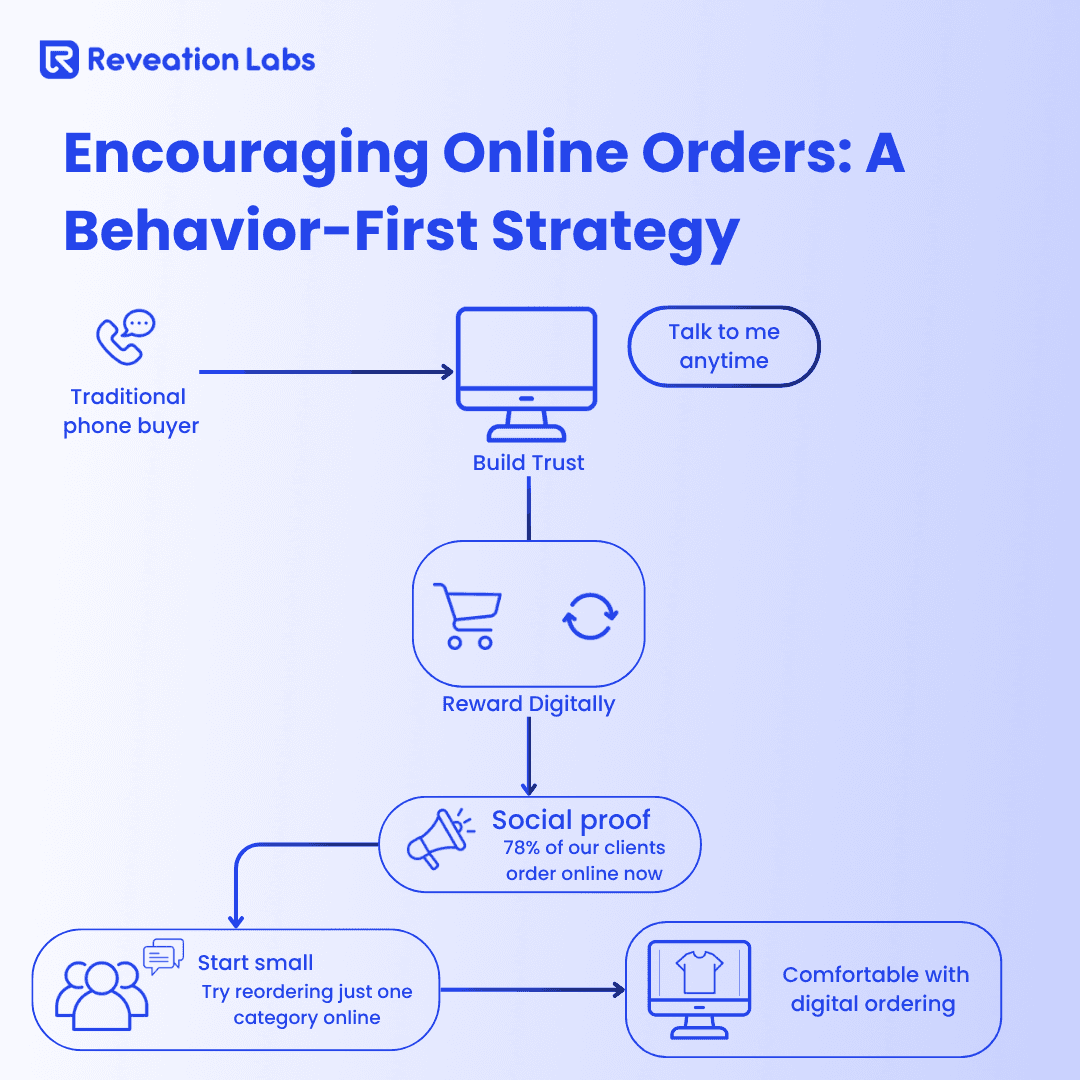
Highlight the WIIFM (“What’s in it for me?”): communicate the benefits buyers get when they use the portal. For example, emphasize time savings (no waiting on hold), fewer errors (since they input orders directly), quick reorders, and 24/7 convenience.
Provide incentives and rewards: Everyone loves a good deal or reward. Consider offering incentives to promote online ordering – for instance, a small discount, free shipping, or loyalty points for orders placed through the website. Even a one-time promo can give hesitant buyers the push to try the portal. Incentives driving digital adoption can increase sales by 30%.
Make the first steps easy (Start small): To overcome fear of the unknown, lower the barrier to entry. Encourage customers to use the site for a small, routine purchase or a quote request – something low-stakes. As one strategy suggests, start with simple reorders or low-value items to build trust in the system. Celebrate those first successes with a thank-you email or personal follow-up, reinforcing the positive experience.
Mirror the familiar and offer support: A clever way to ease the transition is to design your online experience to feel somewhat familiar. Choose a user-friendly B2B eCommerce platform that echoes elements of traditional buying (like clear product categories similar to your print catalog). This reduces the intimidation factor.
- Leverage social proof and success stories: Share metrics or testimonials that show many customers are happily using the online system. For instance, “X% of our clients have shifted to online ordering and report faster turnaround and satisfaction.” Social proof taps into the psychology that if others trust it, maybe I can too.
The goal is to make the online channel not just the mandated option, but the preferred option because it genuinely makes buyers’ jobs easier and more rewarding. And when that happens, both your customers and your internal teams win.
Conclusion: Tech Isn’t Enough—You Need Behavioral Insight
In conclusion, boosting digital adoption in B2B eCommerce requires understanding that tech alone isn’t enough – you need behavioral insight. Your buyers are still calling instead of ordering online, not because they can’t use technology, but because of human factors: comfort, habits, cognitive overload, and trust.
Solving this isn’t just an IT upgrade; it’s a change-management exercise in B2B buyer behavior. The companies that succeed don’t just build great eCommerce portals; they build great B2B customer experiences around those portals, addressing fears, motivating new habits, and communicating value every step of the way.
The takeaway is clear: if you want to encourage online orders and truly maximize your ROI on that shiny new platform, dive into the psychology of your customers. Talk to them, learn their pain points, and apply the tips above to gently guide them online. Over time, you’ll not only see more ordering online in B2B eCommerce – you’ll also free your team from chasing faxes and phone orders, allowing them to focus on higher-value activities.
Finally, remember that you’re not in this alone. Tech adoption and customer behavior change is a journey, and having the right partner can make all the difference, especially when considering how to rank for b2b search terms. At Reveation Labs, we specialize in B2B eCommerce solutions and behavior-driven strategies to elevate your digital channel. We can help you optimize your platform and craft adoption campaigns that resonate with your buyers.
If you’re ready to reduce dependency on phone orders and unlock the full potential of your online channel, let’s chat. Contact Reveation Labs for a consultation – and let’s turn those call-in orders into seamless clicks. (Your customers – and your bottom line – will thank you.)