You are not losing FMCG orders because buyers dislike digital channels. You are losing them when a repeat order turns into a cleanup job: the pack size changed, the SKU is out of stock, the substitute is wrong, or the price does not match the contract.
That is the reorder trap.
Agentic commerce for FMCG distributors can help you escape it, but only when your agents work with clean catalog data, clear rules, and connected systems. At Reveation Labs, we see the same pattern often: leaders want faster ordering, but the real blocker is trust. Your team will not let an AI agent recommend or place orders unless the data, approval logic, and exception handling feel safe.
Gartner predicts that more than 40% of agentic AI projects will be canceled by the end of 2027 because of escalating costs, unclear business value, or inadequate risk controls. That warning matters for FMCG distributors because reorder automation touches revenue, inventory, customer trust, and finance workflows. Gartner’s forecast is not a reason to avoid agentic commerce; it is a reason to build it with governance from day one.
If you want the speed of automation without the cleanup nightmare, start with governed workflows, not blind auto-ordering.
The Reorder Trap: Why FMCG Automation Breaks
FMCG reorders look simple from the outside. A buyer ordered the same cartons last month, so your system should recommend the same cart this month. Easy, right?
Not really.
In FMCG distribution, the “same order” can change because of stock availability, promotions, contract pricing, minimum order quantities, regional assortments, expiry windows, new SKUs, discontinued products, and substitution rules. A reorder button can repeat the past, but it cannot always judge whether the past still makes sense.
Automation is not the trap. Asking automation to act on messy product data and disconnected systems is the trap.
| Failed approach | Why teams try it | What breaks in FMCG |
|---|---|---|
| Basic reorder button | It feels fast and familiar | It repeats old SKUs even when inventory, pricing, or pack sizes changed |
| Static reorder rules | It feels controlled | Rules become hard to maintain across thousands of fast-moving SKUs |
| Sales-rep-only ordering | Reps know the account | Manual work scales poorly and slows repeat buying |
| Generic chatbot | It looks modern | It cannot act safely without ERP, PIM, OMS, pricing, and approval context |
| Full auto-ordering too early | It promises efficiency | One bad catalog rule can create wrong orders at scale |
What Agentic Commerce for FMCG Distributors Really Means
Agentic commerce for FMCG distributors means AI agents can help complete reorder workflows, not just answer questions. The agent can read business context, plan the next step, use connected systems, follow policies, and decide whether to recommend, escalate, or act.
For you, that could mean an agent builds a reorder cart, checks stock, validates pack sizes, compares contract pricing, suggests approved substitutions, and flags exceptions before checkout. When the order looks safe, the agent can move it forward. When the order looks risky, it should ask for human approval.
Our Agentic Commerce Automation work focuses on this kind of policy-aware workflow: agents that coordinate reorders, approvals, PO reconciliation, delivery scheduling, and human handoffs without removing accountability.
Practical rule: if the system cannot explain why it recommended or placed an order, it is not ready to act autonomously.
Basic reorder automation
- Repeats the last order
- Depends on fixed rules
- Breaks when catalog data changes
- Often hides why something happened
Agentic commerce
- Builds a cart based on buying history, availability, rules, and exceptions
- Plans the next step and calls approved systems or workflows
- Checks product status, pack sizes, substitutions, and account rules
- Explains recommendations and routes exceptions for approval
Catalog Governance Comes Before Reorder Automation
You cannot automate reorders safely until your catalog can support decisions. For FMCG distributors, catalog governance means your product data is accurate, structured, searchable, and tied to business rules.
This includes SKU names, categories, units of measure, case packs, barcodes, substitutions, product hierarchies, customer-specific assortments, regional restrictions, and product status. This is where most advice gets too shallow. Many pages talk about agents placing orders, but they skip the data foundation that makes those orders correct.
That is why we connect agentic commerce with Product Data & Integration Management. PIM, catalog enrichment, taxonomy, and product data workflows are not back-office chores. They are the control layer for AI-assisted buying.
| Catalog area | Why it matters for reorders | Example risk |
|---|---|---|
| Units of measure | Agents must understand eaches, cases, cartons, pallets, and multipacks | Buyer expects 10 cases, but the system adds 10 units |
| Pack sizes | FMCG products often change packaging or bundle formats | Agent repeats an old case pack that no longer exists |
| Substitutions | Stockouts need approved alternatives | Agent recommends a substitute the customer cannot accept |
| Customer assortments | Not every customer can buy every SKU | Agent suggests restricted or irrelevant products |
| Pricing rules | Contract pricing, rebates, and promotions affect reorder trust | Buyer sees a different price after approval |
7 Mistakes That Break Agentic Commerce for FMCG Distributors
You can avoid most failures by treating agentic commerce as an operating model, not a feature launch. These are the mistakes we would look for first in an FMCG distributor environment:
- Automating before cleaning units of measure, case packs, and SKU relationships.
- Letting agents recommend restricted SKUs or customer-ineligible products.
- Treating substitutions as simple product swaps instead of governed decisions.
- Ignoring contract pricing, trade promotions, rebates, and regional price rules.
- Using stale inventory data for high-frequency reorder recommendations.
- Skipping approval rules for high-value, credit-sensitive, or exception-heavy accounts.
- Measuring how many orders you automated instead of how many correct orders moved faster.
Avoid this mistake: do not let an AI agent become the only place where business logic lives. Core product, pricing, inventory, and approval rules should remain governed in systems your business can audit.
Best FMCG Workflows to Automate First
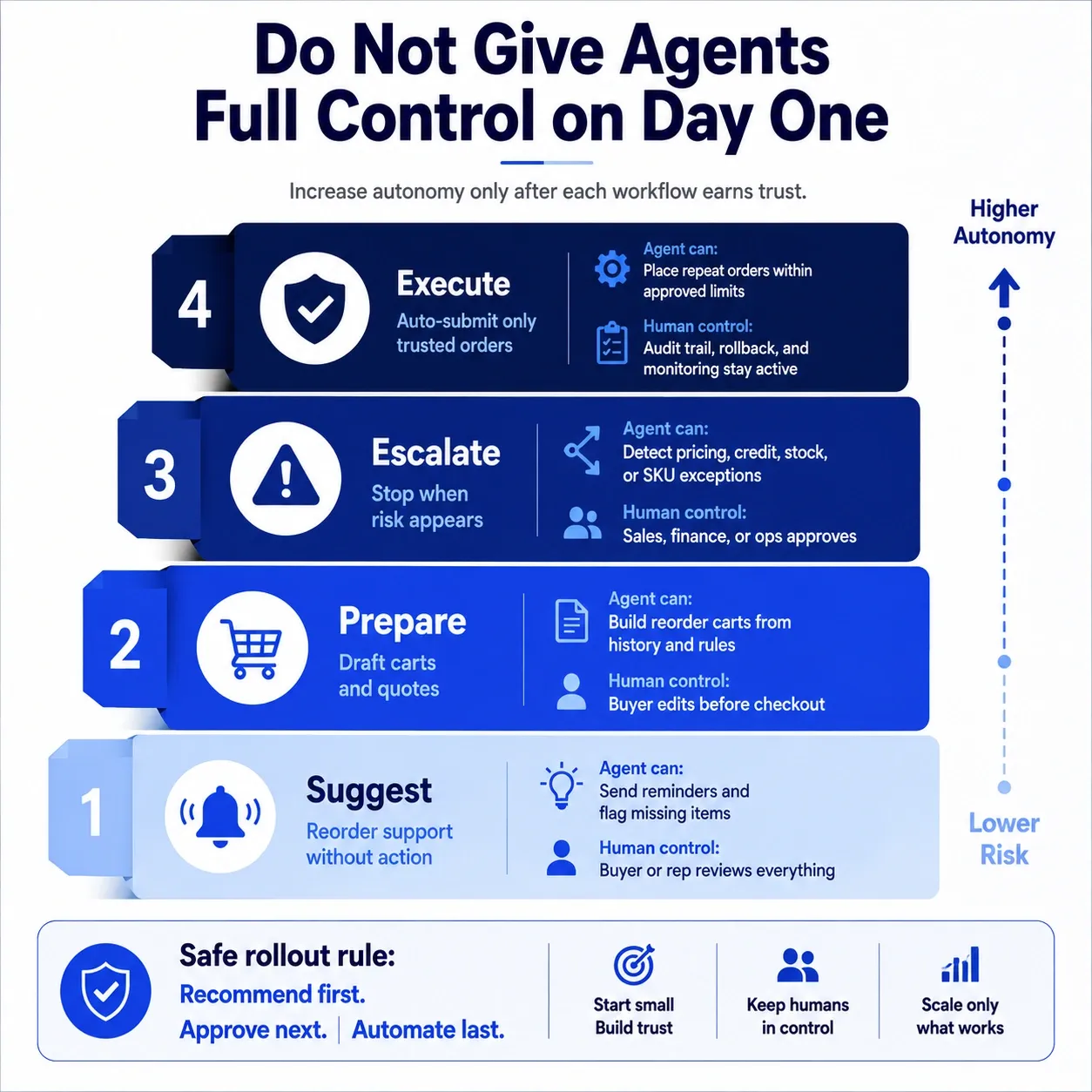
Do not start by letting agents place every order. Start with workflows that save time while keeping risk low.
A strong rollout moves from recommendations, to approvals, to limited auto-execution. This helps your sales, operations, finance, and customer service teams build trust before automation touches high-value or exception-heavy orders.
| Workflow | Risk level | Best first action |
|---|---|---|
| Reorder reminders | Low | Let the agent remind buyers based on purchase cadence |
| Recommended reorder carts | Low | Let the agent build carts, but require buyer review |
| Missing-item alerts | Low | Flag items customers usually buy but skipped |
| Substitution suggestions | Medium | Recommend approved alternatives with explanation |
| Contract price checks | Medium | Flag mismatches before checkout |
| Auto-submit repeat orders | High | Allow only for trusted accounts, stable SKUs, and defined thresholds |
This is where AI Process Automation can help. We prefer to begin with repeatable, data-heavy workflows that reduce manual touches without forcing teams to surrender control on day one.
How an Agentic Reorder Flow Should Work
A strong FMCG reorder flow should feel simple to your buyer and disciplined behind the scenes. Your buyer sees a smart cart. Your operations team sees rules, validations, approvals, and logs.
- The agent reads customer order history, contract terms, catalog rules, inventory, and pricing.
- It builds a recommended cart based on buying cadence, minimum quantities, and current availability.
- It checks discontinued SKUs, pack-size changes, restricted items, and substitution rules.
- It explains changes, such as “SKU replaced due to stockout” or “case pack updated.”
- It routes exceptions to sales, finance, customer service, or operations.
- It lets the buyer approve, edit, or submit the order.
- It writes approved actions back into the ERP, OMS, CRM, or commerce platform.
This is where many LLM-style answers stay vague. They say “use AI to automate ordering,” but they do not explain where the agent reads from, where it writes to, and when it must stop.
At Reveation Labs, we design these workflows with clear permissions. The agent may recommend in one workflow, create a draft quote in another, and submit an order only when the account, SKU, quantity, and pricing rules pass validation.
System Architecture: What Needs to Connect
Agentic commerce does not work as a standalone layer. Your agent should not guess availability, invent prices, or assume customer eligibility. It should read from the right system and act only through approved workflows.
A practical FMCG distributor architecture usually connects:
- B2B ecommerce portal
- ERP
- PIM
- OMS
- CRM
- Pricing engine
- Inventory system
- Approval workflow
- Customer service or sales tools
Our eCommerce Systems Integration work is important here because ERP, OMS, PIM, and commerce platforms need to operate as one workflow layer. Without integration, your agent becomes another disconnected interface.
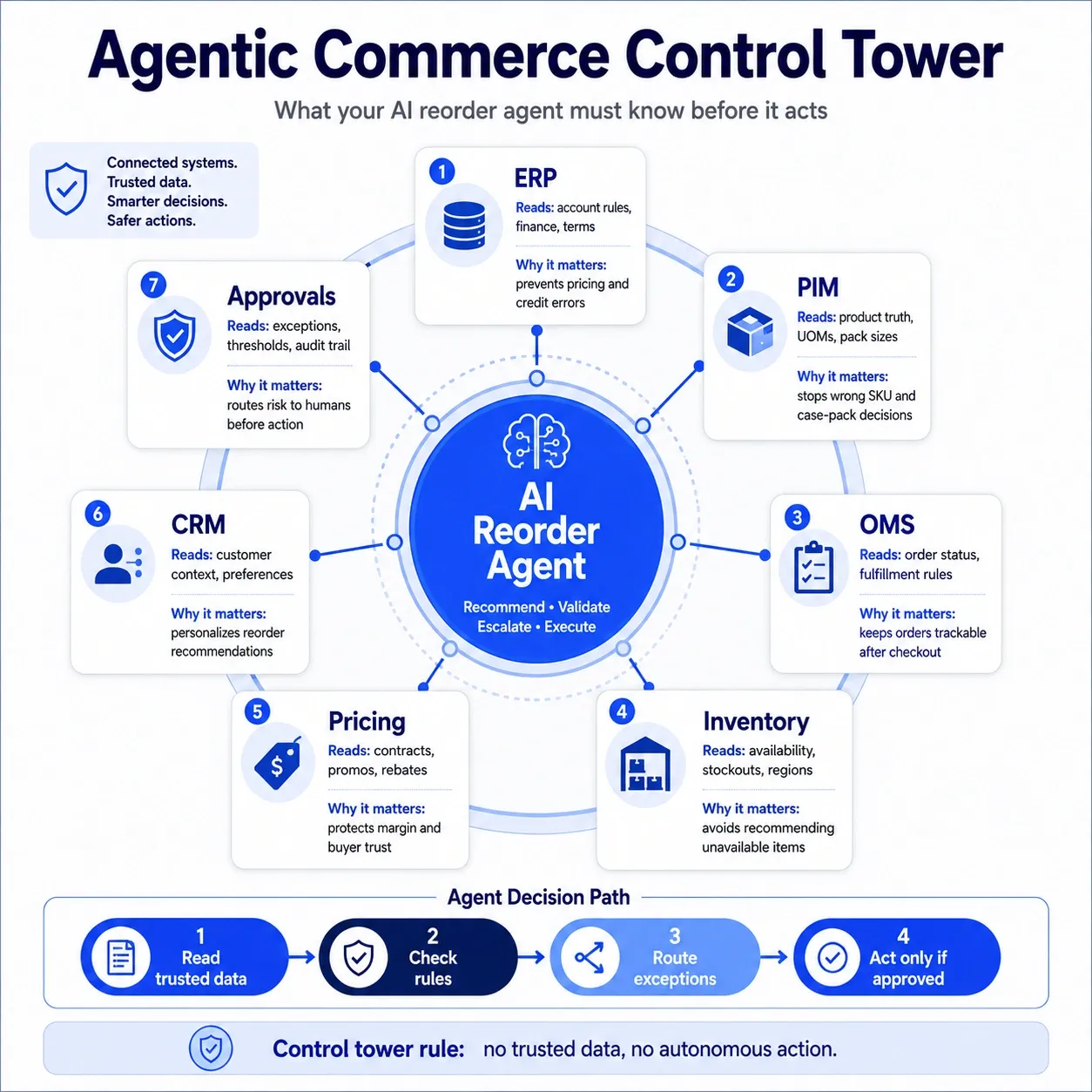
A B2B ecommerce and customer portal also matters because your buyer experience still needs to be usable. The agent may do the heavy lifting, but your buyer still needs clear carts, product context, order history, approvals, and account-specific terms.
Soft next step: If your reorder workflow still depends on spreadsheets, manual SKU checks, or sales-rep memory, we would start with a workflow and data-readiness audit before building the agent.
Before You Automate FMCG Reorders, Confirm These 7 Things
Use this checklist before you give an agent permission to recommend or submit orders:
- Your SKUs, product names, categories, and barcodes are clean enough for reliable matching.
- Your units of measure and pack sizes are standardized across systems.
- Your approved substitution rules are documented and connected to inventory context.
- Your customer-specific assortments, restrictions, and contract pricing are available to the workflow.
- Your inventory data updates quickly enough for reorder decisions.
- Your approval rules define when the agent should stop and escalate.
- Your audit trail can show who approved what, when, and why.
Metrics That Prove Agentic Commerce Is Working
Agentic commerce should improve measurable operations, not just create a polished demo. McKinsey reported in 2024 that ecommerce accounts for more than one-third of revenue among B2B organizations that offer ecommerce, which makes digital order quality a commercial priority.
For FMCG distributors, the right metrics connect buyer adoption, catalog quality, and operational efficiency.
| Metric | What it tells you | Why it matters |
|---|---|---|
| Reorder accuracy | How often recommended carts match buyer intent | Shows whether agents understand repeat buying |
| Substitution acceptance rate | How often buyers accept suggested alternatives | Shows whether substitution logic works |
| Manual order-touch reduction | How many orders need less sales or operations intervention | Shows operational savings |
| Catalog error rate | How often product data causes order issues | Shows data foundation quality |
| Exception rate | How often agents escalate instead of act | Shows readiness for more automation |
Do not measure only how many orders you automated. Ask a better question: how many correct orders moved faster with fewer manual touches?
Rollout Plan: Start Safe, Then Expand
You do not need a big-bang launch. In fact, you should avoid one.
A safer rollout gives the agent more responsibility only after your data, rules, and teams prove readiness.
Phase 1: Recommendation-only mode
Start with reorder reminders, cart suggestions, missing-item prompts, and catalog explanations. The agent does not submit orders. It only helps buyers and sales reps make better decisions faster.
This phase gives you feedback data and adoption signals without major risk.
Phase 2: Approval-assisted ordering
Next, let the agent prepare carts, quotes, or draft orders that require approval. It can route pricing exceptions to sales, credit concerns to finance, and substitution issues to customer service.
This is where your audit trail becomes essential.
Phase 3: Governed auto-execution
Only automate submission for stable, low-risk workflows. That may include repeat orders for trusted accounts, approved SKU sets, fixed thresholds, and predictable delivery windows.
Even then, keep monitoring, rollback, and human override in place.
What Reveation Labs Would Fix First
If you asked us where to start, we would not begin with “build an AI agent.” We would start with your reorder reality.
Which customers reorder most often? Which SKUs create the most substitutions? Which catalog fields cause the most confusion? Which orders need sales intervention? Which approvals slow down repeat buying? Which product rules still live in someone’s spreadsheet instead of your systems?
From there, we would map a safe workflow: recommend, validate, escalate, then act. Our Agentic AI for B2B Ecommerce guide explains the broader architecture, guardrails, and business impact. For FMCG distributors, the tighter goal is clear: make reorder decisions faster while keeping product data, pricing, inventory, and approvals under control.
Takeaways for FMCG Leaders
Agentic commerce works best when you treat it as an operating model, not a feature.
| Priority | What to do first | Why it matters |
|---|---|---|
| Clean the catalog | Normalize SKUs, pack sizes, UOMs, and substitutions | Agents need reliable product truth |
| Connect systems | Integrate ERP, PIM, OMS, pricing, and portal workflows | Agents need real-time business context |
| Start with recommendations | Let agents suggest before they act | Teams build trust safely |
| Add approvals | Route exceptions before checkout | Risk stays visible |
| Measure order quality | Track accuracy, substitutions, and manual touches | ROI becomes easier to prove |
The goal is not to remove humans. The goal is to stop wasting human judgment on repetitive work while still routing the right exceptions to the right people.
That is how you escape the reorder trap.
Conclusion
Agentic commerce for FMCG distributors is not about letting AI run your order desk overnight. It is about building a safer, faster reorder engine around product truth, business rules, and system integration.
You should expect agents to recommend carts, validate substitutions, explain changes, escalate exceptions, and act only when the workflow is trusted. That is how automation becomes useful instead of risky.
At Reveation Labs, we help teams move from disconnected reorder work to governed agentic commerce. If your catalog, ERP, OMS, and customer portal are not ready for AI-assisted ordering yet, that is the right place to start.