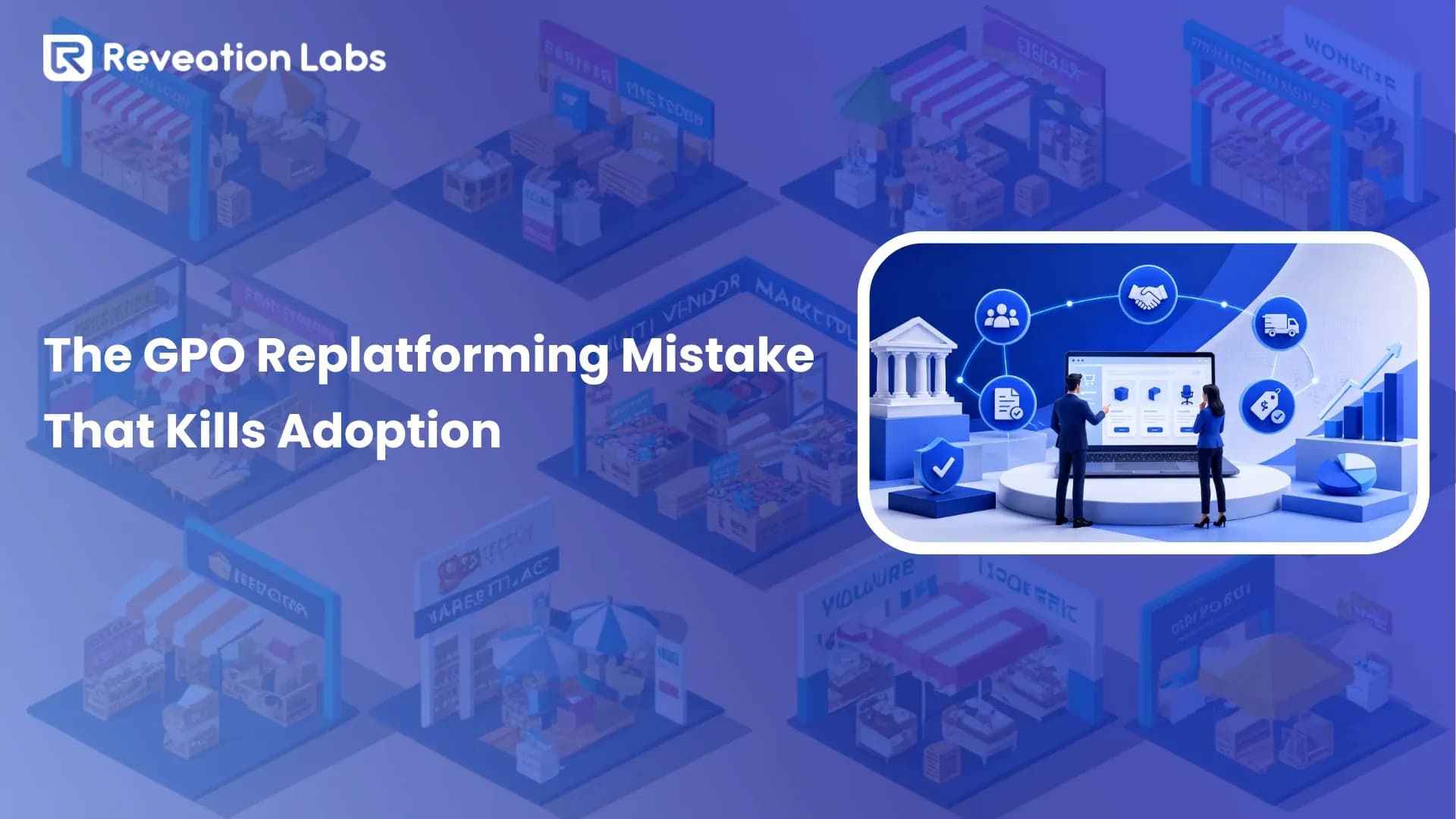

You can modernize your portal and still lose member adoption if pricing, supplier data, approvals, and contracts do not work together.
Core challenge
Members need a buying environment they can trust.
Scale goal
Add suppliers, contracts, and members without manual chaos.
Main risk
A better interface can still expose broken workflows.
That is why a GPO marketplace requires more than a cleaner interface. You need a model that protects negotiated value, gives members a reason to buy through the network, and helps suppliers participate without creating manual work for your team.
At Reveation, we see many teams start with a platform demo when they should start with the operating model. Before you compare features, you need to answer harder questions: who sees each catalog, which price applies, who owns supplier data, how rebates get tracked, and where ERP, punchout, approvals, and purchase orders fit.
If you plan to replatform for a scalable GPO marketplace, do not rebuild the old portal in a better interface. Build the buying environment your members trust enough to use, and your suppliers trust enough to support.
Why the Old Portal Stops Working
Most GPO portals started as access points. Members could log in, find supplier information, review contract options, and maybe place or route an order.
That model breaks when members expect the experience to work like a real procurement marketplace. They do not want to browse a supplier list. They want to find the right item, confirm the right price, follow the right approval path, and complete the order with confidence.
Adoption problem
Members still call, email, use supplier websites, or buy outside the network because the portal does not help them complete the buying job.
Pricing doubt
If a member sees one price in the portal, another in a quote, and another after ERP validation, they stop trusting the system.
Supplier friction
If your team still manages onboarding through spreadsheets, manual catalog updates, and unclear ownership, every new supplier adds operational drag.
We see the same pattern in procurement-heavy replatforming work. Before a GPO replaces its portal, it should pressure-test the same issues that break industrial MRO ecommerce replatforming: wrong prices, missing products, ERP gaps, weak search, and offline order work.
A Marketplace Is Not a Bigger Portal
A portal gives members access. A GPO marketplace helps members act.
Portal mindset
- Gives members access
- Shows supplier information
- Supports basic self-service
- Often leaves buying work offline
Marketplace mindset
- Helps members act
- Controls eligibility and pricing
- Connects contracts to the buying journey
- Completes procurement workflows
That distinction matters because your members do not behave like one buyer segment. They may belong to different tiers, regions, business units, contract groups, rebate structures, approval workflows, or eligibility rules.
Your suppliers also need more than a listing page. They need governed onboarding, catalog standards, fulfillment expectations, service levels, and a clear reason to keep their data current.
Your contracts should not sit outside the buying journey. They should shape what members see, what prices appear, which suppliers get preference, and how the system measures spend capture.
Many teams confuse portal modernization with marketplace transformation. Our B2B customer portal work helps companies improve self-service, account access, documents, and order visibility. A scalable GPO marketplace needs those capabilities, but it also needs contract logic, supplier participation, member-specific buying rules, and procurement workflow control.
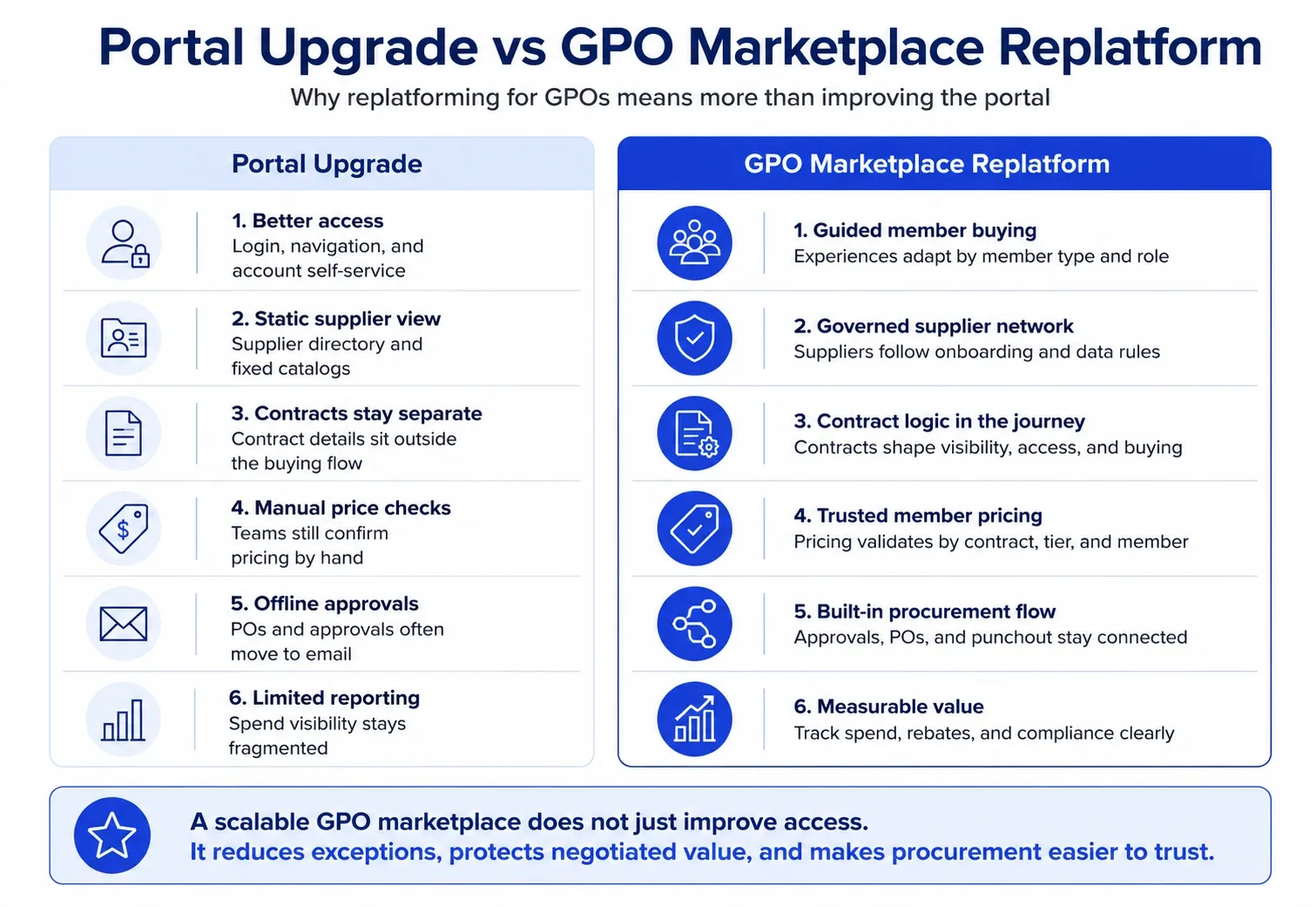
Do not ask, “Can we launch a better portal?” Ask, “Can members complete the right buying action with the right supplier, price, contract, approval path, and order flow?”
Start Before the Platform
Start with the rules that make your GPO model work. Platform selection comes after that.
1. Map member groups
Define how you segment members, what each group can access, which contracts apply, which locations matter, and who can approve purchases.
2. Map supplier ownership
Decide who owns onboarding, catalog updates, product enrichment, fulfillment expectations, and issue resolution.
3. Map contract logic
If pricing depends on volume tiers, negotiated terms, regional access, rebate rules, or exclusions, document those rules before you evaluate technology.
4. Define what ERP controls
Your ERP may own account records, payment terms, pricing validation, inventory, invoices, or order status.
We usually recommend settling these decisions before platform selection, and our guide on ERP and ecommerce alignment before replatforming explains why pricing, inventory, and account-data surprises often derail launch plans.
Fix the Trust Breakers
Your members will forgive a simple interface faster than they will forgive wrong prices.
Trust drives adoption in a GPO marketplace. If members cannot trust the catalog, pricing, eligibility, or order path, they will work around the system.
Do not let these problems become post-launch tickets. Turn them into demo scripts, acceptance criteria, and pilot test cases.
We apply the same thinking when we help teams validate pricing before replatforming. The checks in our ERP and pricing readiness guide also help GPO teams test contract pricing, account terms, quote history, and workflow trust before they migrate.
Design the Real Buying Journey
Your members do not browse for inspiration. They need to complete a procurement job.
Design the journey around how buying actually happens: search, compare, confirm eligibility, validate pricing, request approval, create a PO, reorder, track, and report.
The marketplace journey should support:
Search should match buyer behavior. Some members search by SKU. Others search by category, supplier, contract, location, or use case. Our guide to B2B ecommerce search explains why industry-specific search logic matters when buyers use technical terms, supplier names, and product attributes in different ways.
Contract value should appear in the flow. If a member cannot see why a contracted item gets preferred status, the marketplace becomes another catalog.
Quotes and approvals should not push users offline. If a product needs approval or a supplier quote, the marketplace should show the next step and keep the buyer in the workflow.
Repeat buying should feel simple. Many procurement journeys involve replenishment, saved lists, standard kits, or contract-driven reorder flows. Our ecommerce user experience work focuses on these practical B2B flows, including bulk ordering, approvals, pricing visibility, and buyer self-service.
We also design GPO marketplace journeys with integration in mind. Our B2B ecommerce solutions connect account-based pricing, customer-specific catalogs, roles, permissions, quote management, and ERP integration so the buying experience does not depend on disconnected tools.
Build What Must Work at Scale
A scalable GPO marketplace needs more than more suppliers and more SKUs. It needs fewer exceptions as volume grows.
We usually model the marketplace through four operating layers: members, suppliers, contracts, and integrations. Each layer controls a different part of the buying promise.
Member layer
Account hierarchy, roles, eligibility, permissions, approval limits
Scale question: Can each member see the right buying experience?
Supplier layer
Onboarding, catalogs, lead times, fulfillment rules, data quality
Scale question: Can suppliers join without creating manual chaos?
Contract layer
Pricing, terms, tiers, exclusions, rebates, compliance logic
Scale question: Can negotiated value show up inside the buying flow?
Integration layer
ERP, PIM, OMS, CPQ, punchout, analytics, tax, payments
Scale question: Can orders and data move without rework?
This model separates a GPO marketplace from a standard ecommerce site. The marketplace does not only sell products. It enforces a procurement relationship.
Product data plays a major role here. Supplier catalogs change, contract rules change, and member access changes. Our guide to B2B ecommerce solutions for large product catalogs can help teams plan for SKU scale, product-data performance, and catalog complexity before they expand supplier count.
Use the Platform Where It Matters
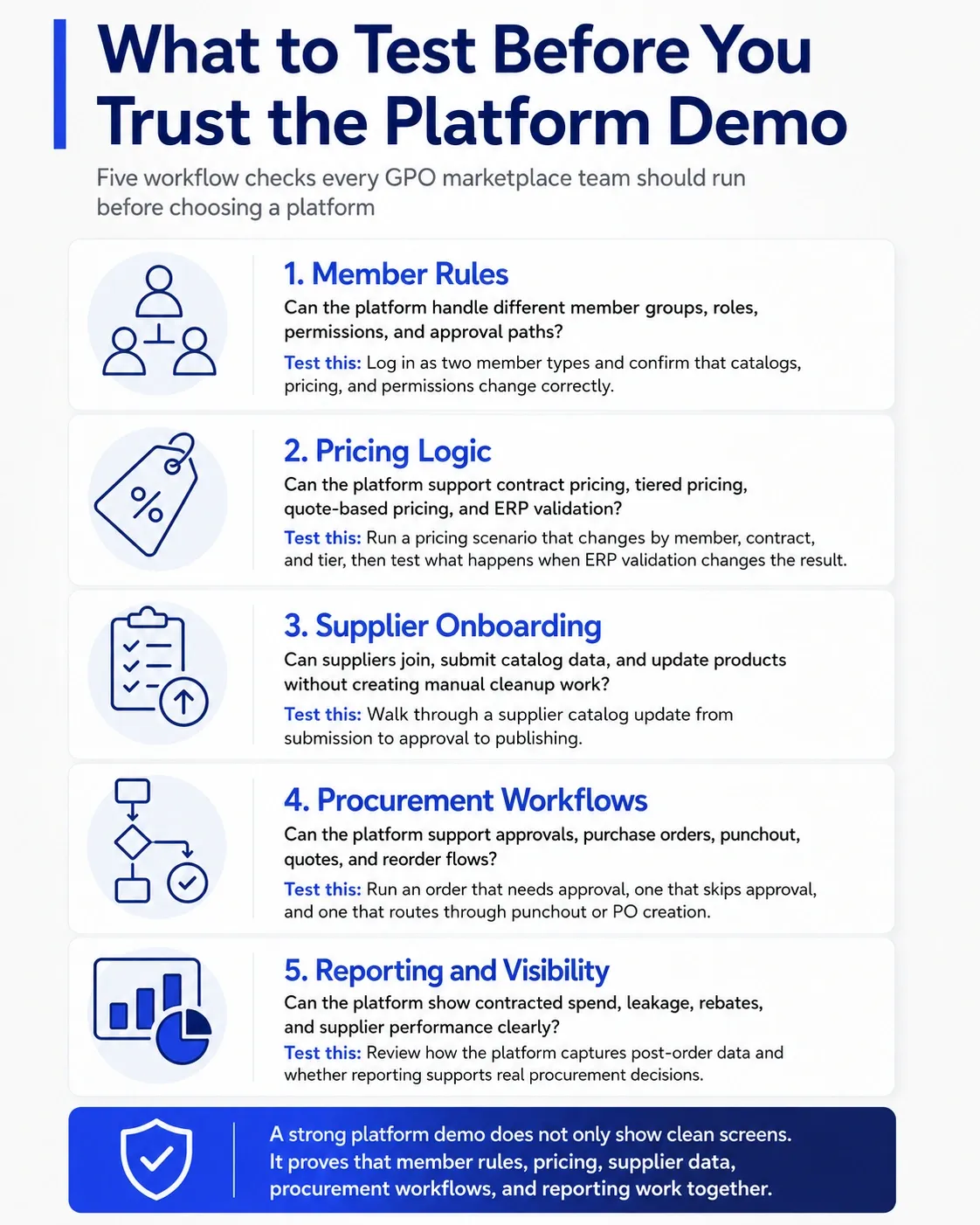
Choose technology based on the workflows it can prove, not the screens it can show.
For a GPO marketplace, the platform needs to handle member-specific catalogs, contract pricing, supplier onboarding, ERP integration, punchout workflows, quote paths, and future marketplace expansion.
This is where modular commerce can help. A platform should orchestrate the experience: who the buyer is, what they can see, which suppliers they can access, which contracts apply, what price appears, whether approval applies, where the order goes, and what data returns for reporting.
That does not mean one platform should replace every system. In many GPO architectures, the commerce platform works best as the marketplace layer while ERP, PIM, OMS, supplier systems, and procurement tools continue to own specific records and workflows.
Our article on Virto Commerce for B2B ecommerce solutions connects well here because it covers modular B2B architecture, complex pricing, ERP-driven catalogs, and procurement workflows.
For teams evaluating Virto more seriously, our Virto Commerce implementation partner page explains how we approach implementation, integrations, and roadmap alignment.
Do not trust a platform demo until it runs your hardest pricing, catalog, approval, punchout, and supplier onboarding scenarios.
Pick the Right First Launch
Do not launch the entire GPO marketplace at once.
A broad launch hides too many variables. You do not want to test every supplier, category, contract, member group, pricing rule, approval flow, and integration on day one.
A safer first launch should include:
- One strong category with repeat purchase demand
- Clear contract rules
- Committed suppliers
- Active members
- Measurable savings
- Manageable SKU complexity
- Low exception volume
Then choose suppliers who will participate actively. They should maintain data, respond to issues, support fulfillment expectations, and help your team improve the marketplace experience.
Next, pilot with active members. Do not choose only friendly stakeholders. Choose users who buy often enough to expose friction quickly.
Use the pilot to answer practical questions. Did members find the right products? Did contract pricing show correctly? Did approvals work? Did POs route cleanly? Did suppliers receive usable orders? Did support tickets decrease? Did members return?
Only expand after the workflow holds. That may feel slower at first, but it prevents your marketplace from becoming a larger exception machine.
When we support B2B ecommerce implementation, we plan around integrations, ERP connectivity, platform deployment, go-live readiness, and workflow validation. A GPO marketplace needs the same discipline, with more attention on contracts, suppliers, and member trust.
Know When It Can Scale
A scalable GPO marketplace does not grow through more SKUs alone. It grows when each new member, supplier, catalog, and contract creates less manual work than the last one.
That gives you the clearest signal of readiness. If every new rule needs custom work, every catalog needs manual cleanup, and every order needs human review, the marketplace has not scaled. It has multiplied operational debt.
This is also when platform evaluation becomes more honest. A system that works for a basic catalog may struggle when you add member tiers, supplier rules, quote workflows, contract pricing, punchout, and analytics.
Our B2B ecommerce platforms comparison can help teams assess platform fit through integrations, scalability, workflow support, and long-term operating complexity instead of demo polish alone.
Final Takeaway
You should not replatform a GPO portal just to make it look modern.
You should replatform because the old model no longer supports how members buy, how suppliers participate, how contracts create value, and how procurement teams measure spend.
A scalable GPO marketplace protects the GPO advantage. It makes negotiated value easier to find, easier to use, easier to trust, and easier to prove.
At Reveation, we help teams connect business rules, marketplace architecture, ERP workflows, product data, and user experience before build decisions become expensive. If you need a broader platform plan, our B2B ecommerce platform services help teams align strategy, implementation, integrations, and scalability around complex buying models.
Do not rebuild the old portal in a better interface. Build the marketplace your members trust enough to use, and your suppliers trust enough to support.