Modern B2B eCommerce demands far more flexibility than legacy platforms can offer. Buyers expect complex pricing (tiered, contract-based), ERP-driven catalogs, and even procurement punchout workflows – features that traditional B2C-inspired systems weren’t built to handle.
Virto Commerce, by contrast, is a composable cloud-native platform purpose-built for B2B complexity. Let's find out how Virto’s modular “atomic” architecture and microservices deliver agility, extensibility, and low TCO for enterprise B2B use cases.
The Nature of B2B Complexity
B2B commerce often involves many buyer types (dealers, distributors, OEMs), each with their own catalogs and user roles. Pricing is rarely one-size-fits-all – instead, you see tiered, volume- or account-specific pricing, negotiated contracts, and dynamic discounts.
Product catalogs run into the tens or hundreds of thousands of SKUs with rich attributes, and buyers expect faceted, attribute-level search across those catalogs.
On top of this, businesses must handle multiple geographies (local currencies, tax rules, language) and tightly integrate with back-office systems. In practice, a B2B store must synchronize customers, products, inventory, and pricing with an ERP/PIM/WMS.
Altogether, these factors mean a B2B platform must be extremely flexible and integration-friendly to meet enterprise needs.
The Virto Architecture: Built to Be Broken Apart
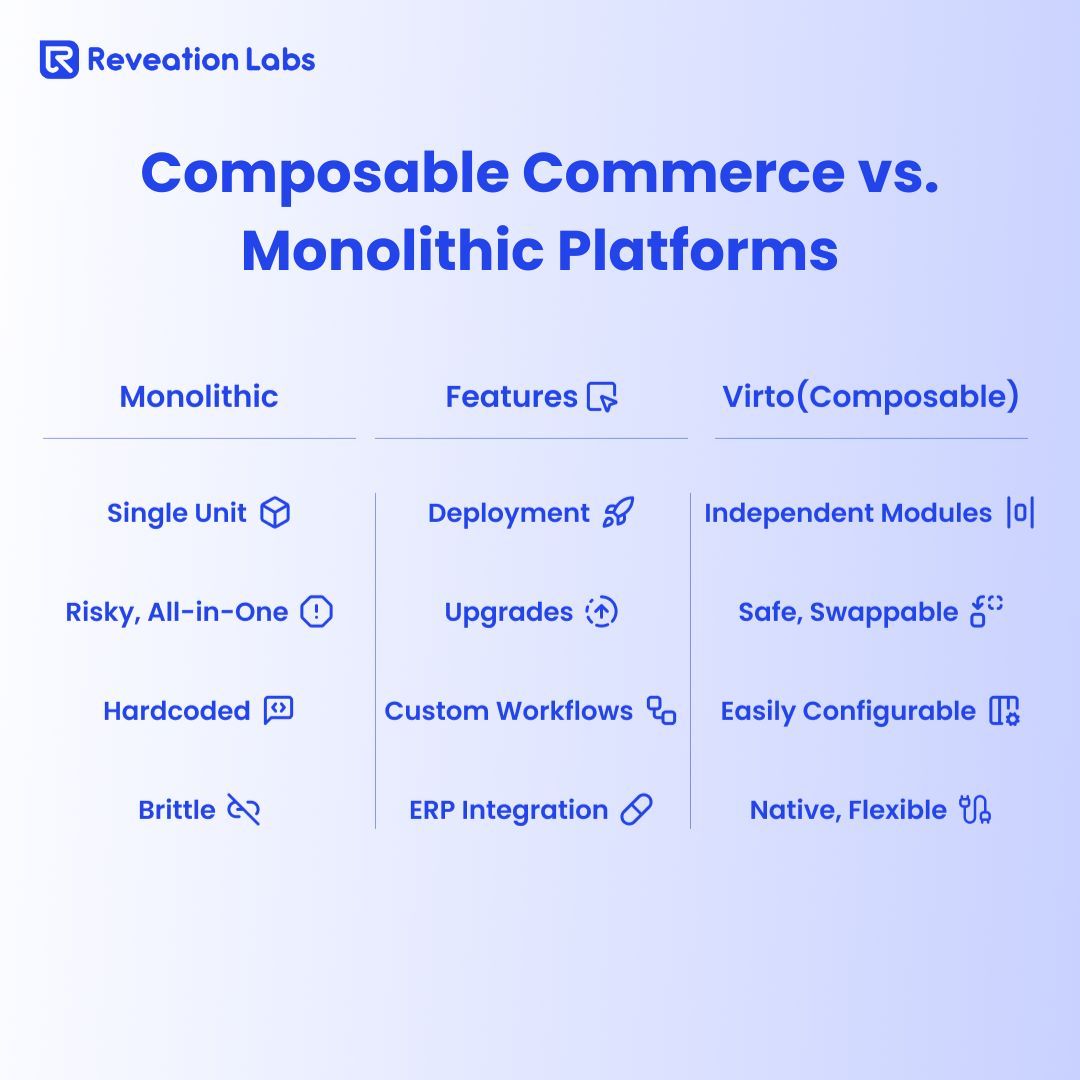
Virto solves this by breaking eCommerce into independent service modules (Packaged Business Capabilities, or PBCs). Each core function – cart, catalog, pricing, orders, promotions, search, etc. – is delivered as a separate microservice that can be deployed, scaled, and upgraded on its own.
The platform includes 80+ ready-to-use PBCs (e.g. Catalog, Price Lists, Orders, etc.), each installable via a JSON package. In Virto’s Commerce Modules layer, “independent commerce modules” each handle one goal (catalog, pricing, marketing, inventory, etc.) and connect to others via APIs.
Because these modules share no hard dependencies, teams can work in parallel on different pieces, and you can upgrade or replace one component without touching the rest.
- Packaged Business Capabilities (PBCs): Virto offers dozens of out-of-the-box modules (Catalog, Pricing, Promotions, Search, etc.) that cover common B2B scenarios. You can also develop or install custom modules for niche needs.
- Independent scaling and upgrades: Each module can use its own database or share one, and can be scaled or updated without redeploying the entire platform. This means, for example, you can scale up the pricing service under heavy load without touching the search service.
- Parallel development: With clearly separated modules, different teams (or vendors) can build new features simultaneously. One team could iterate on the catalog, another on checkout, etc., without code conflicts.
An example of a headless microservices B2B architecture: multiple frontend channels (web, mobile apps, partner portals) connect via APIs to independent backend services (catalog, cart, pricing, etc.). Such an architecture (powered by Virto’s Atomic Architecture) lets you “mix and match” components.
Virto’s Atomic Architecture is designed for composability and openness. Any module can be replaced with a third-party or custom service. For instance, you could swap out Virto’s search for a specialized AI search engine, or use an external CRM for customer data – everything just communicates via APIs.
This decoupled design also makes upgrades and maintenance much cheaper: you update one tiny module instead of a huge monolith, and you only pay for the capabilities you use.
While Virto Commerce offers a robust framework, finding the right implementation partner is crucial. We provide comprehensive B2B eCommerce Solutions designed to meet the unique needs of your business, ensuring a seamless digital transformation.
Microservices and Composability in Practice
In practice, composability means you assemble a solution from interchangeable services and APIs. Virto’s platform fully embraces the MACH paradigm (Microservices, API-first, Cloud-native, Headless).
Its APIs expose all business logic, so front-ends and integrations talk to Virto through REST/GraphQL interfaces.
The result is a highly flexible toolkit: you can swap or upgrade modules independently, build around existing systems, and orchestrate custom processes.
- Mix & match modules: Virto’s modular design lets you replace any subsystem. “We allow our customers to retain their existing back-end systems… and our modular architecture makes it possible to replace subsystems that don’t meet today’s challenges with modules (from newswire).” In other words, you can keep what’s working and just add or swap the pieces you need.
- ERP-centric integration: Many B2B companies have an ERP (like SAP) that they can’t change. Virto supports real-time ERP integration, so pricing, inventory, and order data flow bi-directionally. As one Virto engineer explains, “Virto’s B2B platform can support ERP integration in real time… whether it is a legacy or the most innovative system,” thanks to the atomic architecture.
- Custom workflows: Because all services are API-driven, you can script bespoke processes. Need a quote/approval pipeline for high-value orders? You can chain together Virto’s Order module with a custom workflow module.
Need separate checkout flows for different buyer groups? Each storefront (a “head”) can hit different sets of APIs or microservices. Essentially, you compose the workflow for each segment by wiring together the right modules and services, without rewriting core logic.
By building in this way, Virto customers achieve agility: they can plug in best-of-breed solutions (PIMs, payment gateways, AI search, etc.) and tailor processes per customer type, all while reusing the unified Virto platform.
Example: Complex B2B Flow for an Industrial Distributor
Consider an industrial distributor selling machinery and parts. Their pricing lives in SAP and depends on negotiated contracts. With Virto, the online store can call SAP via API to retrieve the right price for each order line in real time.
Their order workflow requires manager approval for large orders; this can be implemented as a separate service or rule within Virto’s orchestration engine (e.g., route orders over $X to a supervisor’s queue). Meanwhile, some corporate buyers purchase through their e-procurement system (like Coupa or Ariba) using punchout catalogs.
Virto handles this by integrating with TradeCentric’s punchout gateway: when the buyer initiates a punchout session, they shop a Virto-powered catalog seamlessly within their procurement UI. The orders then flow back into Virto and SAP.
In this flow, Virto’s decoupled services work together: the Catalog module serves a specialized punchout storefront, the Pricing module talks to SAP, and custom Workflow or Order modules enforce approvals.
Each part is independent, so, for example, the punchout interface can evolve separately from the core order processing.
This illustrates how Virto’s modular architecture enables a complex B2B scenario without custom-forking a monolithic codebase.
With the support of B2B eCommerce consulting experts, organizations can customize Virto Commerce modules to align perfectly with their specific workflows, integrations, and long-term digital strategies.
Tech Stack and Extensibility
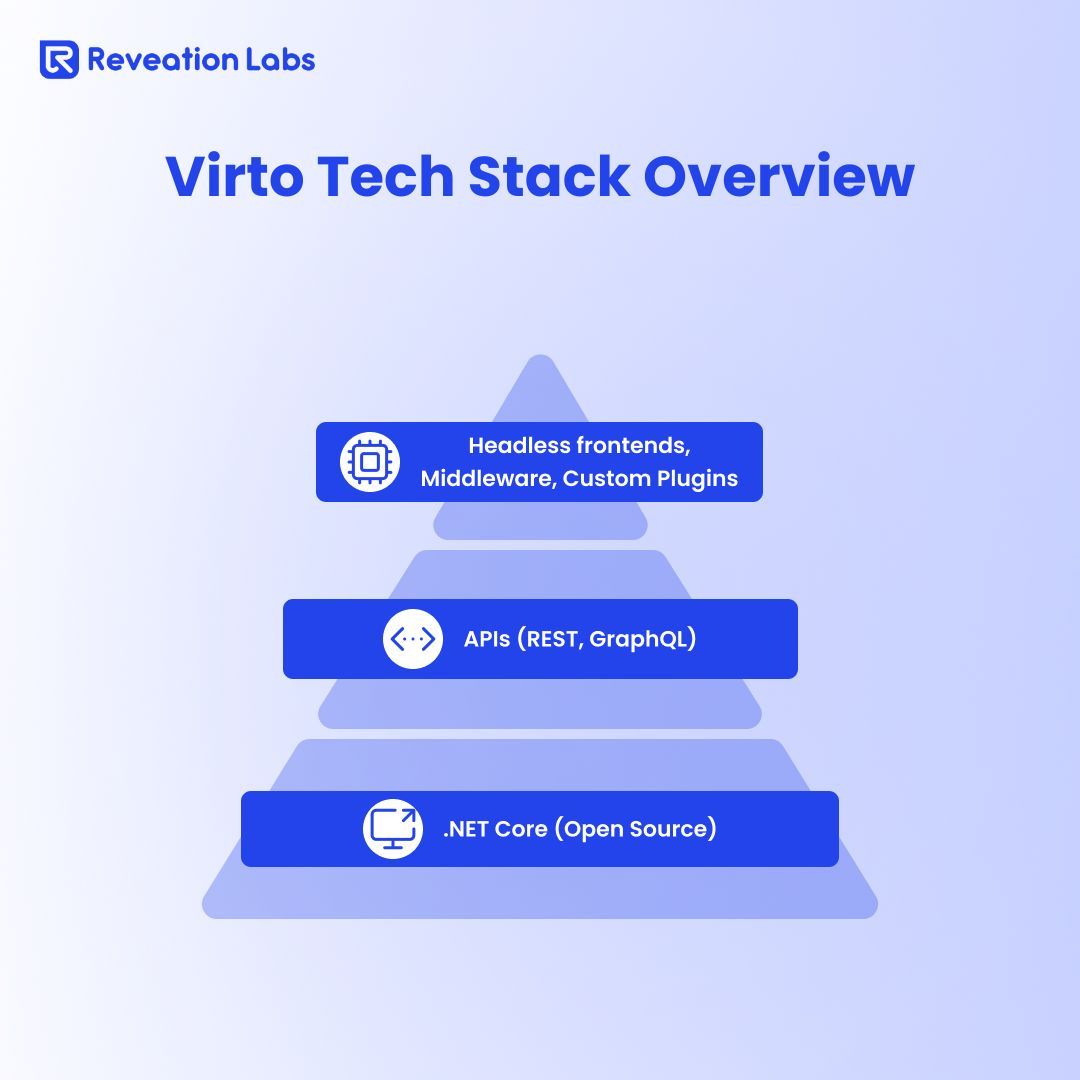
Virto’s core is an open-source .NET Core platform, giving enterprise-grade performance and full C# customizability. It’s designed for the cloud: you can run Virto on Azure, AWS, etc., using Kubernetes or Docker orchestration (Virto is a true cloud-native PaaS). The platform is fully headless/API-first: business logic is exposed via REST and GraphQL.
In fact, “Virto Commerce is a truly headless eCommerce platform… we provide an isolated layer of business logic [and] a GraphQL-based API to simplify channel connection”. This means any frontend – React, Angular, Vue.js, mobile apps, custom portals – can plug in without being locked to a specific templating engine.
Developers can extend Virto via modules or middleware. Need to add a new payment gateway, analytics engine, or business rule? You build a Virto module or plugin, and it hooks into the relevant events/APIs. The open-source core means you can even modify the base platform if required.
Overall, Virto supports polyglot frontends (for example, you could integrate Builder.io or any CMS on top) and an extensible plugin pipeline for all customizations.
Why This Matters: Total Cost of Change
All of the above translates to a much lower Total Cost of Ownership versus monolithic B2B platforms. With Virto you pay only for the functionality you use – e.g. if you don’t need a marketplace module, you simply omit it. This “tiny services” approach has lower TCO compared to monolithic solutions.
Upgrades are faster and safer: you update one microservice at a time with minimal downtime, instead of executing a huge patch on an all-in-one system. Developer velocity goes up because smaller codebases and clear APIs mean fewer regression issues.
In contrast, traditional platforms (like Magento or SAP Commerce) bundle many unused features and require extensive re-testing for each change. By decoupling components, Virto dramatically reduces the cost, time, and risk of evolving the system over the years.
- Reduced upgrade scope: Only relevant modules need to change, so upgrades take less time and testing.
- Faster feature delivery: Teams work in parallel on different modules, accelerating time-to-market for new capabilities.
- Future-proof integrations: New services can be plugged in without a full replatform. As enterprise needs evolve (new sales channels, AI tools, analytics), you simply add or swap modules.
Overall, Virto’s architecture helps enterprises future-proof their B2B commerce stack. The initial investment pays off in more agile development cycles and the ability to adapt to new business requirements without costly replatforming.
Partnering with a trusted Virto Commerce integration partner enables businesses to fully leverage the platform’s modular architecture, ensuring scalable and tailored B2B eCommerce solutions.
Final Thoughts & Next Steps
Virto Commerce delivers the speed, scale, and flexibility that complex B2B sellers require. Its composable, API-first platform lets you stitch together best-of-breed services (ERP, PIM, payment, search, etc.) with core commerce modules – all without compromise.
The result is a tailored B2B solution that can handle any custom pricing, catalog, or workflow challenge, while keeping total cost and risk under control.
Virto Commerce empowers you to answer “yes” to tough B2B demands.
Download our flexible platform whitepaper to see it in action.