
If your MRO ecommerce site shows the wrong price, hides the right part, or forces buyers back to email, the problem is not cosmetic. It is operational.
You do not need a shinier ecommerce site. You need a buying system your MRO customers can trust when a line is down, a technician needs the right replacement part, or procurement has to reorder 200 SKUs before the end of the day.
That is why industrial MRO ecommerce replatforming is different from a normal website migration. Your buyers do not casually browse. They search by part number, compare specs, check availability, expect contract pricing, and often need purchase order workflows that match how their company already buys.
The stakes are high because B2B buyers now expect better digital purchasing. Sana Commerce reports that 73% of B2B buyers prefer to buy online, 85% experience frustration when buying online, and 75% would switch suppliers for a better online buying experience. B2B Buyer Report 2025 ties those frustrations to reliability, efficiency, speed, and access to accurate information.
So before you choose a new platform, ask a harder question: what actually needs to change?
In this replatforming plan
Replatform or Fix?
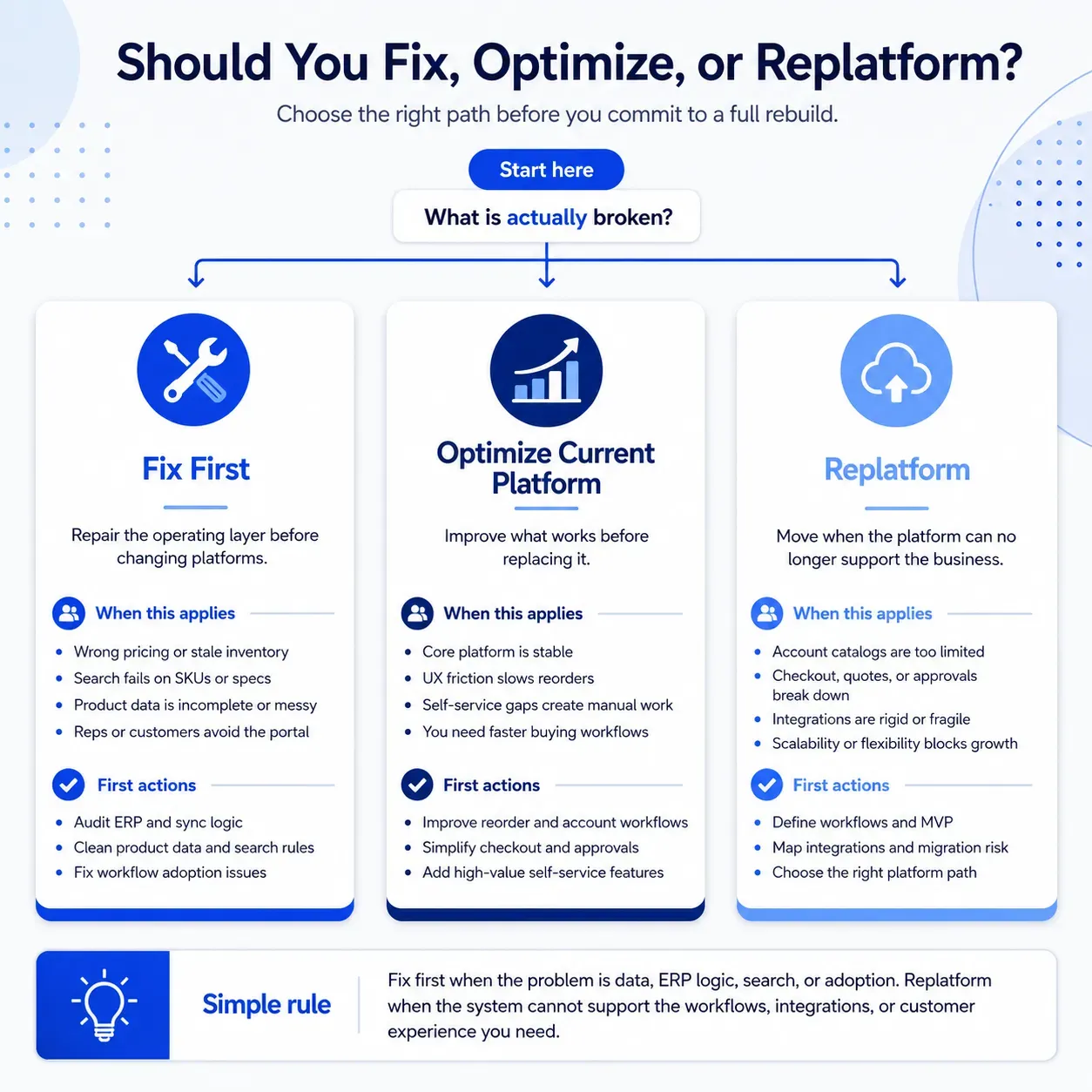
A full replatform may be the right move. It may also be the wrong first move if your real problem sits in ERP logic, messy product data, weak search, or internal adoption.
Use this diagnostic before you talk to vendors or evaluate modern b2b ecommerce solutions. It helps you separate platform limitations from operating-model issues.
Fix first when issues point to
- Data quality
- ERP logic
- Internal adoption
- Search rules
Replatform when the system cannot support
- Buying workflows
- Data accuracy
- Integrations
- Customer experience needs
If three or more issues point to platform limitations, replatforming may be justified. If most issues point to data, ERP, or adoption, fix those first before replacing the platform.
At Reveation Labs, we usually start here because the root cause decides the roadmap. Our B2B ecommerce consulting helps teams clarify operating needs, customer behavior, and roadmap priorities before they commit to a full build.
Practical takeaway: Do not replatform because the site looks outdated. Replatform when the current system cannot support the buying workflows, data accuracy, integrations, or customer experience your business needs.
Why MRO Is Different
Industrial MRO ecommerce has a different job than standard B2B ecommerce. It must help buyers find the right item quickly, trust the information, and place repeat orders with minimal friction.
In retail ecommerce, a bad search result is annoying. In MRO ecommerce, a bad search result can mean downtime, wrong replacement parts, or a buyer calling your competitor.
Buyers Know the Part
Many MRO buyers arrive with a SKU, manufacturer part number, spec, or replacement requirement. They do not want inspiration. They want confidence.
Orders Repeat Often
MRO purchasing depends on repeatable workflows. Buyers reorder from history, saved lists, templates, or job/site-specific lists.
ERP Drives Confidence
Pricing, inventory, invoices, credit limits, order history, tax, freight, and customer account rules often live in ERP.
Data Carries Confidence
Product data helps a maintenance manager know whether a part fits, meets spec, ships from the right branch, or has a valid substitute.
Buyers Know the Part
Many MRO buyers arrive with a SKU, manufacturer part number, spec, or replacement requirement. They do not want inspiration. They want confidence.
Your site must support exact matches, partial matches, cross-references, product attributes, substitutes, compatible parts, datasheets, and safety documentation.
Orders Repeat Often
MRO purchasing depends on repeatable workflows. Buyers reorder from history, saved lists, templates, or job/site-specific lists.
If your current site makes reorder difficult, your customers will keep emailing reps. That creates extra work for your team and weakens digital adoption.
ERP Drives Confidence
Pricing, inventory, invoices, credit limits, order history, tax, freight, and customer account rules often live in ERP. For MRO ecommerce, a modern front end cannot fix bad back-office truth.
If the buyer sees one price online and another price on the invoice, confidence breaks. This is why ecommerce ERP integration belongs near the center of your replatforming plan.
Data Carries Confidence
Product data does not just fill a page. It helps a maintenance manager know whether a part fits, meets spec, ships from the right branch, or has a valid substitute.
That is why product data and integration management matters so much in MRO. PIM, CPQ, OMS, and ERP connections need to support one reliable source of truth.
Map Buying Workflows
Before you evaluate an MRO ecommerce platform, map the workflows your buyers and internal teams use every week. Platform demos look clean because they show ideal paths. Your business has exceptions.
A platform demo is not proof your MRO workflows will work. You need to test the workflows that create revenue, reduce service load, and protect customer confidence.
Do not ask, “Can the platform do B2B?” Ask, “Can it support our top five buying workflows without forcing manual workarounds?”
If your team needs help moving from workflow maps to implementation scope, our B2B ecommerce implementation work supports complex use cases across data migration, integrations, launch planning, and operational rollout.
Audit Four Risks
A strong industrial MRO ecommerce replatforming plan starts with risk. Not design. Not feature lists. Risk.
Score each area from 1 to 3. A score of 1 means low risk, 2 means moderate risk, and 3 means high risk. If you score high in two or more areas, slow down and solve those issues before you lock the roadmap.
Platform risk
The platform cannot support account-specific catalogs, complex pricing, custom checkout, quotes, saved lists, or bulk ordering.
Integration risk
ERP, CRM, PIM, OMS, WMS, or procurement systems do not sync reliably enough for ecommerce.
Product data risk
SKUs, attributes, images, datasheets, categories, units, and substitutes are incomplete or inconsistent.
Adoption risk
Sales reps, service teams, and key accounts do not trust the new workflow enough to use it.
Your current platform may block growth if it cannot handle the account, pricing, checkout, and catalog rules your buyers need. This is where modern B2B ecommerce and customer portal planning helps connect buying, support, and self-service into one reliable experience.
Product data deserves special attention. A new platform will not magically fix missing attributes, inconsistent units, duplicate SKUs, weak images, poor categories, or outdated spec sheets.
If search fails after launch, buyers will blame the new site. In reality, the problem may be the data you migrated into it.
Define the MVP
Your MVP should not mean “small website.” It should mean the smallest release that supports revenue-critical buying tasks.
For MRO ecommerce, accuracy beats novelty. If a feature does not improve pricing accuracy, search success, reorder speed, checkout completion, or sales/service efficiency, it probably does not belong in the first release.
Do not pack the first release with personalization, advanced AI search, marketplace features, or complex automation unless those directly support your top buying workflows.
A focused MVP reduces launch risk. It also gives buyers one clear reason to switch from email: the new portal makes routine buying faster and more accurate.
Match Platform to Complexity
Do not choose a replatforming path because a platform sounds modern. Choose it because it fits your complexity, budget, team, and operating model.
Improve current platform
Best Fit: The foundation works, but UX or data needs help
Watch-Out: May delay needed replacement
MRO Fit: Good for lower complexity
ERP-native commerce
Best Fit: ERP owns most pricing, inventory, and accounts
Watch-Out: UX and flexibility may feel limited
MRO Fit: Good when ERP logic dominates
SaaS B2B platform
Best Fit: You need speed, standard B2B features, and lower ownership
Watch-Out: Deep customization can get constrained
MRO Fit: Good for many mid-market teams
Composable/headless
Best Fit: You need flexibility across channels and systems
Watch-Out: Requires stronger technical ownership
MRO Fit: Good for complex growth plans
Custom build
Best Fit: Differentiated workflows cannot fit standard tools
Watch-Out: Higher cost and maintenance burden
MRO Fit: Good only when justified
The best choice is the one your team can support after launch. Mid-market companies often underestimate this part.
If your team is comparing ERP-native, SaaS, composable, or custom paths, our ecommerce tech stack consulting helps turn that choice into an architecture and ownership decision.
Protect Revenue During Migration
Most migration plans focus on moving content and SKUs. MRO companies need to focus on the things that can break revenue.
Your migration plan should protect pricing, inventory, search, account rules, and order flow first.
Pricing and Catalogs
Test contract pricing by customer, role, branch, quantity break, and product category. Include edge cases, not just perfect accounts.
If pricing is wrong, buyers will not trust the portal.
Inventory and Availability
Decide how the site will show stock status. A simple “in stock” message may not work if availability depends on branch, vendor, lead time, allocation, or backorder rules.
Make availability useful, not just technically connected.
Search and Taxonomy
Build redirects, category mappings, synonym rules, part-number logic, attribute filters, and substitute relationships before launch.
Search is not just a UX feature. In MRO, it is a revenue workflow.
Accounts and Permissions
Customer hierarchies can get complicated fast. One company may have multiple buyers, approvers, branches, ship-to locations, catalogs, and payment rules.
Test these structures before migration, not after launch.
Orders and Invoices
Buyers often need order history, invoice lookup, shipment status, and reorder tools. If that data stays trapped in ERP, your portal feels incomplete.
This is where ERP integration becomes a practical requirement, not a technical nice-to-have.
Test Before Launch
A good launch does not come from a pretty staging site. It comes from brutal testing against real buying scenarios.
Base test cases on your highest-value customers, highest-volume SKUs, messy accounts, common quote flows, and known exceptions.
Invite sales reps and real customers into UAT. They will find workflow problems your implementation team may miss.
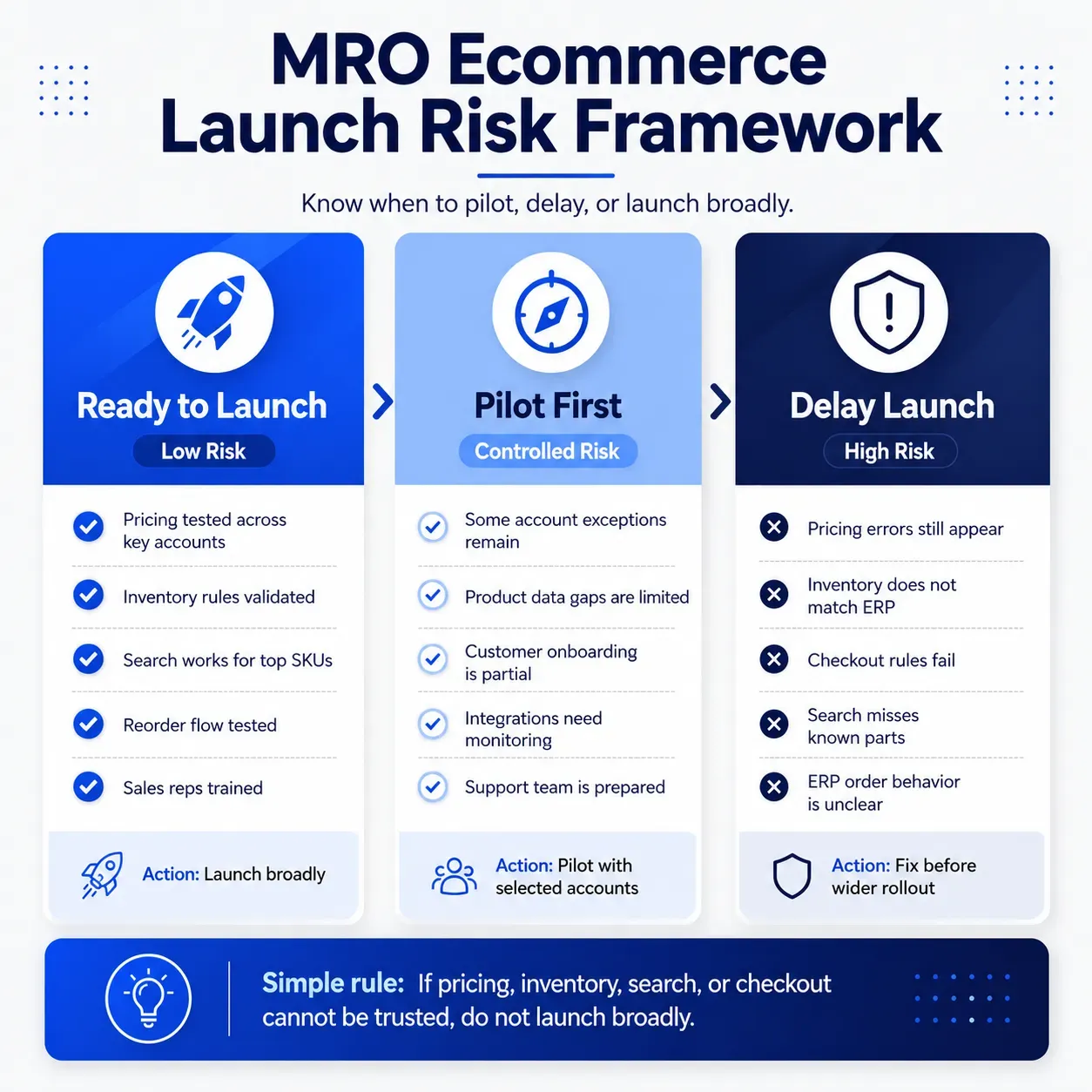
Launch rule: If pricing, inventory, search, or checkout cannot be trusted, do not launch broadly. Pilot with controlled accounts first.
Avoid Costly Mistakes
Industrial MRO ecommerce replatforming gets expensive when teams solve the wrong problem first.
The most common mistake is starting with design. Design matters, but it cannot overcome inaccurate pricing, poor search, weak product data, or broken ERP workflows.
Choosing Too Early
Do not pick a platform before you map ERP logic, customer accounts, pricing rules, procurement workflows, and product data readiness.
A strong vendor demo can hide a weak operational fit.
Migrating Dirty Data
If your categories, attributes, images, datasheets, and substitute relationships are inconsistent today, they will still be inconsistent on the new platform.
Clean the data that affects buying confidence first.
Ignoring Sales Reps
Sales reps influence adoption. They know which customers will use self-service, which accounts need onboarding, and which workflows break in the real world.
If your reps do not trust the portal, your customers probably will not use it.
Overbuilding Launch
Many teams try to launch every feature at once. That slows the project and increases testing risk.
Launch the buying workflows that matter most. Then expand.
Skipping Customer Onboarding
Your best customers may not switch channels automatically. Show them how to reorder, use saved lists, check invoices, request quotes, and manage approvals.
A customer portal creates value only when customers know when and why to use it.
Start Here Monday
You do not need a 90-day promise to make progress. You need a practical first week that reveals where the risk lives.
- Pick five high-value customer accounts.
- Map their top buying workflows.
- Test pricing, inventory, search, reorder, and checkout.
- Score platform, ERP, product data, and adoption risk.
- Define the MVP around the highest-risk revenue workflows.
That is a better first move than asking five vendors for demos. It gives your team evidence before opinions take over.
Final Takeaway
Industrial MRO ecommerce replatforming should not start with “Which platform should we buy?” It should start with “Which buying workflows must work better than they do today?”
You need to diagnose root causes, map MRO workflows, audit platform/data/integration/adoption risk, define a revenue-critical MVP, and test the workflows that can break buyer confidence.
At Reveation Labs, we help mid-market B2B companies modernize complex ecommerce, product data, ERP integrations, and customer portals. If you need a practical replatforming roadmap before committing to a full build, book a consultation with us. We will help you decide what to fix, what to replace, and what to launch first.