
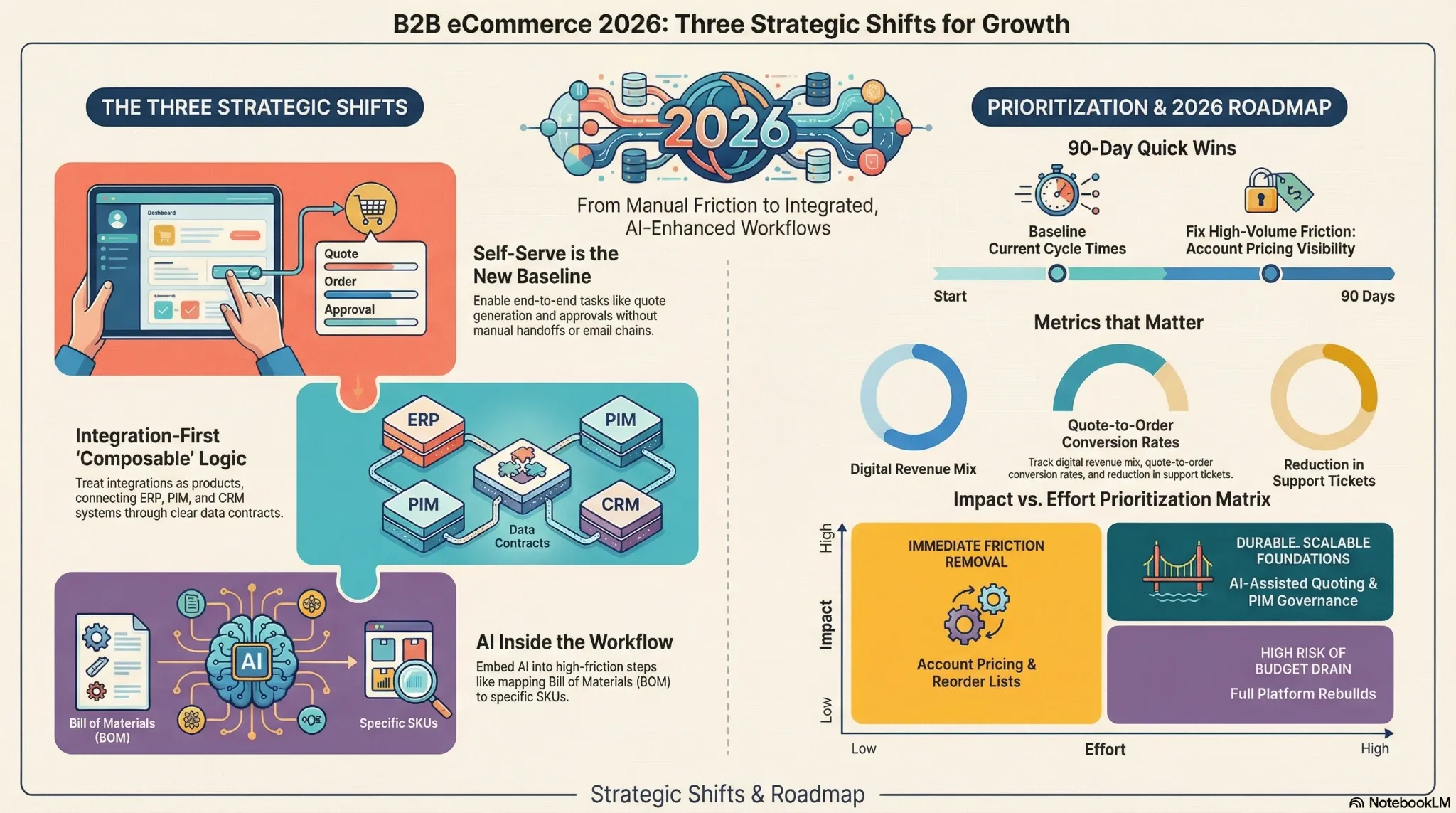
2026 is an execution year for B2B commerce: buyers expect self-serve, stacks must become integration-first, and AI is moving from novelty to workflow. Here are the three shifts that matter, and how to act without betting the business on a rebuild.
Why 2026 matters for B2B commerce decisions
2026 is shaping up to be a “compound interest” year for B2B commerce. Small gaps that used to be tolerable, slow quoting, inconsistent pricing, disconnected inventory signals, and manual approvals now stack into lost conversion, higher support costs, and more margin leakage.
Buyers have gotten used to consumer-grade experiences everywhere, and they’re bringing those expectations to work.
The leaders who win will modernize in sequence: fix the friction that blocks revenue first, then strengthen foundations.
The decision isn’t “do we modernize?”, it’s what to modernize first, so self-serve grows while manual work shrinks. That requires treating commerce as a set of connected capabilities: customer experience, product/pricing data, and buying workflows that reduce handoffs.
If you’re looking for a practical point of view, this is the approach we use at Reveation Labs when helping B2B teams move faster with less risk.
Below are three shifts that will matter most in B2B eCommerce 2026, along with concrete examples and a clear “what to do next” plan.
Shift 1: Self-serve is now table stakes (even in complex B2B)
Self-serve in B2B used to mean “place a basic reorder online.” In 2026, self-serve means buyers can complete meaningful work without waiting: discover the right product, validate compatibility, see account pricing, route approvals, generate a quote, and purchase with the right terms.
This doesn’t remove sales, it moves sales to higher-value moments where expertise and deal shaping matter. The upside is real: less friction for buyers and lower cost-to-serve for you.
Quick definition: “Self-serve” in B2B means customers can complete a buying task end-to-end (with governance) without email ping-pong. The goal is fewer handoffs, not fewer relationships.
What “self-serve” really means in B2B
In B2B, self-serve isn’t one feature; it’s a bundle of outcomes that remove friction while preserving governance. The teams making progress standardize the most common buying motions and reserve exceptions for true exceptions. That’s what creates speed without chaos.
- Account pricing and entitlements (who can buy what, at what price, under what contract).
- Fast product discovery with specs, substitutions, and availability signals.
- Reorder and saved lists for repeat buying patterns.
- Approvals and permissioning for procurement controls.
- Quote-to-order that doesn’t require inbox workflows.
- Service self-serve (status, RMAs, documentation, part matching).
One concrete example: quote-to-order without email
Imagine a manufacturer selling configurable parts to distributors. The “request a quote” flow often becomes a form submission followed by days of back-and-forth, PDF quotes, and stalled approvals.
In 2026, leaders are moving to a path where a buyer builds the order digitally, sees contract-aware pricing, routes approvals, and converts to an order without leaving the portal. It’s not “automate everything”, it’s to add guardrails and make the standard path fast.
If you’re still translating RFPs and PDFs into custom responses by hand, that’s a strong sign you’re ready to standardize what can be standardized. Here’s a practical perspective on turning RFP PDFs into scalable commerce without losing nuance.
Leader takeaway: Self-serve wins come from removing handoffs, not adding “features.” Pick one high-volume workflow and make it doable end-to-end in one sitting. ✅
Shift 2: Composable + integration-first becomes the default operating model
For years, B2B teams hoped a single platform would solve everything. In 2026, the market reality is clearer: commerce success depends less on “the platform” and more on how well you connect systems, govern data, and evolve capabilities without breaking operations.
That’s why composable and integration-first approaches are moving from “modern” to “default.” The payoff is changeability: you can improve one capability without replatforming everything.
Platform and architecture implications (in plain language)
Most B2B commerce problems are integration problems: pricing doesn’t match contracts, inventory signals aren’t reliable, product data is inconsistent, and quote rules don’t align with what’s sold. These issues rarely get fixed by a new UI alone.
They get fixed when you establish clear system roles and predictable flows for data and decisions. A practical 2026 pattern looks like “thin storefront, strong services.”
Integration-first teams treat integrations as products, not projects. They define ownership, SLAs, monitoring, and data contracts so the commerce experience can evolve without surprises.
If you’re prioritizing this shift, you’ll want an approach to seamless eCommerce system integration that reduces fragility instead of adding another layer of complexity.
Practical operating model: govern capabilities, not vendors
Composable succeeds when it’s paired with governance. Define what each system owns (ERP, CPQ, PIM, OMS, CRM), and make “source of truth” explicit so teams stop debating and start fixing drift. Then modernize capability by capability: pricing visibility, inventory confidence, product data quality, and quote automation.
This is the most defensible path for digital transformation 2026 without overcommitting to a big-bang rebuild.
Shift 3: AI shows up inside the buying workflow (not just on the homepage)
In 2024–2025, many commerce AI experiments were surface-level: chatbots, content generation, and basic product Q&A.
In 2026, the bigger shift is AI inside workflow, supporting the steps that slow deals: discovery, configuration, quoting, approvals, and post-order service. The leaders who win will embed AI where it reduces cycle time and errors, while keeping strong controls around permissions and accuracy.
Where AI fits in B2B commerce in 2026
The highest ROI AI placements are usually the least flashy ones. They help buyers find the right item faster, help teams produce compliant quotes, and help support resolve issues with fewer escalations. The principle is simple: AI should be constrained by your rules and fed by your data.
- Search and discovery that understands customer context (account, contract, industry).
- Compatibility and substitutions that reduce returns and support tickets.
- Quote assistance that drafts a compliant structure from rules and patterns.
- Support triage that routes cases and answers from approved knowledge.
- Procurement enablement that helps buyers complete approvals and policies.
From chatbots to agentic commerce
“Agentic commerce” is best understood as AI that can take a goal (like “build a quote under this contract”) and execute steps (validate pricing, confirm eligibility, check availability) within permission boundaries.
It’s not magic; it’s orchestration plus guardrails. If you want a plain-English view of how this is evolving, see our take on agentic commerce in B2B eCommerce.
One example: AI-assisted quote creation (with controls)
A common bottleneck is the BOM-to-quote process: mapping items to SKUs, applying contract pricing, validating availability, and capturing approvals.
In an AI-assisted model, the system can ingest the BOM, map it using approved product data, flag mismatches, recommend substitutions, and draft a quote structure for review.
Humans still approve the final output, and every step is logged. This is how you get speed without giving up control.
Governance matters because AI should not invent pricing or policy. A useful way to think about it is to define how agents behave, what they can access, and how actions are audited; this is the spirit of an Agentic Commerce Protocol (ACP) approach.
What Leaders Should Do Next: Prioritization and Next Steps
Most leadership teams face the same trap: too many initiatives and no sequencing.
The best approach is two tracks: buyer-facing quick wins and foundational work that prevents rework. Tie both to measurable outcomes so you can say “no” to initiatives that don’t move cycle time, accuracy, or margin.
Prioritization matrix (Impact vs. Effort)
| Bucket | What to prioritize | Why it matters in 2026 |
|---|---|---|
| High impact / low effort | Account pricing visibility; search relevance for top categories; reorder + saved lists; consistent lead times. | Removes friction on the highest-volume paths and reduces support load quickly. |
| High impact / higher effort | Quote-to-order modernization; integration-first refactor for pricing/inventory/eligibility; PIM + data governance; AI-assisted quoting/support with guardrails. | Builds durable foundations so self-serve and AI are reliable at scale. |
| Lower impact / high effort | Full platform replacement without workflow sequencing; AI pilots without measurable outcomes; one-off integrations that create permanent exceptions. | Consumes budget without reducing handoffs or improving accuracy. |
A 90-day plan (focused and measurable)
In the next 90 days, pick one buyer journey that represents real volume and pain, often reorder, quote, or support. Establish a baseline (time-to-quote, error rate, tickets per order, conversion), then remove steps until the standard path is fast and predictable.
Your goal is not “transformation”; it’s a lift you can measure and defend. If you need a broader modernization lens, align this with your longer-term roadmap through digital transformation services so quick wins don’t become dead ends.
A 6–12 month plan (build the foundations)
Over 6–12 months, make integration-first real: define system roles, establish data contracts, and build reusable services for pricing, inventory, eligibility, and customer context.
Then layer AI into workflows where your rules and data are strong, starting with “assist” modes before adding autonomy. If you want a skeptic-friendly calibration on what’s real versus hype, this is a useful read on AI in B2B eCommerce.
Metrics that matter in 2026
| Shift | Leading indicators | KPIs to track |
|---|---|---|
| Self-serve | Fewer emails per order; more portal sessions that end in completion. | Digital revenue mix, conversion rate, repeat purchase rate, support tickets per order. |
| Composable + integration-first | Fewer “exceptions” and data mismatches across systems. | Order accuracy, exception rate, time-to-ship, pricing consistency, integration uptime. |
| AI in workflow | Shorter quote cycles; faster support resolution with verified answers. | Time-to-quote, quote-to-order conversion, time-to-resolution, deflection rate, audit exceptions. |
Conclusion
The big story of B2B eCommerce 2026 isn’t one technology; it’s the combination of three shifts: self-serve becoming the baseline, integration-first composable architectures becoming the operating model, and AI moving into real buying workflows.
Each shift is manageable when you approach it through specific journeys and measurable outcomes. The teams that win will modernize in sequence, reduce handoffs, and build foundations that let them evolve quickly.
If you want a tailored view of how these shifts apply to your stack, workflows, and growth targets, get in touch. We’ll help you prioritize what to fix first and how to modernize without unnecessary rebuild risk, starting with the journeys that move revenue and margin.