
B2B product discovery is shifting from manual catalog navigation toward more guided, intent-led experiences. Buyers increasingly expect to describe what they need in plain language, get relevant options faster, and move forward without decoding internal product structures first.
We see that shift showing up across our work in agentic commerce, product discovery, and 2026 B2B commerce trends. The real change is not just that AI can answer questions. It is that discovery is becoming more conversational, contextual, and action-oriented.
That is where GenAI and agentic AI start to matter in different ways. GenAI changes how buyers explore and understand. Agentic AI extends that shift by helping systems plan, validate, and support bounded next steps inside commerce workflows.
Executive takeaway: The next competitive gap in B2B discovery is not just better search. It is whether your product data, UX, and commerce architecture are ready for AI-guided evaluation and bounded agent action.
Why product discovery is changing faster than most B2B teams realize
The old model assumed buyers would browse, filter, and click their way toward confidence. The newer model assumes buyers want the shortest path to relevance. That changes what discovery needs to do.
If buyers begin with a problem, a use case, or a set of constraints, then discovery has to interpret intent before it can return useful options. That is a better fit for complex B2B catalogs, where product families, technical attributes, compatibility rules, and account context often make traditional keyword search feel too rigid.
This is also why we keep connecting discovery to broader commerce strategy. A polished storefront still underperforms if buyers cannot find the right product, understand fit, or move through evaluation with low friction. In practice, discovery now acts more like revenue infrastructure than a secondary UX feature.
Old model
The old model assumed buyers would browse, filter, and click their way toward confidence.
New model
The newer model assumes buyers want the shortest path to relevance. That changes what discovery needs to do.
GenAI vs agentic AI: what is the difference in commerce?
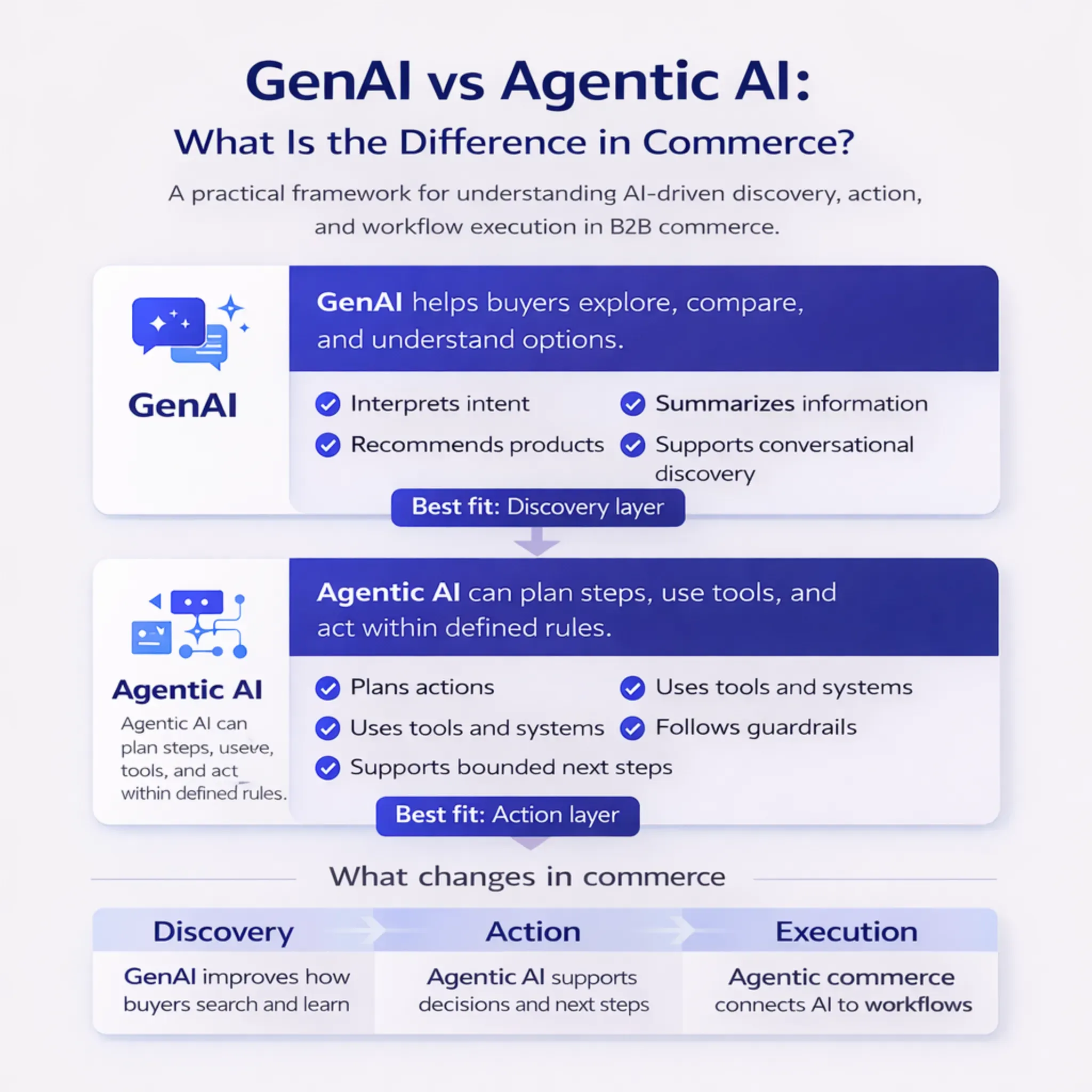
These terms get blended together too often, and that leads to weak strategy. The distinction matters because each layer solves a different problem.
GenAI as the interface layer
GenAI improves how buyers ask, compare, refine, and learn. In product discovery, that usually means conversational search, guided recommendations, summarization, and better interpretation of natural-language intent. It improves the interface between what the buyer means and what the catalog contains.
Agentic AI as the action and orchestration layer
Agentic AI goes beyond generating responses. In our agentic commerce vs agentic AI and agentic AI for B2B eCommerce content, we describe it as systems that can plan steps, use tools, and act within rules. In commerce, that can mean validating eligibility, preparing a quote path, routing an approval, or supporting a bounded next step rather than only returning information.
Agentic commerce as the applied business layer
Agentic commerce is where those capabilities get applied to real buying and operational workflows. On our agentic commerce automation page, we focus on practical examples like quote building, approvals, reorders, reconciliation, and other controlled actions with auditability.
That distinction matters because not every AI feature is agentic, and not every agentic workflow belongs in discovery first. Most B2B teams will get more value by improving guided discovery before they expand into broader agent-supported execution.
How GenAI is reshaping B2B product discovery
The biggest shift is that discovery is moving from query matching to intent interpretation. Buyers no longer need to start with exact SKUs, internal jargon, or category names. They can describe the problem they are solving, the environment they operate in, or the constraints they need to meet, and the system can guide them toward relevant options.
That change matters even more in B2B because the catalog is usually harder to navigate. Manufacturers and distributors often have technical specs, compatibility dependencies, layered evaluation logic, and account-specific considerations. In those environments, manual discovery patterns create friction long before pricing or checkout becomes the issue.
This is why GenAI product discovery is not just a search refresh. It changes how buyers ask, how catalogs communicate, and how digital journeys reduce uncertainty before a seller steps in.
What agentic AI means for the future of B2B buying
Agentic AI matters because discovery is not an isolated step in B2B. It connects to quotes, approvals, account permissions, procurement systems, and post-discovery actions. The strategic question is not whether AI can generate answers. It is whether your systems can support useful next steps safely.
From research assistant to buying agent
Today, many AI experiences behave more like research assistants than autonomous buyers. They summarize, compare, and guide. Over time, more will act like bounded buying agents that can validate fit, prepare quote paths, or route requests through approved workflow logic.
Guardrails, approvals, and human-in-the-loop workflows
In B2B, agentic AI only works if the business trusts what the system is allowed to do. That makes approvals, observability, auditability, role controls, and policy boundaries essential. The winning model is not reckless automation. It is bounded action in environments where the stakes are real.
What is real now vs what is still emerging
Real now
- Conversational discovery
- AI-guided recommendations
- Catalog enrichment
- Quote preparation support
- Approval routing in controlled workflows.
Still emerging
- Deeper cross-system orchestration
- Broader autonomous execution
- Agent-mediated purchasing at larger scale.
Best near-term strategy
Improve discovery quality first, then add bounded actions where trust and business rules are already clear.
Practical takeaway: treat GenAI as a discovery upgrade and agentic AI as an execution readiness question. Most teams need both eventually, but not at the same maturity level or in the same order.
What B2B leaders should do now
The smartest response is not to bolt AI onto a weak buying journey. The better move is to fix the foundations that make AI-driven discovery actually useful.
1) Fix product data and catalog structure
AI cannot rescue weak product data indefinitely. If attributes are inconsistent, use-case content is missing, or compatibility logic is hard to infer, the discovery layer will still frustrate buyers. That is why we keep tying product discovery back to product truth and catalog readiness.
2) Improve UX for AI-assisted self-service
If buyers want more self-guided evaluation, the interface has to support that. This is where our UI/UX design for eCommerce perspective matters: AI becomes more valuable when the surrounding experience helps buyers refine, compare, and proceed with confidence.
3) Prepare commerce architecture for agent-ready workflows
As agentic commerce matures, the key question is whether your systems can support approved next actions. Our work on agentic commerce automation, B2B Commerce & Customer Portals, and broader commerce strategy points to the same conclusion: integrations, permissions, approvals, and execution logic need to be clear if AI is going to do more than generate text on top of brittle workflows.
The strategic opportunity for B2B commerce teams
The companies that benefit most from GenAI product discovery will not be the ones with the flashiest demo. They will be the ones that make discovery easier, product truth clearer, and buying workflows more adaptable.
There is also an important balance to keep. AI can reduce friction, improve guidance, and support more self-service evaluation. But in complex B2B buying, human judgment, approvals, and relationship context still matter. The strongest model is likely to be AI-supported and human-calibrated rather than fully autonomous.
If your team is deciding what GenAI should change first, start with the places where discovery breaks today. Look at what data is missing, which journeys need guidance, and what your architecture can realistically support next. That is the kind of problem we address through B2B commerce delivery, UX design, and broader AI-enabled digital strategy.
Discovery easier
Product truth clearer
Workflows more adaptable
Conclusion
Product discovery is shifting from search-and-filter UX to AI-guided evaluation. GenAI is changing how buyers ask, compare, and learn. Agentic AI extends that shift by connecting discovery to bounded action, orchestration, and workflow support.
The near-term opportunity is not to chase every new label. It is to build a discovery experience that helps buyers get to confidence faster, while preparing your data, UX, and architecture for a more agent-ready future. That is the real strategic move behind GenAI product discovery.