
Most B2B teams do not struggle because they picked the wrong platform. They struggle because they picked the wrong rollout model for the business they actually run.
We have already covered the broader case for B2B eCommerce replatforming and why ERP and eCommerce alignment has to come first. This article stays focused on one decision: how to choose between big-bang migration, phased migration, and parallel run, and how to decide what should move first.
The safest first wave is usually not the one that looks best in a demo. It is the one that removes the most operational doubt.
Here is where teams get burned: they treat rollout as a website launch when the real move involves pricing logic, account rules, inventory visibility, order workflows, and service expectations.
Big-bang, phased, or parallel?
On paper, these sound like technical delivery choices. In practice, they are business risk choices.
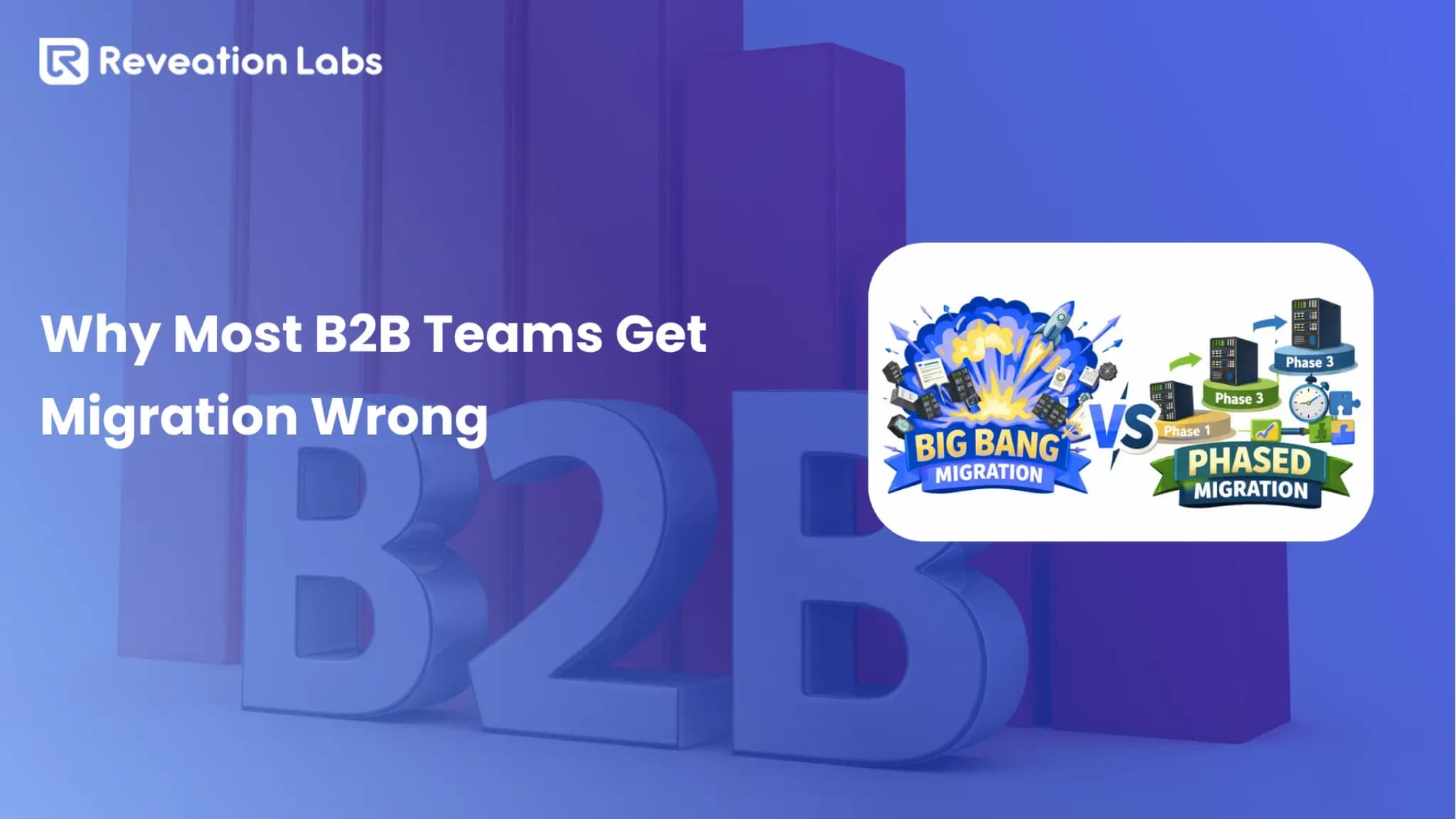
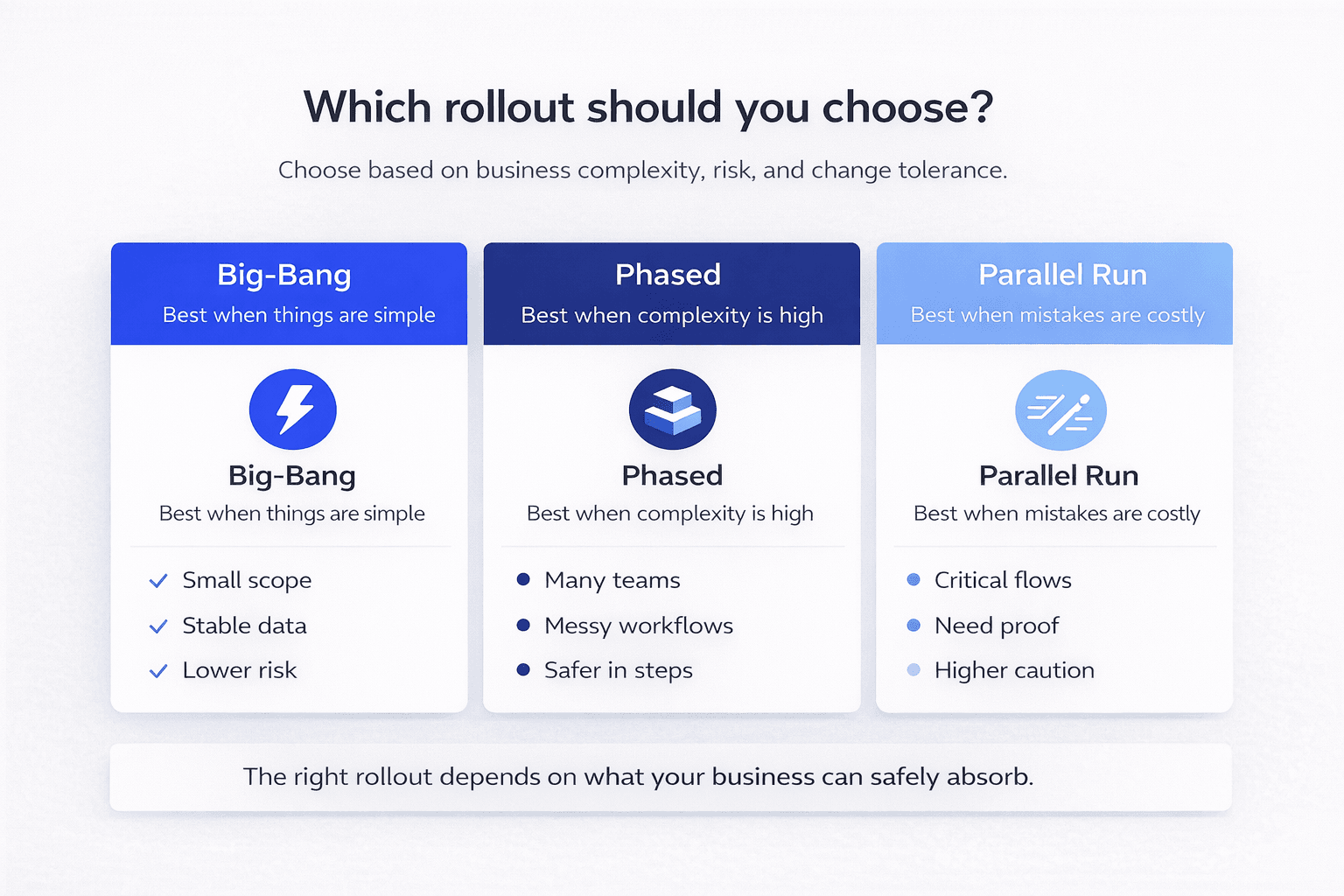
Big-bang means one concentrated cutover. Phased migration means moving in waves over time. Parallel run means the old and new environments operate together for a defined period while the team validates critical flows.
Big-bang migration
One concentrated cutover. Everything moves at once.
Best fit
Smaller, cleaner scope with fewer moving parts.
Main risk
Too much can break at once.
Phased migration
Move in waves over time. Validate one layer, then the next.
Best fit
Complex business logic and cross-functional change.
Main risk
More coordination over a longer period.
Parallel run
Old and new run together briefly while the team checks critical outputs.
Best fit
Critical flows need proof before full cutover.
Main risk
Extra cost and comparison fatigue if it drags on.
In B2B, this choice matters because the move is rarely just the storefront. Once pricing, inventory, orders, and account workflows depend on connected systems, rollout strategy starts affecting buyer trust directly.
What should move first?
Start with the part of the business that needs the most certainty, not the part that looks the most impressive in a launch meeting.
1. Start with risk
If your biggest pain is order errors, pricing confusion, or account-service friction, the first wave should cut those issues down fastest. A visual refresh should not lead the roadmap if the back-office truth is still unstable.
2. Start with users
Good phase-one groups are specific:
- One account segment
- One region
- One buying workflow
- One customer type that gives useful feedback without putting the whole revenue engine at risk
3. Start with proof
A first phase should prove something that matters. Buyers need to complete a core task, support needs to handle the change, and the data behind that experience needs to stay reliable under real conditions.
A practical way to think about wave one
If product data is weak, start earlier with catalog cleanup. That is where PIM for eCommerce, ERP integration, and implementation support stop being background work and become the real pace setters for rollout.
We have already gone deeper on the experience decision in our article on customer portal vs. storefront. Here, the focus is sequencing the move, not re-arguing the experience split.
When phased migration wins
Rules are messy
Phased migration wins when business logic is heavier than the launch plan makes it look. If pricing rules, account permissions, approvals, or order exceptions vary by customer, market, or workflow, waves give teams room to validate one layer before exposing the next.
Teams need time
Product, sales ops, service, finance, and fulfillment rarely adapt at the same speed. Smaller waves make training, support, and issue handling much more believable.
Timing is bad
If you are heading into a busy season, an all-at-once cutover usually raises business risk faster than business upside. A wave-based rollout gives you a tighter blast radius and a cleaner fallback.
This is where phased rollout feels less glamorous but more grown up. It respects the fact that businesses absorb change unevenly, even when the technical plan looks clean.
When big-bang works
Scope is tight
Big-bang migration can work when the scope is truly narrow. Fewer integrations, fewer workflow branches, and fewer customer-specific exceptions make one concentrated cutover more realistic.
Data is stable
Big-bang gets more credible when the underlying data is already dependable. If product structure is clean, access rules are settled, and connected systems agree on the core truth, the business may be able to absorb one launch moment.
Fallout is low
The final test is simple. If something goes wrong, how painful is it? If the business cannot tolerate pricing mistakes, missing inventory, broken approvals, or confused repeat buyers, speed matters less than the cost of being wrong.
A big-bang launch is a business decision, not just a delivery decision. If the business cannot absorb errors in pricing, inventory, or ordering, the launch model should reflect that.
That is why big-bang is not really about courage. It is about how much unresolved mess is still hiding in catalog data, pricing logic, and order handling.
When parallel run helps
Flows are critical
Parallel run is useful when a few flows matter so much that you need proof before full cutover. That is especially true for pricing, order status, inventory visibility, and other paths where silent drift can damage trust before anyone notices.
Comparison matters
A short comparison window can show whether the new environment is producing the right outputs before the business fully commits. It gives teams a chance to catch drift while the old path is still available.
Exit stays clear
Parallel run only helps if it has an end. If teams keep both worlds alive too long, the validation model turns into a permanent operating burden.
The point is not to run two systems forever. The point is to validate the few flows that really matter, then exit with confidence.
Use this scorecard
The easiest way to choose between big-bang and phased migration is to score the business, not the platform. Give each factor a score from 1 to 5, where 1 favors big-bang and 5 favors phased.
| Factor | 1 to 2 favors big-bang | 4 to 5 favors phased |
|---|---|---|
| Scope size | Limited scope | Broad cross-functional scope |
| Data stability | Clean and settled | Messy or still changing |
| Workflow complexity | Few exceptions | Many account-specific rules |
| Business timing | Quiet period | Busy season or high demand |
| Team readiness | One team, clear ownership | Many teams, uneven readiness |
| Error tolerance | Mistakes are recoverable | Mistakes hurt trust fast |
Mostly 4s and 5s?
Phased migration is usually the safer fit.
Mostly 1s and 2s?
Big-bang may be realistic.
If the scores split down the middle, that is often the signal to use a phased rollout with a short parallel run for the flows that carry the most trust risk.
Watch these signals
Before go-live
Do not ask only whether development is done. Ask whether the business is ready to absorb the wave.
- Support knows the change
- Users understand the new path
- Key scenarios were tested end to end
- Someone owns the go or no-go decision
After wave one
Judge the first month by stability, not celebration.
- Order acceptance
- Pricing accuracy
- Support tickets
- Manual overrides
- Whether users keep using the new path instead of retreating to email and spreadsheets
Those are better rollout signals than launch-day applause. They tell you whether the new experience is actually earning trust.
We covered the need for that kind of discipline more deeply in our article on ERP and eCommerce alignment.
What to do now
If you are still debating what should move first, start by mapping the buyer tasks that matter most, then line them up against system dependencies and business timing. That usually reveals whether the first phase should focus on discovery, account workflows, product data, or core order flows.
That is also where our B2B eCommerce implementation, ERP integration, and broader B2B eCommerce solutions can support the rollout as a single, connected program rather than a disconnected checklist.
Navigating these technical hurdles requires more than just a checklist; specialized B2B eCommerce consulting can help you sequence your rollout to ensure zero disruption to your core revenue streams.
The question is worth asking
The better question is not, “Should we go big-bang or phased?” It is, “What can we move first without breaking trust?”