
If you run ecommerce for a manufacturer or distributor, you already know the pattern. Orders still move, pages still load, and your team has learned the workarounds. The stack looks fine in a status meeting, then a simple catalog, price, or account-rule change turns into a project.
That is the job of B2B ecommerce replatforming for complex companies: decide whether the current platform, data, and ERP connections are the bottleneck, not whether the homepage needs a new theme. You are not starting from a blank storefront.
You are trying to keep contract pricing, catalog rules, and self-service working while the business asks for faster change.
Replatforming is a reset of the platform and the operating model around it. Migration is the move of data, content, and workflows inside that reset. If you treat the two as the same task, you usually get a cleaner interface with the same constraints underneath.
Practical test: If a routine product, price, or permission change needs a ticket queue and a specialist, the platform is already shaping how you serve accounts.
Why B2B ecommerce replatforming can’t wait
Rigid commerce systems rarely fail in one outage. They slow launches, multiply workarounds, and turn ordinary buyer requests into expensive operational work. In B2B that drag compounds because pricing, product data, ERP logic, and self-service have to stay aligned.
You wait because the system still looks functional. The real cost is that every improvement takes too long, and every exception chips away at buyer trust.
Are rigid systems slowing growth already?
Most rigid platforms do not create one dramatic failure. They create a chain of smaller delays across marketing, sales, service, and operations. Over time you start adapting the business to the system instead of the other way around.
That shows up in familiar ways. Product updates take too long, account pricing is hard to maintain, and buyers cannot finish routine tasks without help. When that becomes normal, the platform is already steering growth in the wrong direction.
The problem is not only technical debt. It is commercial drag. If every change request feels like a project and every workflow depends on manual intervention, you are paying for rigidity every day.
Key point: Rigid systems do not only slow technology. They distort how your teams serve customers and respond to demand.
Why “good enough” breaks faster now
Buyer expectations have moved faster than many B2B stacks. Your customers want speed, visibility, and control without a rep for every action. A platform that felt acceptable a few years ago can feel like friction now.
That friction does not stay inside ecommerce. It shows up in reorder behavior, service confidence, account growth, and how easily customers stay. “Good enough” often means the team has learned to live with unnecessary delay.
| Friction | What you typically see |
|---|---|
| Launch delays | High |
| Operational workarounds | High |
| Buyer self-service maturity | Needs improvement |
What is B2B ecommerce replatforming, really?
B2B ecommerce replatforming is a planned change of the commerce foundation while you keep (and improve) the parts that already produce revenue. It is not a redesign of buttons. It is a change to how catalog, price, account, and order logic run.
You do this when the current platform limits growth that is possible on paper but slow or risky to ship. The question is not “which demo looks modern.” The question is what has to stay true on day one for named accounts.
Replatforming or ecommerce migration?
B2B ecommerce migration is the movement of content, data, and workflows from one system to another. B2B ecommerce replatforming is broader because it questions the architecture, operating model, and buyer experience behind that move. You can complete a migration and still run the same account, price, and exception logic you had before.
Many projects fail by treating replatforming like a technical swap. Teams move the same broken processes into a newer interface and call it a transformation. You get a cleaner front end with the same old constraints underneath.
A better start is business reality. What needs to change for buyers, internal teams, and connected systems to work together with less exception handling? That question beats a feature checklist.
| Path | What you actually do | Where it falls short |
|---|---|---|
| Patch the old stack | Keep adding plugins, custom code, and workarounds | Complexity grows faster than capability |
| Lift-and-shift migration | Move the old setup as-is to a new platform | Old process problems come with you |
| True replatforming | Redesign platform, data, and experience together | Needs more planning up front, and creates a better long-term fit |
Warning: A lift-and-shift can look like progress in a project plan and still leave account pricing, inventory truth, and order exceptions exactly where they were.
Why is B2B different?
B2B commerce is more demanding because the logic is heavier. You are not only managing products and checkout. You are managing account rules, contract pricing, approvals, credit terms, order workflows, and system dependencies that must stay aligned.
That is why ERP and ecommerce alignment belongs in the replatform conversation early. In many failed projects the storefront was not the real problem. The real problem was weak alignment between commerce, data, and operations.
What triggers ecommerce replatforming now?
You do not need a platform sunset to have a trigger. You need a pattern: the business wants a buying motion the stack cannot support without another layer of custom work. The triggers below are operational, not a feature tour.
Is ERP ecommerce integration the real issue?
Often, yes. When ERP and ecommerce integration is weak, teams stop trusting the site and start creating workarounds. Inventory visibility slips, order exceptions rise, and pricing accuracy gets harder to maintain.
That turns ecommerce into an operations problem, not just a digital one. Buyers feel it quickly because trust drops the moment the site shows one thing and the real process delivers another. Clean execution depends on clean system alignment.
Product data belongs in the same conversation from the start. Integration is not an add-on after you pick a platform. In B2B, how ecommerce connects to ERP and related systems is part of the platform decision, not a ticket you open after the contract.
Are buyers pushing for self-service B2B ecommerce?
In many industries, they already are. Buyers want to reorder, check status, review invoices, and manage routine tasks without waiting on a rep. That expectation keeps rising because digital convenience now shapes how professional buyers judge suppliers.
Strong self-service reduces friction for customers and frees your team for higher-value work. Weak self-service does the opposite and keeps basic interactions expensive. If self-serve still dumps work into email and phone, the platform is part of that cost.
Is your storefront, portal, or both too rigid?
Sometimes the platform is not the only issue. Sometimes you are asking one experience to do two different jobs. A product-led buying flow and an account-led service flow do not always belong in the same pattern.
A storefront usually supports discovery and conversion better. A portal usually supports account tasks and service visibility better.
Many B2B companies need both, and the mistake is forcing one model to carry jobs it was never designed to handle. Customer portal vs storefront is the decision when that split is unclear.
If you do not have a live B2B storefront yet, the constraint set is different. Greenfield vs replatform compares those two paths without mixing the fences.
How to choose a flexible eCommerce platform?
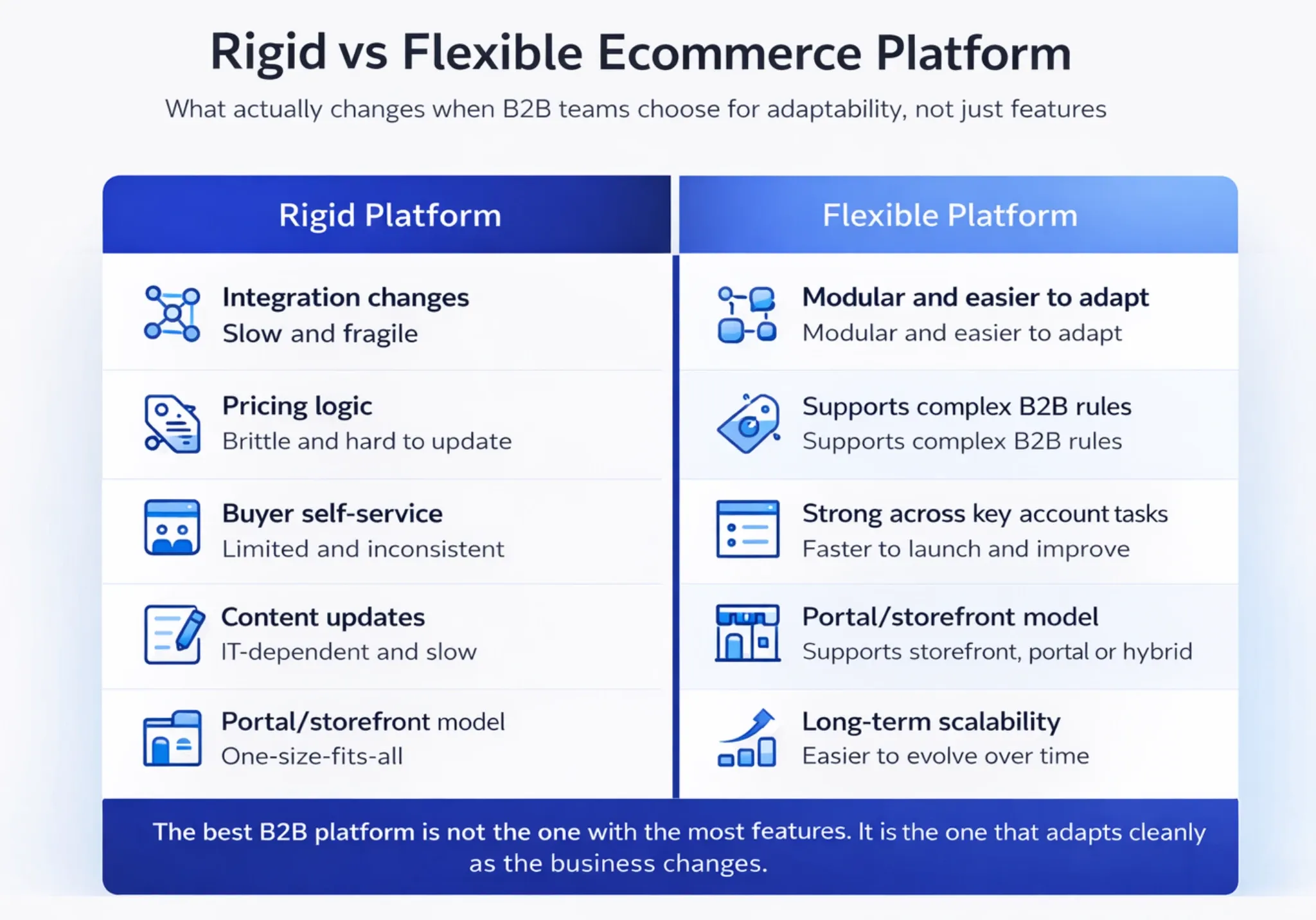
A flexible ecommerce platform is not the one with the longest feature list. It is easier to integrate, easier to extend, and easier to change without rebuilding the operating model every time the business moves. Flexibility shows up in how fast you can ship a real change.
If pricing logic is brittle, integrations are fragile, and content changes are slow, the platform is not flexible. It is familiar. Evaluate through integration depth, operational fit, and how fast your team can change workflows that actually drive revenue.
What makes a platform truly flexible?
| Lens | What to inspect | Why it matters |
|---|---|---|
| Integration readiness | Clean support for ERP, PIM, CPQ, OMS, and CRM | Reduces manual work and sync failures |
| Catalog and pricing flexibility | Account rules and complex product data | Supports how you actually sell |
| Experience model | Storefront, portal, or hybrid patterns | Matches how customers buy |
| Change velocity | Content and workflows can launch without a program | Keeps pace with accounts and the market |
SaaS, custom, or composable commerce for B2B?
There is no universal winner because each model solves a different problem. SaaS can help when speed and a simpler operating model matter most. Custom can fit unusual requirements, and it often increases maintenance and slows the next change.
Composable commerce for B2B becomes useful when you need modular flexibility more than forcing every function into one system. The better question is which model gives you the best balance of control, speed, and sustainability over the next few years, not which label sounds most current.
We help mid-market manufacturers and distributors make that call against ERP, catalog, and account reality, not against a slide of logos. Platform choice without that map is how expensive projects solve the wrong problem well.
How to reduce B2B ecommerce migration risk?
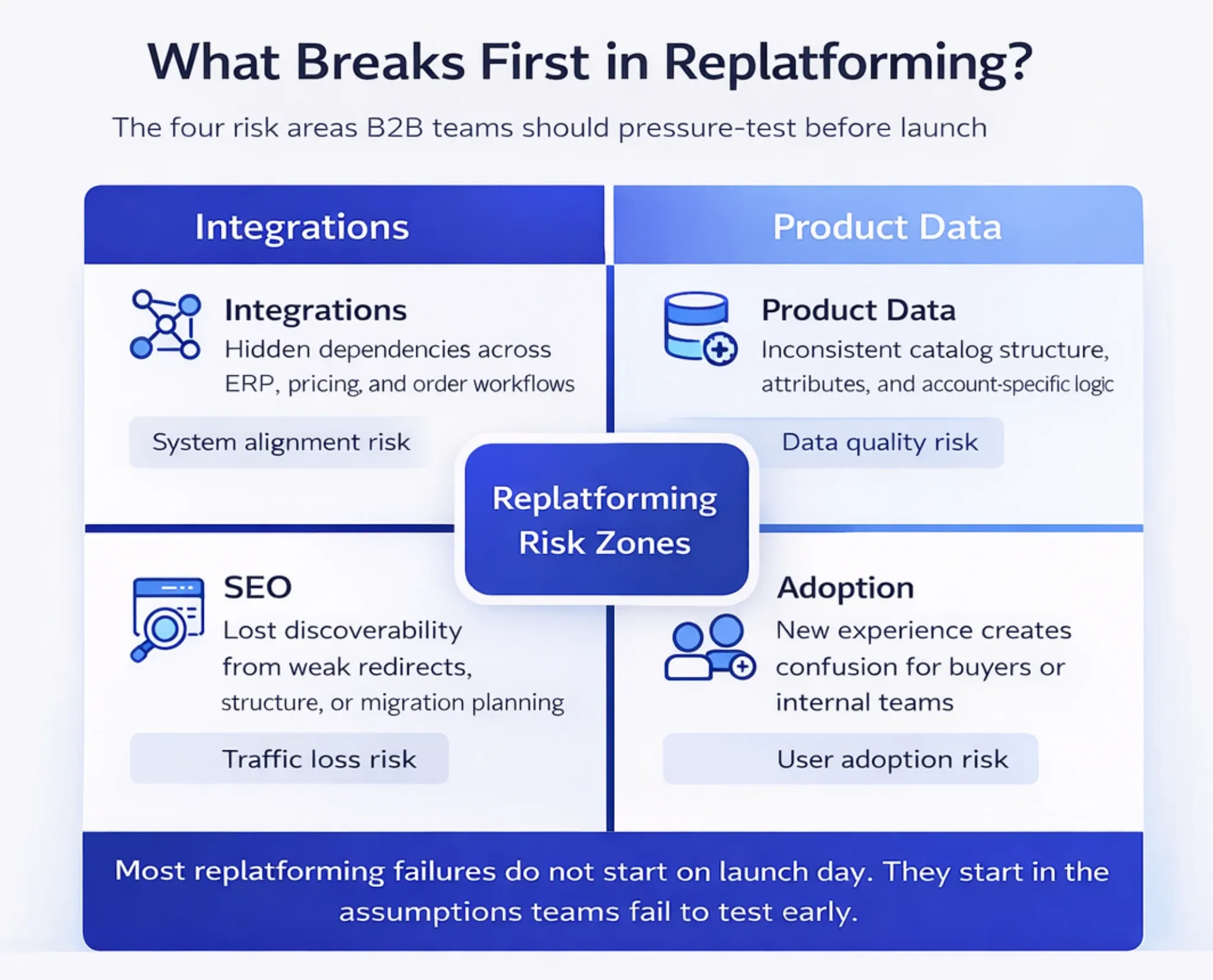
In most projects, one of four things breaks first: integrations, product data, search visibility, or adoption. Teams often spend too much time on launch theater and not enough time pressure-testing how the new system behaves under real complexity. That is where risk hides.
Start from workflow reality, not platform demos. If the project is not grounded in business friction, you will optimize the wrong things.
What breaks first during replatforming?
Integrations break when order, inventory, or price sync was held together by exceptions your team already knows by heart. Product data breaks when the catalog looked complete in the old admin and is incomplete the moment buyers search with real attributes.
Search visibility breaks when public URLs, redirects, and content structure are treated as a last-week task. Adoption breaks when buyers and internal users cannot complete the same jobs they could yesterday.
Those four are the pressure tests. A go-live that is “green” for IT can still be a loss if service tickets spike and buyers stop trusting the numbers on the site.
How to protect SEO and adoption?
SEO protection starts before launch. Redirect logic, URL mapping, metadata continuity, and content structure need owners early. If public discovery is an afterthought, organic visibility is one of the first hidden losses, and you will not see it on launch day.
Adoption needs the same attention. A new platform still fails if buyers and internal teams struggle to use it. Better technology only creates value when people can move through it with less friction than before.
Many projects underperform here. They launch successfully from an IT perspective and create new confusion for customers and service teams. Technical success is not enough if the day-to-day experience gets harder.
Tip: The best replatforming projects are easier for buyers and internal teams to trust from day one, not only easier to demo.
What does a smarter replatforming roadmap look like?
Start with friction, not features. Name where buyers get stuck, where your team loses time, and where connected systems create exceptions. That gives the program a business case rooted in work you already do, instead of a platform narrative.
Then define the future operating model. Decide what needs to be public, what needs to be account-based, and what must integrate cleanly before launch. Those choices shape everything else.
What should you assess first?
1. Audit business friction before features: Where do reorders, quotes, or price checks leave the site?
2. Prioritize ERP, pricing, product data, and permissions early: These are the dependencies that make a new storefront feel trustworthy or fake.
3. Plan SEO, UX, and rollout together: Do not sequence them as three unrelated workstreams.
If you already know you are moving data and workflows, the migration checklist covers cutover continuity for distributors and wholesalers. Use the five dependencies above first if you are still deciding whether a new platform would change how work gets done.
What dependencies should you map before a demo tour?
You do not need a 40-page architecture deck to start. You do need named sources of truth so a vendor demo cannot skip the hard parts.
1. Catalog ownership: Who edits product data, and which system is allowed to win when records disagree?
2. Account price source: Where does contract or customer-specific price actually live today?
3. Inventory truth: Which location, warehouse feed, or available-to-sell rule do you show the buyer?
4. Permission model: Who can see which SKUs, documents, and order history?
5. Cutover continuity: Which orders, credits, and open quotes cannot break on day one?
If you cannot name owners for those five, you are not ready to compare platforms. You are still discovering the operating model.
What should success look like later?
Success should look like fewer exceptions, faster updates, and better trust in the numbers the site shows. It should also look like a buyer experience that matches how customers actually purchase, reorder, and manage accounts. If the new platform is live and you are still trapped in the old workarounds, the project is not finished.
Implementation should focus on more than go-live. The real test is whether you can operate more cleanly, adapt more quickly, and support growth with less friction after launch.
Ready to test your replatform readiness?
B2B ecommerce replatforming should not be treated as a cosmetic refresh. It is a chance to correct the deeper issues that slow growth, weaken buyer trust, and make internal teams work harder than they should. The right project modernizes how the business runs, not just what the interface looks like. The biggest risk is often not changing platforms. It is staying tied to a rigid system that keeps distorting customer experience and operational execution. If the current stack is slowing self-service, complicating ERP alignment, or making change feel expensive, that is already a signal. If you want a short, fixed-scope way to map those dependencies against a live stack, book a B2B eCommerce Discovery Sprint. Bring the friction you already see. We will help you separate a true replatform from a lift-and-shift that would recreate it.