
You are weeks away from a composable commerce migration, and your team has checked the big boxes: platform, ERP, PIM, CMS, integrations, and launch timeline.
But one question can still break the whole plan: Can AI search understand what you sell well enough to recommend you?
That is the real AEO problem for B2B commerce teams. You can launch a faster storefront, cleaner integrations, and a more flexible stack, but if your product data, public content, and buying workflows stay unclear, answer engines may still ignore you.
Answer engine optimization, or AEO, means structuring your content and product data so AI search tools can understand, summarize, and recommend your business. For B2B commerce teams, that means product pages, specs, use cases, comparisons, schema, and buying workflows need to be clear without exposing private account logic.
At Reveation, we see this gap often. Teams modernize the storefront but carry over the same hidden catalog logic, thin product pages, PDF-heavy specs, and incomplete product data. That creates a modern commerce stack with an old visibility problem.
This B2B AEO checklist focuses on what to fix before your team goes composable.
Moving to Composable Commerce? Fix What AI Search Can See First
Composable commerce gives your team more flexibility. It helps you connect commerce engines, CMS, ERP, PIM, search, payments, and customer-specific workflows in a modular way.
But composable architecture does not automatically make your business easier to understand.
If your product content is thin, your specs live in PDFs, your category pages lack context, and your best buying guidance sits behind a login, answer engines have very little to work with. They may know your company exists, but they will struggle to explain what you sell, when to choose it, and why a buyer should trust it.
Composable architecture will not rescue messy product content
A new storefront can improve performance, integration flexibility, and release speed. It cannot turn vague product pages into useful answers by itself.
Use the migration to improve the answer layer of your commerce experience. That means the public, structured, machine-readable content that helps buyers and AI systems understand your catalog.
Our guide on B2B eCommerce search explains why public storefront content supports discovery, while portals serve logged-in account tasks like reorder history, negotiated terms, and account-specific workflows.
AI search can’t recommend what your storefront hides
Many B2B teams hide too much.
They gate product details, bury specs in PDFs, force buyers into portals, or rely on sales reps to explain fit. That may work for existing accounts, but it weakens discovery for new buyers and answer engines.
You do not need to expose contract pricing or private availability. You do need to expose enough public context for buyers and AI systems to answer basic questions:
- What does this product do?
- Which applications does it support?
- What specifications matter?
- What is it compatible with?
- What should a buyer compare it against?
- When should someone request a quote?
This shift is not only happening in B2B commerce. Other industries are also moving from traditional search-only strategies toward GEO and AEO because buyers increasingly use AI assistants during discovery, as this article on GEO and AEO visibility explains.
The real goal: become understandable before you become modular
Going composable should not only change your stack. It should make your commerce experience easier to understand, govern, and improve.
The winning teams do both at once. They modernize architecture while cleaning up the product data, page structure, public answers, and search signals that influence buyer trust.
Key idea: Do not migrate your old content problems into a new composable stack.
Why B2B AEO Breaks During Commerce Migration
B2B AEO often breaks during migration because teams treat content as cargo. They move pages, products, and files from one system to another without asking whether those assets still answer buyer questions.
That is risky.
Our B2B eCommerce replatforming guide frames replatforming as more than a software swap. It is a reset of architecture, workflows, buyer experience, and content quality.
Old URLs lose buyer intent
During migration, teams often redirect old pages to the closest new template. That sounds safe, but it can erase intent.
Those old URLs may carry search demand, buyer language, technical context, and AI-readable specificity. Protect them before launch.
Product data moves, but context disappears
A migration can preserve SKUs while losing meaning.
The SKU transfers. The product name transfers. Maybe the image and price logic transfer.
A legacy “replacement parts for commercial refrigeration compressors” page should not redirect to a generic “parts” category. A “chemical-resistant hose for food processing” page should not become a broad “hoses” page.
But the useful context often disappears:
- Applications
- Compatibility
- Materials
- Certifications
- Replacement relationships
- Installation environment
- Safety notes
- Buyer FAQs
- Comparison guidance
- Documentation links
Answer engines need that context to understand fit. Buyers need it to make decisions without waiting for sales.
Faceted pages, duplicate SKUs, and missing schema create noise
Composable migrations can create technical SEO clutter if teams do not plan carefully.
Faceted navigation may generate hundreds of thin URLs. Duplicate SKU pages may compete with product-family pages. New templates may launch without product schema, breadcrumb schema, or FAQ schema.
That noise makes your site harder for search engines and AI answer systems to interpret.
Portal-only answers make your expertise invisible
Portals matter. They help known customers reorder, view account pricing, manage invoices, and access private workflows.
But if your best product education only exists behind login, new buyers cannot find it. Answer engines cannot easily summarize it. Procurement teams cannot share it during early research.
Use the portal for private account execution. Use the public storefront for education, comparison, and discovery.
Product Data Fields That Help AI Understand What You Sell
Product data is not just an operations asset. It is a visibility asset.
If your data fields are inconsistent, incomplete, or trapped inside disconnected systems, your storefront cannot answer buyer questions well. AI-powered discovery tools will struggle too.
Our work on industry-specific eCommerce search shows why the same product-data quality that improves technical search also improves AEO.
The minimum fields every priority SKU needs
| Field type | Examples | AEO value |
|---|---|---|
| Identity | SKU, MPN, product name, brand, product family | Helps AI understand what the product is. |
| Classification | Category, subcategory, taxonomy, industry | Helps AI place the product in the right context. |
| Specifications | Dimensions, materials, capacity, tolerance, voltage, pressure rating | Helps buyers compare fit. |
| Compliance | Certifications, standards, safety notes, regulatory requirements | Supports technical and regulated buying decisions. |
| Availability logic | Stock status, lead-time range, regional availability notes | Explains buying constraints without exposing private account terms. |
| Relationship data | Accessories, replacement parts, compatible products, alternatives | Connects products to buyer needs. |
| Documentation | Spec sheets, install guides, manuals, warranty, CAD/BIM files when relevant | Gives buyers confidence before they contact sales. |
The context fields most teams forget
Most teams capture the product. Fewer teams capture the buying situation.
Add fields for:
- Industry
- Application
- Operating environment
- Installation constraints
- Buyer role
- Common failure mode
- Compatible equipment
- Replacement scenario
- “Do not use when” guidance
- Common comparison
- Required documentation
These fields help turn a catalog into a decision engine.
Weak page vs. AEO-ready page
Weak page
- “Industrial Hose Model 4500”
- “Replacement Part Catalog PDF”
- “Request a Quote”
- “Valves”
Better AEO-ready page
- “Chemical-resistant industrial hose for food processing washdown systems”
- “Replacement parts for Model X compressors: compatibility, specs, and quote steps”
- “How to request a quote for custom bulk orders, account pricing, and lead times”
- “High-pressure stainless steel valves for washdown, food-grade, and corrosive environments”
This is the kind of improvement that helps both buyers and answer engines. You are not just renaming pages. You are making product fit easier to understand.
The fields that support future AI buying agents
Agent-ready commerce needs more than product descriptions.
It needs workflow-aware data:
- Quote eligibility
- Reorder rules
- Approval paths
- Minimum order quantities
- Lead-time logic
- Substitution rules
- Documentation access
- Inventory rules
- Account restrictions
- Human escalation triggers
Agent-readable means your systems and content are structured enough for a trusted AI workflow to retrieve the right information, follow rules, and hand off to a human when needed.
This is where AEO overlaps with architecture. Your public content explains the product. Your private systems execute the transaction. Your agent-readable layer helps trusted workflows move faster with guardrails.
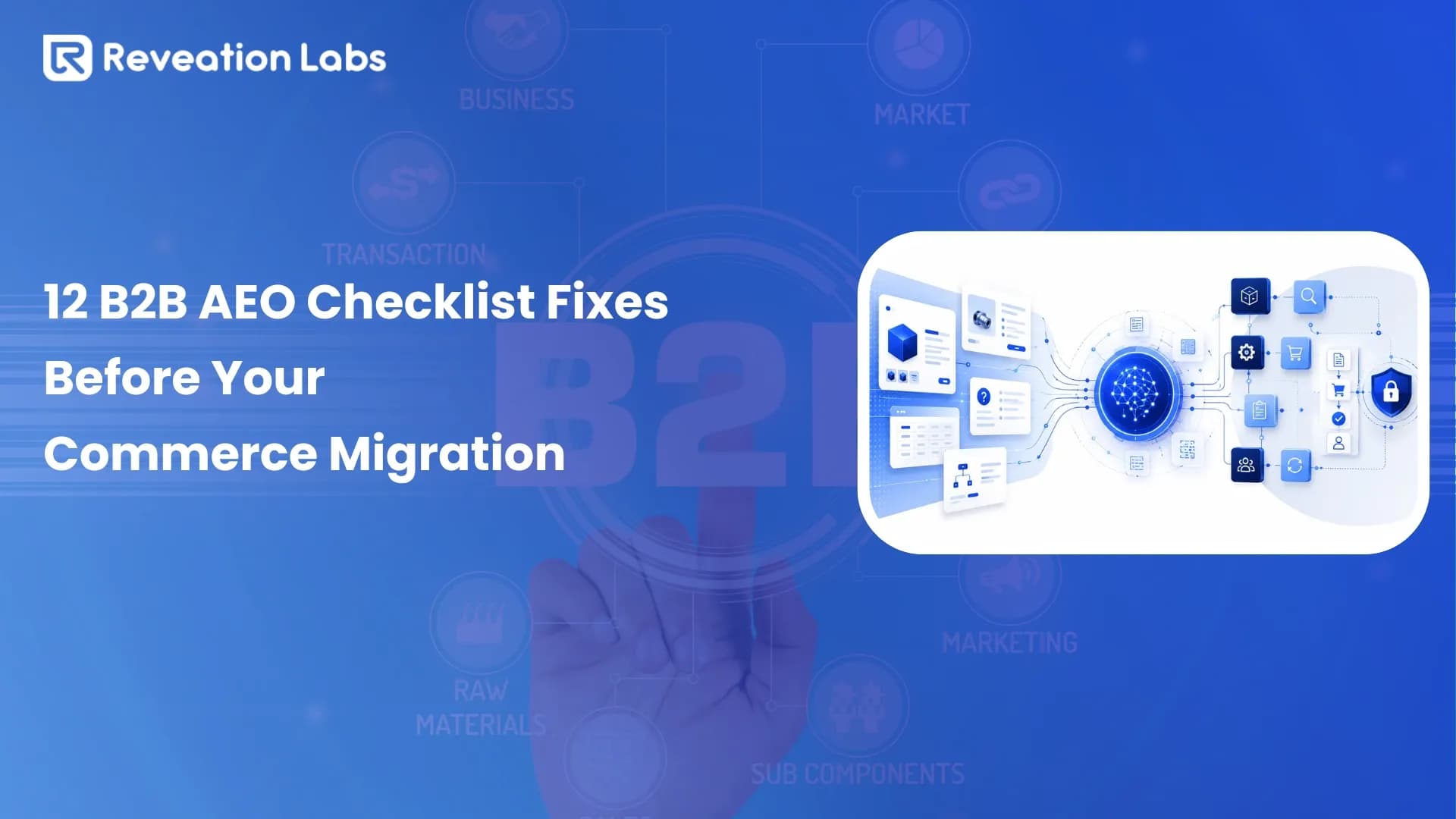
The B2B AEO Checklist: 12 Fixes Before You Go Composable
This checklist groups the work into four areas: content, product data, architecture, and measurement.
Content fixes
Make your pages answer-ready.
Product-data fixes
Give AI the fields it needs.
Architecture fixes
Make public answers and private logic work together.
Measurement fixes
Track AI visibility, not just rankings.
Content fixes: make your pages answer-ready
| Fix | What to do | Why it matters |
|---|---|---|
| 1. Turn product pages into buyer question hubs | Add use cases, specs, FAQs, compatibility notes, and buying guidance. | AI systems need clear answers, not just SKU descriptions. |
| 2. Pull critical specs out of PDFs | Convert key PDF content into crawlable page sections. | PDFs are useful, but they should not be the only source of product truth. |
| 3. Add use-case and industry context | Explain where the product fits, who uses it, and what problem it solves. | B2B buyers search by problem, application, and environment. |
| 4. Build comparison pages | Compare product families, materials, configurations, and alternatives. | Buyers often ask AI assistants to compare options before contacting sales. |
Start with your top product families, not every SKU. Your first goal is to make the most valuable pages answer the questions sales already hears every week.
Our guide on AEO for B2B marketing covers clear answer content, FAQ sections, schema markup, and continuous improvement for AI-search visibility.
Product-data fixes: give AI the fields it needs
| Fix | What to do | Why it matters |
|---|---|---|
| 5. Standardize core fields | Clean up SKU, MPN, product name, category, dimensions, materials, certifications, and replacement parts. | AI systems need consistent entity signals. |
| 6. Add context fields | Include application, compatibility, installation environment, safety, documentation, and lifecycle status. | Context helps buyers understand fit. |
| 7. Connect PIM, ERP, CMS, search, and analytics | Map which system owns each field before migration. | Composable systems work better when data ownership is clear. |
This is where commerce, IT, and product teams need shared ownership. Marketing can write the page, but the page will stay weak if the product data behind it is incomplete.
Architecture fixes: make public answers and private logic work together
| Fix | What to do | Why it matters |
|---|---|---|
| 8. Separate public education from private account logic | Keep specs and use cases public, but protect contract pricing and negotiated terms. | AEO does not require exposing sensitive customer data. |
| 9. Protect high-intent URLs | Map priority URLs, redirects, metadata, schema, and page intent before launch. | Migration can quietly erase pages that drive qualified demand. |
| 10. Explain quote, reorder, approval, and documentation flows | Create public pages that describe buying workflows without exposing private account details. | Buyers need to understand how purchasing works before they commit. |
This is where composable architecture can help. A modular stack lets teams connect the right systems while keeping public content, private account logic, and workflow data in the right places.
Our eCommerce tech stack consulting helps teams align commerce engines, CRM, ERP, and integrations with business goals before key platform decisions get locked.
Measurement fixes: track AI visibility, not just rankings
| Fix | What to do | Why it matters |
|---|---|---|
| 11. Test whether AI tools understand you | Ask real buyer questions and document whether AI tools mention, summarize, or cite your pages. | Rankings do not show the full AI-search picture. |
| 12. Track assisted signals | Monitor cited URLs, quote starts, demo paths, product-page engagement, internal search terms, and assisted conversions. | AEO should influence qualified buyer movement, not vanity traffic. |
Traditional SEO still matters, but AI-generated answers work differently from classic search rankings. One useful way to frame the shift is that teams now need pages that can be understood, summarized, and mentioned inside AI answers, not only ranked as blue links, as this article on GEO vs SEO explains.
Do not treat AEO as a one-time content task. Treat it as a visibility system.
What AI Search Should See and What Should Stay Private
This is the section many generic AEO articles miss.
B2B teams often reject AEO because they assume it means publishing sensitive pricing or customer-specific logic. It does not.
A better question is: what should be public, what should stay private, and what should become agent-readable over time?
Public: specs, use cases, comparisons, compatibility
Public content should help buyers and AI tools understand your business.
- Product-family pages
- Category pages
- Spec explainers
- Application pages
- Industry pages
- Compatibility guides
- Comparison pages
- Buying guides
- Implementation explainers
- FAQ sections
- Documentation summaries
Private: contract pricing, account terms, negotiated availability
Private content should stay behind login.
That includes account pricing, negotiated discounts, customer-specific catalogs, order history, invoices, approval rules, credit limits, and location-based inventory logic.
AEO should not weaken your commercial controls. It should clarify the public knowledge layer around them.
Agent-readable: quotes, reorders, approvals, documentation
Agent-readable does not mean “let AI buy anything without oversight.”
In practical B2B commerce, it means trusted workflows can retrieve accurate information, follow business rules, and escalate when needed.
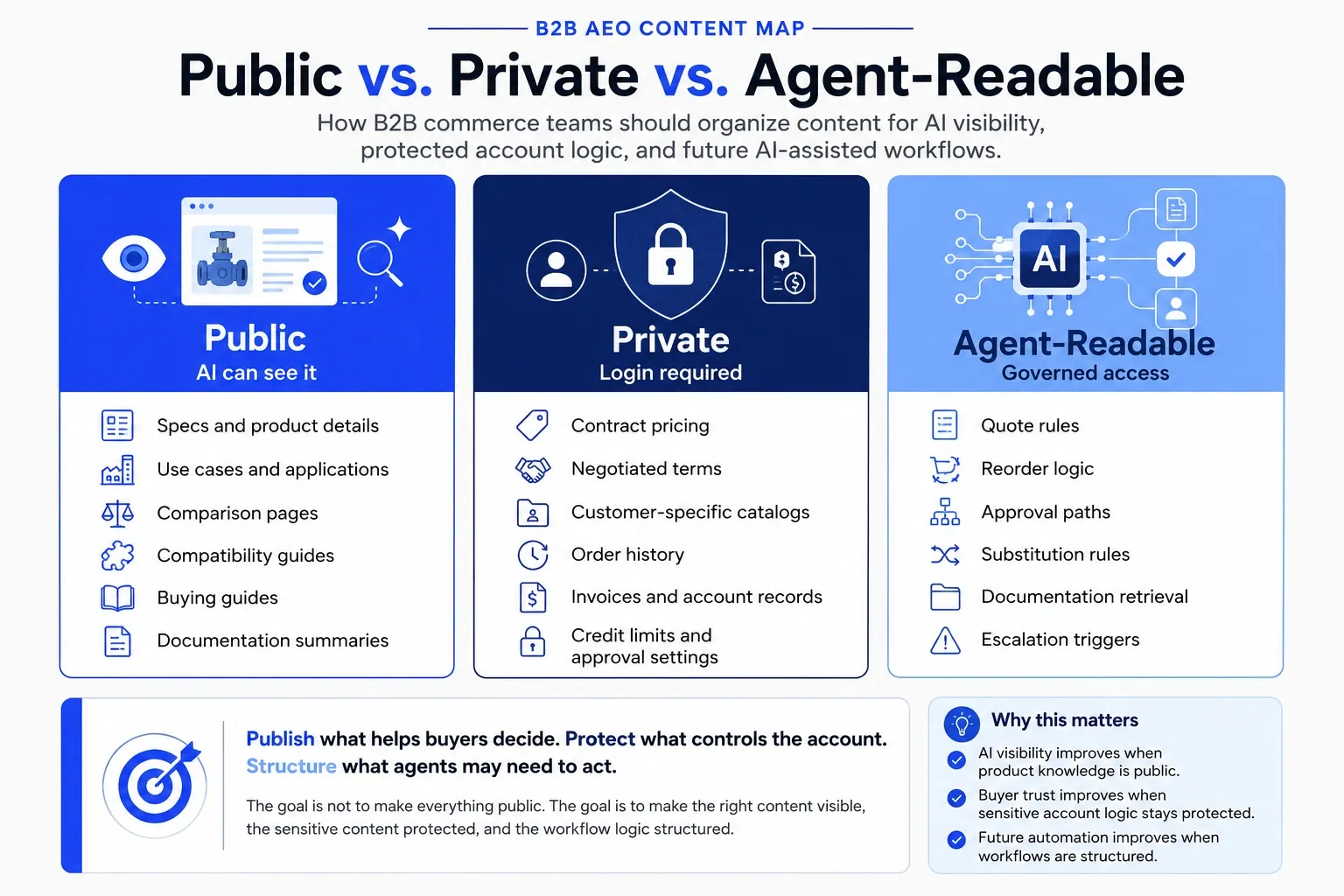
This content earns visibility because it answers real questions without exposing private terms.
Future AI buying workflows may help buyers compare parts, assemble a cart, request a quote, check documentation, or trigger a reorder. Our article on GenAI product discovery explains the shift from better search toward AI-guided evaluation and bounded agent action.
That future depends on the work you do now: clean product data, clear workflows, structured content, and architecture that can expose the right signals safely.
SEO Gets You Found. AEO Gets You Chosen. Agent Readiness Gets You Bought.
SEO, AEO, and agent readiness are connected, but they do different jobs.
Use this framing when your team debates priorities.
| Layer | Main question | What it optimizes | Typical owner |
|---|---|---|---|
| SEO | Can buyers find us? | Crawlability, rankings, metadata, internal links, technical health | Marketing / SEO |
| AEO | Can AI systems understand and recommend us? | Clear answers, schema, structured content, entity clarity, comparison depth | Marketing + commerce |
| Agent readiness | Can trusted AI workflows take the next step? | APIs, rules, quote paths, approvals, documentation, account logic | IT + commerce + operations |
What SEO optimizes for
SEO still matters.
Your pages must be crawlable, indexable, fast, well-linked, and technically clean. If your migration breaks redirects, metadata, canonical tags, or page performance, your AEO effort starts from a weaker base.
What AEO optimizes for
AEO focuses on clarity.
It asks whether your content can be summarized, cited, compared, and trusted by answer engines. For B2B commerce, product and category pages need more than short descriptions.
They need buyer questions, product context, entity clarity, schema, and useful next steps.
What agent readiness optimizes for
Agent readiness focuses on action.
Can a trusted workflow help a buyer find a compatible part, build a cart, request a quote, route an approval, or access the right documentation?
Our article Agentic AI Architecture Explained covers planning, memory, tooling, orchestration, observability, and governance for agentic systems.
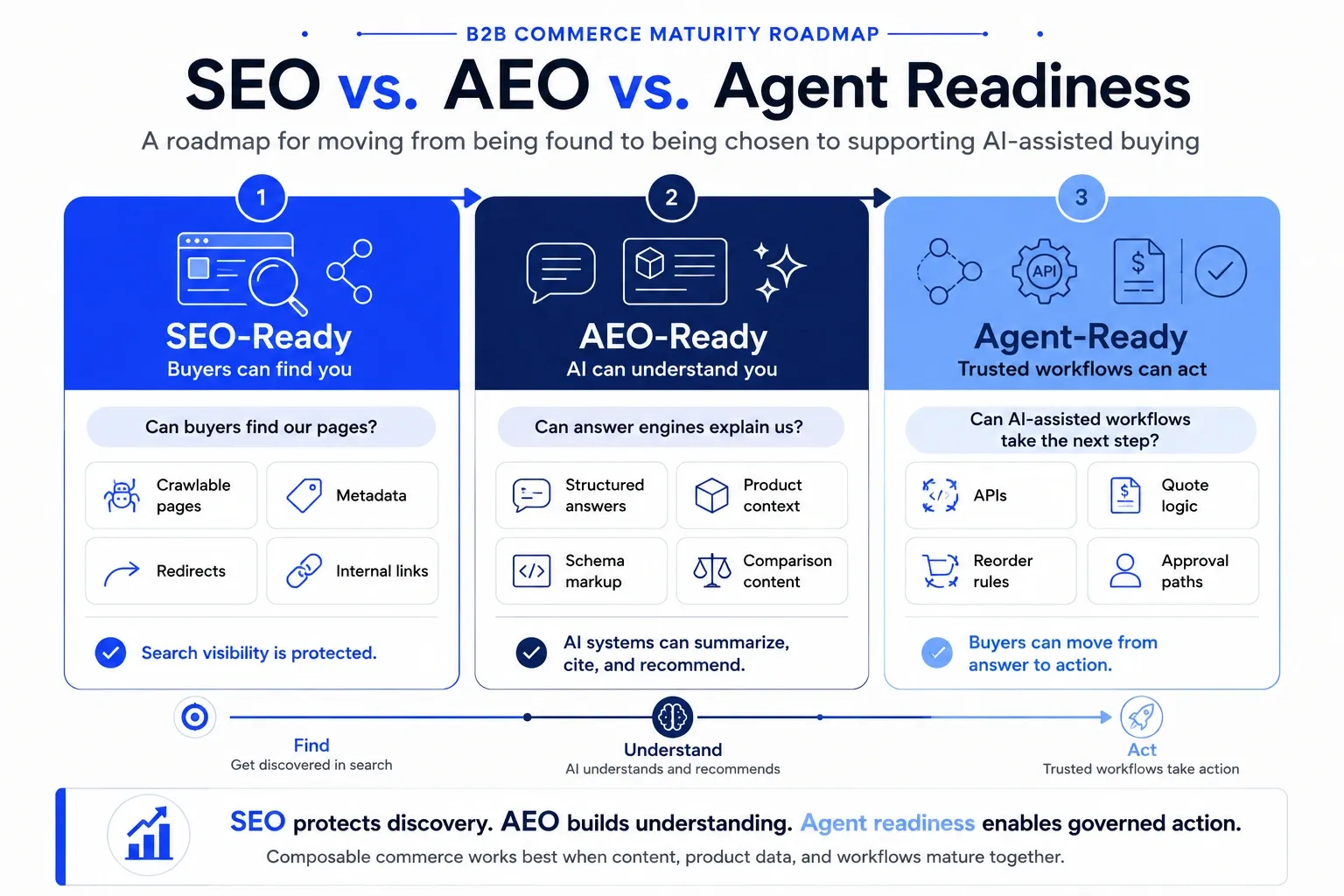
90-Day AEO Sprint for Commerce Teams
You do not need to fix everything before migration. You do need a focused sprint.
Use this 90-day plan before launch or during the earliest phase of composable planning.
Days 1 to 30: audit visibility, URLs, and product data
Deliverables:
- AEO gap audit
- Priority URL risk map
- Public/private content map
- Top 25 buyer questions
- Priority SKU list
- Product-data field audit
- Current AI visibility test log
- Legacy page inventory
Days 31 to 60: rebuild priority buyer-answer pages
Deliverables:
- Rebuilt product-family pages
- Application pages
- Compatibility pages
- Comparison pages
- FAQ blocks
- Schema plan
- Redirect map
- Internal linking plan
Days 61 to 90: add schema, test AI answers, and scale governance
Deliverables:
- Schema rollout
- AI visibility test log
- Measurement dashboard
- Content governance owner
- Product-data backlog
- Post-launch optimization plan
- Quarterly AEO review process
Start with pages that already influence revenue. Look at category pages, product-family pages, top internal search queries, quote-start pages, comparison content, and support documentation.
Do not only audit traffic. Audit usefulness.
This is where content and commerce teams should work together. Marketing knows buyer questions. Product teams know specs. Sales knows objections. IT knows what the new architecture can support.
At Reveation, we recommend aligning this work with platform planning, not treating it as a post-launch cleanup task. If your team is still choosing or validating platforms, our B2B eCommerce platform comparison can help frame the decision around workflow fit, integrations, and scalability rather than feature lists alone.
Ask the same buyer questions in AI tools every month. Track whether your brand appears, which pages get cited, what gets misunderstood, and which gaps keep repeating.
Then feed those gaps back into content, product data, search, and storefront priorities.
When to Bring in Technical Help Before the Migration
AEO looks like a content project from the outside. In B2B commerce, it quickly becomes a systems project.
Involve technical partners before your team locks migration decisions.
Your content team cannot fix broken architecture alone
Content teams can write better answers. They cannot always fix duplicate templates, disconnected product data, broken schema, slow pages, search relevance issues, or ERP/PIM integration gaps.
If your CMS cannot support flexible product content, your AEO roadmap will stall.
Your IT team cannot guess buyer intent alone
IT can build the architecture. But commerce, marketing, sales, and product teams must define the answers buyers need.
A strong AEO plan connects both sides.
A strong AEO plan connects both sides:
- What buyers ask
- What data answers it
- Which system owns that data
- Which page presents it
- Which workflow moves the buyer forward
- Which metrics prove impact
The best time to fix AEO is before go-live
Do not wait until launch to discover that your new storefront preserved the old visibility problems.
Before go-live, audit whether your architecture will protect demand, expose the right public answers, preserve high-intent URLs, and support future AI buying workflows.
Our B2B eCommerce implementation services support complex integrations, ERP connectivity, platform deployment, and commerce workflow planning.
Final Takeaway: Do Not Move Composable With Monolithic Content
Composable commerce gives your team flexibility. AEO makes that flexibility visible and useful to buyers.
If you migrate messy product data, hidden answers, thin pages, and unclear workflows into a new platform, you will still have the same discovery problem. You will just have it in a more modern stack.
Fix the answer layer before the new commerce architecture goes live.
At Reveation, we help B2B teams modernize commerce without carrying old discovery problems into a new stack. Before you migrate, we can help audit the answer layer: product data, public content, search, schema, integrations, and AI-ready workflows.
Start with one question:
Can AI search clearly understand what we sell, who it is for, and what the buyer should do next?
If the answer is no, fix that before launch.