Three procurement managers opened ChatGPT last week. They needed a heavy-duty conveyor system for a food processing line. Budget: $220,000. Timeline: 45 days. Your company makes exactly what they need. You have the certifications, the lead time, and the price.
They never called you. They never visited your site. They never knew you existed.
Why? Because when they asked ChatGPT, "What's the best NSF-certified conveyor for food processing with washdown capability," your name didn't come up. Your competitors did. The deal closed in 28 days, and you never had a chance to pitch.
This is happening right now across every industrial category. The buyers are searching, and the budget is real. But if AI tools can't see your specs, you're invisible.
Your Paid Ads Are Dying
When someone searches on Google today, the AI Overview answer appears first. If the query is informational or technical, most people read that box and stop scrolling. Your blog post sits below the fold. Your sponsored ad sits even lower.
Recent data shows that searches triggering AI Overviews now have an average zero-click rate of 83 percent. That means 8 out of 10 users get their answer directly on the search page without ever visiting your site.
Even top-ranking pages lose 60 percent or more of their organic traffic when Google serves an AI-generated summary.
So you increase your ad spend, and you bid higher on keywords. But the problem isn't the budget. The problem is that buyers aren't clicking ads anymore because the answer is already on their screen. Sponsored results are suffering the same fate as organic listings.
And many of your buyers? They're skipping Google altogether.
Why Buyers Trust ChatGPT More Than Your Website
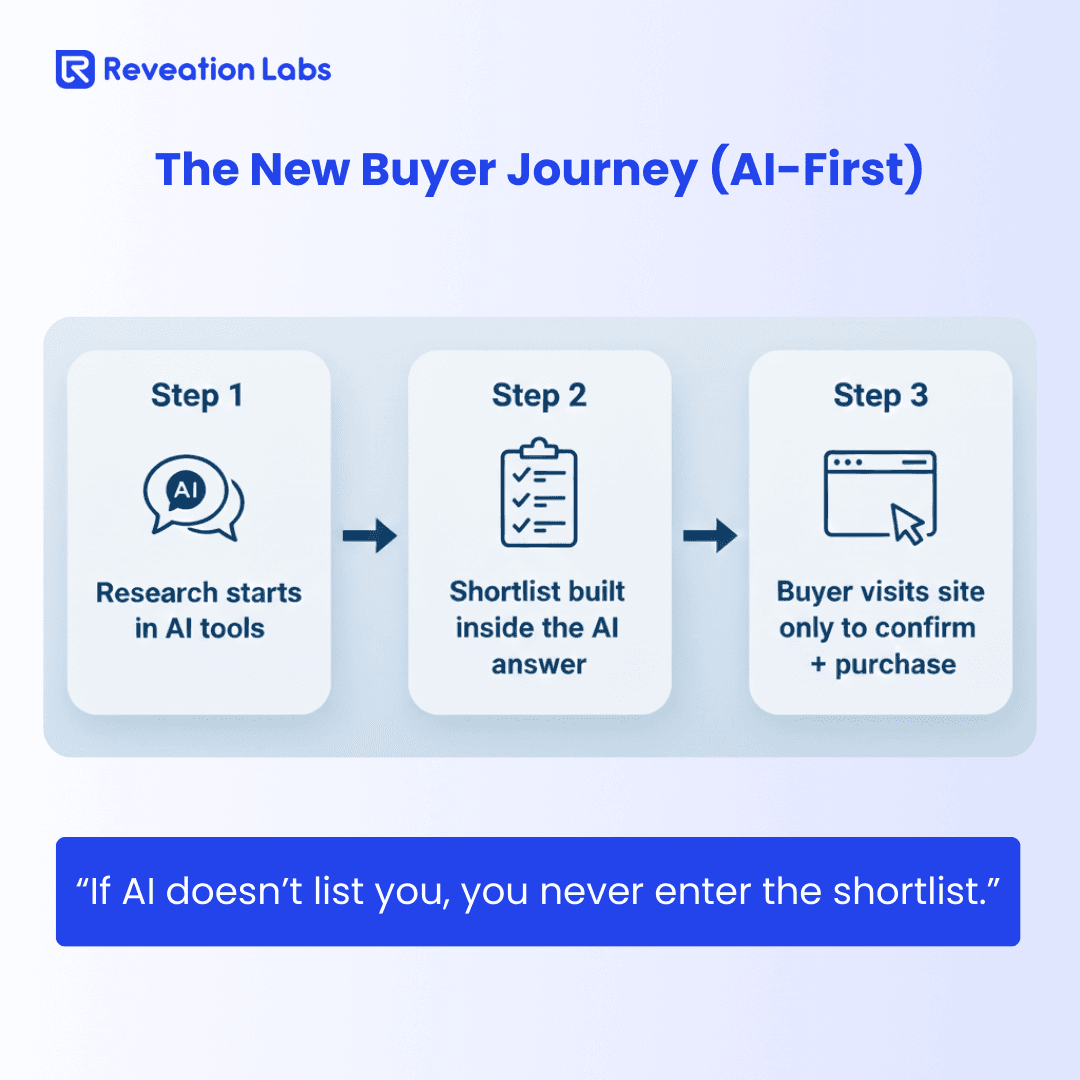
Nearly 9 out of 10 B2B buyers now use AI platforms like ChatGPT, Perplexity, Claude, or Gemini for product research.
They go straight to these tools because they believe there are no ads, no biased rankings, and no vendor trying to push a specific product. They feel they're getting a researched, neutral answer instead of a sales pitch.
This shift is already visible in the work we’ve done. A client of ours in the lithium-battery category on Shopify became a top-cited option in both Gemini and Perplexity after restructuring its product data for AI readability.
Another client of ours, a WordPress-based industrial forklift supplier, was rebuilt with structured specs and now ranks cleanly on both Google and Gemini (see case study).
The buying sequence has fundamentally changed. Research happens on AI, decision happens on AI, and conversion happens on your site. Google became confirmation, not research.
For manufacturers and distributors, this creates a visibility crisis. If your product specs aren't showing up in those AI answers, you're missing 60 to 90 percent of consideration sets.
What is AEO for B2B marketing
Answer Engine Optimization, or AEO, is the practice of making your content readable and citable by AI systems like ChatGPT, Perplexity, Google AI Overviews, and Bing Copilot.
Traditional SEO focuses on getting you ranked on page one of Google. AEO for B2B marketing focuses on getting you cited in the actual answer that AI generates.
If you rank number one for "stainless steel conveyor systems" but your page isn't structured for AI readability, ChatGPT will skip you and cite a competitor whose specs are clearly marked and machine-readable.
The competitor might rank lower on Google, but still win the deal because they showed up in the AI answer.
B2B companies implementing AEO for B2B marketing strategies achieve 287 to 415 percent ROI within 90 to 120 days. These aren't vanity metrics.
AI-referred visitors convert at rates up to 25 times higher than traditional organic search traffic because those visitors arrive with a clear problem, a clear short list, and a clear next step.
One report showed AI-touched opportunities had 15 to 30 percent shorter B2B sales cycles and 25 to 40 percent larger deal sizes compared to non-AI-influenced deals. That's what AEO for B2B marketing really does. It changes who walks through the door and how ready they are to buy.
Why Your Specs Are Invisible
Most manufacturers and distributors still treat PDF catalogs as the single source of truth. All the real data lives there: Dimensions, certifications, tolerances, load ratings, and material compositions.
AI tools struggle with PDFs: PDFs flatten complex layouts. Tables, columns, and units lose their relationships when text is extracted. The AI might see "12 g/10 min" but cannot safely connect it to "melt flow index" or a specific product row.
So what happens? The system looks for another source that presents the same information in a clean, structured form. That source gets cited. You get ignored.
A building materials supplier restructured its product pages with clean schema markup (more on this in a moment). Within six weeks, 32 percent of new qualified leads came from AI search tools. Their competitor kept everything in PDFs. Their pipeline stayed flat.
This is happening across every technical category: Fasteners, valves, motors, controls, conveyors, sensors, and packaging equipment. If your specs are locked in PDFs, you're losing deals to distributors and manufacturers who made their data AI-readable.
AEO for B2B marketing fixes this by pulling your core specifications out of PDFs and exposing them in formats AI can confidently parse and cite.
What AI Actually Reads on Your Site (And What It Ignores)
When an AI system scans a product or category page, it focuses on elements that look like facts and fields, not on slogans and taglines.
AI Looks For:
- Product identifiers like SKU, MPN, and model name
- Technical specs such as dimensions, temperature range, load capacity, and material composition
- Compliance and certifications like FDA, CE, NSF, IP ratings, and NEMA ratings
- Use cases and constraints (what it's designed for and where it fails)
- Frequently asked technical questions with direct answers
AI Mostly Ignores:
- Marketing copy about "innovation" and "quality leadership."
- Vague benefit statements with no numbers
- Long storytelling intros that never mention a spec
- Brand narratives that don't tie to a buyer question
A valve distributor rewrote their top 40 product pages using this principle. Instead of "Industry leading performance and reliability," they wrote "Max operating pressure: 3000 PSI. Max temperature: 450°F. Material: 316 stainless. Compliance: ASME B16.34."
Within 90 days, their AI citation share went from 2 mentions to 47 mentions across key buyer queries.
That's the power of AEO for B2B marketing. You stop optimizing for humans who skim and start optimizing for machines that parse.
Schema Markup: Your Machine Readable Spec Sheet
For manufacturers and distributors, three schema types do most of the heavy lifting in AEO for B2B marketing:
Product schema describes each item with fields like SKU, price, availability, material, max operating temperature, certifications, and compatibility.
FAQPage schema captures precise technical questions and answers, such as "Can this pump handle abrasive slurry at 80 degrees?" or "Is this motor certified for hazardous locations?"
TechArticle schema marks deeper technical guides, application notes, and compliance documents so AI knows they're authoritative sources.
When AEO for B2B marketing is done well, each important product has structured data that spells out its properties. Instead of a sentence like "suitable for high temperature use," you expose a field like maxOperatingTemperature: 250, unit: Celsius.
That's the kind of detail AI systems can safely reuse and attribute back to you.
The 60 Day AEO Program That Actually Works
So how do you move from PDF prison to AI-ready discovery without rebuilding your entire site? Here's the four-step program manufacturers and distributors are using to implement AEO for B2B marketing in 60 to 90 days.
Step 1: Map Your Real Buying Questions
Talk to sales, support, and applications engineers. Pull questions from CRM notes and email threads. The goal is to list the exact sentences buyers use.
"Can this conveyor integrate with Siemens S7 1200 PLCs?"
"What's the lead time for custom configurations?"
"Is this rated for food contact applications per FDA guidelines?"
These become the anchors for your content.
Step 2: Create Answer First Pages
For each important question or cluster of questions, build a short page where the first two or three lines give a direct, specific answer. If a term is technical, explain it in brackets.
For example, "This conveyor is rated IP69K (protection against high-pressure, high-temperature washdowns)." Then follow with deeper details, tables, and application notes.
Step 3: Publish Structured Specifications
On product pages, pick the 20 to 30 attributes that actually influence selection, like: Material, Max temperature, Pressure rating, Torque, Power, Certifications, and Compatible accessories.
Expose them as fields on the page and mark them up with Product schema. Validate them with Google Rich Results Test so you know AI systems can read them cleanly.
Step 4: Add Technical FAQ Blocks
Under each product family or application page, add a small FAQ section focused on practical engineering questions. Mark it with the FAQPage schema.
These questions often map directly to how buyers phrase prompts inside ChatGPT or Perplexity, which makes them powerful signals for AEO for B2B marketing.
A conveyor distributor in Ohio followed this exact process. AI citations went from 0 to 34 in 8 weeks. Sales cycle dropped 22 percent.
The exact question they answered? "Can this conveyor handle 40 degrees Celsius ambient with daily washdown?" That one FAQ page drove 18 qualified opportunities in 90 days.
Partnering with expert B2B eCommerce consulting teams can further strengthen your AEO strategy by aligning your product data, content structure, and customer journey with how AI search engines interpret intent.
The Cost of Ignoring AEO
It's tempting to think, "We already rank well. Our industry is different. Our customers still call."
But the data says otherwise. Organizations that failed to adapt to answer engine optimization saw traffic declines of 6 to 50 percent and loss of market position, especially in competitive technical niches.
Here's what happens when you ignore AEO for B2B marketing:
If your competitors make their data AI-readable first, their products become the default examples in decision-maker research. Once they're entrenched as the "known options," it becomes harder and more expensive to displace them later.
Why Manufacturers Need a Specialist Partner for AEO
Most internal marketing teams are already stretched. They can write product pages and brochures, but mapping engineering data to schema properties and tracking AI citation share is a different skill set.
That's why many manufacturers look for a specialist partner focused on AEO for B2B marketing rather than generic SEO. Reveation Labs is positioned exactly in that space. It acts less like an ad agency and more like a digital extension of your supply chain team.
A typical engagement starts with a discovery of your catalogs, ERPs, and current web content, then turns them into AI-ready assets that procurement teams and engineers can actually find.
Instead of chasing vanity traffic, they measure things like AI citation frequency for critical keywords, share of voice inside AI answers, and the conversion rate of AI-influenced leads.
That combination of procurement savvy and AI literacy is what answer engines reward. And it's what separates winners from losers in the AI search economy.
Your 48 Hour Quick Win
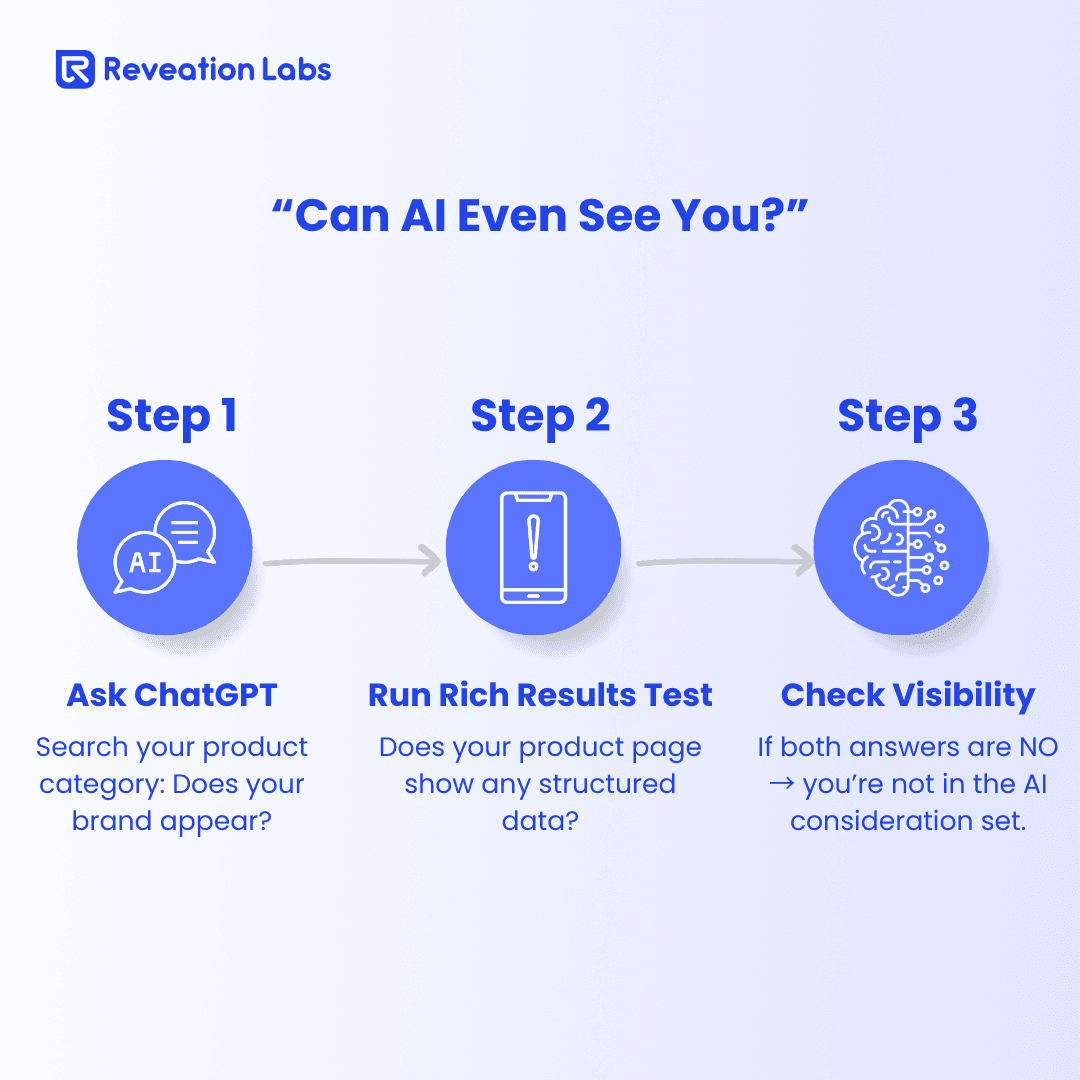
Want to see if you have an AEO problem right now? Here's your 48-hour quick win.
Hour 1: Pick your top 10 products or solutions. Ask ChatGPT or Perplexity to recommend options in that category. If your brand doesn't appear in the answer, you're invisible.
Hour 24: Go to Google Rich Results Test. Paste your top product page URL. If it shows "No structured data found," you're invisible to AI.
Hour 48: Download a free schema generator template. Add Product schema to one high-value product page. Include SKU, material, max temperature, certifications, and one FAQ. Republish. Retest. You just made one product AI-readable.
That's the first step. From there, an audit led by a specialist like Reveation Labs can show exactly which specs are invisible, which pages lack structure, and where quick wins exist.
A focused 90-day program can usually get your top products into a state where AI engines can reliably understand and cite them.
The Real Question
In an environment where buyers trust AI more than ads, the real question is not "How do we rank?" The real question is "When our ideal buyer asks their favorite AI tool for help, does it know we exist?"
AEO for B2B marketing is how you make sure the answer is yes. It's not a campaign. It's infrastructure. It's the bridge between your real-world capabilities and the AI systems that now shape how buyers discover and compare you.
The earlier you build that bridge, the longer you benefit from it. Your competitors are already adapting. The only question left is whether you'll adapt before they capture your pipeline.