
A B2B eCommerce platform can become the bottleneck long before it fails.
You usually feel it when every catalog change, pricing update, portal request, or ERP exception takes too much effort to ship.
Buyers now expect faster self-service and cleaner digital buying paths, so when your platform cannot keep up, the problem is no longer cosmetic. It is operational.
We’ve already written about B2B eCommerce replatforming and the most visible signs your platform is holding you back.
In this blog, we’re taking a more practical angle. You’ll use 12 questions to figure out whether your current platform is still helping you grow or quietly slowing your team down.
Our point of view is simple: in B2B, platform problems are rarely just storefront problems.
They usually show up when buyer workflows, data ownership, and change velocity no longer match the business you’re trying to run.
Why a B2B eCommerce Platform Can Become the Bottleneck Without Breaking
In B2B, “the site still works” is not a useful success metric.
Orders may still go through while your team absorbs hidden costs in manual quoting, account exceptions, slow releases, and support-heavy self-service.
That’s why platform friction usually shows up in operations before it shows up neatly in a revenue report.
Over time, teams normalize workarounds because they seem manageable in isolation.
But every workaround becomes a dependency, and every dependency makes change slower.
What looks like a series of small process issues is often a platform fit problem underneath.
| What teams normalize | Why it feels manageable | What it usually signals |
|---|---|---|
| Manual order and pricing exceptions | “That’s just how B2B works” | Your digital model does not match buyer reality |
| Small changes turning into projects | “We just need better backlog discipline” | Release velocity is constrained by the platform |
| Constant ERP or catalog fixes | “Integration cleanup is never done” | Data ownership and architecture are misaligned |
| Portal requests that stall for months | “We’ll add self-service later” | The platform is not built for account-first workflows |
What this usually means: your platform does not need to be broken to be expensive. It only needs to make ordinary business change too slow.
How to Assess Whether Your B2B eCommerce Platform Is the Bottleneck
Use these 12 questions as a scorecard with your digital, IT, sales, and operations leaders.
For each one, answer Yes, Partly, or No. In our experience, “Partly” is usually where the real platform debt hides.
Buyer Experience & Self-Service
1) Can your buyers complete common account tasks without contacting your team?
Think beyond checkout. Can they reorder, find invoices, view account-specific pricing, manage users, and track shipments on their own? If not, your digital experience may look modern while your service model is still manual.
2) Does the experience match how your customers actually buy?
B2B customers often need role-based permissions, contract pricing, approval flows, and repeat-order behavior. If the experience keeps pushing them back into email, spreadsheets, or rep intervention for standard tasks, platform fit is already weakening.
3) Can you clearly support storefront, portal, or hybrid journeys?
You may think you’re choosing software, but you’re really choosing how buyers get work done. In our article on customer portals vs. B2B eCommerce storefronts, we break down why this decision is really about buyer jobs, not just feature lists.
Data, ERP, and Integration Reality
4) Is ERP data flowing into commerce and back without constant exception handling?
If pricing, availability, customer terms, and order status frequently disagree across systems, the issue may be deeper than the storefront. In our article on ERP and eCommerce alignment, we explain why system-of-record ownership, process alignment, and sync rules need to be settled before a platform decision turns into a build plan.
5) Can your product data scale without creating downstream chaos?
If new SKUs, spec changes, or pricing rules trigger rework across multiple teams, your platform may be amplifying a data-governance problem. Our product data and integration work focuses on exactly this issue: creating one source of truth for catalogs, pricing, quotes, and orders.
6) Do your integrations reduce work, or just hide complexity?
A healthy architecture makes commerce easier to govern. An unhealthy one makes every release dependent on invisible fragility between commerce, ERP, PIM, and fulfillment systems.
Change Velocity & Team Efficiency
7) Can your team launch meaningful changes in weeks, not quarters?
When pricing updates, new catalogs, search improvements, or account-flow fixes take a full project cycle, the issue is bigger than backlog management. Your platform is slowing business response time.
8) Is maintenance effort growing faster than business value?
Watch how much time your team spends keeping the current setup stable versus improving the buyer experience. When most effort goes to maintaining complexity, you are funding inertia.
9) Can non-developers make routine changes safely?
Merchandising, content, onboarding content, and routine account experience updates should not require heavy engineering involvement every time. If they do, scale gets expensive fast.
Strategic Fit & Growth Readiness
10) Can the platform support the next version of your business model?
New regions, dealer programs, customer-specific catalogs, and deeper self-service usually expose platform limits quickly. A system that worked for your last growth stage may resist the next one.
11) Are your buyers feeling friction your internal team has learned to ignore?
Internal teams adapt to broken processes faster than customers do. Your buyers do not care whether the issue sits in ERP, catalog structure, workflow logic, or platform architecture. They only feel delay, inconsistency, and extra effort.
12) If you were choosing today, would you buy this platform again?
This is the bluntest question in the scorecard, and often the most revealing. If your honest answer is no, it’s time to stop treating the issue like a temporary inconvenience.
A quick example
Picture a distributor launching a new dealer program with account-specific pricing, approval roles, and self-service reorders. The storefront can stay online, but every new rule requires custom work, the ERP team keeps patching pricing exceptions, and support still handles basic account tasks by email. That’s not a single feature gap. It’s a mismatch between the platform, the data model, and the operating model.
Score Your B2B eCommerce Platform Assessment
Give yourself 2 points for every Yes, 1 point for every Partly, and 0 points for every No.
20–24
Your platform is mostly fit
14–19
Your platform is straining under growth
8–13
Your platform is constraining execution
0–7
Your platform is blocking change
| Score | What it means | First move | Recommended path |
|---|---|---|---|
| 20–24 | Your platform is mostly fit | Fix targeted friction | Optimize UX, search, reporting, and governance |
| 14–19 | Your platform is straining under growth | Clean up ownership gaps | Modernize integrations, product data, and self-service layers |
| 8–13 | Your platform is constraining execution | Start readiness planning | Build the business case and migration scope |
| 0–7 | Your platform is blocking change | Escalate to leadership | Treat this as a transformation decision, not a backlog issue |
If your score lands in the middle, do not jump straight into vendor demos. In many cases, you need sharper architecture, clearer ownership, and better workflow design before you need a new platform. In our article on how to choose a B2B eCommerce platform, we show why platform selection only gets easier after you diagnose the real constraint first.
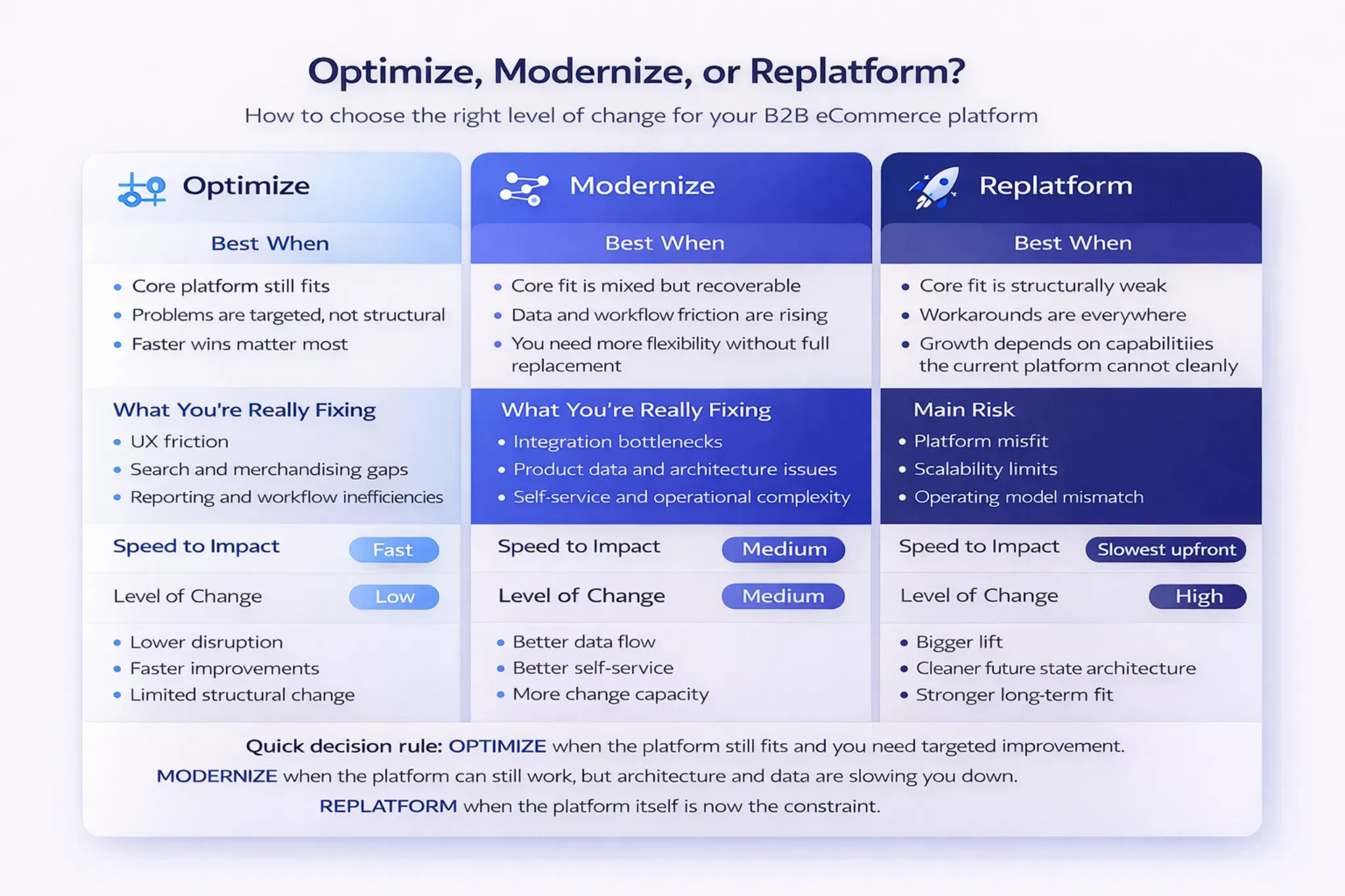
Optimize, Modernize, or Replatform?
The goal is not to replatform because your team is frustrated. The goal is to move when staying put costs more than change.
Optimize
Best when
Core fit is still strong
Main risk
Cosmetic fixes hide deeper issues
What you should expect
Faster wins, lower disruption, limited structural change
Modernize
Best when
Core fit is mixed but recoverable
Main risk
You stop halfway and keep the same bottlenecks
What you should expect
Better data flow, better self-service, more change capacity
Replatform
Best when
Core fit is structurally weak
Main risk
Poor scoping recreates old problems on new software
What you should expect
Bigger lift, cleaner future-state architecture
If you’re stuck between optimizing and replatforming, we can help you pressure-test the decision before you commit to the wrong path. Our B2B eCommerce consulting work is built for exactly that kind of cross-functional decision.
What Leadership Should Align Before Making a Move
Before you approve any major platform move, align on four things: target buyer workflows, system-of-record ownership, rollout logic, and business ownership.
Miss one of those, and even a promising platform can recreate the same friction under a new architecture.
Target workflows
Decide which buyer jobs must be self-service, which remain assisted, and where portals and storefronts should overlap.
Data ownership
Define what lives in ERP, what belongs in commerce, and how product, pricing, and quote logic are governed.
Rollout logic
Sequence what moves first, what stays stable, and what continuity risks you cannot tolerate.
Business ownership
Assign outcome ownership beyond implementation milestones.
Rollout logic deserves special attention. In our article on big-bang vs. phased migration, we show why many B2B teams struggle less because they picked the wrong platform and more because they picked the wrong rollout model for the business they actually run.
Final Takeaway
A B2B eCommerce platform becomes the bottleneck when it slows change more than it supports growth.
That usually shows up first as self-service gaps, manual exceptions, brittle integrations, and release friction, not as a dramatic outage.
These 12 questions are here to help you turn platform frustration into a decision framework.
If your answers keep landing on “Partly” and “No,” your next step is not another round of patchwork. It’s a candid conversation about what to optimize, what to modernize, and what to replace.
Practical next step: run this scorecard in a workshop with digital, IT, sales, and operations leaders. If the answers diverge sharply, that gap is usually the clearest sign that you need alignment before more execution work.