
Traditional automation broke when the workflow hit an exception. Agentic commerce breaks when an AI agent has authority but no control plane.
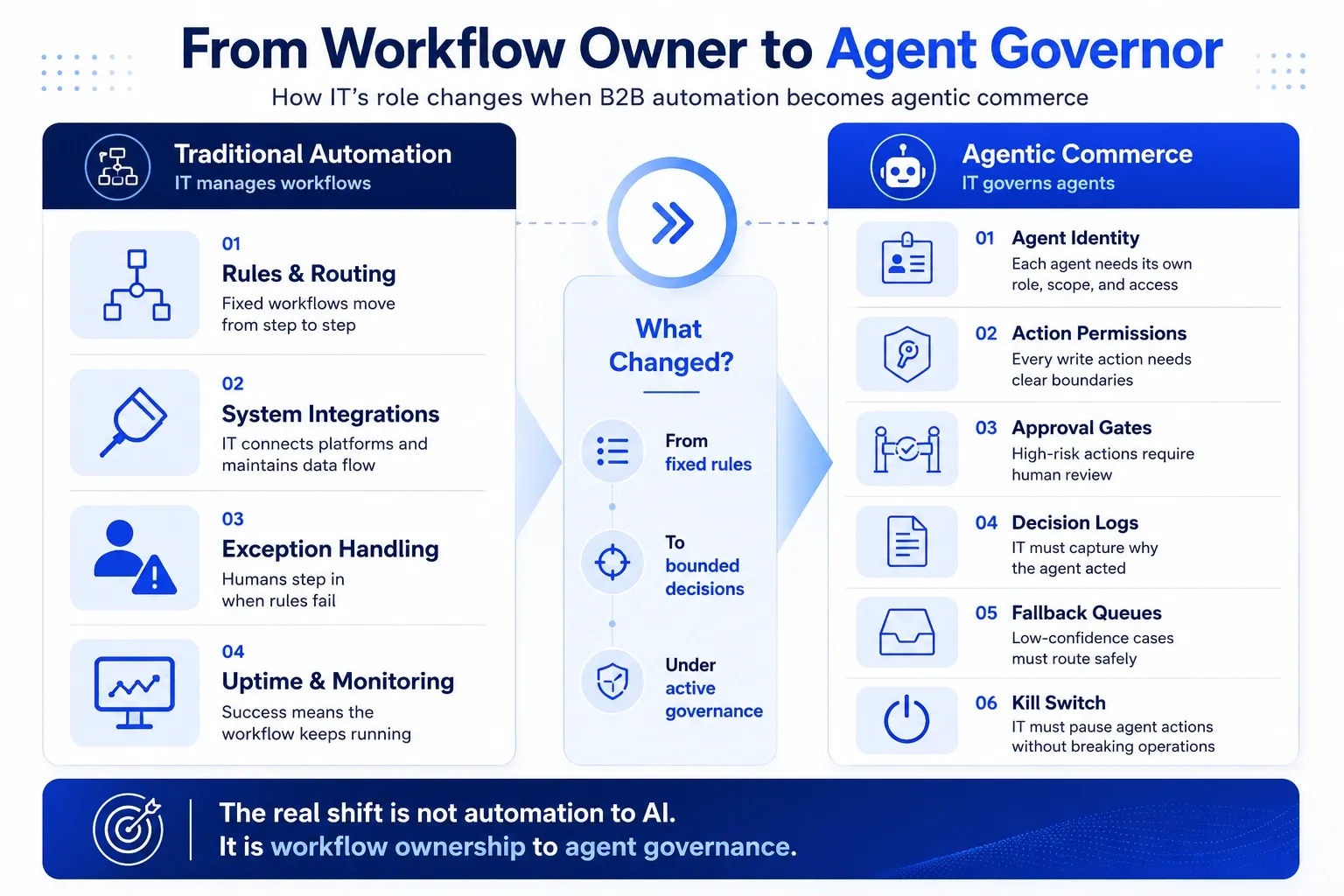
That difference matters. In traditional B2B automation, IT connected systems, wrote rules, monitored failures, and kept workflows moving. In agentic commerce, IT governs actors that can read data, choose tools, request approvals, update records, and trigger business actions.
At Reveation, we define the shift simply: traditional automation executes steps; agentic commerce pursues bounded goals. That shift changes what IT owns across ERP, OMS, PIM, CPQ, CRM, commerce portals, approval queues, audit logs, and fallback paths.
We already covered the broader market shift in our guide to agentic commerce in B2B eCommerce. This guide focuses on the production question: what must IT change before agents touch pricing, inventory, orders, approvals, and customer commitments?
The pressure will keep rising. Gartner expects 40% of enterprise applications to include task-specific AI agents by the end of 2026, up from less than 5% in 2025. Gartner also expects organizations to cancel over 40% of agentic AI projects by the end of 2027 because teams underestimate cost, miss business value, or skip risk controls.
The lesson feels blunt: do not connect agents to business systems and hope governance catches up. Build the control plane first.
Rules Break Here
Traditional B2B automation works when the process behaves like a track. A clean input arrives, the system checks fixed rules, and the next step follows.
B2B commerce rarely behaves that cleanly. Buyers upload messy POs, request substitute SKUs, ask for contract pricing, change ship-to locations, exceed credit limits, and expect the portal to remember account-specific rules from the last five orders.
We already explained why agentic AI is replacing rule-based automation in ecommerce. Here is the IT version: when agents enter the workflow, IT must govern the actor, not just the route.
The Workflow Was Never Fully Automated
Many B2B workflows look automated from the dashboard. The portal captures the order, the ERP receives it, the warehouse sees a pick ticket, and the customer gets an email.
Then the exception hits. Sales fixes the customer-specific price. Support checks substitute eligibility. Finance reviews a credit hold. Operations confirms whether a partial shipment makes sense.
That manual exception layer contains the real business logic. Agentic commerce exposes it.
“If This, Then That” Fails When Buyers Change the Ask
Rule-based automation needs predictable branches. B2B buyers create unpredictable branches.
They reference old quotes. They use internal product nicknames. They request freight changes after checkout. They send POs with line items that do not match the catalog.
An agent can reason across that context. IT must still limit where that reasoning can lead.
Boring Automation Still Wins in the Right Places
Not every workflow needs an agent. Stable rules, clean inputs, and low-ambiguity actions still belong in deterministic automation.
Keep tax logic, standard order confirmations, inventory threshold alerts, compliance checks, and simple routing rules boring. Use agentic commerce for messy judgment zones, not as a replacement for every reliable rule.
IT takeaway: The goal is not to make commerce fully autonomous. The goal is to make the right parts autonomous under controls IT can prove.
| Traditional Fix | Why Teams Try It | What Breaks | Better IT Move |
|---|---|---|---|
| Add more rules | The team wants control | Rule trees become fragile and hard to maintain | Keep rules for deterministic decisions; use agents for exception triage |
| Route exceptions to email | The team wants speed | Approvals disappear from the audit trail | Move approvals into structured queues |
| Connect agents directly to ERP | The team wants fast execution | The agent can create costly write errors | Add scoped permissions, thresholds, and rollback paths first |
| Pilot the most painful workflow | The team wants visible ROI | The workflow often carries the worst data and highest risk | Start with a bounded workflow that creates trust |
Your APIs Are the Product Now
Traditional automation treats APIs like pipes. Data moves from system A to system B.
Agentic commerce treats APIs like action surfaces. The agent does not just read data. It can draft quotes, submit changes, open tickets, check entitlement, prepare reorders, and trigger fulfillment steps.
We often start with product data and integration readiness because agents cannot act safely on messy catalog, pricing, inventory, CPQ, OMS, ERP, or commerce data.
Agents Do Not Browse. They Act.
A chatbot can answer a question and stop. An agent can take the next step.
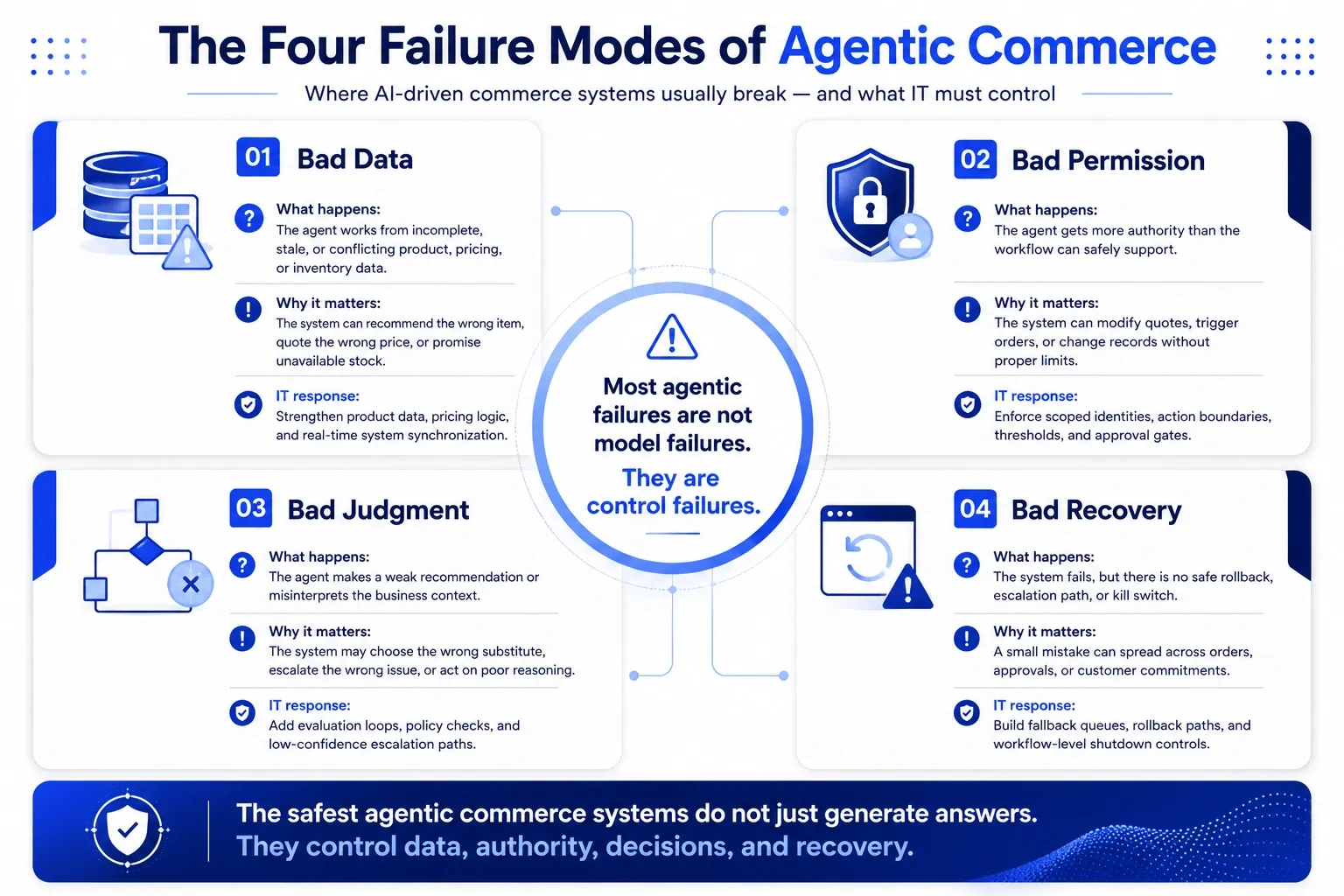
That next step creates the risk. If an agent can modify a quote, update a ship-to address, change quantity, or submit a reorder, IT must define the action, account, threshold, approval path, and rollback path.
Do not treat agent access like normal user access. Treat it like a new operational role.
Every Write Action Needs a Gate
The agent may read product specs broadly. It should not change pricing broadly.
It may draft a quote. It should not approve margin exceptions. It may prepare a reorder. It should not submit a high-value order without buyer confirmation.
- Who does the agent act for?
- Which systems can it touch?
- Which actions can it perform?
- Which thresholds require human approval?
- Which actions can IT revoke immediately?
Bad Catalog Data Becomes Bad Agent Behavior
Agents amplify data quality. If product attributes contain gaps, the agent may recommend the wrong substitute. If pricing tables conflict, the agent may quote the wrong customer-specific price.
IBM’s 2025 Cost of a Data Breach research shows the same pattern in security: AI adoption can outrun access controls, governance, and oversight. Commerce teams face a parallel risk when they give agents action rights before they clean data and enforce policy.
ERP Lag Stops Being an Edge Case
Traditional automation can tolerate some system lag. A nightly sync may work when humans review exceptions the next morning.
Agents shrink that tolerance. If an agent checks inventory, recommends a substitute, drafts a quote, and triggers approval in minutes, stale ERP data becomes a production risk.
IT must define which data needs real-time access, which data can lag, and which workflows must pause when systems disagree.
The New IT Control Plane
Agentic commerce needs more than prompts and APIs. It needs a control plane.
At Reveation, we use that term for the layer that tells the agent what it can do, when it must ask, how it logs decisions, where it sends uncertainty, and how IT shuts it down. Our agentic AI architecture explainer goes deeper into agents, tools, memory, orchestration, governance, and feedback loops.
Agents Need Their Own Identity
IT should know when the agent acts, who requested the action, which account it represented, which system it touched, and which permission allowed the action.
Shared service accounts blur that trail. Give the agent its own identity. Scope it, monitor it, and revoke it when needed.
Approval Logic Needs a System of Record
Email approvals create invisible risk. A manager may approve a discount in email, but the business loses the reason, threshold, context, and downstream effect.
Agentic workflows need structured approval queues. Each request should capture the customer, order value, margin impact, policy trigger, approver, timestamp, and final action.
Logs Must Explain Decisions, Not Just Events
Traditional automation logs system events. Agentic commerce needs decision logs.
Capture the agent’s input, sources, confidence, recommendation, approval status, final action, and rollback path. When a customer disputes a price or finance questions a margin exception, IT should not stitch together evidence from five systems.
Low Confidence Needs a Landing Zone
A production agent must not guess. It needs a place to send uncertainty.
That landing zone may route issues to sales ops, customer service, finance, product data, or operations. The queue should include context, not just a generic error.
The Kill Switch Belongs in the Launch Plan
Every production agent needs a shutdown path. IT should stop one action, one workflow, one customer segment, or the entire agent without breaking the commerce stack.
This sounds dramatic until the agent touches pricing, orders, refunds, substitutions, or shipment commitments. Build the kill switch before launch.
| Control Layer | What IT Owns | Risk It Reduces | Minimum Guardrail |
|---|---|---|---|
| Identity | Agent role, scope, delegation | Unknown actor risk | Dedicated agent identity and revocation |
| Policy | Allowed actions and thresholds | Agent overreach | Policy-as-config, not prompt-only rules |
| Approval | Review queues and approver rules | Unauthorized commitments | Structured approvals with context |
| Tool Access | ERP, OMS, PIM, CPQ, CRM actions | System misuse | Read/write separation and action limits |
| Audit | Decision records | Unexplainable outcomes | Logs with sources, confidence, and history |
| Fallback | Exception routing | Agent guessing | Low-confidence queues |
What IT Owns Now
Traditional B2B automation gave IT ownership of integrations and uptime. Agentic commerce adds ownership of action boundaries, accountability, and operational review.
For teams modernizing the front-office layer, our B2B commerce and customer portal work matters because the portal often becomes the place where buyers, sales, service, and agents meet.
Who Approves the Order?
Approval rules need system ownership. A buyer may confirm an order, sales may approve a discount, finance may release a credit hold, and operations may approve a substitute.
The agent should not blur those roles. IT should encode them.
Who Rolls It Back?
A workflow that cannot reverse should not auto-execute. Some changes only update status. Others affect inventory allocation, credit exposure, manufacturing schedules, or freight bookings.
Reversibility should shape autonomy.
Who Explains the Decision?
The agent should show its work. If it recommends a substitute, it should cite compatibility, inventory, customer preference, pricing, and approval rules.
If it routes an order to review, it should state the trigger. A vague answer like “policy conflict” will not satisfy a buyer, sales manager, finance lead, or auditor.
Who Shuts the Agent Off?
Business users may spot the problem first, but IT needs shutdown controls. Support may notice bad recommendations, sales may catch quote errors, and finance may detect margin leakage.
IT should create a clear escalation path so the right team can pause the right action fast.
Who Audits the Agent After Quarter-End?
Agentic commerce creates a new audit workload. Teams need to review actions by customer, workflow, product category, approval path, exception type, and financial impact.
Design the audit view early. Do not force teams to reconstruct the agent’s behavior after something goes wrong.
Start Here, Not Everywhere
The best agentic commerce pilot will probably look boring. That is a good sign.
A narrow pilot gives IT clean scope, cleaner measurement, lower reversibility risk, and faster trust. For concrete workflow examples, our guide on how B2B companies use agentic AI to automate sales and ordering covers quotes, POs, reorders, approvals, and exceptions.
Safe First Moves: Drafts, Recommendations, and Triage
Start where the agent assists but does not commit the business. Good first moves include product recommendations with citations, quote drafts, PO parsing, missing-data detection, order exception summaries, and support ticket triage.
These workflows create value without giving the agent full authority. They also reveal data gaps before the agent gets write access.
Risky Next Moves: Quotes, Substitutions, and Reorders
Move into bounded execution only after the team trusts the inputs, logs, and approval paths.
Quote changes, approved substitutions, reorder preparation, shipment change requests, and account-specific buying assistance can work well when IT enforces thresholds. The agent should execute low-risk actions and escalate the rest.
Do Not Automate This Yet
Keep high-value discounting, credit hold release, legal commitments, customer-specific contract overrides, regulated product substitutions, and irreversible fulfillment actions human-led at first.
Agents can gather context and recommend next steps. Humans should still decide when the action creates financial, legal, compliance, or customer-trust risk.
Do not automate actions you cannot explain, reverse, or audit.
| Workflow | Move | Why | Guardrail |
|---|---|---|---|
| Product recommendation with evidence | First | Low risk and easy to review | Cite product data sources |
| PO parsing and order draft | First | Saves manual work without auto-commit | Require human confirmation |
| Order exception summary | First | Improves triage speed | Route to the correct queue |
| Approved reorder under threshold | Later | Creates a real financial action | Add buyer confirmation and value limits |
| Substitute item execution | Later | Can affect compatibility and trust | Require compatibility rules and approval |
| Credit hold release | Not first | Creates high financial risk | Keep human-led until controls mature |
The 90-Day Readiness Sprint
Agentic commerce does not need a year-long transformation to start. It needs a disciplined 90-day sprint.
The goal should not involve “deploy agents everywhere.” Pick one bounded workflow, connect the right systems, define the guardrails, and prove the operating model.
If your team needs implementation support, our Agentic & Autonomous AI services focus on agents that reason, plan, use tools, and operate with oversight and guardrails.
Week 1: Find the Hidden Humans
Map the process as it really happens, not how the diagram says it happens. Find every person who fixes pricing, validates substitutions, checks contracts, cleans product data, resolves ERP mismatches, or approves exceptions.
Those people hold the logic the agent will need.
Week 4: Lock Down Writable Actions
Separate read actions from write actions. The agent may read product data, account terms, inventory, pricing, order history, and policy documents early.
It should earn write access slowly. Define write actions by system, threshold, account type, role, approval need, and rollback path.
Week 8: Test the Weird Cases
Do not test only happy paths. Test partial shipments, stale inventory, missing catalog attributes, duplicate POs, conflicting contract terms, unavailable substitutes, credit holds, multi-ship orders, and buyer approval delays.
Agents often look great in demos because demos avoid messy B2B reality. Your pilot should attack the messy parts first.
Week 12: Decide What Scales
At the end of 90 days, do not ask only, “Did the agent work?” Ask whether the agent reduced manual work without increasing rework, escalated the right cases, earned user trust, and left a clear audit trail.
The pilot should also prove that IT can change agent behavior without rewriting the whole workflow.
| Sprint Stage | Goal | IT Deliverable | Success Signal |
|---|---|---|---|
| Days 1-30 | Map reality | Workflow map, exception list, risk score | The team identifies one bounded pilot |
| Days 31-60 | Prepare systems | Permission model, API scopes, data checks | The agent can read safely and draft actions |
| Days 61-75 | Test edge cases | Test set, evals, fallback routes | The agent escalates instead of guessing |
| Days 76-90 | Pilot and review | Audit dashboard and go/no-go decision | The business trusts limited expansion |
The Real Upgrade
Agentic commerce does not upgrade a chatbot. It changes the operating model for B2B automation.
Traditional automation asks IT to keep workflows running. Agentic commerce asks IT to govern a goal-seeking actor inside the workflow.
That actor needs identity, permissions, policies, tools, approvals, logs, fallbacks, and shutdown controls. Without those pieces, the company may gain a faster interface and create bigger operational risk.
The winning team will not build the most autonomous stack. It will build the most governable one.
At Reveation, we help B2B teams move toward agentic commerce without skipping the foundation: product data, integrations, portals, process automation, approvals, and production guardrails. For companies moving beyond brittle RPA, our AI Process Automation service helps teams identify bounded, measurable pilots before they expand into higher-risk workflows.
Start with one workflow. Give the agent a narrow job. Log every action. Keep humans in the loop where risk demands it.
That is how IT turns agentic commerce from a demo into a system the business can trust.