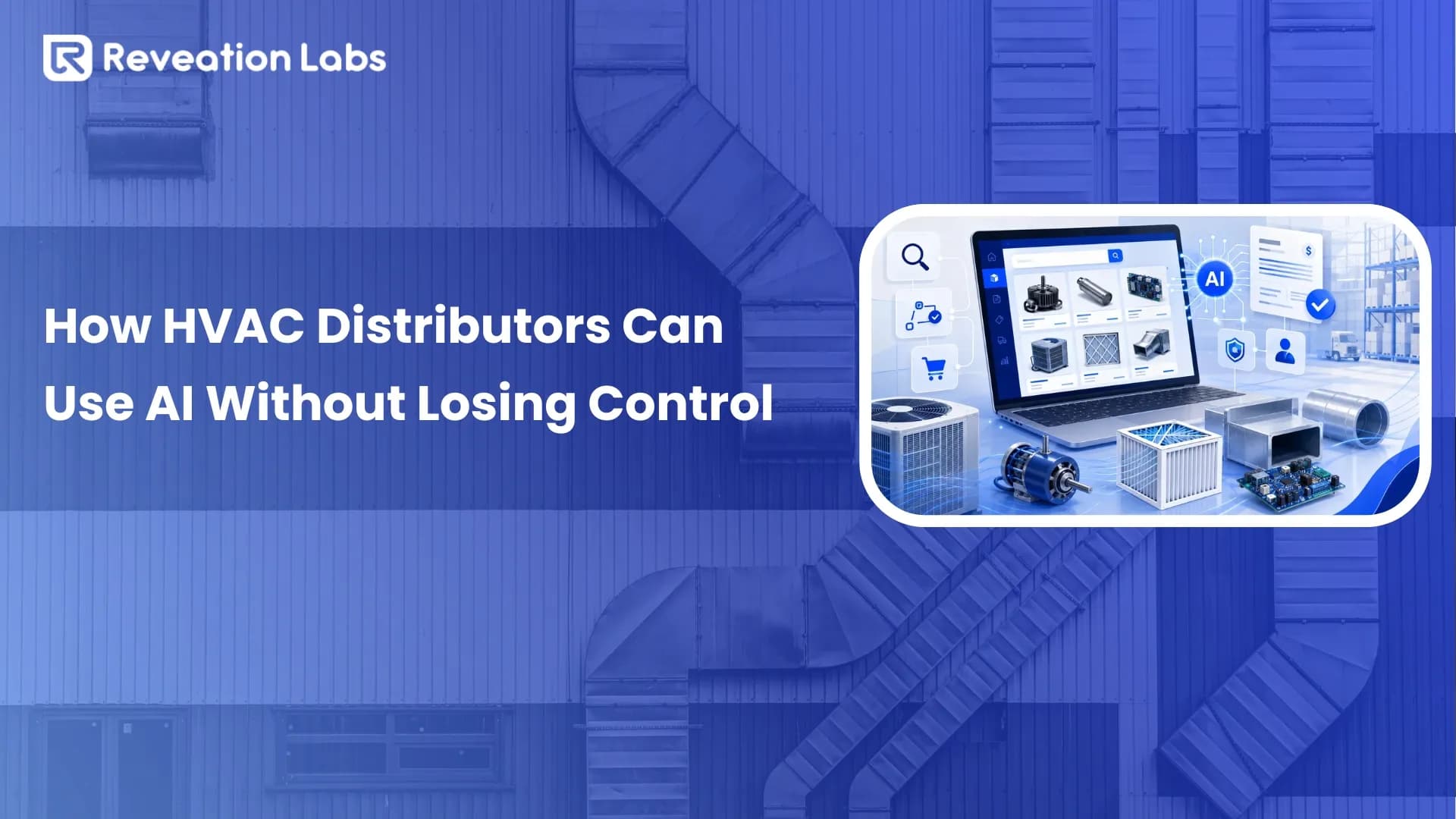

You can have 80,000 SKUs online and still lose the order if a contractor cannot find the right motor, see the correct account price, or get a quote back before the job moves on. That is the real challenge with HVAC distributor ecommerce. It is not just search, checkout, or a cleaner-looking portal.
You need product fit, customer-specific pricing, branch availability, substitutions, approvals, and quote workflows to work together under pressure. A contractor may be standing at a job site. An inside sales rep may be trying to rescue a quote. A branch team may be checking whether a replacement part is available before tomorrow morning.
AI can help, but only when you use it carefully. The goal is not to let AI guess prices, approve complex replacements, or override your ERP. The goal is to help your team find better answers faster, catch issues earlier, and move quotes forward without losing control.
Gartner reported that 61% of B2B buyers prefer an overall rep-free buying experience, but the same research also notes that buyers still prefer seller input for tasks that require contextual intelligence. That tension matters for HVAC distributors. Your customers want speed and self-service, but they still need expert help when fitment, substitution, pricing, or project scope gets complicated.
Why HVAC Ecommerce Is Hard
Most ecommerce systems assume the buyer knows what they want. HVAC buyers often do not search that way. They may search by old model number, partial part number, tonnage, voltage, brand, equipment type, job need, or the part they bought years ago.
That means HVAC distributor ecommerce has to solve more than product discovery. It has to reduce wrong-fit orders, prevent pricing mistakes, support branch-specific availability, and help customers move from quote request to order without waiting on manual back-and-forth.
When the portal gives a weak answer, the customer does not blame “bad data.” They blame the distributor. Then they go back to texting a rep, calling the branch, or ordering from whoever gives them a faster answer.
We build B2B ecommerce and customer portals for teams that need more than online checkout. We help connect buying, support, account workflows, and self-service so the digital experience reflects how your business actually runs.
| Failed approach | Why it breaks in HVAC | Better approach |
|---|---|---|
| “Just launch the catalog online.” | Customers still cannot find the right product if attributes, aliases, compatibility, and replacements are missing. | Build findability around real HVAC search behavior, not only SKU structure. |
| “Let AI recommend substitutes automatically.” | A wrong substitute can create field delays, warranty issues, returns, and customer frustration. | Use AI to suggest alternatives with confidence levels and approval rules. |
| “Expose ERP pricing as-is.” | ERP pricing may include expired rules, branch overrides, one-off exceptions, or manual sales adjustments. | Validate pricing hierarchy, approval rules, and exception logic before showing prices online. |
| “Automate every quote.” | A reorder quote is not the same as a project quote, substitution-heavy quote, or equipment package. | Separate quote workflows by risk, complexity, and approval need. |
Where AI Helps
AI works best when it supports the systems and people that already run the business. In HVAC distributor ecommerce, that usually means AI sits between the buyer experience, ERP, PIM, CPQ, CRM, inventory systems, inside sales, and branch operations.
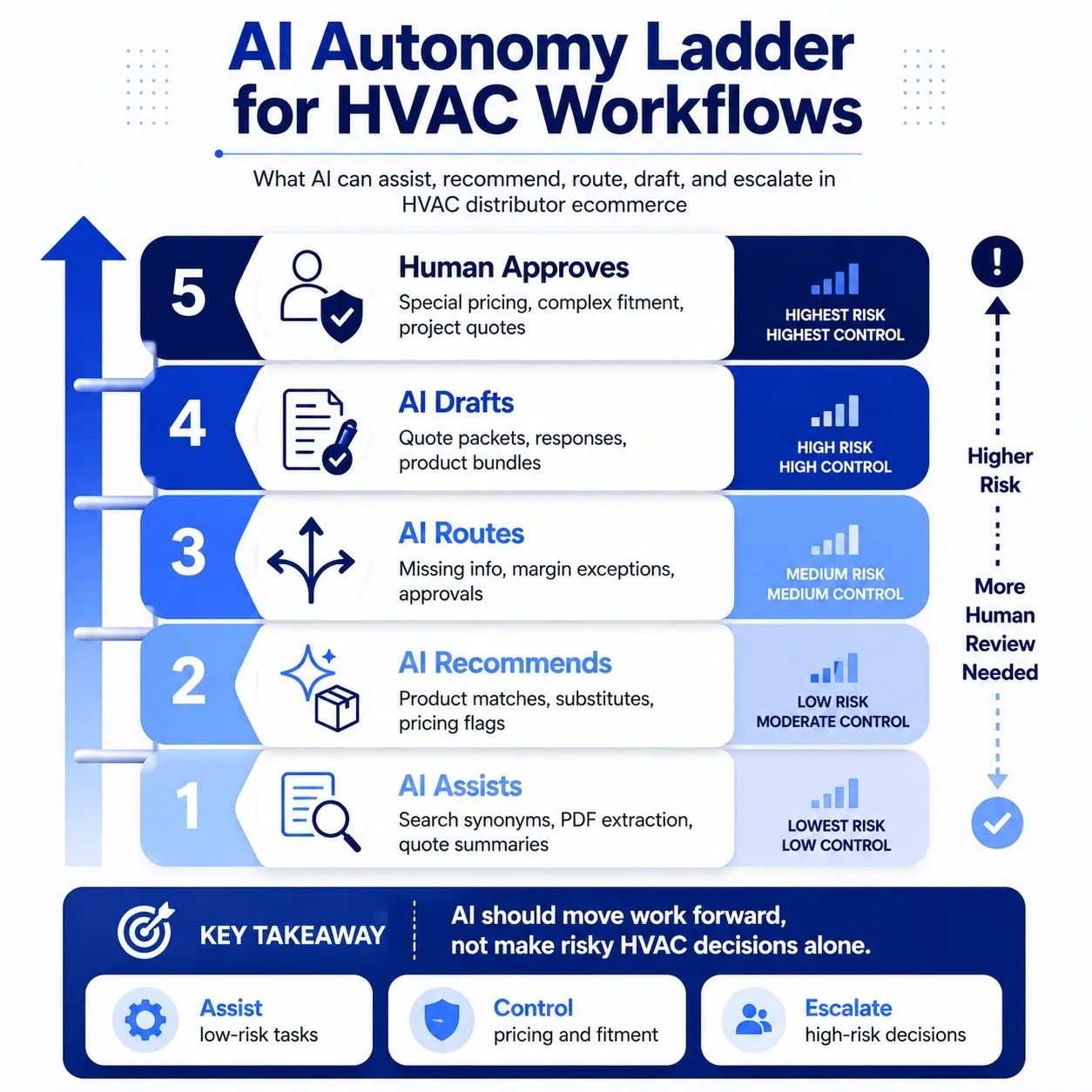
Safe AI
Safe AI handles low-risk work. It can normalize partial part numbers, extract product specs from PDFs, summarize quote requests, enrich product attributes, and improve search results. These tasks help your team move faster without giving AI final decision authority.
Controlled AI
Controlled AI supports decisions that need rules. It can flag pricing anomalies, check margin thresholds, suggest approved replacements, or identify quote requests that need manager review. These use cases need guardrails, audit trails, and confidence scoring.
Human-Approved AI
Human-approved AI supports high-risk work. It can prepare project pricing packets, summarize compatibility assumptions, or recommend options for warranty-sensitive replacements. Your team still approves the final answer.
AI should recommend, draft, enrich, and flag. It should not silently override pricing, compatibility, inventory, warranty, or approval rules.
We take the same practical view in our guide to AI in B2B ecommerce. AI creates the most value when it solves specific workflow problems instead of chasing hype.
Make Products Findable
HVAC catalog quality is not just a data hygiene issue. It is a field productivity issue.
A technician does not always search like a catalog manager. They may type what they know from the job site: “old Carrier blower motor,” “3 ton condenser fan,” “replacement for discontinued valve,” or a partial part number copied from a worn label.
A basic catalog search may fail on those queries. A stronger HVAC ecommerce experience connects the search to equipment type, tonnage, voltage, brand, compatible replacements, branch availability, and account-specific purchasing rules.
AI can help by extracting attributes from spec sheets, normalizing product descriptions, suggesting missing attributes, grouping related items, and mapping discontinued products to approved replacements. It can also recognize synonyms, abbreviations, brand nicknames, and technician-style language.
This only works when your product data foundation is strong. We help teams connect product, pricing, quote, order, ERP, PIM, CPQ, and OMS data through our product data and integration management services, so ecommerce workflows do not depend on disconnected spreadsheets or tribal knowledge.
Better catalog structure also gives AI better context. In our article on B2B catalog management for distributors, we explain how taxonomy, attributes, enrichment, and product discovery directly affect distributor ecommerce performance.
Protect Pricing
Customer-specific pricing is one of the most sensitive parts of HVAC distributor ecommerce. AI should help your team find pricing issues faster, not become the pricing engine.
Pricing can depend on contracts, customer tiers, branch rules, region, rebates, volume breaks, vendor programs, project pricing, inventory position, and manual sales exceptions. Many distributors also have years of pricing logic inside ERP customizations or rep-managed spreadsheets.
The biggest risk is not that AI gives a bad internal suggestion. The bigger risk is showing the wrong price to the wrong customer. That can leak margin, damage trust, and create painful cleanup work for sales.
Pricing needs rules before AI. Keep ERP or CPQ as the source of truth, then use AI to flag anomalies, identify expired pricing logic, compare quotes against margin thresholds, and route special pricing requests for approval.
Pricing control checklist
- Keep ERP, CPQ, or your pricing system as the source of truth.
- Use AI to flag exceptions, not publish final prices on its own.
- Require approval for margin exceptions and special pricing.
- Log AI recommendations, overrides, and approval decisions.
- Test pricing outputs against historical quotes before launch.
We help teams build these foundations through ecommerce implementation services that account for pricing, approvals, automation, self-service tools, and back-office workflow discipline.
Improve Quotes
Quote automation sounds simple until you look at how many quote types HVAC distributors manage. A reorder quote for common parts is not the same as an equipment package, project bid, substitution-heavy request, or special pricing quote.
Quote requests may arrive through email, portal forms, phone notes, PDFs, spreadsheets, rep texts, or repeat-order history. AI earns its place in quoting when it turns scattered request details into a structured quote packet your team can review.
That packet might include suggested products, account history, missing information, customer-specific pricing checks, availability notes, margin alerts, and approval recommendations. The rep starts from a prepared draft instead of a blank screen.
| Quote type | AI role | Human approval? | Risk level |
|---|---|---|---|
| Reorder or common parts quote | Draft quote, confirm account pricing, check availability | Low or optional | Low |
| Account-specific bulk quote | Apply contract context, flag margin issues, summarize history | Sometimes | Medium |
| Equipment package quote | Suggest bundle items, accessories, and missing components | Yes | Medium-high |
| Substitution-heavy quote | Recommend alternatives and explain fit assumptions | Yes | High |
| Project or special pricing quote | Prepare packet, calculate scenarios, route approval | Always | High |
This is where agentic workflows become useful. In our article on agentic AI for B2B ecommerce, we cover quote creation, guided discounting, contract pricing, entitlement verification, order modifications, and exception handling as practical use cases for B2B commerce.
Help Inside Sales
AI adoption fails when sales teams feel like the system was built around them instead of with them. Sales teams do not resist automation because they dislike technology. They resist it when it creates bad recommendations, adds duplicate entry, or exposes customers to mistakes they have to clean up later.
Inside sales often carries the operational memory of the business. Your reps know which customers need special handling, which substitutions are risky, which branches can solve urgent problems, and which pricing requests need manager review.
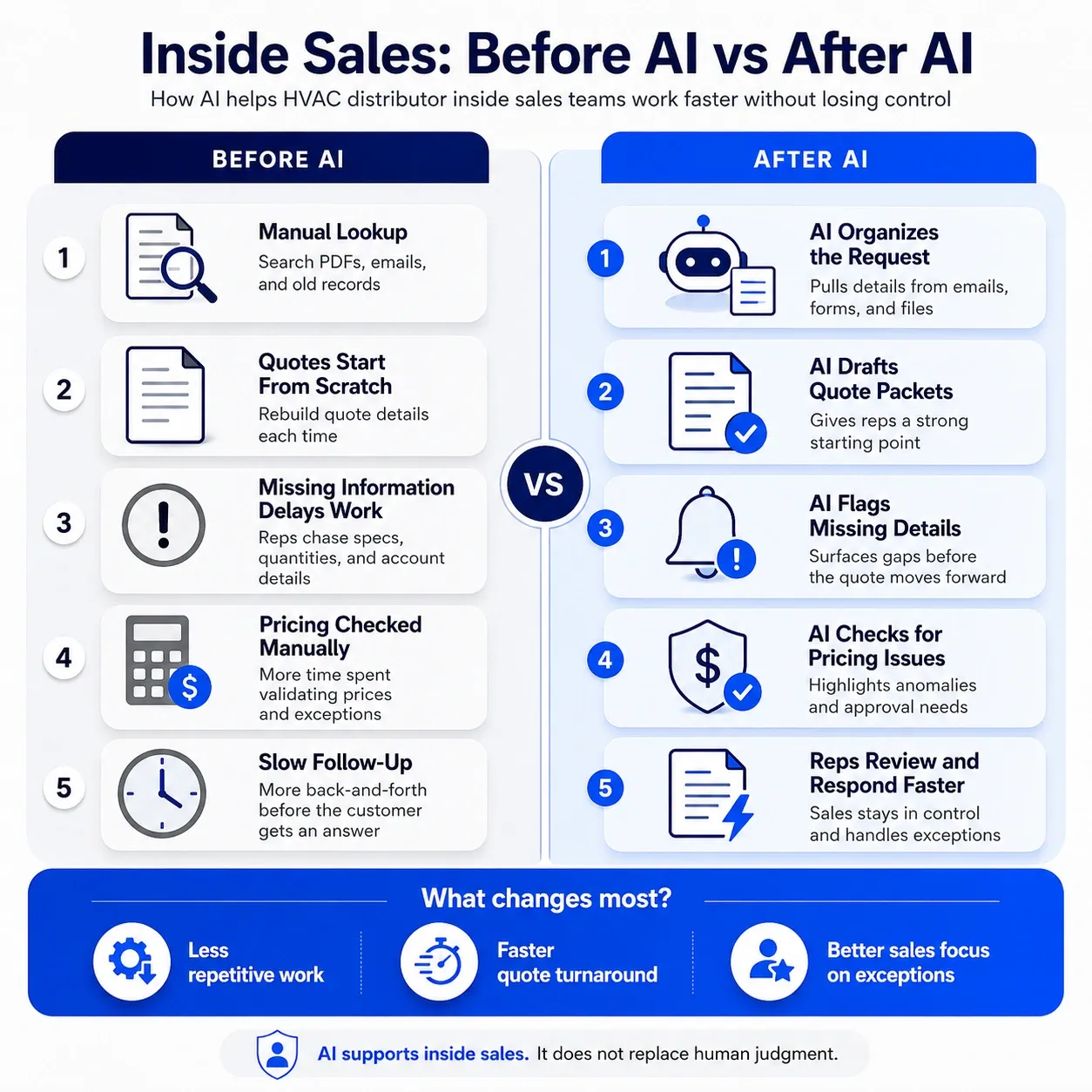
AI can reduce repetitive work without removing that judgment. It can summarize account history, draft responses, identify likely products, flag missing information, suggest approved alternatives, and prepare approval packets.
That means your team spends less time searching PDFs, checking old emails, cleaning product descriptions, or copying quote details. They spend more time on exceptions, customer relationships, and complex jobs.
At Reveation, we automate the work that slows people down, not the judgment that protects the business. Our generative AI agents solutions focus on document-heavy, repetitive, and decision-support tasks where AI can assist teams without removing oversight.
Do Not Start Here
The fastest AI pilot is not always the safest one. HVAC distributors should be careful with workflows where bad outputs create real operational damage.
- Do not start with fully autonomous special pricing for large contractors or project bids.
- Do not start with warranty-sensitive compressor, control board, or replacement-part substitutions.
- Do not start with complex equipment compatibility decisions where a wrong answer can delay installation.
- Do not start with customer-facing “recommended replacement” widgets if fitment data is unreliable.
- Do not start with workflows where ERP, PIM, or pricing data conflicts across systems.
A better first move is to choose workflows where AI can help internally before it makes customer-visible decisions.
Start Here
The best first AI pilot is usually not the most impressive workflow. It is the workflow with enough data, clear rules, and visible business impact.
For many HVAC distributors, that means quote intake triage, catalog enrichment, product search improvement, quote packet drafting, or pricing anomaly detection. These use cases reduce manual work while keeping people in control.
| Workflow | Business value | Bad-output risk | Data readiness | Priority |
|---|---|---|---|---|
| Quote intake triage | High | Low | Medium | Best first pilot |
| Catalog attribute enrichment | High | Medium | Medium | Good first pilot |
| Product search synonyms | Medium-high | Low | Medium | Good first pilot |
| Pricing anomaly detection | High | Medium | High | Pilot with controls |
| Substitute recommendations | High | High | High | Pilot after data cleanup |
| Autonomous special pricing | High | Very high | Very high | Later-stage automation |
The point is not to slow down AI. It is to match AI autonomy to business risk.
Run a 90-Day Pilot
A practical AI pilot should be small enough to control and important enough to prove value. Do not start with a company-wide transformation. Start with one workflow where speed, accuracy, and control can improve together.
Days 1 to 15
Choose one workflow
Pick a real operational pain point, such as quote intake triage, catalog enrichment, product search, or quote packet drafting. Keep the scope tight: one branch, one region, one product category, or one customer segment.
Days 16 to 30
Audit the data
Review ERP pricing, PIM attributes, product PDFs, quote history, approval rules, customer records, and inventory feeds. Look for missing fields, conflicting rules, duplicate records, and manual exceptions.
Days 31 to 60
Build the workflow
Add AI where it can draft, classify, extract, enrich, recommend, or flag. Add guardrails for pricing, compatibility, confidence scores, approval routing, and audit history.
Days 61 to 75
Test against history
Run the workflow against real past quotes, orders, searches, or catalog records. Compare AI suggestions to what your team actually approved.
Days 76 to 90
Launch with controls
Roll out to a limited team or customer group. Track quote response time, no-result search rate, quote correction rate, margin exception rate, sales rep time per quote, ecommerce-to-quote conversion, and adoption by account segment.
Key Takeaways
HVAC distributor ecommerce needs to support product fit, account pricing, inventory, quotes, branch workflows, and sales review. That makes it more complex than a standard online catalog.
AI helps when it improves findability, quote preparation, pricing review, catalog enrichment, and inside sales productivity. It becomes risky when it makes final decisions without reliable data and approval rules.
The safest first pilots are usually internal-facing workflows. Start with quote intake triage, catalog enrichment, product search, quote packet drafting, or pricing anomaly detection before moving into customer-facing automation.
The long-term opportunity is bigger than automation. Done well, AI can help HVAC distributors create a faster buying experience while protecting the operational judgment that keeps customers loyal.
Conclusion
HVAC distributor ecommerce is entering a new stage. Buyers want speed and self-service, but HVAC workflows still need accuracy, fitment confidence, pricing discipline, and expert review.
AI can help you close that gap. It can make products easier to find, quotes faster to prepare, pricing issues easier to catch, and inside sales teams more productive.
The right approach is not full automation on day one. It is a guarded workflow strategy: connect the systems, clean the data, pilot one use case, involve sales teams, and expand only when the results are reliable.
At Reveation, we build B2B ecommerce, product data, integration, and AI workflows for teams that need more than a storefront. We help you connect the systems, clean up the workflows, and pilot AI where it can improve speed without creating pricing, fitment, or approval risk.