You thought the launch risk was downtime. By 10 a.m., a hospital buyer sees products they should not access. By noon, a contract customer flags pricing that does not match the ERP. By the end of the day, sales reps ask why they cannot see online orders, and operations starts routing exceptions by email again.
That is the real risk behind pharmaceutical distribution ecommerce replatforming. The project may look like a platform upgrade, but it touches license controls, restricted catalogs, customer-specific pricing, inventory rules, fulfillment, traceability, and audit readiness.
At Reveation Labs, we treat pharma ecommerce replatforming as an operating model project first and a technology project second. When teams start with the platform instead of the workflow, the new portal often carries old problems into a cleaner interface.
For adjacent healthcare distribution context, our guide on medical supply B2B ecommerce migration explains why contract pricing, ERP integration, reorder workflows, and compliance-sensitive product data need careful migration planning. Pharma distribution raises the stakes because regulated access and supply-chain traceability affect what buyers see, order, return, and document.
The FDA describes DSCSA as a framework for interoperable, electronic product identification and tracing at the package level across the prescription drug supply chain. Your ecommerce platform does not need to become the traceability system, but it must not interrupt the systems and workflows that support traceability, verification, exception handling, and documentation.
The biggest replatforming risks rarely come from page design. They come from unclear ownership across pricing, licenses, product restrictions, inventory, fulfillment, approvals, and audit history.
Access risk
Licensed buyers, restricted catalogs, and ship-to rules need clear ownership.
Pricing risk
ERP pricing, contract terms, overrides, and approvals must stay aligned.
Operational risk
Inventory, fulfillment, substitutions, returns, and audit logs need testing.
1. Starting With the Platform Before Mapping Workflows
Many teams start with a familiar question: “Should we use Shopify Plus, Virto Commerce, custom development, or a composable stack?” That question matters, but it should not come first.
Start with the workflows that carry the most risk. Map licensed customer access, restricted catalog visibility, contract pricing, ship-to rules, order approvals, substitutions, returns, recalls, and audit logs before you compare platforms.
A strong pharmaceutical distribution ecommerce replatforming plan answers the questions below before platform selection begins.
| Workflow area | What to map first | What breaks if ignored |
|---|---|---|
| License validation | Customer eligibility, license status, ship-to rules, account roles | Unauthorized access and manual compliance reviews |
| Restricted catalogs | SKU restrictions, customer groups, contract groups, location rules | Restricted products appear to the wrong buyers |
| ERP pricing | Contract terms, tiers, overrides, rebates, approval rules | Pricing disputes, margin leakage, and buyer distrust |
| Traceability handoff | Where serialized product, documentation, returns, and recalls are managed | Disconnected exception handling and weak investigation support |
| Audit logging | Approvals, edits, substitutions, uploads, access attempts, role changes | Teams cannot reconstruct key decisions later |
If your team selects a platform first, you may force regulated workflows into features that never fit them. We recommend that leaders define workflow control, system ownership, and integration depth before they approve a platform shortlist.
2. Treating Ecommerce as the System of Record
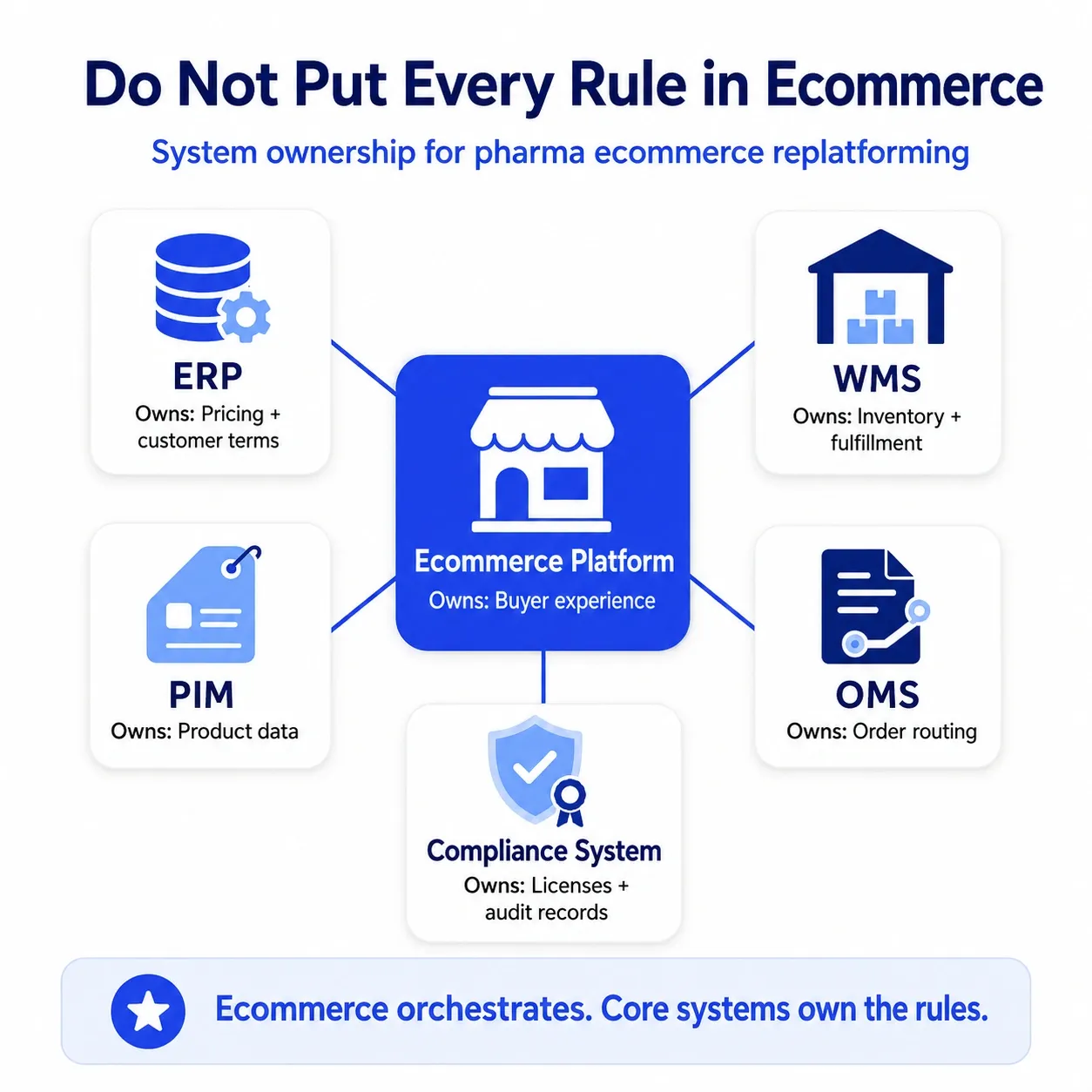
A pharma ecommerce portal should not own every business rule. It should orchestrate the buyer experience while ERP, WMS, PIM, OMS, and compliance systems continue to own the data they manage best.
Your ERP may own contract pricing and customer terms. Your WMS may own inventory allocation and fulfillment status. Your PIM may own product attributes and content. Your compliance or licensing system may own buyer eligibility and regulated documentation.
When teams move too much logic into the storefront, they create duplicate rules. Duplicate rules drift. Once they drift, buyers see wrong prices, wrong products, or wrong availability.
Teams usually discover this mistake after launch. Ecommerce updates one catalog rule, ERP updates one customer term, and nobody catches the mismatch until a buyer disputes the order.
Watch this closely: Do not turn the storefront into the source of truth for pricing, licensing, inventory allocation, serialization, or compliance documentation unless your architecture deliberately supports that choice.
3. Migrating Catalogs Without Permission Rules
A clean product catalog does not mean you have a compliant product catalog. Pharmaceutical distributors need catalog logic that reflects who can see, request, or order specific products.
Restricted catalog rules may depend on customer type, license status, facility, contract, geography, ship-to location, or internal approval. If you migrate SKUs without these permission layers, the new portal can expose products to the wrong accounts.
This mistake damages trust quickly. Buyers expect the portal to reflect their approved relationship with your business. Sales, compliance, and operations teams expect the portal to enforce the same rules they follow offline.
Our guide to B2B ecommerce solutions explains why regulated distributors need secure login gates, role-based catalog access, and integration hooks for licensing or quality systems. Those controls should shape the catalog migration plan from day one.
4. Importing ERP Pricing Instead of Integrating It
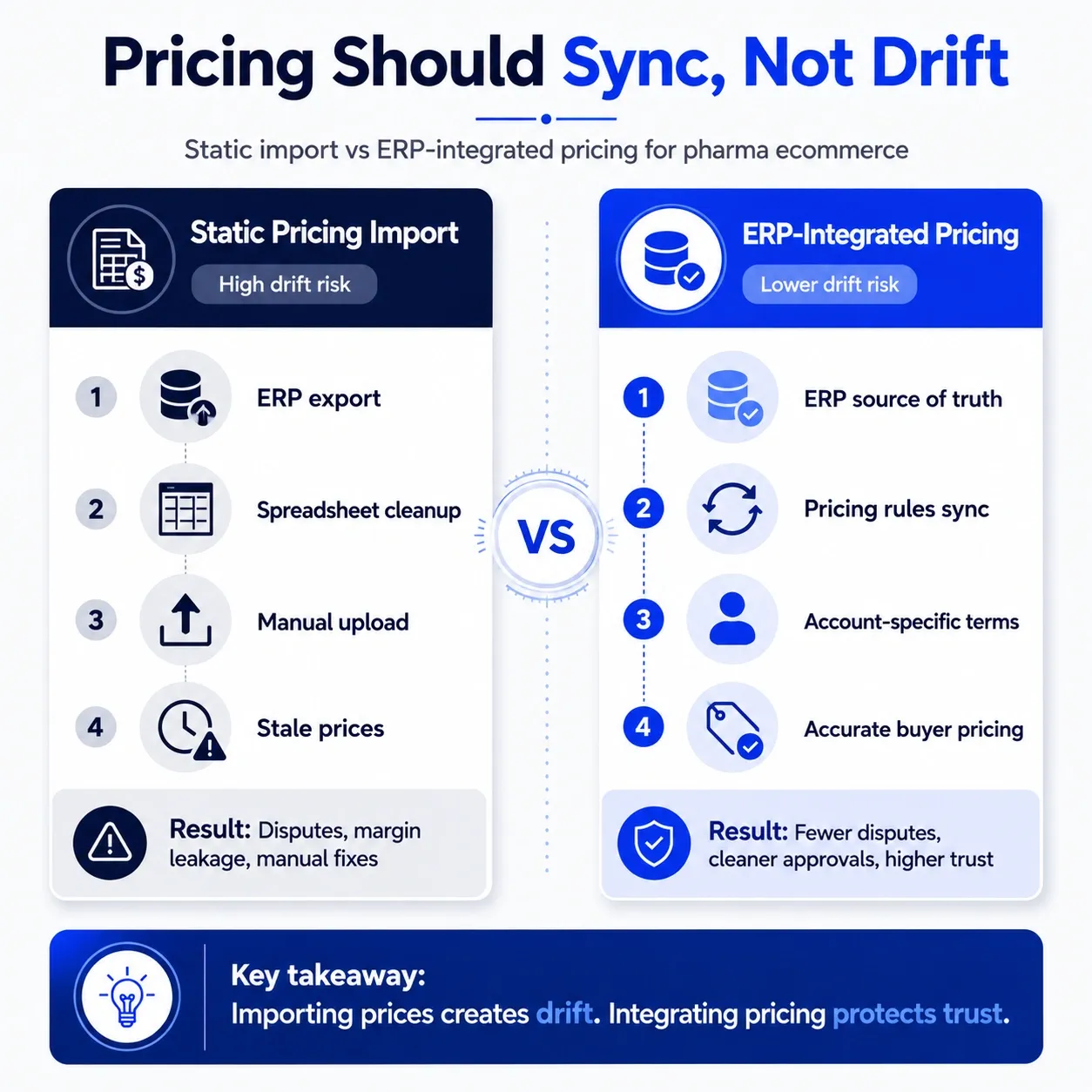
Some replatforming teams export pricing from ERP, clean it in spreadsheets, and import it into ecommerce. That approach may work for a simple catalog. It rarely works for pharmaceutical distribution.
Pharma distributors often manage contract pricing, account-specific terms, tiered rules, volume breaks, customer groups, negotiated exceptions, and approval-based overrides. If ecommerce stores these rules as a static copy, pricing starts aging the moment the import finishes.
Pricing errors damage trust immediately. Buyers challenge invoices, sales teams handle disputes, finance reviews margin leakage, and support teams field tickets that the portal should have prevented.
During replatforming, define the source-of-truth model for pricing. Then design the integration so ecommerce can show accurate prices without owning every pricing rule.
Risky approach
Export pricing from ERP, clean it in spreadsheets, and import it into ecommerce.
Stronger approach
Define the source-of-truth model for pricing and design the integration around accurate display.
5. Hardcoding License Logic Into the Storefront
License validation needs structure, auditability, and clear ownership. When teams hardcode license rules into the storefront, they create fragile logic that becomes hard to update and harder to explain.
This shortcut usually starts with good intent. A team wants to move fast, so developers add conditional logic directly into the ecommerce layer. Later, license rules change, new customer types appear, or compliance asks for a clear audit path.
Now the business depends on code that few people understand. That creates delays, risk, and extra cost.
Define where license data lives, how ecommerce checks it, what happens when a license expires, and how teams review exceptions. The portal should guide the buyer experience, not hide compliance logic inside scattered storefront code.
6. Simplifying Inventory Into “Available Quantity”
B2B buyers do not only ask, “Is this product in stock?” They ask, “Can my account buy it, from this location, under this contract, for this order size, by this date?”
That question requires more than a simple inventory feed. Pharmaceutical distributors may need allocation rules, serialized product workflows, substitution logic, cold-chain handling, backorder rules, and fulfillment constraints.
If ecommerce shows generic availability, buyers place orders that operations cannot fulfill as promised. That leads to cancellations, substitutions, support calls, and poor adoption.
Your WMS, ERP, or OMS likely already manages these rules. During replatforming, connect ecommerce to the right operational logic instead of flattening inventory into one availability field.
7. Forgetting Sales Rep Visibility
Many distributors worry that ecommerce will create channel conflict. That risk grows when the new portal hides buyer activity from sales teams.
Sales reps need visibility into online orders, reorder behavior, abandoned carts, quote requests, exceptions, and account-level issues. Without that visibility, reps lose context and buyers receive fragmented service.
A strong pharma ecommerce portal supports self-service and sales-assisted service at the same time. Buyers reorder faster, while reps focus on strategic accounts, exceptions, and relationship management.
This mindset also prepares distributors for more advanced workflows. In our article on agentic commerce in B2B ecommerce, we explain why AI-enabled buying needs strong guardrails, auditability, and clean system orchestration before teams automate more of the buying journey.
8. Skipping Audit Trail Design
Audit trails do not appear automatically just because the platform logs events. You need to define what matters.
For pharmaceutical distribution ecommerce, teams should decide how they will log buyer actions, role changes, approvals, order edits, substitutions, document uploads, restricted product access, and pricing overrides. They should also decide who can view those logs and how long the business will retain them.
Weak audit design creates problems during reviews, investigations, and internal troubleshooting. Teams waste time reconstructing decisions from emails, screenshots, and support notes.
Build the audit model before launch. It should support compliance, operations, sales, and customer service instead of serving only the technical team.
9. Testing Only the Happy Path
A happy-path order tells you very little about pharma ecommerce readiness. Most replatforming risk hides in exceptions.
Test expired licenses. Test restricted SKUs. Test contract pricing changes. Test partial fulfillment, substitutions, backorders, returns, ship-to restrictions, approval routing, tax rules, and ERP sync failures.
Also test with real buyer roles. A purchasing manager, approver, sales rep, customer service user, and admin should not see the same screens or actions.
| Test area | What to validate | Who should review |
|---|---|---|
| Restricted access | Product visibility by account, role, license status, and location | Compliance and sales operations |
| Pricing | ERP parity, contract terms, overrides, taxes, and fees | Finance and sales |
| Orders | Checkout, approvals, substitutions, backorders, returns, and exceptions | Operations and customer service |
| Integrations | ERP, WMS, PIM, OMS, and compliance checks | IT and business owners |
| Audit logs | Edits, approvals, exceptions, restricted actions, and role changes | Compliance and leadership |
If you only test standard login, search, cart, and checkout, you miss the workflows that will break trust after launch.
10. Choosing an Implementation Partner Without Pharma Workflow Depth
A general ecommerce partner can build a polished portal. That does not mean they can protect pharmaceutical distribution workflows.
Your implementation partner should understand complex B2B account structures, ERP dependencies, restricted catalogs, pricing logic, approval flows, role-based access, and regulated operational processes. They should ask hard questions before they recommend architecture.
At Reveation Labs, we help B2B teams design ecommerce systems around the workflows that drive revenue and risk. Our B2B ecommerce implementation partner work covers platform selection, systems integration, ecommerce architecture, and implementation planning across complex distribution environments.
The right partner will not rush you into a platform demo. They will help you define what must stay in ERP, WMS, PIM, OMS, compliance systems, and ecommerce before the build begins.
Replatform Around Risk, Not Screens
Pharmaceutical distribution ecommerce replatforming succeeds when leaders treat the portal as one part of a regulated operating system. The storefront matters, but the connections matter more.
Your team should know which system owns pricing, licenses, inventory, fulfillment, product content, approvals, audit logs, and compliance documentation. Once you define those boundaries, the platform decision becomes clearer.
For platform-fit conversations, our article on Shopify Plus B2B ecommerce development explains where a scalable platform can support wholesale use cases such as custom pricing, B2B catalogs, approvals, and back-office sync. The right answer still depends on your regulated workflows, integration needs, and source-of-truth model.
| Replatforming step | What to do | Why it reduces risk |
|---|---|---|
| 1. Workflow mapping | Map regulated buyer journeys, sales workflows, and exception paths | Prevents platform-first decisions that ignore operational reality |
| 2. System ownership | Define owners for pricing, licenses, catalog rules, inventory, and orders | Stops duplicate logic from drifting across systems |
| 3. Data cleanup | Clean product, account, pricing, ship-to, and permission data | Reduces launch defects and manual support tickets |
| 4. Exception-first integration | Design for backorders, substitutions, expired licenses, returns, and sync failures | Protects the business when real-world orders do not follow the happy path |
| 5. Phased rollout | Launch with controlled buyer groups, sales feedback, and support monitoring | Limits disruption and helps teams fix issues before broad release |
This approach gives your team a stronger foundation for future automation, AI-assisted buying, and self-service growth. If your current platform already shows warning signs like slow changes, manual order workarounds, or integration exceptions, our article on signs your B2B ecommerce platform is holding you back can help you frame the repair-versus-replatform conversation.
Final Takeaway
You do not need a prettier pharma ecommerce portal. You need a portal that respects how pharmaceutical distribution actually works.
That means restricted catalogs stay restricted. Contract pricing matches ERP. Licensed buyers get the right access. Sales reps keep visibility. Operations can fulfill what buyers order. Compliance teams can trace what happened when questions arise.
At Reveation Labs, we help teams plan ecommerce replatforming around those realities. Before you choose a new platform, we can help your team map the workflows most likely to break: restricted catalog rules, license validation, ERP pricing, inventory logic, approval paths, and audit requirements.
If your team needs a broader ecommerce modernization partner, our B2B ecommerce development agency guide explains how we approach complex B2B requirements, integration-heavy builds, and scalable commerce architecture for manufacturers and distributors.