
You have executive approval, a target launch date, and pressure to show progress. Your current platform frustrates customers, slows sales, and forces operations to rely on manual workarounds.
So, your team starts discussing platforms, implementation partners, and build timelines. Then the questions arrive.
Sales needs customer-specific pricing. Operations wants to protect order exceptions. Finance needs reliable ERP data. Customer service wants better account visibility. Everyone wants a better experience, but nobody agrees on what the first release should include.
Now you face the real decision: how much discovery before a B2B replatform does your team actually need?
In a B2B replatform, discovery is the pre-build process of clarifying business requirements, workflows, system ownership, risks, and launch priorities before development begins.
You do not always need a long discovery phase. You also should not begin development while major business decisions remain open. You need the smallest amount of discovery that makes the scope, timeline, ownership, and first release credible.
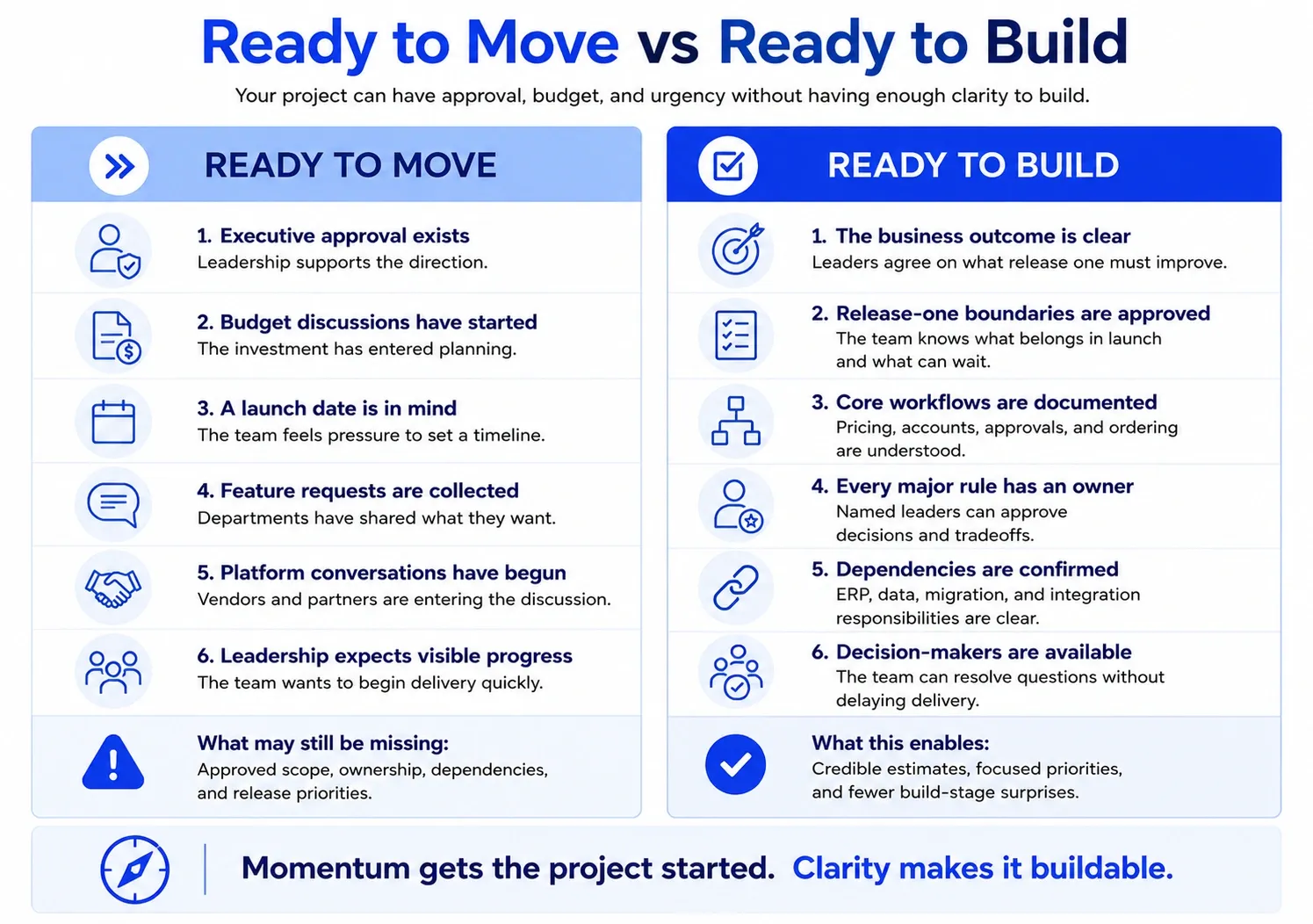
Are You Ready to Build or Just Ready to Move?
Urgency often starts a replatform. Your legacy system costs too much to maintain, customers want better self-service, and leadership wants progress before the next budget cycle.
That urgency can help your team act. It can also make activity look like readiness.
You can choose a platform, name a budget, and announce a launch month without knowing who owns pricing rules, how customer accounts work, which data will move, or what the first release must achieve.
Your team should also confirm whether it needs a true replatform or a different modernization path. Our article comparing greenfield development and B2B replatforming helps leaders separate those decisions.
Meet the distributor in this scenario
Imagine a regional industrial distributor that wants to replace an aging ecommerce platform. Its customers use contract pricing, branch accounts, purchase orders, and repeat-order lists. Its ERP controls inventory and invoicing, while sales representatives manage several pricing exceptions manually.
Leadership calls the project a storefront replacement. Operations sees an order-management change. Sales sees a new self-service channel. Finance sees integration risk.
The company feels ready to move, but it has not yet proved that it is ready to build.
What Goes Wrong When Discovery Is Too Light?
Many expensive replatform problems start with unresolved business decisions. Development simply exposes them.
| Rushed approach | What the team assumes | What happens next |
|---|---|---|
| Start with a feature list | Every request deserves a place in release one | The scope grows because nobody ranks the outcomes |
| Choose the platform first | The platform will define the right process | The team copies old problems into a new system |
| Estimate before mapping dependencies | The project follows a standard storefront timeline | Pricing, ERP, and account rules change the estimate later |
| Invite everyone but name no owner | Discussion will create agreement | Meetings create opinions but no final decisions |
Our example distributor may estimate a simple storefront replacement. During development, the team could discover that each branch uses different approval rules, pricing exceptions live in spreadsheets, and customer records contain duplicate account structures.
A practical B2B ecommerce migration checklist can expose many of these dependencies before they affect delivery.
Key point: Moving quickly with unresolved decisions does not shorten the project. It moves the delay into a more expensive phase.
How Much Discovery Before a B2B Replatform?
The answer depends on uncertainty and business change, not company size.
At Reveation Labs, we use three practical paths. These thresholds do not act as rigid formulas. They help leaders test whether the project has enough clarity to move forward.
Fast-Track
Choose it when
The team knows the goals, workflows, system owners, and release-one boundaries
Practical threshold
No more than one material dependency remains open
Next move
Validate the assumptions, confirm scope, and start delivery
Discovery Sprint
Choose it when
The direction is clear, but several cross-functional decisions still affect scope
Practical threshold
Two to four major decisions require focused alignment
Next move
Resolve the gaps, approve the first release, and create the build plan
Deeper discovery
Choose it when
The project changes sales processes, channel strategy, ownership, or core commercial rules
Practical threshold
Teams disagree on the future process or cannot explain the current one
Next move
Define the operating rules before committing to implementation scope
Fast-Track when the path already works
Choose Fast-Track delivery when your team has documented the core workflows, confirmed system ownership, approved the first release, and named decision-makers who can resolve issues quickly.
Fast-Track does not mean “skip planning.” It means your team has already completed most of the important thinking.
- Leaders agree on measurable launch goals.
- Teams understand customer pricing and account rules.
- Each major data object has one clear owner.
- The integration approach follows a proven pattern.
- The first release has firm boundaries.
- Decision-makers can respond during delivery.
Our distributor would qualify for Fast-Track only if it already understands the branch hierarchy, pricing exceptions, ERP responsibilities, and launch priorities.
Run a sprint when the gaps look manageable
Choose a B2B ecommerce Discovery Sprint when the team agrees on the overall goal but still needs to settle several decisions that affect scope or risk.
Our distributor may know that it needs contract pricing, branch accounts, ERP inventory, and online reordering. It may still need to decide which system owns each rule, which exceptions belong in release one, and how customers will move to the new platform.
In our B2B ecommerce Discovery Sprint , we bring ecommerce, operations, sales, and technology stakeholders around one practical plan. We focus on the decisions that change scope, timeline, and launch risk.
Go deeper when the business itself changes
Choose deeper discovery when the replatform changes how the company sells, serves customers, manages channels, or assigns responsibility.
The distributor may plan to combine several brands, introduce dealer self-service, replace sales-controlled pricing exceptions, or redesign approval rules. Those decisions shape the business, not just the storefront.
Deeper discovery should still have a finish line. It should produce agreed commercial rules, named system owners, a clear channel model, and a defined boundary for implementation.
Ask These Five Questions First
You do not need a technical assessment to choose the right discovery depth. Start with five business questions.
1. What must stay the same?
Identify the workflows that protect revenue, customer trust, or operational control. These may include contract pricing, quote conversion, purchase-order rules, credit limits, branch access, or quick reordering.
2. What must work differently?
Define the improvement in plain business language. “Modernize the experience” does not guide scope. “Let repeat buyers reorder without calling sales” does.
3. Where could operations break?
Ask what happens when pricing fails to sync, a customer account does not match, inventory looks stale, or the ERP rejects an order.
Clear ERP and ecommerce alignment before replatforming helps your team identify ownership and operational risk before development begins.
4. Who can make the final call?
Assign an owner for pricing, product data, customer accounts, integrations, content, and launch scope. Your project can collect input from many people, but it needs a small group of leaders who can approve tradeoffs.
5. What belongs in release one?
Release one should solve a valuable customer and business problem. It should not contain every feature that each department requests.
Your rollout decision also changes the discovery scope. Review the tradeoffs between a big-bang and phased B2B migration before you lock the first-release plan.
Practical test: When different leaders give different answers to three or more of these questions, run discovery before you approve the build.
What Should Discovery Actually Settle?
Good discovery does not end with a large document. It ends with decisions that your team can use.
- A clear business outcome: Leaders know what release one should improve.
- An approved scope: Teams understand what belongs in the launch and what can wait.
- Named owners: Each major workflow, rule, and data source has one accountable owner.
- Known dependencies: The plan reflects ERP, pricing, account, catalog, and migration needs.
- A credible timeline: The estimate reflects the work instead of assumptions.
- A firm next step: Leaders can approve Fast-Track delivery, a defined implementation, or further work around one specific risk.
Teams that need broader support can use B2B ecommerce consulting to connect business priorities, platform decisions, integrations, and rollout planning.
Keep Discovery From Becoming a Delay
Some leaders avoid discovery because they expect endless meetings. Poor discovery can create that problem, but focused discovery works differently.
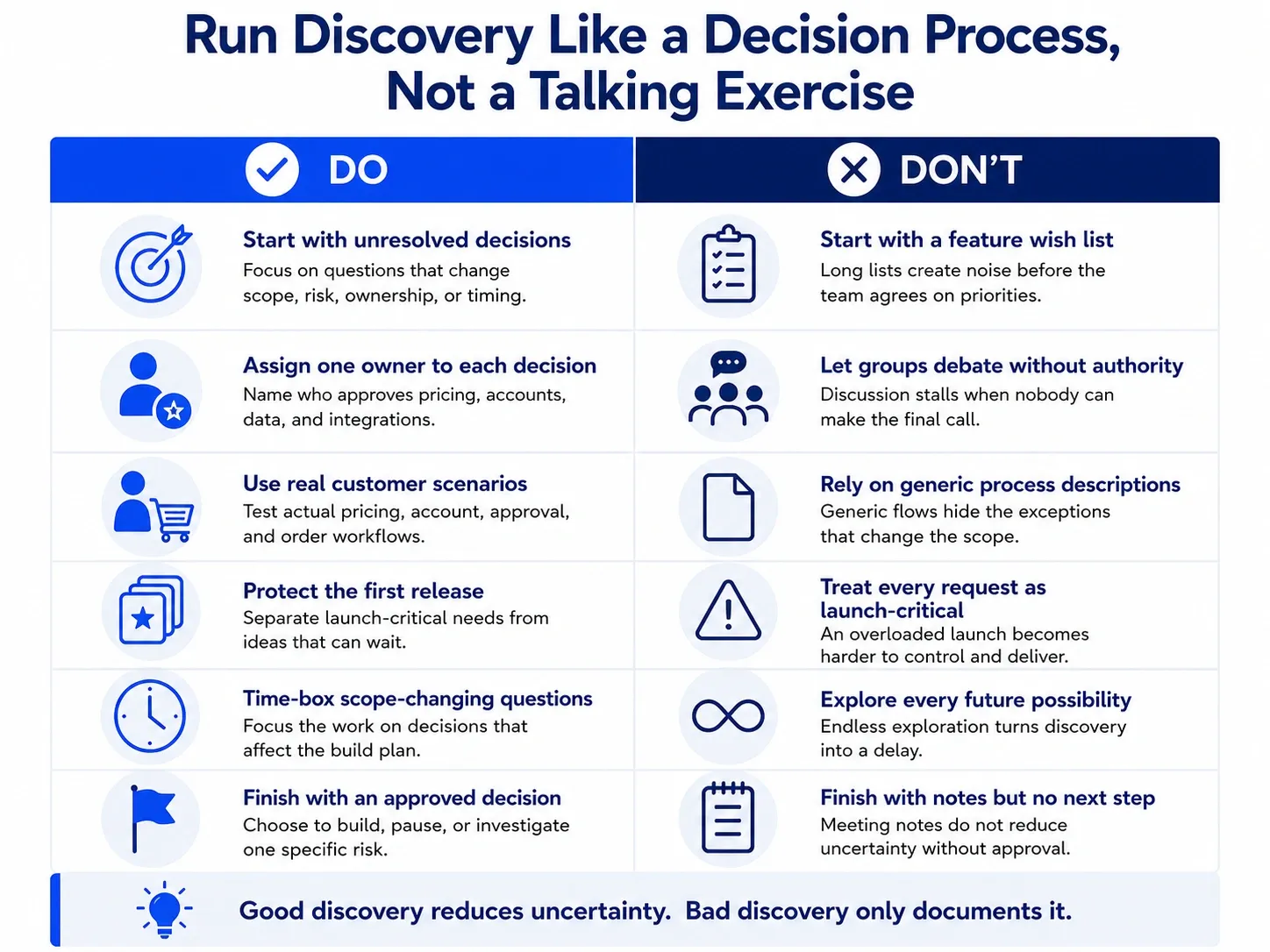
Time-box the unknowns
Focus on decisions that block scope, estimation, or launch readiness. Do not explore every future idea.
Put decision-makers in the room
Include the people who own revenue, operations, customer experience, financial controls, and technology. Ask them to join the sessions where the team must make tradeoffs.
Protect the first release
Keep a separate list for later ideas. That gives stakeholders confidence that the roadmap will preserve valuable requests without forcing all of them into launch.
End with a decision
At Reveation Labs, we use discovery to help the team choose a delivery path. We do not treat it as a permanent phase.
Once leaders approve the goals, scope, responsibilities, and release plan, the project can move into B2B ecommerce implementation with fewer open questions.
Build Once, With Fewer Surprises
The question is not whether discovery adds value. The question is how much discovery before a B2B replatform will protect the build without slowing useful progress?
Choose Fast-Track when the team has already proved the path. Run a Discovery Sprint when a focused effort can settle the remaining gaps. Go deeper when the project changes how the business sells, serves customers, or manages operations.
You do not need perfect information. You need enough clarity to approve the first release, trust the timeline, and understand the tradeoffs.
Ready to test your replatform readiness?
Book a scoped discovery workshop with Reveation Labs. We will help you determine whether your project needs a focused Discovery Sprint or already has enough clarity for Fast-Track delivery.