
You do not lose customers just because your website looks outdated. You lose them when buyers cannot find the right part, see the right contract price, confirm branch availability, or reorder fast enough to keep a job moving.
That is why electrical distributor ecommerce is not a basic storefront decision. It is a workflow decision across product data, ERP pricing, inventory, quotes, account roles, and fulfillment.
Virto Commerce, Shopify Plus, and BigCommerce can all work in the right situation. The real question is simple: which platform fits how your customers buy and how your team operates?
Virto Commerce
Best for complex pricing, ERP rules, account structures, quotes, and long-term flexibility.
Shopify Plus
Best for faster launches, polished UX, and simpler B2B buying journeys.
BigCommerce
Best for mid-market B2B teams that need practical capability without overbuilding.
Which platform fits your business?
If your team needs a fast shortlist, start here. Electrical distributor ecommerce works best when the platform matches your hardest operating requirements, not just your preferred UX or brand name.
Virto Commerce
Your business situation: You manage complex customer pricing, account hierarchies, quote logic, and ERP-driven rules.
Why it fits: It gives complex B2B teams more control over workflows, integrations, and custom business logic.
Shopify Plus
Your business situation: You need a polished buying experience and a faster launch for simpler B2B ordering.
Why it fits: It works well when speed, UX, and ecosystem matter more than deep workflow customization.
BigCommerce
Your business situation: You want mid-market B2B capabilities without a heavier composable build.
Why it fits: It offers a practical balance for distributors with moderate catalog, pricing, and integration needs.
Product data-heavy catalogs
Your business situation: Your catalog depends on specs, filters, datasheets, substitutes, and manufacturer part numbers.
Best-fit platform: Virto Commerce or BigCommerce with strong product data work.
Quote-heavy selling
Your business situation: Your sales team handles configurable products, quotes, approvals, or negotiated deals.
Best-fit platform: Virto Commerce with CPQ, or another platform connected to CPQ.
A broader B2B ecommerce platforms comparison can help your team compare workflow fit, scalability, and integration needs. For distributors, our B2B ecommerce platform comparison tool also helps you compare platforms by industry needs instead of brand recognition.
Practical takeaway: Choose the platform that supports your hardest workflow. A clean storefront will not fix broken pricing, messy product data, or unreliable inventory.
Why electrical distribution ecommerce is harder than standard B2B
Most B2B storefronts need accounts, pricing, checkout, and order history. Electrical distributors need those basics plus technical search, contract pricing, branch inventory, quick reorder, quote support, and ERP accuracy.
Your buyers may search by manufacturer part number, voltage, amperage, certification, enclosure type, cable length, compatibility, or replacement need. They may also need to know whether a nearby branch can fulfill the order today.
That means your website has to work like a digital catalog, ordering portal, inventory window, and sales support tool at the same time.
Digital catalog
Specs, attributes, datasheets, images, accessories, substitutes, and category-specific filters.
Ordering portal
Account rules, customer-specific pricing, quick reorder, order history, and checkout workflows.
Inventory window
Branch availability, warehouse visibility, stock confidence, fulfillment logic, and order status.
Product data controls the buying experience
Electrical catalogs can include thousands or hundreds of thousands of SKUs. Each product may need specs, attributes, datasheets, installation details, compliance documents, images, accessories, substitutes, and category-specific filters.
If your product data is weak, your storefront will feel weak. Search results get noisy, filters feel incomplete, and buyers cannot compare products quickly.
At Reveation Labs, we connect commerce, PIM, CPQ, OMS, and ERP workflows through our Product Data & Integration Management work. That helps teams clean, structure, and connect product data before it damages the buyer experience.
Pricing needs more than a public price
You may sell the same product at different prices depending on the account, contract, branch, job, quote, customer tier, or sales agreement. A standard price table will not support that reality.
Your platform needs to know who the buyer is, which account they belong to, what pricing rules apply, and which products they can see or buy. It also needs to show accurate pricing without slowing the buying experience.
This is where many teams outgrow simple storefront setups. A fast launch feels good until buyers see the wrong price or your sales team starts fixing orders manually.
Inventory visibility builds or breaks trust
Electrical buyers often care about availability as much as price. If your site says an item is available but the branch cannot fulfill it, the buyer may call another distributor.
Real-time warehouse and branch visibility helps customers make decisions with confidence. It also reduces calls to sales reps, stock checks, order status requests, and manual follow-ups.
We explain this in more detail in our article on real-time inventory and multi-warehouse fulfillment, especially for distributors that need accurate stock visibility across locations.
Common mistakes that create platform regret
Many teams do not regret launching ecommerce. They regret launching an experience that ignores how the business actually runs.
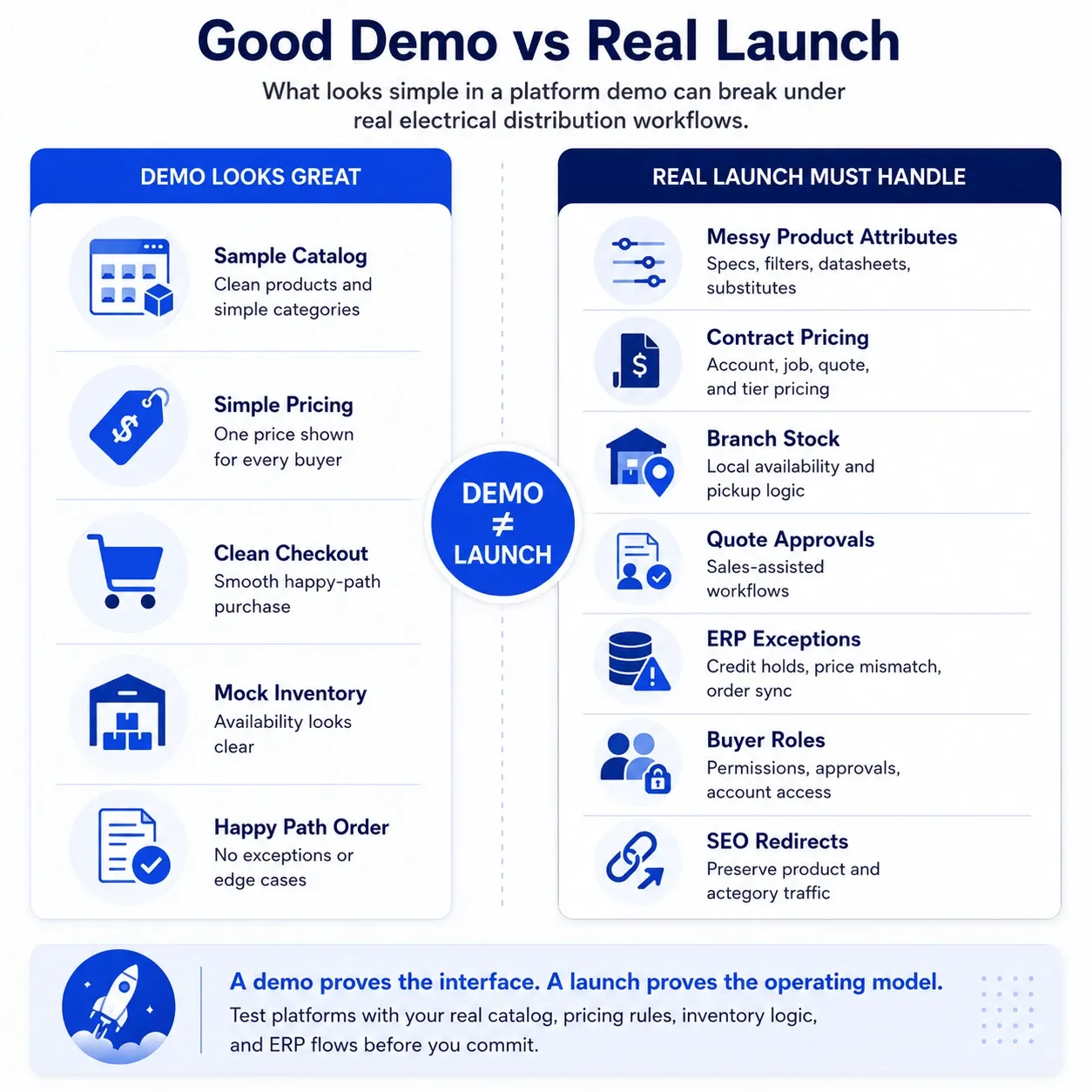
Mistake
Choosing the platform because the storefront demo looks good.
What it causes: The site looks modern but cannot support real pricing, inventory, account, or ERP rules.
Better approach: Start with workflows, then evaluate UX.
Mistake
Launching before product specs, filters, datasheets, and substitutes are clean.
What it causes: Buyers cannot find the right product, and internal teams blame the platform.
Better approach: Fix catalog structure before migration.
Mistake
Assuming pricing and inventory can be fixed later.
What it causes: Sales reps manually correct orders, customers lose trust, and adoption drops.
Better approach: Define system ownership for pricing and inventory early.
Mistake
Copying B2C checkout patterns.
What it causes: Buyers cannot handle approvals, job accounts, quotes, bulk orders, or reorders.
Better approach: Design around real B2B buying roles.
Mistake
Moving everything in one big launch.
What it causes: Risk spreads across catalog, pricing, users, SEO, integrations, and operations.
Better approach: Phase launch by customer group, catalog segment, or workflow.
The goal is not to overcomplicate the project. The goal is to avoid choosing a platform that forces your team into workarounds from day one.
Choose Virto Commerce when your workflows need flexibility
Virto Commerce works best when the commerce platform needs to act like part of a larger operating system, not just a storefront. It fits distributors that need deeper control over pricing, accounts, integrations, catalogs, quotes, and fulfillment logic.
We position our Virto Commerce implementation partner work around complex B2B and marketplace use cases. Virto's modular and API-first approach gives teams more flexibility when they need commerce to connect with ERP, PIM, CPQ, OMS, and other business systems.
Choose Virto when the cost of workarounds would be higher than the cost of a deeper implementation.
Virto is a strong fit when:
- You manage complex account structures and customer-specific pricing.
- You need ERP, PIM, CPQ, or OMS to shape the buying experience.
- Your catalog depends on technical attributes, product relationships, and custom search logic.
- Your sales process includes quotes, approvals, branches, negotiated rules, or customer-specific catalogs.
- You want long-term architecture flexibility instead of a short-term storefront fix.
Watchouts before choosing Virto
Virto usually needs more discovery, planning, and implementation discipline than simpler SaaS storefronts. That tradeoff can be worth it when your business rules are complex, but it may feel heavy if your team only needs basic online ordering.
Before you choose Virto, align product, sales, operations, IT, and finance around the rules that matter most. Decide who owns pricing, product data, inventory, customer records, order status, and quote logic.
Choose Shopify Plus when speed and buyer experience matter most
Shopify Plus can work well when your B2B buying journey is simpler and your team wants a polished experience quickly. It gives teams a strong storefront foundation, a large app ecosystem, and a faster launch path.
That makes it attractive for distributors with cleaner catalogs, simpler pricing, and fewer account-specific workflows. It can also work for hybrid businesses that serve both direct buyers and trade customers.
Choose Shopify Plus when your buying journey is simple enough that speed matters more than custom logic.
Shopify Plus is a strong fit when:
- You need a modern storefront quickly.
- Your catalog is smaller, cleaner, or easier to structure.
- Your B2B pricing rules are not deeply customized.
- Your buyers mostly place standard orders.
- Your team values ease of use, ecosystem speed, and a strong UX layer.
Watchouts before choosing Shopify Plus
Shopify Plus may need apps, custom development, or integration work for advanced distributor requirements. Before you commit, test your real edge cases.
Can the platform show the right contract price for a contractor, a national account, and a job-specific quote? Can it support account roles, approval flows, branch inventory, quick reorder, bulk buying, and ERP-owned pricing?
If those requirements drive revenue, do not treat them as phase-two details. They should shape the platform decision from the start.
Choose BigCommerce when you need a practical B2B middle ground
BigCommerce works best for mid-market distributors that need more B2B capability than a basic storefront but do not want a heavier composable architecture. It can offer a practical balance between speed, native functionality, and extensibility.
For distributors, BigCommerce may fit when the catalog is manageable, pricing logic is moderate, and integrations are clearly defined. It can also suit teams that want a SaaS platform with B2B features and a more controlled implementation path.
Choose BigCommerce when your workflows fit the platform without forcing too many exceptions.
BigCommerce is a strong fit when:
- You need B2B features without overbuilding.
- Your team wants a faster path than a fully custom or composable build.
- Your catalog and pricing rules are moderately complex.
- Your integrations are important but not deeply unusual.
- Your business needs a practical platform for growth without excessive customization.
Watchouts before choosing BigCommerce
BigCommerce can support many B2B needs, but it still depends on clean product data, clear pricing logic, and reliable integrations. Do not assume native features remove implementation work.
Before you choose it, test quote flows, customer groups, price rules, inventory visibility, search behavior, product relationships, and ERP sync. If the platform needs too many workarounds to match your operating model, you may need a more flexible architecture.
Platform alone is not enough
A commerce platform does not fix every operational issue by itself. For distributors, the surrounding systems often decide whether the experience works.
Commerce gives buyers the storefront and ordering layer. PIM makes the catalog usable. ERP protects pricing, inventory, customer records, tax, credit, invoices, and order processing. CPQ supports quotes, configuration, approvals, and negotiated selling. OMS helps with order routing, fulfillment visibility, and status updates.
At Reveation Labs, we use this systems-first view when we plan B2B commerce architecture. Our eCommerce ERP integration work helps teams connect commerce with the back-office systems that control daily operations.
PIM / product data
What it does for distributors: Structures specs, attributes, datasheets, categories, substitutes, accessories, and product relationships.
Risk if ignored: Buyers cannot find or compare products easily.
ERP integration
What it does for distributors: Syncs customer data, pricing, inventory, orders, invoices, taxes, and account rules.
Risk if ignored: Teams manually correct orders, prices, stock levels, and customer records.
CPQ
What it does for distributors: Supports quotes, approvals, configurable products, and negotiated pricing.
Risk if ignored: Sales teams keep quote work outside the ecommerce platform.
OMS
What it does for distributors: Coordinates fulfillment, allocation, order status, shipping, and visibility.
Risk if ignored: Customers keep calling for updates because the portal lacks reliable order information.
If your team handles quote-heavy sales, our CPQ solutions can help connect pricing and configuration workflows back to commerce and ERP. If fulfillment creates more friction, OMS planning may matter more than adding another storefront feature.
Migration checklist for electrical distributors
A platform migration should protect the workflows that already drive revenue. The biggest risks usually sit behind the website: pricing, product data, ERP integrations, inventory visibility, SEO, order history, and buyer adoption.
Our B2B ecommerce migration checklist for distributors and wholesalers covers the operational checks teams should run before moving platforms. For distributors, the migration plan should protect customer accounts, negotiated pricing, custom catalogs, credit terms, approvals, branch inventory, invoice access, and repeat ordering.
Use this checklist before you choose a platform or launch path.
Product data
Are categories, attributes, datasheets, images, substitutes, and accessories clean enough for search and filters?
Pricing
Which system owns contract pricing, customer tiers, promotions, quotes, and exceptions?
Accounts
How will users, roles, permissions, job accounts, branch relationships, and approvals move?
Inventory
Will buyers see branch, warehouse, regional, or aggregate inventory? How often will it sync?
Orders
Where do orders go after checkout? How will customers see status, invoices, returns, and reorders?
SEO
Which category and product URLs drive traffic today? Which redirects need to be protected?
Adoption
Which customers should launch first? How will sales reps guide buyers into the new portal?
A phased migration often works better when your workflows are complex. You can launch by customer segment, product category, region, branch, or use case instead of forcing every risk into one release.
Decision framework: how to choose without overcomplicating it
You do not need to turn platform selection into a year-long debate. You need to identify which business rules create the most risk.
If your biggest need is deep B2B workflows and long-term flexibility
Lean toward: Virto Commerce
Why: It gives complex teams more room for custom architecture and business logic.
If your biggest need is speed, UX, and simpler B2B selling
Lean toward: Shopify Plus
Why: It helps teams launch faster when workflows are not too complex.
If your biggest need is balanced mid-market B2B functionality
Lean toward: BigCommerce
Why: It offers a practical middle ground for many distributors.
If your biggest need is better product discovery
Lean toward: Any platform plus product data/PIM work
Why: Catalog quality drives search, filters, SEO, and buyer confidence.
If your biggest need is accurate pricing and inventory
Lean toward: Any platform plus ERP integration
Why: Buyers need trusted data, not just a clean interface.
If your biggest need is better quoting
Lean toward: Platform plus CPQ
Why: Sales teams need quote rules, approvals, and pricing logic to flow cleanly.
Choose Virto when complexity drives the business. Choose Shopify Plus when speed and UX matter more than deep customization. Choose BigCommerce when you need a practical B2B middle ground. Strengthen any of them with the right product data, ERP, CPQ, and OMS strategy.
Final recommendation
The best platform depends on how much complexity your business needs to support.
Virto Commerce deserves serious consideration when you manage complex pricing, quote workflows, ERP dependencies, account structures, and long-term customization needs.
Shopify Plus can work well when your buying journey is simpler, and speed matters most. BigCommerce can fit mid-market teams that need B2B capability without overbuilding.
The strongest electrical distributor eCommerce strategy starts with your workflows: product data, pricing, accounts, inventory, orders, quotes, and migration risk.
At Reveation Labs, we help teams map those workflows before choosing the build path, because the right architecture should make buying easier and operations cleaner.