If engineers cannot find the right part fast, procurement cannot approve cleanly, and sales ops cannot support orders without exceptions, your catalog experience is working against you.
Common buyer signals
- It is hard to find the right part
- Search results do not match specs
- Buyers call instead of ordering online
What this section covers
- Spec-first discovery and search
- ERP-aligned pricing and inventory
- PunchOut, EDI, PIM, and BOM workflows
Are Your Buyers Getting Lost in Your Catalog?
If buyers are asking, “Why is it so hard to find the right part?” or “Why are buyers still calling when they can just order online?” your catalog is sending a clear signal: discovery is harder than it should be.
For manufacturers and distributors, B2B ecommerce web development is not about launching a basic storefront. It is about building an experience that fits how engineers search, how procurement approves, and how sales ops tracks and supports revenue.
Where “standard ecommerce” usually breaks
If you sell configurable products, spec-heavy parts, or operate through distributor networks with account pricing, standard ecommerce usually breaks at the exact moment buyers need precision. The most common failure is not design. It is missing structure in product data, search, and ordering workflows.
Buyers need to search by attributes, validate part numbers, upload bills of materials (BOM), and order through procurement processes, while pricing, inventory, and approvals stay aligned with ERP. When those basics are right, self-serve grows and phone orders drop.
Here’s how B2B ecommerce solutions and the right web development approach unlock better discovery, cleaner ordering, and fewer exceptions for manufacturers and distributors.
Turning Complex Specs into Configurable Ordering
Manufacturers with detailed specs, certifications, and product options need web development that captures every attribute buyers use to decide. If the spec model is incomplete, configurators fail, filters become unreliable, and buyers lose confidence.
Engineers and technical buyers often start with part numbers, compatibility, tolerances, and certifications. They want to confirm fit quickly, not scroll through marketing copy.
What strong implementation supports
- Part-number tolerant search
- Guided configurators that block invalid combinations
- BOM upload flows for CSV validation before checkout
Managing Multi-Brand Catalogs and Enterprise Buyers
For distributors, the challenge is scale: massive catalog management across brands, regions, and customer-specific rules. Buyers need the right products, the right eligibility, and the right terms without digging.
That requires multi-brand navigation, account-based restrictions, and eProcurement compatibility when enterprise buyers need to order from their own systems. The goal is to reduce decision time and prevent ordering mistakes.
Spec-First Discovery: Make Navigation Engineer-Friendly
Engineers do not shop by catchy product names. They shop by attributes, standards, and compatibility.
B2B ecommerce web development for industrial catalogs should make those attributes first-class. Filters need to be accurate, fast, and consistent across categories, not a nice-to-have that works for only a few products.
Attribute-based browsing, synonym dictionaries, and SKU cross-referencing help buyers find the right match even when they use alternate naming conventions or older part numbers.
What Makes Spec-First Navigation Critical?
Many buyers use ecommerce search with legacy or alternate part numbers. Cross-references prevent dead ends, while compatibility matrices and family groupings make it easier to buy related parts together without manual verification.
ERP-Truth Pricing and Inventory
Have buyers ever challenged a price because what they see online does not match what they were quoted?
What buyers expect
- Contract and account pricing is consistent
- Availability reflects the right location
- Lead times and backorders are clear
What your systems must do
- ERP defines pricing, terms, and policies
- Storefront presents the truth by account and location
- Updates are reliable and monitored
In B2B ecommerce web development, pricing and inventory need to reflect your ERP rules. That includes contract pricing, customer-specific terms, credit policies, and region-based availability.
Your ERP should define the truth. The storefront should present it clearly, quickly, and consistently by account and location.
APIs or event-driven updates can keep availability, lead times, and backorder statuses current. What matters most is not the method. It is that updates are reliable, monitored, and designed for real ordering scenarios.
Why ERP Integration Matters
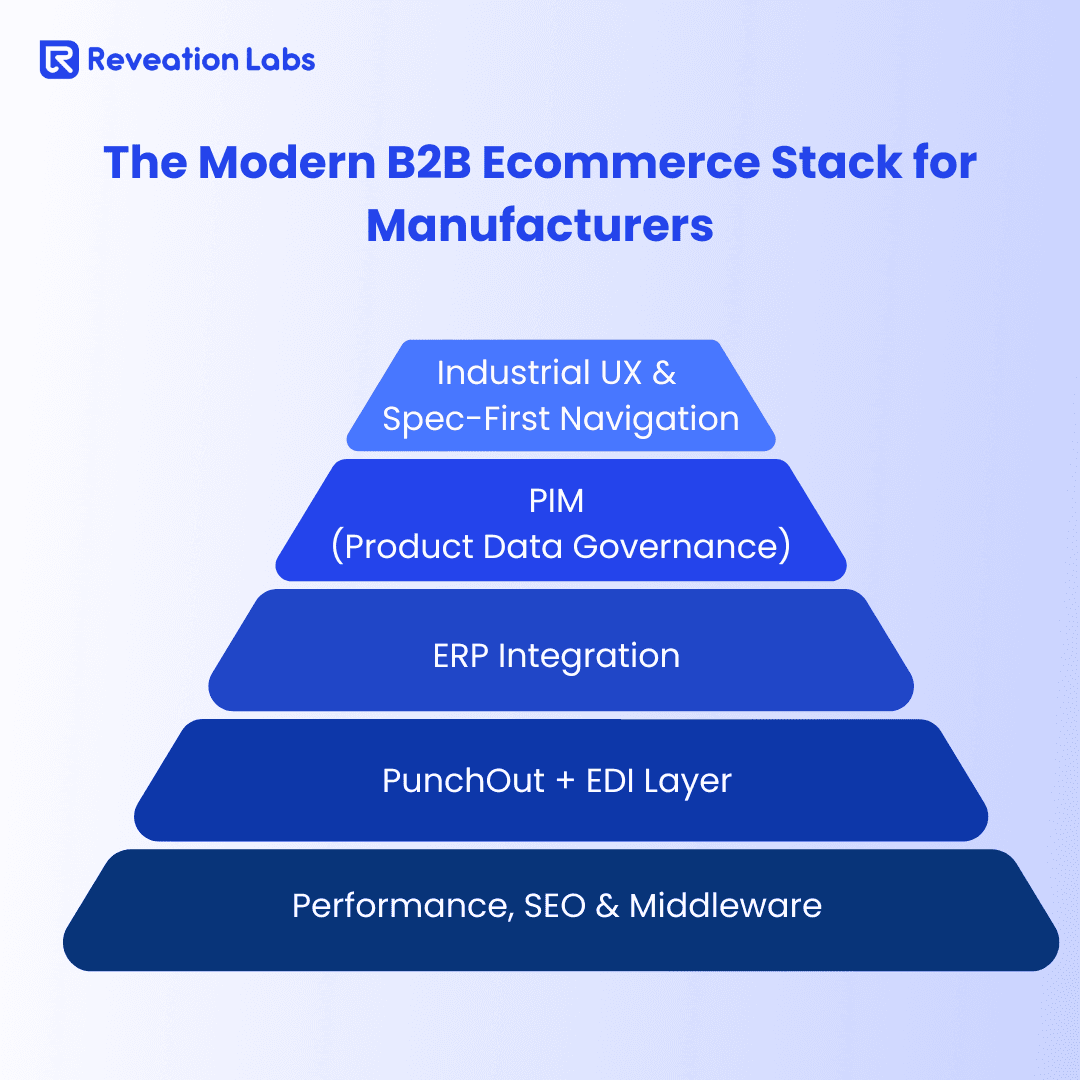
Contract pricing and terms come directly from ERP (the system that manages financials and inventory).
When tax codes, credit limits, and inventory stay aligned, you reduce quoting disputes, prevent checkout surprises, and cut the manual work your teams do to fix orders after submission.
Contract Commerce
How do you make sure every order respects the buyer’s internal policy?
Core workflow components
- Company accounts with role-based permissions
- Requestors build carts and approvers review them
- Accounts payable roles manage payment steps and documentation
- Quote-to-order with net terms, PO numbers, and budget thresholds
The payoff is simple: fewer exceptions, fewer disputes, and less time spent chasing missing information.
PunchOut and EDI Integration
For enterprise buyers, traditional shopping carts are not enough.
Some enterprise buyers order from procurement systems, not supplier storefronts. PunchOut supports this by letting buyers shop your catalog from their procurement tool, then return an approved cart to your system for processing.
B2B ecommerce web development can support PunchOut and related workflows so ordering feels natural for enterprise procurement teams.
EDI (Electronic Data Interchange) can automate order submission, shipping notices, and invoicing for large accounts. This reduces manual handoffs and helps keep high-volume relationships running smoothly.
PIM-Driven Product Data Governance: Centralize Specs and Data
Outdated datasheets and inconsistent specs create expensive mistakes. Buyers pick the wrong item, returns increase, and support teams spend time correcting preventable issues.
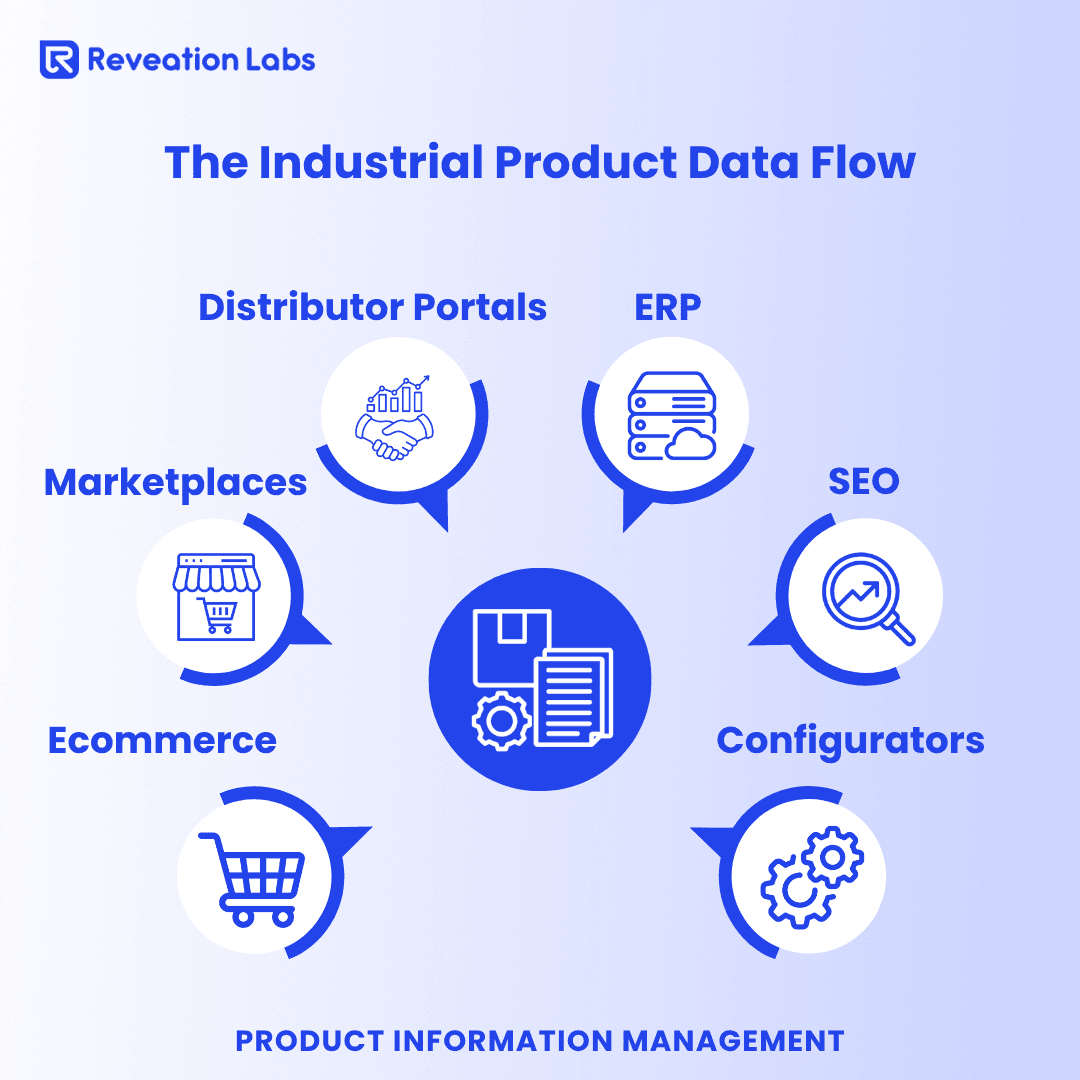
A centralized Product Information Management (PIM) system reduces this by keeping specs, documentation, certifications, and variant logic in one place.
B2B ecommerce web development powered by PIM can push updates to your web store, distributor portals, and marketplaces without relying on manual edits across channels.
Data completeness rules also help keep catalogs consistent and ensure successor SKUs appear when old parts are phased out.
Configurators and BOM-Aware UX: Guided Selling for Complex Products
If your catalog includes configurable items, buyers need guardrails. Without them, carts fill with incompatible options and orders turn into support tickets.
What guided selling enables
- Restrict invalid combinations and reduce mistakes
- Simplify selection for technical products
- Reduce back-and-forth with sales and support
- Validate BOM uploads via CSV earlier in the journey
BOM uploads (via CSV import) streamline assembly purchasing by validating part numbers, flagging alternatives, and surfacing price and lead-time information earlier in the journey.
Comparing B2B Ecommerce Web Development for Complex Catalogs
Replenishment and Contract Buying
Is repeat buying harder than it needs to be for your biggest customers?
What great replenishment looks like
- Quick orders via SKU and quantity grids
- List-based ordering by project or site
- CSV imports for recurring purchases
- Only negotiated catalogs and restricted items visible per account
Buyers should only see negotiated catalogs and restricted items. This supports compliance with contract terms and reduces ordering errors without adding friction.
Getting Found by High-Intent Buyers
How do you win searches from engineers and procurement teams who already know what they need?
Industrial SEO goes beyond keywords by organizing pages around specs and real use cases, such as “food-grade conveyor bearings.” This helps buyers find the exact category that matches their requirements.
Compatibility charts, MRO guides, install tolerances, and failure-mode FAQs also help capture high-intent queries from buyers troubleshooting a real problem and comparing options.
Fast Performance Under Heavy Data and Middleware
Slow storefronts turn research sessions into phone calls. Speed is not just a UX detail. It is a conversion and support issue.
B2B ecommerce web development needs to perform under large datasets, spec-heavy imagery, and middleware connectors. Optimization matters most on search, category browsing, product detail pages, and checkout.
Practical performance improvements
- Efficient image formats (WebP and AVIF)
- Deferred scripts and selective loading
- Caching patterns for ERP reads
- Consistent speed on search, category pages, PDPs, and checkout
Core Web Vitals are a useful performance baseline, but the real goal is consistent speed where buyers spend time.
Sales Ops Alignment and Channel-Safe Rules
Worried about ecommerce creating channel conflict or undercutting partners?
Account scoping, price floors, and geo rules can help respect territories and minimum advertised price (MAP) expectations. The goal is to protect relationships while still enabling self-service ordering where it makes sense.
When sales teams have visibility into saved carts, quotes, and approval workflows, they can step in at the right moment and convert self-service activity into assisted orders without disrupting the buyer experience.
Rollout with Real Risk Controls
How do you launch without turning early customers into QA testers?
Safer rollout moves
- Start with pilots by product line or buyer segment
- Expand once workflows and integrations are stable at real volume
- Freeze SKU schemas during major integration work
- Set clear SLAs for PIM enrichment before launch
- Define fallback strategies like cached prices labeled as last-known values
Architecting the B2B Ecommerce End-to-End
If your business needs spec-first navigation, PIM governance, ERP-aligned pricing, PunchOut and EDI integration, and industrial SEO delivered together, Reveation Labs can support the strategy and implementation.
A strong approach connects catalog structure, data flows, and buying workflows so the storefront matches how engineers and procurement teams actually purchase. It also ensures operations can fulfill what the site promises without constant manual intervention.
If you want guidance across discovery, build, integration, and rollout, align with a partner who can define the operating model, not just ship pages.
Partnering with a skilled B2B eCommerce consulting team helps ensure your catalog, integrations, and backend rules are designed for complexity without overwhelming day-to-day operations.
Conclusion
The difference between generic ecommerce and B2B ecommerce web development shows up in the details buyers care about most: finding the right part fast, trusting specs, and ordering with confidence under procurement rules.
The best implementations connect ERP, PIM, and eProcurement workflows so your storefront becomes a reliable extension of sales and service operations, not a separate system that creates exceptions.
The only question that matters
Is your current storefront making ordering easier, or pushing buyers back to email and phone calls?
If you want to win repeat orders, support engineers, and give sales teams better visibility, a future-ready B2B ecommerce web development strategy is one of the highest-leverage investments you can make.