
If your platform looks fine on paper but falls short in repeat orders, checkout flow, and support volume, the issue is usually fundamental. Data quality, integration reliability, and buying workflows shape buyer trust more than feature lists.
Signals you have a friction problem
- Repeat buyers reorder with help from sales
- Pricing is questioned or inconsistent
- Support tickets spike after checkout
What this blog focuses on
- Reducing buyer friction
- Improving adoption and repeat orders
- Making operations easier over time
Is your B2B eCommerce platform doing “okay” on paper but falling short where it matters most: repeat orders, clean checkout flows, and fewer support tickets?
Even businesses running B2B2C eCommerce and B2C eCommerce models can hit the same wall when buyers struggle to find products, trust pricing, or complete orders without friction.
It is tempting to assume the fix is “a new platform” or “an online marketplace.” Platforms like Virto Commerce, Shopify Plus, nopCommerce, WooCommerce, and Grand Node offer plenty of features.
But conversion issues usually come from the fundamentals: data quality, integration reliability, buying workflows, and the small details that shape buyer trust.
A predictable reason strategies underperform
Teams launch before tax settings are fully validated, ERP connections are stable, or product information is structured consistently in the PIM. The result is familiar: buyers get stuck, sales teams create manual workarounds, and the digital channel becomes harder to scale each quarter.
If this sounds familiar, you do not need more features. You need clearer priorities and a plan that matches how your customers buy. This blog shares 10 practical strategies that help teams reduce friction, improve adoption, and make the platform easier to operate over time.
If you are dealing with outdated workflows, weak customer engagement, or complex integration challenges, B2B eCommerce consulting can help you pinpoint what is actually blocking performance and build a roadmap that delivers results.
10 Strategies For Your B2B eCommerce Platform
1. How Can You Drive More Repeat Business?
New customer acquisition is expensive. Repeat business is where margins usually improve because ordering becomes faster, support needs drop, and relationships deepen. Yet many B2B platforms still make repeat purchasing harder than it should be.
Repeat buyers are the backbone of B2B growth. B2B eCommerce consulting helps teams use account history, saved lists, and role-based experiences so buyers can reorder confidently without recreating work every time.
Modern buyers bring expectations shaped by B2C eCommerce. The goal is not flashy personalization. The goal is relevance and speed: the right products, the right pricing, and a fast path back to checkout.
Practical repeat order improvements
- Saved order lists and reorder from history
- Easy account setup with clear approvals
- Subscriptions for predictable replenishment categories
- Reorder reminders and post-purchase follow-ups
Loyalty programs in B2B are not about points. They work best when they reward outcomes buyers care about, such as faster service, better terms, priority availability, or dedicated support. B2B eCommerce consulting can help design programs that align with how your buyers actually measure value.
Proactive engagement is key. Use post-purchase follow-ups, reorder reminders, and account health check-ins to keep relationships strong and reduce churn risk.
2. How Do You Choose the Right Ecommerce Platform?
Choosing your platform is a major decision because it shapes what is easy, what is expensive, and what is fragile. The right answer depends on your buying workflows, pricing complexity, and integration landscape, not just feature lists.
B2B eCommerce consulting helps evaluate platforms such as Virto Commerce, Shopify Plus, nopCommerce, WooCommerce, and Grand Node. Each can be a fit, but only when it matches your requirements and your operating model.
Start with what must be true on day one
- Stable CMS integration
- Clean payment gateway support
- Tax handling that matches your markets
- Reliable ERP and PIM data management
- Assess your size and complexity: Large distributors often need robust workflows and strict governance. Smaller businesses may benefit from solutions that are easier to operate day to day.
- Integration matters: Make sure your platform communicates reliably with ERP, CRM, and inventory systems, and that failure modes are visible and recoverable.
- Scalability is crucial: Does the platform support multi-region growth or B2B2C eCommerce expansion without duplicating systems and processes?
- Always budget beyond initial fees: Add implementation, customization, maintenance, and the people required to run the platform. The lowest upfront cost can become the highest total cost if change is painful.
3. How Can You Streamline Procurement and Cut Manual Errors?
Manual procurement slows everything down. It creates pricing mistakes, inventory confusion, and extra back and forth for approvals and substitutions. Most teams do not notice how costly this becomes until volume grows.
B2B eCommerce consulting emphasizes ERP integration and automation so buyers see accurate pricing, inventory, and delivery expectations. When data sync is reliable, exceptions drop and customer service can focus on real issues instead of order cleanup.
Implementation steps that reduce errors
- Define system ownership: ERP, commerce, PIM
- Monitor integration paths and alert on failures
- Choose the right integration approach: APIs, middleware, or service bus tools
- Reduce invoicing errors with automation and shared services
Automation also reduces invoicing errors and lost paperwork. B2B eCommerce consulting often recommends shared services and maintenance support to keep integrations stable and continuously improved.
4. What Tools Boost Personalization and Automate Quoting?
B2B personalization is about relevance, not gimmicks. Buyers want the right catalog, the right terms, and fewer clicks to complete a repeatable task. When personalization supports speed and accuracy, it earns trust.
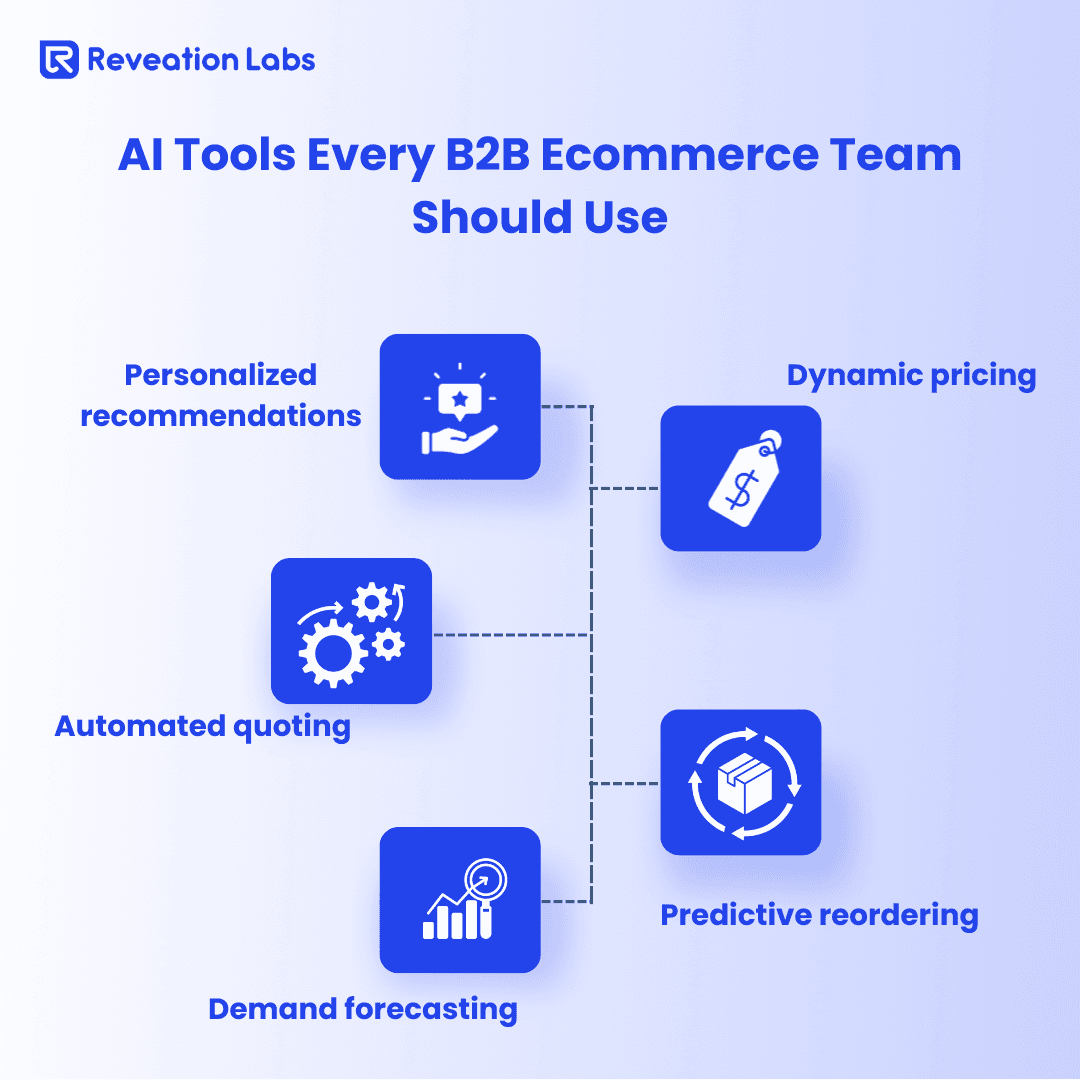
AI and machine learning can help identify buying patterns and surface relevant products, especially in large catalogs. Dynamic merchandising can also highlight best-sellers, contract items, or promotions so buyers see what matters first.
CPQ (Configure Price Quote) platforms can speed up quoting by applying discount rules, contract pricing, and approval logic consistently. B2B eCommerce consulting helps select and connect tools so quoting works across CRM, ERP, and PIM systems without introducing fragile manual steps.
Automating quoting is most valuable when it reduces cycle time and errors. Start with the most common quote types, add guardrails, and expand from there as rules and data mature.
5. How Should You Approach Market Expansion?
Expanding into a new market brings growth opportunities, but it also introduces new failure points. Payment methods, tax requirements, logistics, and support expectations can change quickly across regions.
A phased approach reduces risk
- Start with market research: Validate compliance, taxes, and payment feasibility.
- Confirm ERP, PIM, and fulfillment readiness before storefront changes.
- Launch one or two priority regions, then expand based on results.
- Use local partners for distribution and support when needed.
B2B eCommerce consulting can help plan a phased roll-out, starting with one or two priority regions and building from what works. This reduces risk and prevents a multi-region launch from becoming a multi-region incident.
Leverage local business partners and shared services for distribution and support. Adapt your offering to the category and buying process, since selling financial services is very different from selling healthcare products. Maintenance and workforce scaling help ensure your infrastructure and team capacity keep up.
Digital marketing tactics should also be localized. SEO, paid campaigns, and content need to reflect how buyers in each region search, evaluate, and purchase.
6. How Do You Localize and Manage Multi-Region Ecommerce?
Localization is more than translation. It includes language, currency, local payment options, and region-specific policies that buyers understand and trust. It also includes operational readiness so fulfillment and support match the promise your storefront makes.
Localization checklist
- Payment gateway integrations that support local methods
- Tax compliance validated with real ordering scenarios
- Region-specific policies, messaging, and content
- Consistent inventory signals and product descriptions across regions
A smart CMS helps manage region-specific content, policies, and messaging. ERP and PIM integrations keep inventory signals and product descriptions consistent across regions.
Don’t forget logistics: Use reliable local carriers and communicate shipping costs and timelines clearly. Maintenance teams and shared services can help manage compliance, support, and operational coordination across markets.
7. What Digital Marketing Tactics Deliver Real B2B Results?
B2B eCommerce consulting often recommends account-based marketing, paid acquisition, and content that supports how buyers evaluate risk. Tactics like PPC ads, SEO, and active social media marketing can work well when they are tied to specific segments and buyer roles.
LinkedIn is often used to reach decision-makers, but results depend on targeting, message-market fit, and consistent follow-up. Use performance analytics to track what drives qualified conversations, then refine campaigns instead of simply increasing spend.
Content marketing, such as webinars, guides, and case studies, can educate buyers and reduce perceived risk. The key is to show proof, simplify evaluation, and answer real objections buyers raise during procurement.
Reputation management matters as well. Clear responses to feedback, consistent brand presence, and strong customer stories can increase trust and reduce friction during decision-making.
8. How Can You Overcome Integration and Technical Challenges?
Integration is tough, especially when ERP, CMS, payment gateway, and PIM systems must stay aligned. Most buyer-facing issues, like incorrect pricing or unavailable items, can be traced back to integration gaps and data inconsistencies.
Common challenges include slow API response times, misaligned data fields, and missing real-time updates. B2B eCommerce consulting often recommends staging the work. Start with reliable catalog and account data, then expand into pricing rules, inventory syncs, and quoting workflows once the foundation is stable.
Testing requirement
Before going live, test using realistic ordering scenarios that include account pricing, approvals, and edge cases. Maintenance teams should monitor integrations regularly so failures are detected quickly rather than discovered by customers.
Shared services provide additional support when issues arise. Keeping documentation current and training teams reduces downtime and helps prevent repeat incidents.
Sometimes dedicated tools like middleware or enterprise service bus solutions are needed for older systems that are not flexible. The goal is not complexity. The goal is reliability and predictable change.
Do not ignore customer experience. When integration is clean, buyers get smoother checkouts, accurate availability, and fewer surprises after checkout.
9. What Role Does Data and Analytics Play in Fixing Your Strategy?
Data and analytics help you identify what is truly breaking the buying journey. Strong analytics can show where buyers drop out, what products are hard to find, and which workflows generate the most support tickets. This turns subjective opinions into a prioritized backlog.
Metrics worth tracking
- Conversion rate and cart abandonment
- Average order value and repeat order rate
- Traffic sources and search behavior
- Support tickets per order and exception rate
Track metrics that match your business goals and segment by new versus returning customers, product categories, region, and device so you do not treat every buyer the same.
Heatmaps and session recordings can reveal friction that standard dashboards miss. Search analytics can also highlight gaps in catalog structure, naming conventions, and filters.
Continuous analysis supports steady improvements. A/B testing can be useful for major changes, but prioritize tests that reduce time-to-order and exception handling, not just cosmetic updates.
External benchmarking can help provide context, but it should not override your customer reality. Use benchmarks to ask better questions, then validate changes against your own buyers.
Analytic dashboards work best when they reflect operational signals, not just web events. When ERP and PIM integrations feed accurate data, you can spot issues early and respond quickly. Reliable feedback loops prevent small problems from becoming recurring incidents.
10. What Are Quick Wins to Improve Your B2B Ecommerce Now?
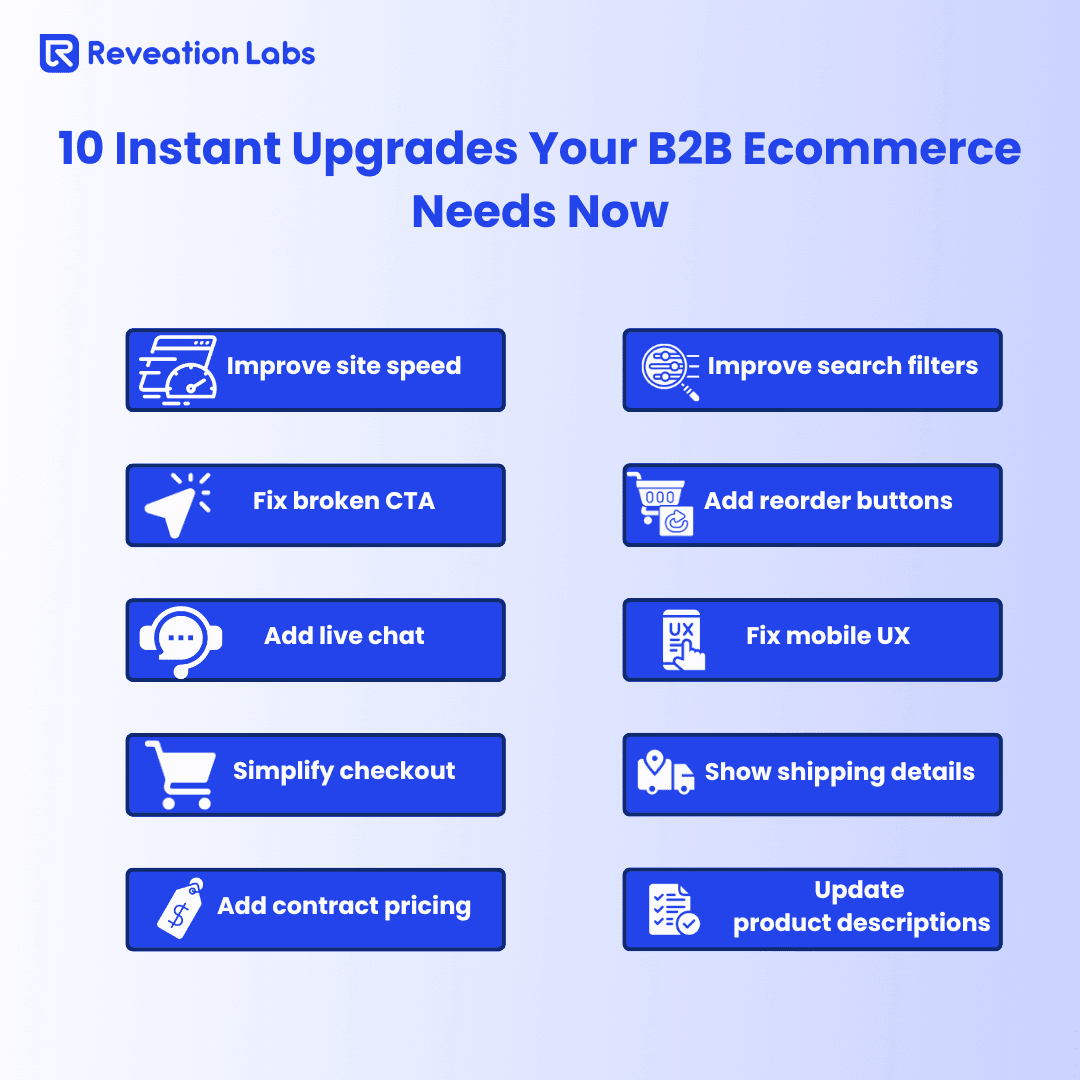
Quick wins matter when they remove friction and reduce manual work. Start by simplifying checkout with clearer forms, predictable payment steps, and fewer avoidable hurdles for buyers. When the buying path is smooth, conversion improves and support load drops.
Quick wins checklist
- Improve speed: Optimize catalog browsing, account pricing views, and checkout. Compress images, reduce unused scripts, and use CDNs where appropriate.
- Show all costs early: Clarify tax and shipping logic early in the journey to prevent late-stage abandonment.
- Enable quick reorder: Reorder from history, saved lists, or CSV uploads for bulk purchasing.
- Upgrade search and filtering: Add autocomplete and strong filters, then use analytics to fix searches that do not convert.
- Create feedback loops: Collect buyer feedback and prioritize fixes that remove recurring friction.
Use performance analytics to identify searches that do not convert, then fix catalog structure and content accordingly.
Conclusion
Your B2B eCommerce strategy can achieve more when you focus on the fundamentals: buyer workflows, reliable integrations, clean product data, and an operating model that supports continuous improvement.
These ten areas become even more effective when combined with tech stack advisory, maintenance, and shared services.
Use solutions that match your requirements and your complexity. That can include platforms like Virto Commerce, Shopify Plus, nopCommerce, WooCommerce, and Grand Node, plus the right building blocks for ERP, PIM, payment gateway, and CMS. Then reinforce adoption with performance analytics, SEO, paid acquisition, and consistent social presence.
Let Reveation Labs support your next step. Our team helps align strategy, integrations, and execution so your platform becomes a reliable channel for growth and long-term customer relationships.