
You might think “Shopify? Isn’t that for T-shirts and sneakers?” But that’s a myth. In reality, traditional manufacturers and distributors are quietly adopting Shopify for their wholesale **digital commerce** business.
Even a premium brand like Brooklinen says Shopify’s B2B tools transformed its “manual and time-consuming” wholesale process.
In fact, Shopify, as a B2B eCommerce solution, has matured into a platform capable of handling complex pricing and ordering needs.
We will show exactly how Shopify Plus can be customized for B2B – from tiered price lists to custom portals, and why it’s worth a second look.
Why Shopify is Quietly Powering Modern B2B eCommerce Solutions
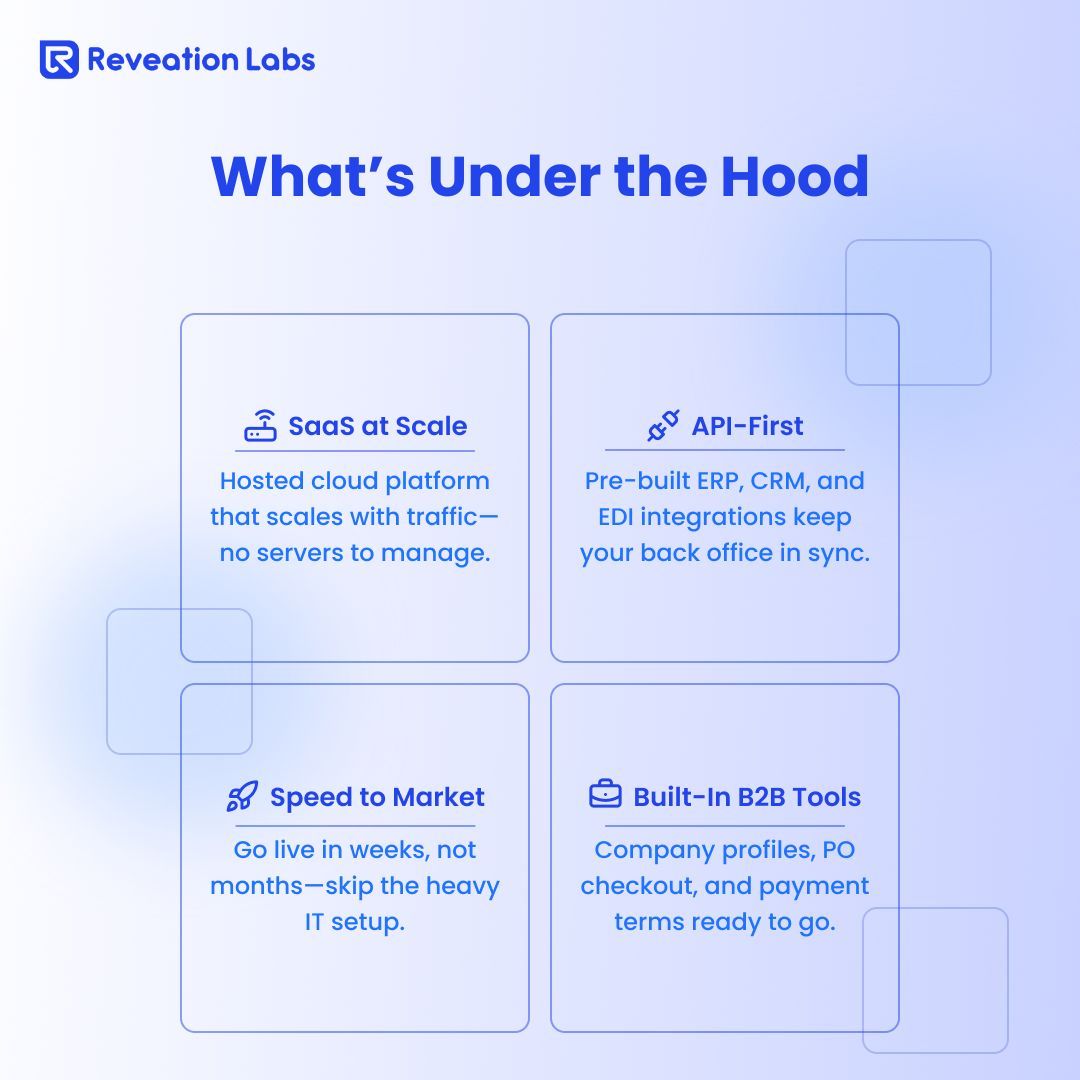
- Built for scale: Shopify Plus is a cloud (SaaS) platform built to handle enterprise traffic and catalogs. You don’t need to manage servers – Shopify’s infrastructure automatically scales for spikes in orders or traffic. This means high reliability and fast load times even during big sales or trade shows.
- API & integration friendly: Shopify Plus is API-first, so it plugs into any ERP, CRM, PIM, or EDI system. For example, it has pre-built connectors for popular ERPs (Microsoft Dynamics 365, Acumatica, etc.). You can also integrate EDI (X12) flows so purchase orders, invoices, and shipping notices sync automatically. In short, your back office stays in sync without manual data entry.
- Speed and simplicity: Because Shopify is hosted and maintained for you, getting a new B2B site live is often much faster than on legacy systems. Many companies deploy a Shopify wholesale **online store** in weeks, not months, far quicker than coding a custom platform.
- Mature B2B features: Shopify now offers built-in wholesale features that once required expensive plugins. The Shopify Plus B2B eCommerce solution includes robust **account management** features such as company (buyer) profiles, custom catalogs, payment terms, PO checkouts, and more. Shopify even describes its platform as an “all-new B2B ecommerce solution” that fits both growing retail wholesalers and pure B2B enterprises.
Taken together, these factors mean Shopify Plus is worth reevaluating for B2B. It isn’t just for consumer brands anymore – it now quietly powers serious business-to-business operations.
What’s Actually Possible on Shopify for B2B eCommerce Solutions
Here are some things you probably didn’t know the Shopify for B2B eCommerce solution could do:
1. Account-Specific Pricing & Catalogs
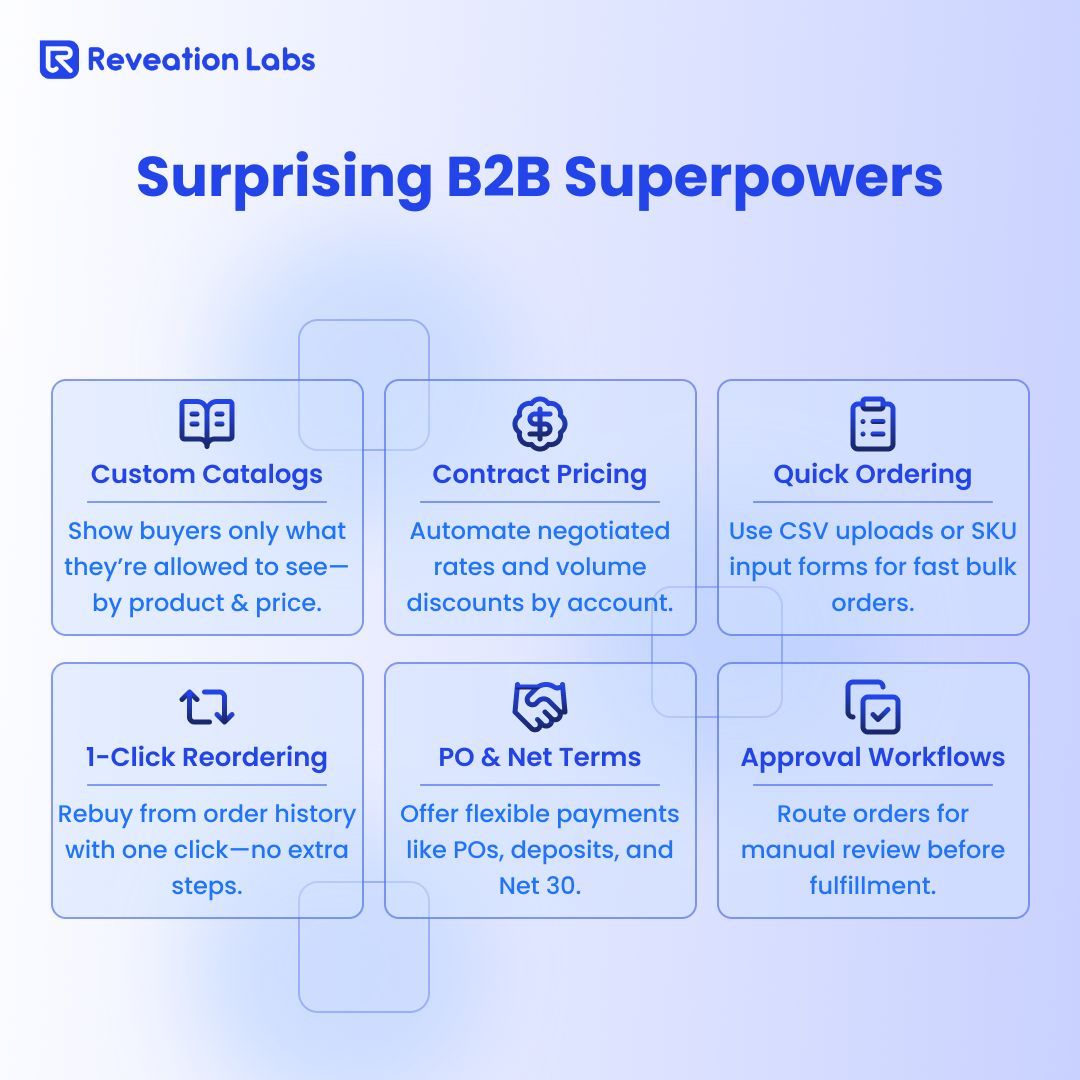
- Segmented catalogs: You can assign **custom pricing** and product catalogs to each customer or segment. In Shopify Plus, each business buyer logs in and only sees the products and prices you’ve assigned them. You simply create a “company” or customer group and tie a catalog to it. That hides other products and shows only the relevant assortment.
- Tiered and contract pricing: Use volume pricing and contract price lists to automate discounts. For example, one retailer set up Shopify so a preferred wholesaler automatically saw a 20% discount catalog (turning a $10 product into $8).
2. Quick & Repeat Ordering Tools
- Bulk ordering: On a Shopify Plus B2B store, buyers can generate whole orders from a CSV or quick-order form. You can install or build a fast-order app that lets customers copy/paste SKU lists or upload an Excel/CSV file of items and quantities. The app immediately builds their cart with those products and quantities. This is a huge time-saver compared to clicking hundreds of products one by one.
- Saved carts and lists: B2B buyers often build complex orders in stages. Shopify apps enable them to save and even share multiple carts. For example, the PluralCart app lets B2B customers “create separate carts for different orders, edit them anytime, and share them with others,”. This means different teams or locations can work on their own draft carts and reorder them later, or your **sales reps** can prepare a “starter cart” and hand it off to a customer.
- Quick reorders: Because each buyer has an account, customers can quickly reorder from their past purchases with one click. Between saved carts and account order history, repeat ordering is essentially instantaneous – a big improvement for businesses ordering the same SKUs regularly.
3. Custom Checkout Workflows for B2B Buyers
- Purchase orders and net terms: Shopify Plus lets you offer payment methods suited to B2B. You can accept purchase orders as a manual payment method and set net payment terms (Net 30/60, etc.) per customer. Partial payments and deposits are supported too. For example, you could require a 50% deposit now and the rest on net terms later, all managed per customer.
- Approval and invoicing: You can route certain orders for manual approval before fulfillment. B2B checkout can create draft orders that staff review or invoice. Shopify also supports sending invoices from draft orders, so you never lose sales just because a buyer isn’t using a credit card.
- Check out custom logic: Shopify Functions and checkout extensions let you tailor the checkout flow for different buyers using **custom data**. For instance, you might show special payment options or shipping rules to one company but not another. You could require an approver’s login on purchase orders, or hide certain checkout steps entirely for **B2B businesses**. In short, the entire checkout experience can be customized by buyer group or account.
4. Integration-Friendly Infrastructure
- ERP/CRM/PIM connections: The Shopify Plus B2B eCommerce solution is built to fit into your existing tech stack. It connects with any ERP, OMS, or PIM via APIs or middleware. Shopify has out-of-the-box integrations for some big systems (Acumatica, Microsoft Dynamics, etc.), and the API can also sync NetSuite, SAP, Oracle, or any system you use.
- Headless and custom storefronts: Shopify Plus is fully headless-capable. Using the Storefront API or Shopify’s Hydrogen framework, you can build completely custom front ends and buyer portals while still using Shopify’s backend.
In short, Shopify Plus can match almost any feature a traditional B2B platform offers. You simply configure the wholesale-specific features and integrations you need.
Scaling B2B Growth with Customization
Leverage data and automation: Shopify Plus isn’t just a static order-taker – it has tools to help your **sales team** grow. For example, you can analyze past orders to personalize each account’s experience (recommend products, suggest reorder reminders, or bulk discounts on frequently bought items). Shopify Flow (included with Plus) lets you automate many B2B tasks.
- Customer self-service portals: You can build fully branded buyer portals on Shopify Plus. Each customer logs into their account to see past orders, invoices, and personalized product recommendations. Using Shopify’s API or a custom front end, you can let buyers reorder from history, download order documents, or even upload POs (all within your store).
Through our B2B eCommerce Consulting services, we guide companies in building tailored Shopify solutions that drive efficiency and long-term success.”
B2B Marketplace Capability (Yes, That’s Possible Too)
Multi-vendor marketplace: Surprisingly, Shopify Plus can even run a full marketplace. Using a marketplace app, you can allow multiple sellers (vendors) to add products, while you manage the site. Each vendor gets its own dashboard to manage inventory and orders, and you can configure commissions on each sale.
For example, the Webkul MultiVendor app lets you “set global, seller-wise…commissions” and provides each seller with a profile.
Shopify’s blog explains: in a multi-vendor model, “each vendor can manage their stores,” and then when a sale happens, “the vendor gets paid, minus the fee or percentage of the sale that the marketplace collects” In other words, you can take a cut (commission) on every order behind the scenes.
On the buyer side, you simply see one unified store – the app or headless front end aggregates products from all sellers. You can also gate catalog sections or products by login (using Shopify’s company profiles) so that different customer groups see only the products they should. In practice, that means your Shopify Plus B2B eCommerce solution can host reseller-only catalogs and multiple sellers at once, all under one roof.
Common Concerns And the Reality
- “Shopify Plus can’t handle our complexity” – You’d be surprised. Shopify Plus is enterprise-grade, and B2B merchants report being pleasantly surprised by the steady stream of wholesale features it’s getting. One customer (Filtrous) says the updates are “highly tailored to the needs of B2B merchants,”.
- “What about our ERP and back office?” – Pre-built connectors and APIs have you covered. Shopify partners with leading ERP platforms and provides robust APIs to sync orders, inventory, and customers. In practice, you can integrate systems like NetSuite, SAP, or Microsoft Dynamics without missing a beat.
- “We need a fully branded buyer portal.” – You can build that with Shopify Plus. Using Shopify’s customer accounts, theme customizations, or headless front end, you can create a portal that matches your brand exactly. Shopify’s extensibility (Functions, checkout scripts, etc.) means every page – even the checkout
For every worry, the new reality is that Shopify Plus B2B capabilities keep catching up. With a little customization (or a trusted partner), it can meet even nuanced B2B use cases.
Conclusion
Shopify Plus has quietly grown into a serious B2B platform. Its Shopify Plus B2B eCommerce solution now supports everything from bespoke pricing and checkout terms to headless integrations and full marketplace models. If you’ve been dismissing Shopify as “just for D2C,” it’s time to take a second look at what it can do for B2B. Shopify Plus B2B eCommerce solution is included with your Plus plan at no extra cost and can be tailored to virtually any wholesale need.
Scale your wholesale business with ease! As a leading Shopify Plus Development Company, we show you how to customize Shopify for a powerful B2B eCommerce solution that drives growth and efficiency.