
The way B2B buyers purchase has completely changed.
They research on their own, expect instant answers, and want the same smooth experience they get when shopping as consumers. At the same time, most manufacturers and distributors are still wrestling with complex pricing, legacy ERPs, manual workflows, and B2B portals nobody wants to use.
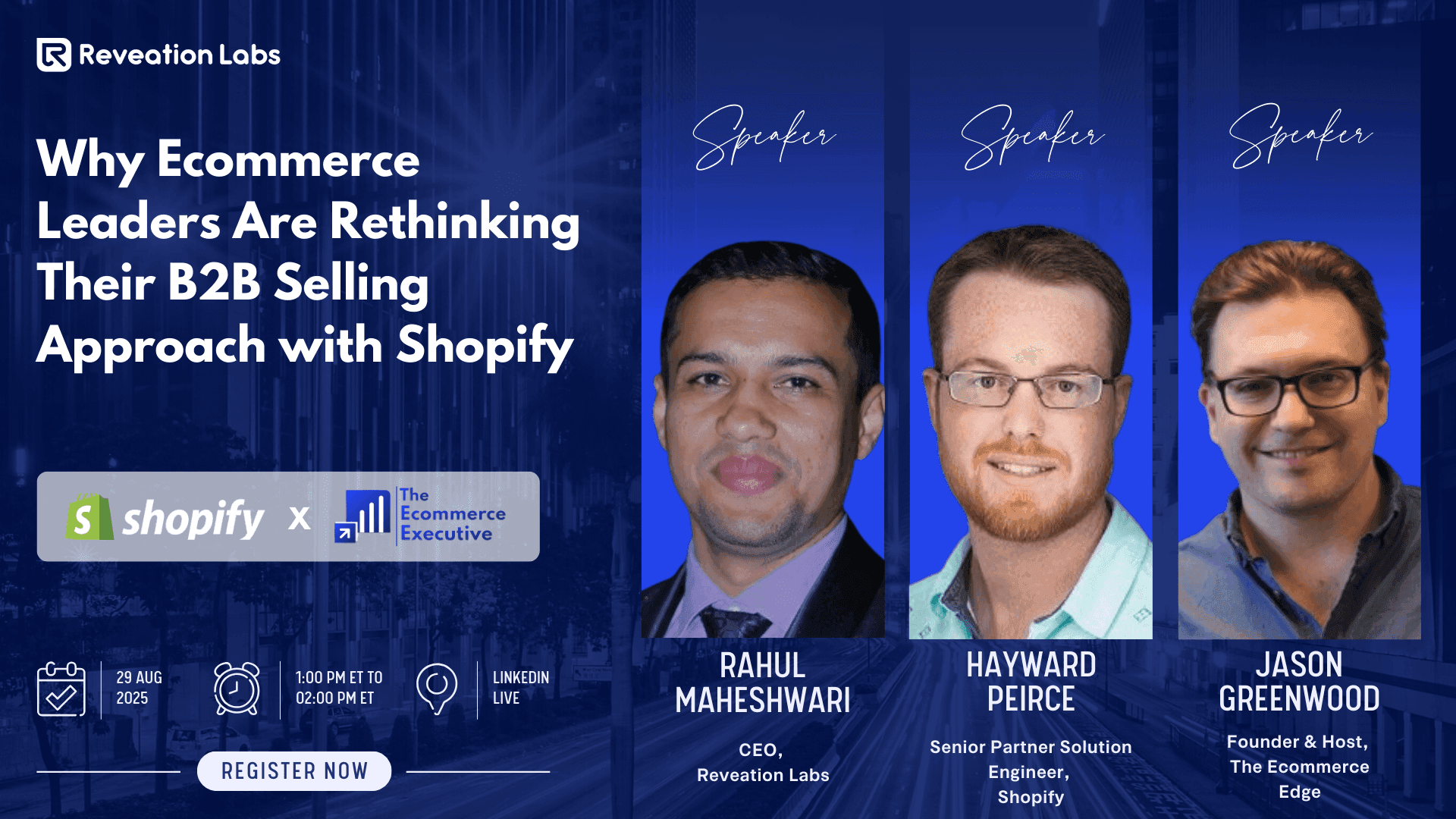
This webinar brings together three perspectives on how to fix that with Shopify:
Rahul Maheswari, CEO, Reveation Labs
Jason Greenwood, Founder, Greenwood Consulting & Host of THE ECOMMERCE EDGE Podcast
Hayward Peirce, Solutions Engineer at Shopify
Together, they break down:
Why 80%+ of B2B sales now touch digital channels
What modern B2B buyers expect from a self-serve portal
How to handle contracts, pricing, terms, credit, and complex checkout on Shopify
How to reduce manual “swivel chair” work with automation and integrations
When legacy platforms are holding a business back (and what to do about it)
How Shopify’s B2B features, APIs, and ecosystem support serious manufacturers and distributors
Below, you can:
Watch the full webinar recording
Read the complete transcript, lightly cleaned for filler words while keeping the original language and flow
If you're wondering whether Shopify can really handle “real B2B” with contracts, net terms, and ERP complexity, this session will give a clear, practical view from people who live in this space every day.
FULL WEBINAR TRANSCRIPT
RAHUL MAHESWARI:
I'm Rahul Maheshwari, Founder, CEO of Revolution Labs. My passion lies in helping established B2B enterprises navigate the complexity of digital transformation that includes the e-commerce solutions that drive growth and create a seamless user experience.
Having seen firsthand how technology can unlock incredible potential, I'm excited to host this crucial conversation today and explore the strategies that are defining the future of B2B. Finally, we have Jason Greenwood. Jason is the founder of Greenwood Consulting and I'll have him introduce himself.
JASON GREENWOOD:
Thanks so much Rahul and Hayward for being along for this webinar today. It's great to be here with you and great to be here with the audience. My name is Jason Greenwood. I've been working in the e-commerce space for over 25 years. I have run and built agencies, have worked inside brands, and for the last 5 years, I've run my own independent B2B e-commerce consultancy where we work with manufacturers and distributors to basically help them through the entire process of digital transformation.
And I also work very closely with the B2B e-commerce association. I was lucky enough to MC their B2B e-commerce world event last week in Melbourne, Australia for the APAC region. So I'm just fresh back from that entire event. And so I definitely am right at the forefront of hearing what is happening in the industry from practitioners in the space. I'm looking forward to sharing that information with you today.
RAHUL MAHESWARI:
Thank you, Jason. All right. Before we do deep dive into the webinar topic, let's quickly talk about Shopify, right?
When many people hear the name Shopify they think it's a powerhouse that transformed B2C e-commerce, making it possible for brands of all sizes, from mom-and-pop shops to large enterprises, to sell directly to consumers in a very short amount of time.
But what many leaders are now discovering is that Shopify has brought the same philosophy of simplicity, power, and scalability to the far more complex world of B2B. And that's what we're going to be talking about as we talk about how the B2B landscape is shifting and changing.
I'll just have Haward give a quick introduction about B2B on Shopify.
HAYWARD PEIRCE:
Yeah, absolutely. I think as you said, Rahul, if you haven't looked at Shopify through a B2B lens in the last few years, you may have blinked and missed the launch of a number of major releases around B2B.
This is really just a very short highlight of some of those key pieces. B2B is built into Shopify from the ground up and all the native primitives are there to support B2B on Shopify.
Everything from supporting company profiles and the locations that their buyers are purchasing from, supporting custom price lists for customized product and pricing availability, payment terms are supported, as well as vaulting credit cards so that those B2B buyers have a card on file.
And of course, importantly from the Shopify perspective as a API-first SaaS platform, there are APIs to interact with all these objects, as well as making it easy for buyers to manage past orders and things like that. So there are a lot of capabilities when it comes to native B2B features on Shopify.
RAHUL MAHESWARI:
Thank you, Howard, for walking us through the exciting B2B features on Shopify.
Now as we deep dive into the pain points, let's set the stage. The B2B buying landscape has fundamentally shifted, and as Jason would agree with me, a massive 80% of B2B sales interactions are now happening on digital channels as per Gartner.
Buyers are behaving more like consumers. They are self-educating using over 10 different channels for research. Frankly, they expect a seamless, representative-free experience just like they have in their personal shopping.
This isn't a future trend. It's reality today. This shift is forcing leaders to invest in a digital-first approach to stay relevant and capture growth.
And if your business is not ready, this is the time. The world has changed. You have to change with your buyers. We have heard many times that Gen Z is coming into the corporate world and they are used to TikTok. They want simplicity, seamless experience. So you have to be ready for that.
That's what we're going to be discussing as we go into some of the pain points that B2B organizations face when they want to either jump into B2B online selling or modernize their infrastructure.
So let's get into our first major pain point: the struggle to deliver a modern customer experience.
In a B2C world. Everything is a fast online experience. B2B buyers are the same people.
What a lot of companies fail to comprehend is that in the B2B world, managing complex pricing contracts is core to B2B operations. We’re talking about customer-specific price lists, volume-based discounts, negotiated terms, things that a typical B2C platform just can't handle out of the box.
So I'm going to ask Jason from his perspective, where do legacy B2B platforms most often fail when it comes to the user experience and core B2B features?
JASON GREENWOOD :
Yeah, maybe Rahul, if you don't mind going back just one slide. There are three points I'd like to bring up in relation to B2B selling trends in 2025 that I think are worth pointing out here.
First of all, on the top left-hand side there you see 80% of B2B sales are taking place on digital channels today as per Gartner. What is also often not talked about is that this includes all B2B digital channels.
In B2B we don't just have self-service e-commerce. We have two other major digital channels that are exceptionally common in the B2B world: EDI and Punchout or e-procurement integration.
So that's actually a misleading stat because, depending on the vertical and the market, only about 40 to 60% of B2B manufacturers and distributors today offer self-service e-commerce at all, meaning a self-service e-commerce portal experience.
Oftentimes B2Bs will consider their EDI and Punchout channels and say, “Hey, we can wash our hands of the digital experience requirements because we offer that. We offer B2B buying through these automated procurement systems.”
The problem is that 71% of B2B buyers today, as per Forrester at the end of 2024, are now millennials and Gen Z. So they expect to be able to self-serve even beyond the transaction.
They still want to have a portal where they can log in and place quote requests. They still want to have a portal where they can log in and check inventory. They still want to have a portal where they can log in and check pricing, where they can check ranges that are available to them, checks on buying increments, and lodge RMA requests and track orders from the time it leaves the supplier's warehouse to the time it's receipted into their warehouse, so they can have their receiving teams ready to go to receive those orders.
So I think this data is somewhat misleading because many manufacturers and distributors today still do not offer a self-service, portalized experience beyond the transaction.
That's the first thing.
Second thing is we have a situation now where automated buying is starting to make its way into the e-procurement space. Agentic procurement is starting to be delivered via the major e-procurement vendors and therefore, if we don't have a portalized experience that is agentically enabled, we're going to have a real problem serving these agentic buyers in the future.
We need to get the commerce foundations correct in our businesses today to serve the modern generation of buyers today, but also the agentic buyers of tomorrow. I think that's a really important thing to point out.
Finally, we also need to be enabling our own sales teams. E-commerce is not about replacing sales teams. Sales teams are always going to be there in the B2B world.
However, what we do see is that somewhere between 20 and 60% of a sales rep's time today, for businesses that track sales rep time by activity, is spent on pure admin functions no value add to the business and no value add to the customer.
They go out into the field, they take an order from a customer, they come back to the office, they key it into an ERP system that's not designed for user-friendly commerce.
So there's a lot of change in the industry right now, not only around expectations, but around internal enablement to allow teams to serve customers faster and more efficiently with that digital services layer beyond the transaction. I think that's worth pointing out.
RAHUL MAHESWARI:
Thank you, Jason, for the insight. I think we have to get back to Gartner to fix their statistics. It seems like we cannot rely on them anymore. But that's why we have you here.
Now let's hear what Howard has to say about how Shopify is tackling some of the challenges to address these B2B buyer expectations and the core features that are essential to their business operations.
HAYWARD PEIRCE:
Yeah, absolutely. I think, to continue on some of the talking points we looked at earlier in terms of those foundational pieces, simply having the self-serve nature which I'll dive into more in a second and the flexibility to have things like price rules and customer-specific catalogues and company profiles on Shopify takes our very self-serve-oriented D2C experience and applies that in a B2B context.
If we move on to the next slide, this slide has a lot of content on self-serve purchasing and I think that speaks to what Jason was saying in terms of providing that portalized experience for these younger buyers who are used to that in a D2C environment and are looking to have that replicated when they're buying for B2B.
Shopify provides that capability by applying a lot of those D2C principles to our B2B offering, both in terms of easy reordering, making it a simplified process in checkout, having that customer account section where you can manage things, where merchants can plug in additional capabilities, as well as being able to provide an easy purchasing process on the website for things like quick order lists and the ability to go through that more traditional B2C buying experience but in a B2B environment. That is a huge win and something a lot of these younger buyers are looking for.
If we go on to the next piece, taking that a step further, there's also a lot of importance in making sure that buying experience is customizable tailoring that storefront to the buyer in question so that they're seeing the correct products that are available to them as a buyer.
Maybe there's a certain subset of the overall store's products that are only available to buyers in a specific company. The contextual pricing that relates to those buyers maybe they've negotiated specific rates needs to be available again through this self-serve experience, and then applying things like volume pricing throughout all of this.
So taking these B2B table stakes and applying them to this self-serve experience is really where Shopify has been looking at B2B.
Then you extend things to the actual design of the storefront and being able to be buyer-aware and add additional contextualization to that browsing experience as needed, plus all of the existing infrastructure and scale pieces which we'll touch on in a further section.
RAHUL MAHESWARI:
Thank you, Howard. I’ve just been informed that the viewers are not able to see our slides. So I'm going to quickly switch the presentation mode so they can see our slides.
I think this should be good now. All right. Excellent.
Let's move to our next challenge, which is friction in the checkout and payment process. B2B isn't just about credit cards. It's about purchase orders, net terms, approval workflows, shipping requirements. There are a ton of things that need to be handled at checkout.
So Jason, I have to ask you, what are the biggest pain points of friction you see companies struggle with when they try to digitize their B2B payment and ordering process?
JASON GREENWOOD:
Yeah, look, I think automating trade credit is critical. Still to this day, the vast majority something like on the order of 80-plus percent of B2B payments are still on account.
So the reality is, having a tokenized credit card, while that's fine and good, the vast majority of businesses aren't buying on a credit card. They're buying on account, they're buying on invoice, they've got 30-day, 60-day, 90-day payment terms.
So we need to make sure that those terms are exposed at checkout, that they can see the status of their credit account: how much credit balance they have left available, being able to actually make payments from checkout against that statement balance.
There are lots of areas where being able to extend trade credit from, say, Allianz and other trade credit providers at the point of checkout, being able to introduce B2B-specific buy-now-pay-later terms to the customer in checkout, and being able to offer all these B2B-specific payment methods are really important in the B2B world.
Then being able to extend messaging into the checkout when a client or a customer is on credit stop for whatever reason because they've hit their credit ceiling messaging that they'll need to contact their account manager to deal with that, address it, and re-release their credit account.
Then having fallback payment methods and fallback rules so that we don't block the purchase. We don't want to say, "Well, look, you're past your credit limit, so you simply can't create this purchase until you resolve that."
Instead, let's put a fallback method in place: "If you want to pay with your business credit card right here, right now, even though you've exceeded your credit limit or you're on credit stop with us, you can do that." Or, "We have third-party trade credit available for you to effectively apply for in real time at checkout."
I think providing optionality in terms of payment methods and fallback payment methods, and then being able to segment payment methods and customers by payment method, is critical.
For example, for our high-risk customers or maybe our brand-new customers, for the first 3 months of doing business with us, we may only want them to pay via business credit card. Then once they have a trading track record with us and we know what kind of volumes they're going to be doing, we know what kind of trade credit we need to apply to their account.
We’ve been able to do some background credit checking in the meantime and now we can give them a trade credit balance of 20 grand a month, or 50 grand a month, or 100 grand a month, which will cover their needs that they've established over the first quarter of trading with us.
These types of considerations are where B2B starts to get really complex. And also when we think about the ordering workflows, things get super complex when you have backorders, split orders, split shipments.
How do we want to handle that? Do we want to give the customer the option of waiting until all items come back into stock before we ship, or do we want to give them the option of defining, “Ship what you have in stock, then ship what's backordered as soon as you have it back into stock”?
We can give them a default warehouse that is assigned to them that is closest to them, and then backup warehouse locations or backup inventory locations for them to ship from. Then we need to understand what that does to the shipping cost as a result.
Oftentimes in the B2B world, the final thing we see is shipping on the customer's carrier account: them being able to put in their carrier account number and select the carrier at checkout so that instead of paying the supplier for shipping, say for an LTL shipment, it goes directly on their carrier account and then you just arrange collection by their preferred carrier.
There are many things to think about that are quite unique in the B2B world, but ultimately what we're talking about here is flexibility, optionality, and really making sure that we're meeting all of those unique business use cases that we have in the B2B world that are just so common.
RAHUL MAHESWARI:
Jason, those are all great points. Without that, you just cannot have B2B ordering or online selling. That shows the level of complexity that the platform whatever platform you pick has to be able to support.
It needs the ability to handle that complexity, the ability to customize it, the ability to extend it to suit your unique requirements and needs.
So, Howard, how does Shopify Plus streamline this? Can you talk about the capabilities around all the different scenarios that Jason just talked about, and give us some more insight into that?
HAYWARD PEIRCE:
Yeah, absolutely. I think what it really comes back to is, from an underlying technology perspective, Shopify has pulled together a number of pieces, and the three highlighted on this slide are what build up a lot of those capabilities.
Shopify Functions are a capability to build additional back-end logic within the Shopify checkout. This powers a lot of the customizable business logic related to things like Jason was talking about: additional validation at checkout, checking that a buyer has approval to do an action, and so on.
There are a lot of capabilities available through Shopify Functions, both in terms of checkout validation, hiding payment methods, hiding shipping methods depending on the buyer. All of that conditional logic is powered through Shopify Functions.
Additionally, our Checkout UI Extensions capability pairs really well with that in that it provides the front-end interface for buyers to interact with. So whether it’s a banner along the top saying, "Hey, you've reached your credit limit, you should contact your account manager," or letting them know about some specific state of the checkout, there's also the ability to add additional form fields, checkboxes, collect additional information, and add customizable UI pieces into the checkout where needed.
This can be used for them to select, for example, that they want to use their carrier account this time or change it and use something else next time. There's a lot of flexibility there in terms of either collecting additional information in checkout or allowing them to interact and make choices as part of that checkout.
All of that comes together with our custom data platform. We have concepts called metafields and metaobjects. These allow you to store structured data in Shopify related to a company, a buyer, products there's a wide range of capabilities this provides merchants in terms of what they can build out.
This can help solve for things like adding in additional information that these Functions and UI Extensions have an awareness of and use to inform conditional decisions and what’s surfaced in the checkout for the buyer.
Together, these three pieces really come together and provide the ability for merchants to build very bespoke checkouts where that experience is tailored specifically to each buyer within each company going through their checkout.
And that builds on top of a wide range of built-in features. You can extend the checkout as needed where there are specific use cases or industry-specific ways a merchant might need to solve something. But there’s also a wide range of built-in capabilities within our checkout, whether it be for collecting and calculating taxes or support for multiple currencies.
There’s a whole range of capabilities within Shopify checkout. A lot of these come from our D2C space. For anyone familiar with the D2C Shopify checkout experience, the B2B experience inherits almost all of those capabilities in terms of built-in power, including responsive checkout across mobile and desktop, built from the ground up to support both.
These younger buyers will be able to place those B2B orders whether they're on their phone or on their work computer at their desk.
RAHUL MAHESWARI:
Great. I'm glad to hear Shopify is tackling some of these unique requirements of B2B, either with out-of-the-box options or the ability to customize and extend the platform to support unique requirements. That’s all great insight.
Now that brings us to a pain point that feels more internal: the reliance on manual processes. This is all about the swivel-chair work that happens behind the scenes tagging customers, reviewing orders, notifying sales, notifying your fulfillment team, and so on. A lot of things happen once the order comes in.
Jason, in your experience, what's the hidden cost of manual repetitive tasks for a B2B organization?
JASON GREENWOOD:
Yeah. The key here is that at a high level in almost all B2B businesses, the ERP is the beating heart of the business. The ERP combined with the CRM are the beating hearts of the business.
The source of truth around customers, not only at an organizational level but also the buyers within those organizations, is in those systems. These buyers are going to be buying through your portalized experience things like credit levels, pricing tiers, discount levels, account management processes, quote request management processes.
All of that is typically managed through a combination of an ERP and a CRM. All of that information should ideally be integrated with and surfaced through the portal experience. That should be the single source of truth.
Many B2Bs, in addition to ERP and CRM, will have a PIM system a product information management system where they hold and house all of the detailed product information, both structured and unstructured: images, descriptions, PDFs, zip files, videos, structured attributes around the product that we need to display on the front end of the website.
At the end of the day, it's almost impossible to create a well-oiled machine in terms of a portal experience if all three of those primary back-office systems aren’t integrated with the commerce system.
Now, there are certain things you can set up in something like Shopify. For example, you could set up Shopify Flow so that if you want to allow new B2B customers to create an account from scratch inside the commerce system as a first port of call, you could automatically tag them as a new customer.
You could automatically assign a default trade price list to them, which is probably your most expensive price list with the least preferential pricing, just to allow them to transact in the moment even before they've actually got an account in the ERP or the CRM.
Then you would create that account through integration when the order flows down into the ERP.
So there are ways to two-way integrate data to and from the commerce system to create a super-efficient customer experience that doesn't create barriers for them transacting with you.
The final thing I would speak to is the concept of gating. Far too many B2Bs still gate their entire experience. Meaning, unless you authenticate, you can't see what products they carry, you can't see pricing, you can't see inventory, you can't see anything.
My suggestion is that even if you don't want to show pricing and inventory, at least ungate your catalog because that is the data, that is the information.
It's your product catalog information that is ultimately going to get indexed by Google, by the ChatGPTs of the world, by the answer engines of the world. If you gate your experience so that Google and the LLMs cannot index your website, then for all intents and purposes, you do not exist online.
It's going to be very difficult for this new generation of B2B buyers, who are not waiting for sales reps to knock on their door. They are doing their supplier search. They're starting their search online for new suppliers and they are initiating that search-and-select process for new suppliers and products they want to sell.
They're not waiting for the old school way phone calls from a sales rep, or a rep knocking on the door, or lunches on Friday, or a ball game on Saturday. They're not waiting for that. They want to self-service.
So my final piece of advice would be: ungate your experience. Even if you require login and authentication to see pricing and inventory, at least ungate your catalog so customers can see the products you sell.
RAHUL MAHESWARI:
Once again, great points, Jason. You packed a lot of things into your response. Let’s talk through them one by one.
This is where automation becomes critical, and integration becomes critical. We're going to talk about integration in the next few slides, but let's focus on automation and how Shopify Flow can automate these unique B2B operational workflows without needing a developer.
Howard, if you can, walk us through Shopify Flow.
HAYWARD PEIRCE:
Yeah, I think Jason made some very salient points about there needing to be real cohesion between the e-commerce system and all of the back-end tools that a merchant is using.
Shopify Flow and a number of other built-in tools are simply one of a number of pieces at play, where you're hopefully slowly chipping away at some of the manual processes that a merchant might have in their existing workflows.
Shopify Flow is one of those tools where there’s a drag-and-drop editor available where you can interact with triggers and actions. There are actions that can be taken as the result of events that trigger these flows more of an “if this, then that” kind of tool.
A lot of things especially those within the Shopify ecosystem on the merchant side can be automated here. Maybe it's transforming data so that it's in the right format for the ERP.
As Jason mentioned, maybe it's tagging newly signed-up customers so that the ERP has awareness that a price list needs to be applied. Or you can perform actions on things that happen once an order gets placed before the ERP picks it up stuff like that.
Jason also touched on company account requests, and Shopify has the ability to support B2B buyers signing up organically. You can then facilitate those initial transactions before someone reviews their account and assigns preferential pricing and things like that.
So those are some of the foundational pieces here and, as Rahul mentioned, we'll touch on integrations in a second.
JASON GREENWOOD:
Before we leave this slide, I think it's worth pointing out that Shopify Flow isn't just for functions inside Flow. There are a lot of apps that leverage Flow within them to share data between apps that are plugged into Shopify.
Flow is a powerful tool, not just for default native out-of-the-box functionality with Shopify, but also for interactions between apps, sharing data with Shopify and vice versa, and with each other.
So I think bringing Flow into a holistic view of everything you're trying to achieve whether leveraging native Shopify functionality, customized functionality on top of Shopify that, say, your SI partner like Reveation might develop for you, and third-party apps in the ecosystem they can all tap into Flow functionality to create a tailored experience for your customers.
I have yet to see a B2B business that does their sales process exactly like another B2B business. They're all unique in the way they onboard customers, the way they set credit limits, the way they apply credit terms. It might even be different by customer one cohort might get 30-day terms, one customer gets 60-day terms, one customer gets 90-day terms.
There are many more variations on this theme, and if you want to customize the entire journey from the time a B2B buyer hits your site for the very first time all the way to a buyer that's transacted with you hundreds of times, you can do that with Flow.
RAHUL MAHESWARI:
Excellent. It’s good to know that Shopify has built-in capabilities where it lets you customize not just the end-user experience but also make your internal team happy by automating all these manual processes.
That brings us to our next point, which Jason briefly touched on in his previous response: siloed systems and disconnected data.
In any decentralized organization, you have ERP, CRM and PIM. They are the core of how you operate your business. When these systems are siloed, nothing works efficiently.
So it's very important that any e-commerce platform you choose has the ability to connect with all those internal systems, and data integrity is everything.
We have worked on projects where most of the work goes into integrations between siloed systems as a systems integrator, and a lot of times leaders underestimate the effort and challenges they face when it comes to integrating those systems.
So Jason, can you give us your take on the importance of seamless integrations between your siloed systems?
JASON GREENWOOD:
Yeah, I have yet to encounter a B2B project in my entire career that did not require extensive system integration.
At an absolute bare minimum, ERP-to-commerce-system integration is the foundational minimum. But the vast majority of B2B projects I'm associated with have three to ten systems integrated whether that be a CDP, a PIM, a separate point-of-sale system for dealer or branch locations, or CPQ systems (configured price quote systems) that are very common in the B2B world.
Extending CPQ into the customer-facing e-commerce experience is vital for many B2B businesses because they have such complex rules, especially if they're selling a combination of physical products, digital products, and services like field services, warranty services, installation services.
B2B is a really complex world. I look at manufacturing, distribution, and wholesale as three distinct types of B2B e-commerce. If you're a D2C brand today and you're just going to sell wholesale quantities into the market, maybe your back-office system is not going to be that complex you're just selling more of those items at different price points.
If you're selling coffee mugs or T-shirts and you're selling a million of them at wholesale pricing to customers, maybe you don't need a CPQ platform and maybe you don't need a complex CRM platform.
But when you have very complex, true B2B businesses, they have significant back-office system investments, and in order for them to get the most value out of the commerce piece, they really need to be integrated with those back-office systems.
This leads me to a point about headless commerce. I've never been a massive fan or big proponent of headless commerce for B2Bs, at least from a storefront perspective, because typically we do not need these hyper-custom front-end experiences like we expect in the B2C and D2C world.
But where headless is starting to become a major consideration in the B2B world is in all of the channels that have historically been pure communication channels email, WhatsApp, Slack, Teams where a customer will communicate with an account manager on the supplier side.
Now these are slowly being turned into headless commerce channels plugged into the commerce system as if the customer had logged into the portal to place an order or place an inventory request.
There are middleware tools that can sit on top of a platform like Shopify Motivate is one, and there are a number of others that effectively turn those communication channels into transactional and informational channels that are automated and don't require any human intervention at all to provide information from the catalog to the customer and ingest orders.
For example, a PDF of a PO or a CSV of a PO attached to an email that would normally be emailed to an account manager and then manually entered into the commerce system or ERP now there are specific, bespoke, built systems for B2B that can inject that directly into the commerce system as if the customer did it themselves.
This brings extreme efficiency to the business and the customer experience. But if your systems are siloed and you do not have automation between your commerce system and your back-office systems, none of this available data is accessible to the customer or to you as the business.
I think that's the most important takeaway for me here.
RAHUL MAHESWARI:
Data integrity is everything. If your data is sitting somewhere not being used, you can't bring business efficiency or increase your sales.
That's why many companies with legacy systems end up with rigid point-to-point integrations that are brittle and expensive. There are plenty of organizations that have already modernized their IT infrastructure or are leveraging platforms that are API-first, and that's where Shopify also, they have with an API-first approach that offers a more flexible and robust way to connect with essential back-end systems.
Now Howard, can you walk us through the capabilities of Shopify when it comes to integrating with third-party systems like ERP, CRM, PIM?
HAYWARD PEIRCE:
Yeah, absolutely. As Jason mentioned, it's absolutely vital that these systems are connected. Otherwise you're really just running two distinct setups, and someone's probably having to do some sort of CSV import/export madness, which really doesn't solve the manual workflow challenge we were talking about earlier.
To that point, Shopify has spent a lot of time working with many large ERP, CRM, PIM, and OMS providers and all the other three-letter acronym tools you can think of to help advocate and get them to build first-party integrations.
There are now a lot of first-party integrations with many of these major ERP providers, where the ERP platform itself has a native first-party integration.
We also recognize there are a lot of use cases that fall outside of what those integrations may support, so there's a huge ecosystem of additional third-party integrations with many of these platforms, as well as connections to iPaaS systems where there may be data transformation or additional logic going between the various systems.
There is no one-size-fits-all, but there is a lot of optionality in terms of ways to connect up these systems.
That extends to apps as well. This doesn't just limit you to apps that apply to the storefront. There are a plethora of storefront apps that can be used to customize that buying experience, but as Jason said, connecting things like Flow to an email tool, or on the D2C side, loyalty solutions, etc.
There's a wide range of non-ERP-related apps, integrations, and external systems worth connecting to the e-commerce platform, whether for visibility or to use that information to make certain decisions. Many of those have built out integrations with Shopify and can be plugged into the back-end either to surface information or be used as part of a wider decision-making process.
The final point in this section is our Marketplace Connect app, which can connect with a number of marketplaces for merchants selling to those marketplaces. This is traditionally more of a D2C play, but for businesses looking to leverage their e-commerce experience for both B2B and D2C and sell into a wider range of channels, this can be a helpful tool.
JASON GREENWOOD:
I would also say that Amazon Business is a massive massive channel for many many B2Bs out there. Whether you're selling through Vendor Central on a first-party basis or Seller Central on a third-party basis via Amazon Business, I've worked with distributors where 25% of their business was done through Amazon Business and Vendor Central.
So I don't want to overlook that.
It's less so with the other D2C or B2C-focused marketplaces, but Amazon Business in particular is huge. Then there are other third-party marketplaces that maybe don't have an out-of-the-box connection with Shopify, but there are plenty of omni-channel listing tools that have integrate with B2B-specific marketplaces like Zoro and Faire and there are a lot of other B2B-specific marketplaces whose logos aren’t shown here. Whether it’s an out-of-the-box integration with Shopify or a middleware tool that already has a connection to the marketplace of choice and an out-of-the-box integration with Shopify, that makes the connection much easier to deliver for the business.
Digital Commerce 360 put out a piece of research mid-2024 where they said that by the end of 2024 there would be over a thousand dedicated vertical-specific B2B marketplaces globally by the end of 2024. That's a staggering number of marketplaces dedicated to wholesale industry, you know there's JORD, there are many out there, any B2B sleeping on the marketplace opportunity is missing a massive opportunity to get their products in front of more B2B buyers.
RAHUL MAHESWARI:
Great insights, guys. I think that shows the platform you choose for your online B2B selling has to be able to support all these kinds of needs not just now, but as new marketplaces enter the market.
You need to be able to integrate with them. How quickly can you integrate? How quickly can you launch? You don’t want to spend too much time custom-integrating each platform, and that's where the in-built capabilities of Shopify make it easier. I'm pretty sure Shopify, if there's a new major marketplace, will be among the first to integrate with them.
All right, that brings us to the fifth point, which is tied to what we just talked about. If you're using third-party systems for ERP, CRM, PIM, that's one thing. But let's be honest: there are plenty of companies that have in-house systems built over the years.
They are very difficult to change. They are rigid in terms of limitations. They are monolithic platforms, often on-premise systems that are difficult to upgrade, expensive to maintain, and simply can't adapt to modern business needs.
So Jason, what are the tell-tale signs that a company has outgrown its legacy platform and is being held back by technology?
JASON GREENWOOD:
I mean for me it all comes down to adoption right at the end of the day you can build a Ferrari but if if your customers don't adopt you know the solution because you haven't done a good enough job bringing them on the digital transformation journey with you they simply like to talk to Bob or Jane their account managers or the front-end experience is so crappy that they go to use it once and they feel like they've been burned by the experience and how difficult it is to use so they never go back and try it again.
So a lot of businesses they've got either you know bespoke built applications or they've got applications that are directly laid on top of their ERP system as a custom app layer on top of their ERP.
And often times you know these applications they're not designed to be not only internally staff friendly but they're not really designed to be very customer friendly either. And so you've got kind of the worst of all worlds where you've got a situation where the staff don't like to use it.
So therefore they don't like to recommend it to the customer. Then the customers that do go to use those solutions, they find that it's a crappy experience.
So they stop using it. And then you know you you say well oh look you know we're only doing it becomes a self-fulfilling prophecy is what I'm saying. So if you if you put in a crappy solution only 1% of your customers adopt it then it's easy for the board or the leadership or the CXOs to say well look we only do 1% of business through our e-commerce platform. Why would we make any further digital investments when such a small fraction of our business comes through the e-commerce platform when if they actually looked at it and they actually used their own platform and they actually experienced it for themselves or if they went and talked to customers and did customer interviews to ask them why they're not using the platform they would get the raw and real answer which is that this platform is so crappy it's you know we implemented it you know I talked to merchants that oh we we implemented this B2B platform 10 years ago or 15 years ago I'm going wow okay cool you know No wonder your customers don't use this experience.
And so and oftentimes it it also it's it's down to incentives. It's not just how bad or good the platform is, but it's also are we incentivizing sales teams to help customers adopt these solutions or are we picking their pocket and saying well orders that don't orders that come through digital channels we're not going to give you commission on. So there's and there's also incentives for the customer.
We want to incentivize the customer to use our digital platforms because it makes us more efficient and it makes them more efficient at their jobs. So I think there's a lot wrapped up in this legacy platform discussion and it's not just oh are you running something from a decade ago and it's onrem or it's not integrated with ERP or whatever. I think it comes down to these legacy platforms often times create a self-fulfilling prophecy where where internal users and external customers do not want to use them.
And so therefore, it's really hard to then go back and make a business case for why you should make further investments in digital when if you look at your key competitors in the marketplace that are winning. It's highly highly likely that they have an advanced self-service e-commerce portal of some variety and that's one of the reasons why they're winning. And so I I would urge anybody in the B2B world to take a long hard look at what they're offering today if they offer self-service e-commerce and say, "Well, maybe the reason we only have a 1% adoption because it's a crappy experience. Hey, how many times you have heard we can't do that. You know, if you are a business and talking to the IT, that's becomes a all too common phrase, right?
RAHUL MAHESWARI:
"It’s just impossible. We can't do it. It's going to take X number of days," and when it's finally delivered, it's nowhere close to what the business or modern buyers are expecting.
Shopify Plus is a multi-tenant SaaS platform. How does that model free these B2B companies who have legacy monolithic systems and outdated, arcane systems? How can Shopify Plus free them and let them take a leap of faith into the modern world?
HAYWARD PEIRCE:
Yeah, I think there are a couple of things to unpack there. One of them is around the different channels that Shopify is known for and supports, which provide flexibility for merchants to expand and drive adoption of their commerce experience beyond just B2B and that can help justify the investment as well.
If we go to the next slide, you'll see we've talked about monolith vs where Shopify fits. Rather than being one contained platform, throughout this presentation we've talked about how Shopify has core functionality but also the ability to extend the platform through integrations, apps, external systems, and customization even within first-party features.
That's really the core of where we think we’ve found the sweet spot between having one fixed monolithic product and, on the other end, a microservices architecture where you have more of a maintenance and maintainability question, requiring a larger development team to keep things running.
We think our SaaS approach provides a good combination: the flexibility that merchants and partners want, while also providing the stability and maintainability of a SaaS platform.
If we look at the last slide in this section, if you pull together what this actually provides, our APIs are really the foundation of this extensibility whether it be for ERP integrations or simply apps integrating with a store.
These apps all use these APIs to talk to the platform in the same way. From a developer perspective it's easy to maintain. They're well-documented and it's a good experience to build on.
We've talked about custom data and being able to take this custom data structure and extend the platform to meet merchant requirements, whether for storing external data or customizing and configuring information related to a customer in Shopify.
We talked about Functions and being able to tailor things within Shopify even without needing external integrations, as well as checkout extensibility. When you combine all of these pieces together, Shopify is in many cases especially in B2B one part of a larger puzzle of systems.
Our flexibility and extensibility allow the merchant to match that, whether it's today or with integrations they’re looking to add in the future.
RAHUL MAHESWARI:
Thank you, Justin. All right. So let's jump to our last point and we have only five minutes left. We're going to quickly discuss mounting technical debt and scalability bottlenecks.
Technical debt isn't just an IT problem. It's a major financial drain and a barrier to growth. You want to modernize, but it's going to cost money and it also costs money to maintain the old systems.
It's very important to effectively and wisely evaluate your next platform investment. You don't want to end up in a situation where you got yourself out of one hole and jumped into another.
So Jason, when you talk to leaders, how do you frame the total cost of ownership, or TCO, of these older systems beyond just obvious licensing fees?
JASON GREENWOOD:
Yeah. This whole conversation about technical debt often overlooks the opportunity cost of being on a bespoke solution or a highly customized solution, or something purely designed for your existing ERP system.
Technical debt is this: if you as a business are responsible for every feature, every function, the entire roadmap because with a bespoke solution in place, you become a product manager. You are managing a product. You are managing the platform.
You are responsible for roadmapping out the features and functionality that your customers need today and that you think your customers will need tomorrow.
You don’t get the benefit of a globally developed solution that is maintained and enhanced globally and whose roadmap is fed by many different businesses with many different requirements globally. You don’t benefit from that global roadmap and global investment into a global platform. You don't get that with a bespoke platform.
So not only do you have the technical debt of maintenance, enhancement, scaling, infrastructure; you also have the overhead of being responsible for the entire product development lifecycle.
I think that’s massively overlooked. It's one reason why when businesses put something in place a decade ago, the solution today looks exactly the same as it did then because it's too painful, too expensive, too hard to change.
They often hardly have project managers inside the business. They often don't have a PMO. They often don't even have a marketing manager. They might have a sales director or a RevOps director, but not necessarily a marketing person.
So they have no one inside the business capable of roadmapping all the additional functionality that needs to be rolled out over time to meet customer needs. I think that's a critical part of technical debt that's massively overlooked when you use legacy systems or create something bespoke from scratch.
RAHUL MAHESWARI:
So I guess it's the opportunity cost that really hurts, right? How does Shopify's cloud-based infrastructure ensure B2B merchants can scale on demand without worrying about performance, and how does that contribute to lower TCO?
HAYWARD PEIRCE:
Looking at the TCO side of things, this goes back to what I was saying about monolith vs SaaS vs micro-architecture.
When hosting of the core e-commerce aspect is taken on by Shopify and the merchant only has to worry about the external tools, that's a huge part of the TCO story.
A lot of it also comes down to the maintainability of our front-end experiences and the work that's been put into making sure those are easy to maintain. There are a whole bunch of small pieces that add up so you don't need an entire dev shop on hand just to keep the lights on. You can spend that resourcing making the site better in many ways.
That's a huge part of it, and our scalability numbers speak to that. Shopify has spent more than a decade cutting its teeth on flash sales in the D2C market and high-traffic events like Black Friday / Cyber Monday.
We are no stranger to high-volume order processing, whether for single stores or across our platform.
The beauty of our SaaS infrastructure is that scaling expanding and contracting as needed to match demand is done without merchant interaction. Merchants can focus on what's important to running their business rather than keeping the lights on.
RAHUL MAHESWARI:
Right. I think, as we just discussed, these six pain points are not separate, isolated challenges. They are deeply interconnected.
Poor customer experience is often a direct symptom of inflexible pricing rules and siloed back-end systems. Inefficient manual workflows are the result of rigid legacy platforms that can't be automated or integrated properly.
We have covered a lot of ground today from the front-end experience to the back-end systems and the technology that powers it all, and how Shopify is uniquely tailored to address B2B e-commerce, built on top of the D2C experience they’ve developed over the past few years.
To thrive, B2B leaders need a platform that is agile, scalable, and built for the modern buyer. It's all about reducing cost, increasing efficiency, and most importantly, delivering a superior customer experience for your B2B buyers.
For everyone listening, we want to help you on this journey. We are offering a personalized e-commerce audit of your existing systems. We can review platform readiness, checkout experience, pricing, click activity experience.
We have the Shopify team who will help us do the e-commerce audit and give you a clear roadmap or path to success.
Feel free to reach out to our team. Our contact information is on the last slide.
Now I think we are right on time and we want to leave it open for a Q&A. If anyone has any questions, please put them in the comments in the LinkedIn Live event.
JASON GREENWOOD:
Yeah, I think, speaking for myself I don't want to speak for Howard but I'm happy to jump into the thread of questions or comments underneath the live event, and I'll revisit that over the next couple of days.
Anybody that hasn't had a chance to ask their question today, I realize we're just about out of time here, but I'm very happy to keep an eye on that and answer questions over the next few days.
RAHUL MAHESWARI:
Thank you, Jason. We would love to have your insight again you bring in-depth industry experience and your opinions are very valuable.
JASON GREENWOOD:
Yeah, Rahul, happy to help support you guys and make sure any questions that are unanswered get a good response.
RAHUL MAHESWARI:
Okay, we're just going to wait a couple of minutes and see if anyone has questions.
Right. I think we don't have anything so far. Maybe we covered a lot of ground and gave a lot of insightful information.
As usual, please reach out to us anytime. The team is ready to help you with any questions you have.
Thank you, Jason. Thank you, Howard, for joining this webinar and sharing your expertise, knowledge, and experience, and talking about Shopify and all the capabilities that are built out of the box and what can be extended.
I’d like a final word from Jason if you have anything you want to say.
JASON GREENWOOD:
No, thank you very much for the time.
I see there were a couple of questions that came through. I think there's one from Alexia. I'll jump into the comment section after the LinkedIn Live completes and answer those questions as best I can.
greenwoodconsulting.net is my website, or you can catch up with me on LinkedIn. I try to put out content there almost every single day about B2B e-commerce. I’d love to have a chat, and if you've got any questions, feel free to reach out.
RAHUL MAHESWARI:
Thank you, Jason. Howard, do you have any final thoughts?
HAYWARD PEIRCE:
Yeah, thanks for putting this together. As I said, I'm happy to help answer any outstanding questions that come up, and thanks for hosting this, Rahul.
RAHUL MAHESWARI:
All right, thank you. Thank you to all the listeners who joined the LinkedIn Live from your busy day. If you’re from the North American market, enjoy your long weekend, enjoy your Labor Day weekend.
Thank you for joining the webinar once again. Bye.