A platform can offer vehicle search, B2B pricing, and ERP integration and still struggle with the way your business sells parts.
A repair shop signs in and searches for a replacement component. The system finds the right part but shows the retail price instead of the customer's contracted rate. Or the checkout works perfectly, but the order never reaches the ERP.
Neither problem becomes obvious from a list of features.
Choosing the right automotive eCommerce platform means finding one that supports your actual buying processes, works with your existing systems, and doesn't create more problems than it solves. For a parts retailer, that may mean dependable vehicle search and straightforward checkout. For a manufacturer or distributor, account pricing, procurement workflows, and enterprise integrations may carry more weight.
So which platforms deserve a closer look, and how can you tell whether they'll work for your business?
What Do You Need the Platform to Do?
Before comparing platforms, look at how customers currently buy from you. The differences between retail and wholesale ordering will influence everything from product search to system integration.
Retail customers may begin with their vehicle details and need help identifying compatible parts. Wholesale customers may already know the part numbers but expect negotiated prices, purchase-order references, and access to account information.
Your existing systems matter just as much. If your ERP manages prices and inventory, the commerce platform must retrieve and use that information. If your PIM manages product content, the storefront must display the correct specifications, attributes, and product relationships.
There are four questions worth answering before you shortlist anything:
How do customers find parts? Do they search by Year, Make, and Model, VIN, part number, brand, or a combination?
How do they buy? Do they use standard checkout, negotiated prices, purchase orders, quotes, or bulk ordering?
Where does the information come from? Which systems control product data, vehicle applications, pricing, inventory, and orders?
What must work from day one? Which capabilities are essential, and which can wait until a later phase?
Vehicle compatibility adds another layer. The storefront needs reliable application data, not just a vehicle selector. Automotive businesses commonly use structured product and application data, including ACES and PIES, to support those requirements.
Once you've identified the purchasing tasks your business cannot compromise on, you can eliminate platforms that don't meet them.
Are You Selling Locally, Nationally, or Internationally?
A platform that works for a regional parts supplier may need additional capabilities to support nationwide or international sales. Your selling reach affects customer pricing, inventory visibility, delivery options, and the systems your storefront needs to connect with.
| Selling reach | What your business may need | What to check before choosing a platform |
|---|---|---|
| Local or Regional | Branch pickup, local delivery, regional stock visibility, and account-specific purchasing | Can buyers see availability and purchasing options for their assigned branch or region? |
| Nationwide | Regional pricing rules, tax calculation, shipping integrations, and availability across locations | Can the platform support different customer locations, delivery options, and purchasing terms across the country? |
| International | Multiple currencies, languages, regional catalogs, tax and customs integrations, and country-specific purchasing rules | Can the platform support additional markets without requiring separate, disconnected storefronts? |
Your current market isn't the only consideration. If you sell across one state today but plan to expand into Canada, ask vendors how their proposed setup would support Canadian pricing, taxes, currency, and delivery requirements.
Which Automotive eCommerce Platforms Should You Compare?
The major options don't all solve the same problem. Some offer an established storefront with a broad app ecosystem. Others focus on automotive parts selling or give development teams more control over complex commerce operations.
Shopify: An Established Storefront With Automotive Extensions
Shopify offers an established commerce platform with storefront, checkout, and app capabilities. Parts retailers can evaluate automotive-focused applications and integrations for vehicle search, product feeds, and other specialized requirements.
Shopify deserves consideration when your business wants to use an established commerce ecosystem and can meet its automotive requirements through a manageable combination of platform functionality, apps, and integrations.
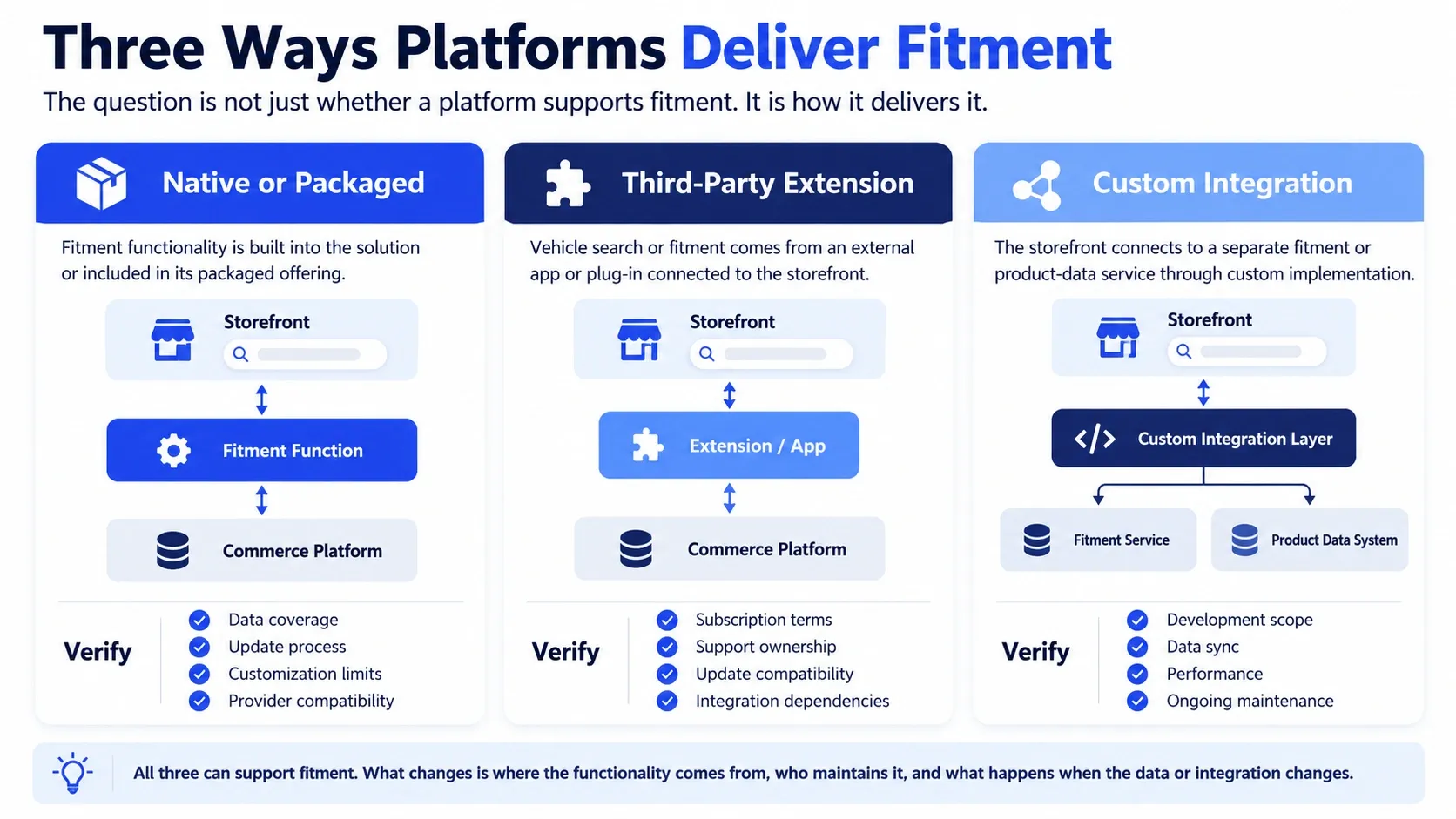
The dependency on additional components deserves attention, though. Find out which provider maintains the fitment functionality, how product data reaches the storefront, and what happens when an extension doesn't work as expected.
If you serve wholesale customers, verify your required pricing and purchasing workflows against the specific Shopify plan, configuration, and integrations under consideration.
BigCommerce: Commerce With B2B and Integration Options
BigCommerce offers commerce functionality alongside B2B capabilities and integration options that businesses can evaluate for account-based selling.
It may deserve a place on your shortlist if you need an established platform and want to combine automotive product discovery with business purchasing requirements.
The questions aren't limited to whether BigCommerce supports B2B commerce. You also need to know which automotive capabilities require extensions, how account-specific pricing works in your proposed setup, and what connects the storefront to your inventory and order systems.
Ask the vendor or implementation partner to demonstrate those functions together, not as separate features.
X-Cart Automotive and Web Shop Manager: Automotive-Focused Options
X-Cart Automotive and Web Shop Manager focus on automotive parts-selling use cases, making them relevant options when vehicle search and automotive catalog functionality dominate the buying experience.
They may help reduce the work involved in assembling automotive-specific features from unrelated services. However, compare their actual offerings rather than treating every automotive-focused product as the same type of platform.
Ask how each handles fitment data, parts catalogs, customer accounts, pricing rules, and your required integrations.
An automotive-focused solution may suit a retailer or parts seller very well, but that doesn't automatically establish its suitability for a distributor with complex wholesale purchasing arrangements.
Virto Commerce: API-First Commerce for Complex Requirements
Virto Commerce provides an API-first approach for businesses that need to connect commerce functionality with several existing systems or deliver different purchasing experiences.
Manufacturers and distributors may find this approach relevant when they manage multiple customer groups, complex pricing, several storefronts, or business processes that require more than standard configuration.
Instead of expecting the storefront to control every function, the business can connect commerce with the systems responsible for product information, customer terms, and order processing.
The trade-off involves implementation and maintenance. Greater flexibility requires clear integration responsibilities and a team that can manage the solution over time.
Virto's discussion of automotive data requirements also covers the business and technology considerations behind connected automotive operations.
Which Platform Approach Fits Your Business?
You don't need to compare every product on the market. Narrow the options based on what your business sells, how customers order, and how much flexibility your existing systems demand.
| Your business situation | What to shortlist | What should influence the decision |
|---|---|---|
| Specialty parts retailer with relatively simple ordering | Shopify, BigCommerce, or automotive-focused solutions | Vehicle search, checkout, catalog integrations, and extension costs |
| Parts seller where vehicle fitment drives most purchases | Automotive-focused platforms or suitable general-purpose platforms with fitment integrations | Compatibility data, product discovery, and the reliability of integrations |
| Wholesale distributor with account pricing and ERP-driven orders | Platforms with strong B2B capabilities, including configurable or API-first options | Contract pricing, purchasing workflows, ERP integration, and order processing |
| Manufacturer serving distributors and several sales channels | Platforms that support the required B2B relationships and integration architecture | Catalog distribution, customer groups, pricing rules, and system flexibility |
These are starting points, not fixed rankings. A general-purpose platform may support complex B2B commerce with the right configuration, while an automotive-focused solution may meet more requirements than its category suggests.
What matters is the complete solution you would implement.
Narrow Your Shortlist With a Platform Comparison Tool
If you're comparing several options, you can use our platform comparison tool to examine B2B commerce capabilities against industry-related requirements.
It compares major commerce platforms across a structured set of features, making it easier to identify which options deserve further investigation.
Use the results to narrow your shortlist, then verify the capabilities that matter most to your automotive business. A general B2B comparison can't establish whether a particular implementation handles your vehicle fitment data, extensions, or integration requirements correctly.
Once you've reduced the list to two or three serious options, ask vendors to demonstrate how each platform handles the same purchasing scenarios.
What Should You Ask Vendors to Demonstrate?
A feature list tells you what a platform claims to support. A working demonstration shows how it handles your requirements.
Ask vendors to use representative catalog and account data. You don't need to import your entire production database, but a demonstration with only a handful of perfectly prepared products won't tell you much about your business.
Start With Vehicle and Part Search
Search for a product using Year, Make, and Model, then try the same part using its part number.
Check whether the platform returns relevant results and handles missing vehicle details or uncertain compatibility. Ask where the fitment data comes from and how the storefront receives updates.
Don't stop when the system finds a compatible part. Buyers still need the correct prices, availability, and purchasing options to complete an order. Our article on auto parts fitment explores that distinction in more detail.
Test Two Customer Accounts
Use two accounts with different purchasing arrangements and search for the same product.
Do both customers see the correct price? Does the price remain consistent through checkout? Can the platform apply the account rules your business actually uses?
If the ERP controls pricing, ask the vendor to show how the storefront retrieves and applies it.
Submit a Complete Order
Build a multi-line order with realistic quantities and purchasing details. Include a purchase-order reference if your customers use one.
Follow the order through checkout and into the system responsible for processing it. Check that the account, pricing, product identifiers, quantities, and other important details remain intact.
A completed checkout isn't enough if someone must re-enter or correct the order afterward.
Check What Happens When Something Fails
Ask the vendor to demonstrate a delayed pricing response, unavailable inventory information, or a failed order integration.
Can your team identify the issue? Does the system provide enough information to resolve it? Can employees recover the transaction without submitting the order twice?
A vendor doesn't need to solve every possible exception during the demonstration, but the proposed system should have a clear approach to handling them.
Five Checks for Your Vendor Demo
| Ask the vendor to show | Look for | Question the result if |
|---|---|---|
| Vehicle and part search | Results using representative compatibility and catalog data | Search works only with prepared examples |
| Account-specific pricing | Different accounts receive their correct purchasing terms | Staff must adjust prices manually |
| Inventory availability | The storefront obtains relevant stock information | Nobody can explain where availability comes from |
| Complete B2B ordering | The order reaches the processing system with the right details | The demonstration ends at checkout |
| Integration failure and recovery | The team can identify, investigate, and recover failed transactions | The vendor cannot explain what happens after a failure |
When a vendor can't demonstrate something immediately, ask for technical evidence or another demonstration. Don't treat an unverified claim as a proven capability, but don't assume the platform lacks that capability either.
What Will the Platform Cost Beyond the License?
The license or subscription fee is only one part of the cost. Extensions, integrations, product data services, implementation work, and maintenance can all affect the amount your business spends.
A storefront may offer an affordable subscription but require several paid services to support automotive fitment and B2B purchasing. Another option may carry a higher initial cost but need less additional development for your specific requirements.
Neither approach automatically costs less.
When vendors send proposals, separate the expenses into three groups:
Platform and third-party services: Licensing, hosting, subscriptions, fitment data services, and required extensions.
Implementation work: Configuration, ERP and PIM integrations, customization, catalog preparation, and testing.
Ongoing support: Maintenance, monitoring, upgrades, technical support, and future changes.
Then check what each proposal excludes. A vendor may quote the commerce platform without including the connections your business needs. Another may include initial integration development but leave ongoing support to your internal team.
Compare proposals over the same period and against the same requirements. Also ask how the costs change when you add another storefront, expand your catalog, or introduce new customer pricing rules.
Before signing, check the contract terms and what happens if you decide to change platforms or implementation partners. Ask who owns your product and customer data, how you can export it, whether early termination carries a fee, and which integrations or customizations you can retain. These details can matter as much as the initial platform price when your business grows or changes direction.
If the scope differs, the price comparison won't tell you which option offers better value.
What Should Make You Rule Out a Platform?
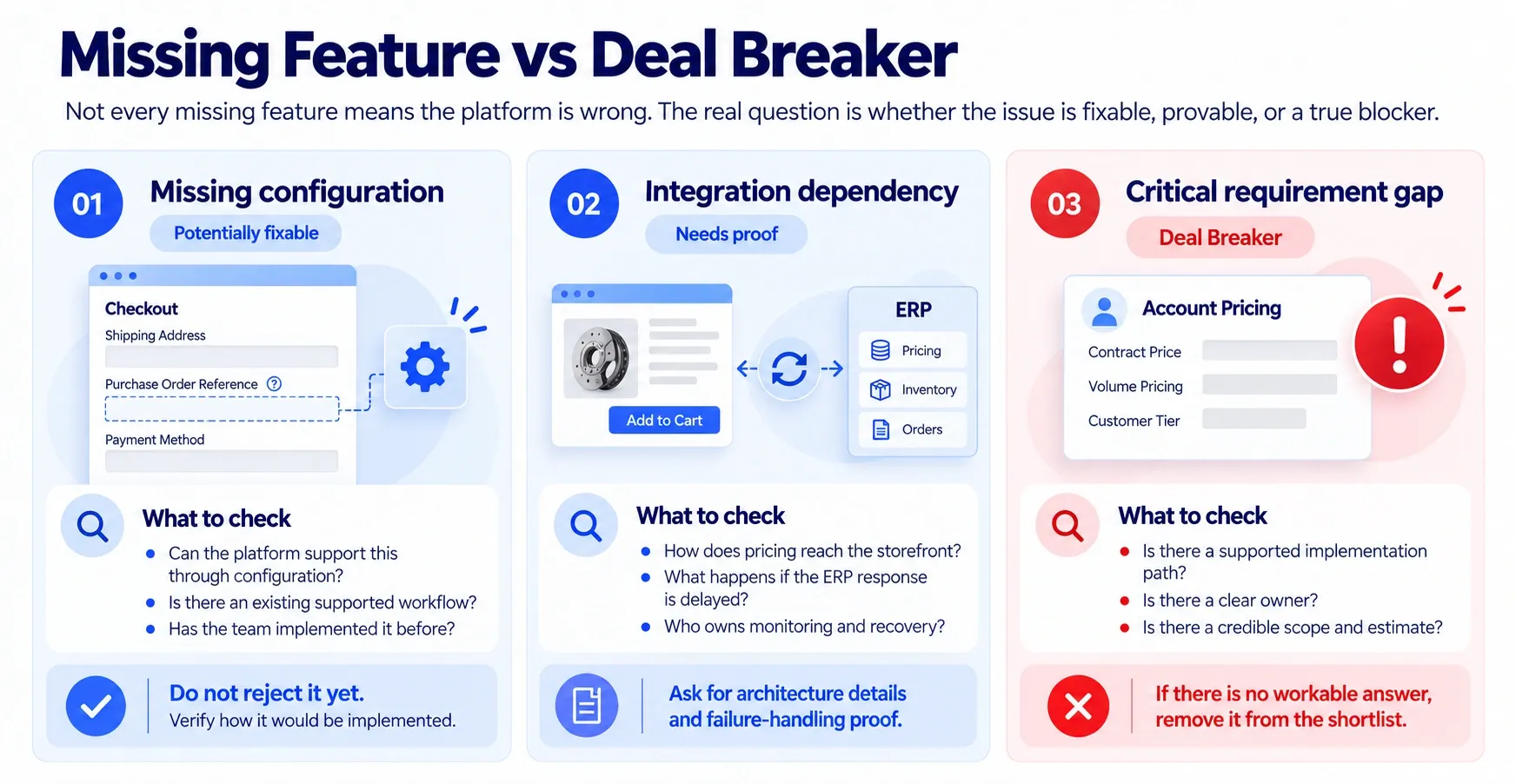
A missing feature doesn't always justify rejection. Your implementation team may be able to configure it, add an extension, or build the required integration.
Some problems, however, should stop the evaluation until the vendor provides a workable answer.
It Cannot Support an Essential Purchasing Process
If your customers rely on contract pricing, bulk ordering, or purchase-order workflows, the proposed solution must support those requirements.
A vendor doesn't need to demonstrate every detail through standard functionality, but the proposed implementation must account for the necessary work.
If the team cannot explain how an essential process will work, keep the platform off the final shortlist until it can.
The Integration Plan Leaves Major Gaps
APIs alone don't guarantee a dependable connection.
Ask who will implement the integrations, monitor errors, maintain data consistency, and support the connections after launch.
A vendor that cannot explain those responsibilities leaves your team exposed to operational problems, even when its commerce functionality looks strong.
Too Much Depends on Unsupported Custom Work
Customization isn't automatically a problem. Automotive commerce often requires it.
The concern arises when essential functionality depends on extensive development without a clear scope, ownership model, testing plan, or maintenance strategy.
Find out whether the vendor has implemented comparable requirements and how your team will manage future platform updates.
Nobody Can Explain the Ongoing Responsibility
Your business will still need support after launch.
Establish who owns platform maintenance, extension updates, integrations, and technical issues. If several providers share responsibility, make sure their roles don't leave critical problems unresolved.
A platform that meets your requirements today should also give your team a realistic way to operate it tomorrow.
When Does an Automotive eCommerce Accelerator Make Sense?
An accelerator can offer a starting point when your business needs automotive-specific commerce capabilities but doesn't want to develop common components from scratch.
Our fitment-ready eCommerce accelerator, powered by Virto Commerce, gives automotive aftermarket businesses a reusable commerce foundation. We configure and integrate it around their catalogs, purchasing processes, and existing systems.
That approach can make sense when the accelerator already supports a meaningful portion of your requirements. You can focus implementation work on the capabilities and integrations your business needs rather than rebuilding everything.
Before selecting it, review what's already available, what needs configuration, and what requires additional development.
An accelerator won't fix incomplete product data or undefined business processes on its own. Its value depends on how well the existing foundation fits your operation and how much work remains.
Before You Sign With a Platform Vendor
You should know exactly which purchasing processes the platform can handle, which integrations your team needs to build, and who will maintain the finished solution.
Make the final decision using evidence from realistic demonstrations, a clear implementation scope, and comparable cost estimates. If a vendor cannot answer an essential operational question, resolve it before committing.
At Reveation Labs, we help automotive manufacturers and distributors evaluate their technology requirements and implement automotive eCommerce solutions that connect commerce with their existing business systems.