Have you ever wondered why some manufacturers are thriving with AI while others struggle to get past the pilot stage? The answer might surprise you. It's not about having the smartest data scientists or the biggest budget. It's about having the right foundation in place.
Think of it like building a house. You can have the most beautiful design and the best furniture, but without a solid foundation, everything falls apart. The same goes for AI in manufacturing. Without proper AI infrastructure, your AI projects are destined to fail before they even start.
What Exactly Is This Technology Foundation
Let's start simple. AI infrastructure is the complete technology foundation that makes artificial intelligence work in your business. It's not just servers and computers. It includes everything from how you store and organize data to how different AI systems talk to each other and actually do their jobs.
Imagine you're trying to cook a meal. You need more than just ingredients. You need a kitchen with the right appliances, storage space, and tools. This foundation works the same way. It's the entire kitchen that lets your AI systems cook up solutions for your business problems.
For manufacturers and distributors, this becomes even more critical. You're dealing with machines that have been running for decades, data scattered across different systems, and processes that can't afford downtime. Getting the foundation right from the start can mean the difference between success and wasted investment.
The Real Problem Most Manufacturers Face Today
Here's what's happening right now in the manufacturing world. Companies are excited about AI. They read success stories, attend conferences, and decide to jump in. But then reality hits hard.
Your data lives in multiple places. Your ERP system (the software that runs your business operations) has some information. Your production machines have sensor data. Your quality control team has inspection records. Your suppliers send documents in different formats. Nothing talks to each other properly.
Legacy systems add another layer of complexity. Many manufacturers run equipment and software that's 20 or 30 years old. These systems were never designed to work with modern AI. Trying to connect them feels like trying to plug a smartphone into a 1990s computer.
Then there's the skills gap. Your team knows manufacturing inside and out. But vector databases (special storage systems that understand relationships between concepts), large language models, and autonomous AI agents? That's a completely different world. Most internal teams simply don't have the expertise to build and maintain proper AI infrastructure.
The result? Projects that start with excitement but end in frustration. Pilot programs that show promise but never scale. Budgets that get spent without clear returns. Executives who become skeptical of AI altogether.
The Five Building Blocks You Actually Need
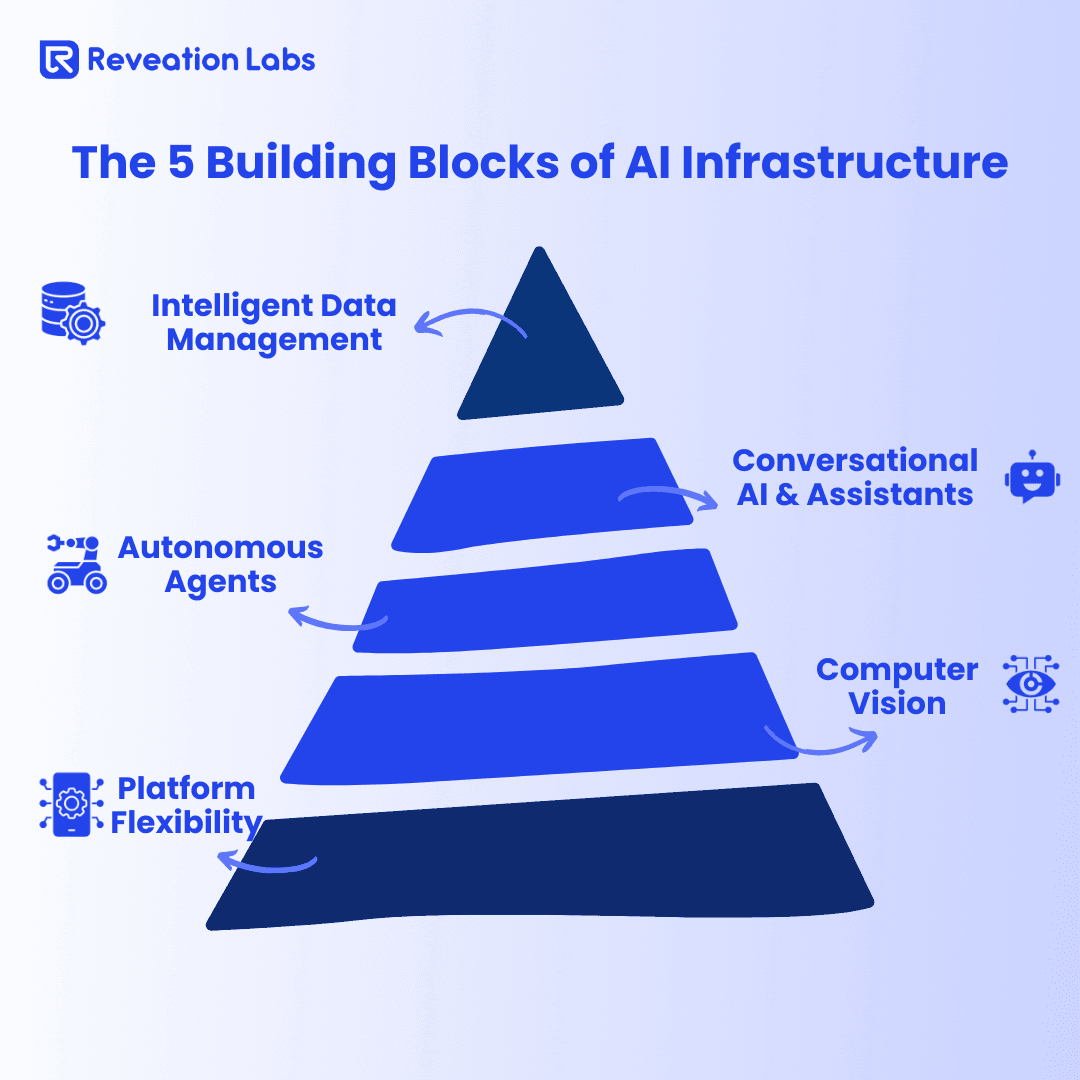
Let's see what working AI infrastructure for manufacturing actually looks like. There are five essential pieces that all need to work together.
First, you need intelligent data management. This means taking all your scattered information and making it searchable and usable. Not with old-fashioned keyword searches that miss the point, but with semantic search (technology that understands meaning, not just matching words).
Think about this scenario. An engineer types "excessive machine vibration." With regular search, they might find documents that literally say those exact words. With semantic search powered by vector databases, they find vibration issues, bearing problems, alignment concerns, and maintenance logs that describe the same problem using completely different words.
Second, you need conversational AI and smart assistants. Your workers and customers shouldn't need to dig through manuals or wait hours for answers. An AI chatbot that actually understands your products and processes can answer questions instantly, 24 hours a day. For distributors, this means customers get part numbers and availability without tying up your service team.
Third, you need autonomous agents that can act independently. These are AI systems that don't just analyze data but actually make decisions and take action. Imagine an AI that monitors your equipment, predicts when a bearing will fail, automatically schedules maintenance during your planned downtime, orders the replacement part, and notifies your team with specific instructions. All without anyone clicking a button.
Fourth, you need computer vision for quality and documents. Cameras and AI can inspect products faster and more consistently than human inspectors. The same technology can read invoices, purchase orders, and shipping documents automatically, pulling out the information and entering it into your systems without manual data entry.
Fifth, you need platform flexibility. AI technology changes fast. What works best today might be different next year. Your setup should let you use Google's Vertex AI for one task, Microsoft Azure AI for another, and OpenAI's models for a third. No vendor lock-in means you always use the best tool for each job.
How This Solves Your Biggest Headaches
How does having the right foundation actually help with the problems you face every day?
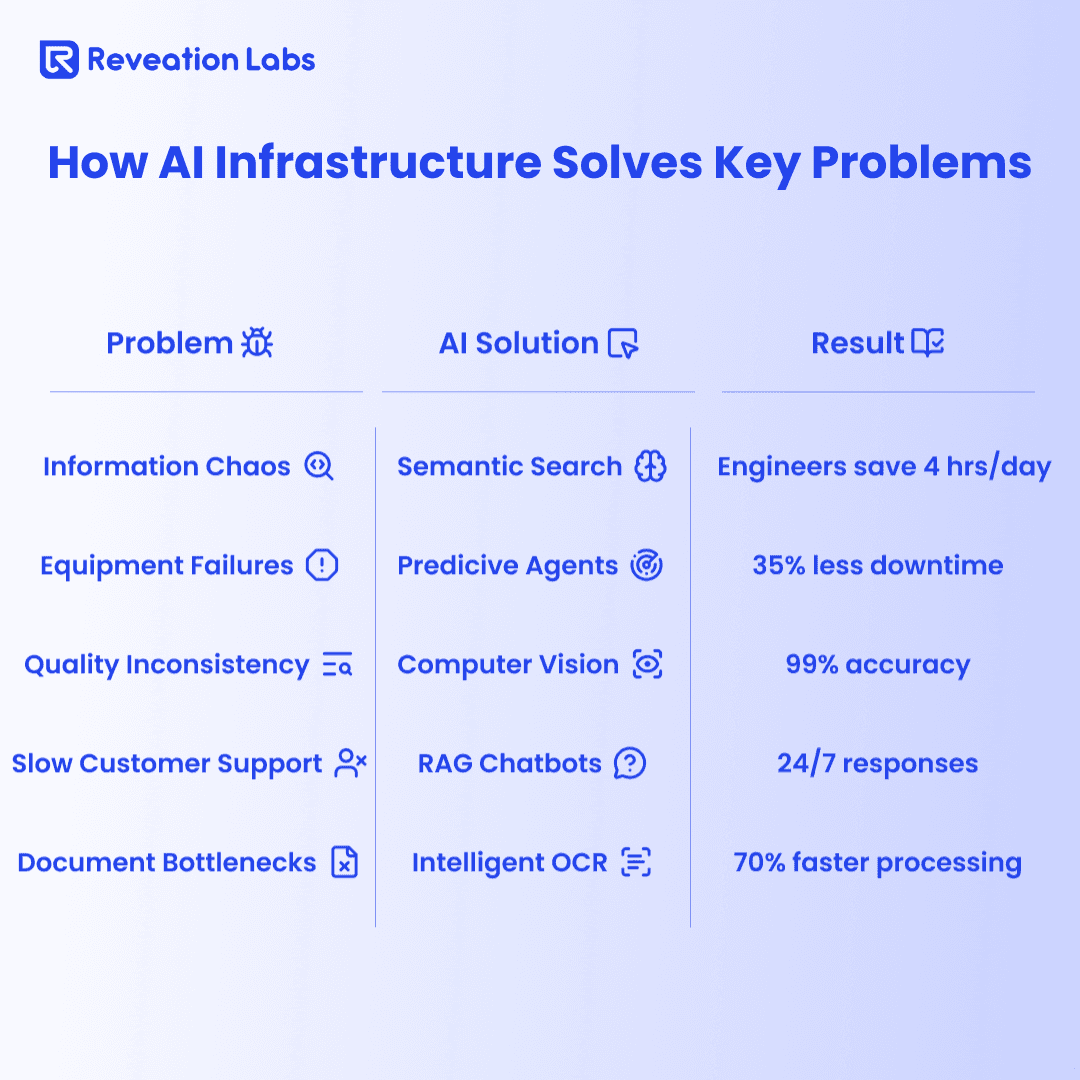
Problem number one is information chaos
Engineers waste hours searching for technical documents, maintenance histories, and troubleshooting guides.
With vector databases and semantic search, that information becomes instantly accessible. An engineer searching for a solution finds relevant answers in seconds instead of spending half their day digging through files.
Problem number two is unexpected equipment failures
Machines break down at the worst possible times. Emergency repairs cost three to five times more than planned maintenance.
Agentic AI (autonomous systems that can act on their own) continuously monitors equipment, learns what normal operation looks like, and predicts failures before they happen. Your maintenance becomes proactive instead of reactive.
Problem number three is quality inconsistencies
Human inspectors get tired, work at different speeds across shifts, and inevitably miss some defects. Computer vision AI inspects every single product at production speed.
It catches defects humans miss, like tiny cracks or subtle color variations. Quality becomes consistent, and defects get caught before products ship.
Problem number four is slow customer service
Distributors especially struggle with this. Customers call asking which part fits their specific equipment. Finding the answer requires checking multiple systems and maybe calling the manufacturer.
A conversational AI powered by RAG (retrieval augmented generation, which means the AI looks up real information instead of guessing) can answer these questions instantly.
Problem number five is document processing bottlenecks
Invoices, purchase orders, and packing slips pile up. Someone has to manually read each one and type information into your system.
Intelligent document processing uses computer vision to read these documents automatically, extract the data, match invoices to purchase orders, and flag exceptions for human review. Processing time drops by 70%.
Read Also: B2B eCommerce for Manufacturers
What About Cost and Return on Investment?
You're probably thinking about money right now. Fair question. Building AI infrastructure requires investment. But let's look at what that investment actually returns.
The financial picture typically unfolds over three years. Year one is your investment phase. You're building the foundation, running pilots, and proving concepts. Most companies don't see positive ROI yet, but they're setting up for future gains.
Year two is when returns start accelerating. Your pilots expand to more production lines and facilities. Multiple AI applications are generating measurable value. Many companies hit break-even around 18 months.
Year three and beyond is where the real magic happens. Industry benchmarks show companies achieving over 300% ROI by year three. That's not marketing hype. It comes from multiple sources of value.
Operational efficiency improves across the board. Better inventory management frees up working capital. A large manufacturer with $10 billion in revenue might free up $400 to $600 million in working capital just from AI-optimized inventory. That's real money that can be invested elsewhere.
Labor productivity increases without cutting jobs. Your team works on higher-value activities instead of manual data entry and searching for information. Quality inspection happens 10 times faster.
Revenue grows because you serve customers better. Delivery reliability improves. Response times get faster. Customer satisfaction goes up, which means less churn and more repeat business.
The competitive advantage might be the biggest benefit. Companies that build strong AI infrastructure now create advantages that last five to seven years. Competitors who wait face an increasingly steep hill to climb.
Choosing the Right Partner for Your Journey
Here's the thing about AI infrastructure. You probably shouldn't try to build it alone. The expertise required spans too many specialties.
You need people who understand manufacturing operations, legacy system integration, modern AI technology, change management, and more.
When evaluating potential partners, look for manufacturing-specific experience. AI companies that mostly work with retail or finance won't understand your unique challenges.
You need someone who speaks your language, understands production constraints, and has helped other manufacturers succeed.
Look for a complete solution: Working with five different vendors for different pieces of your technology foundation creates nightmare integration projects. Find a partner who can handle everything from data management through autonomous agents to computer vision, all working together as one system.
Verify their integration capabilities: Your existing systems represent years of investment and institutional knowledge. Ripping everything out and starting over isn't realistic. You need solutions that work with what you already have, whether that's a 30-year-old control system or a modern cloud ERP.
Ask about security and compliance: Your manufacturing data and intellectual property are valuable. Make sure your partner has enterprise-grade security, keeps your data private, and understands relevant regulations for your industry.
Taking Your First Steps Forward
So where do you start? The best approach is thinking big but starting small. Don't try to transform everything at once.
Begin with a high-impact pilot project. Pick something important enough to matter but contained enough to succeed quickly. Predictive maintenance for critical equipment is a popular choice. So is quality control for your highest-value product line. Or automated customer service for your most common inquiries.
The goal is to prove value in three to six months. That quick win builds credibility, secures executive support, and generates funding for expansion.
From there, scale systematically. Expand your successful pilot to more equipment or production lines. Add a second use case. Then a third. Each success builds momentum and expertise within your organization.
The Bottom Line
AI infrastructure isn't optional anymore for manufacturers and distributors who want to stay competitive. It's the foundation that determines whether your AI initiatives succeed or fail. The companies investing now are building advantages that will compound for years.
The question isn't whether you need agentic AI for your B2B eCommerce business. The question is how quickly you can build it and start capturing the benefits. Every quarter you delay represents unrealized value and ground given to more aggressive competitors.
You don't have to figure this out alone. At Reveation Labs, we will walk you through the complexity, help you avoid common pitfalls, and get you to value faster than trying to navigate this journey on your own.
Your manufacturing business has gone through many changes over the years. This is simply the next evolution. With the right foundation in place, you'll be ready not just for today's challenges, but for opportunities you haven't even imagined yet.