Editor’s Note
Insights from this edition to keep you informed and ahead.
B2B commerce is undergoing a structural reset. What began as incremental digital transformation has evolved into a fundamental architectural shift—from tightly coupled, monolithic commerce suites to composable, API-first, headless ecosystems. As we move deeper into 2025 and 2026, this is no longer a technical debate. It is a board-level growth decision.
Traditional “all-in-one” platforms are now the primary source of technical debt for high-growth manufacturers, distributors, and industrial brands. Every frontend change requires backend deployment. Every regional nuance becomes a customization. Every integration compounds complexity. The result: stalled innovation, ballooning TCO, and fragile systems that break under scale.
In this edition, we break down the economic logic of replatforming, unpack how atomic commerce architectures solve real B2B complexity, and outline a practical roadmap for leaders ready to move from reactive modernization to strategic composability.
Insights from This Edition
By the end of this issue, a Chief Digital Officer, VP of eCommerce, or CIO should be able to:
Articulate why monolithic commerce has become a structural liability in modern B2B environments
Quantify the business case for headless architecture in terms of velocity, cost, and revenue impact
Explain how atomic, composable design reduces vendor lock-in and increases innovation speed
Identify the first three architectural decisions required to initiate a successful replatforming strategy
Trend Watch
The 2026 Replatforming Imperative
1. The Erosion of the Monolithic Paradigm
For decades, monolithic commerce platforms were the default. They centralized storefront, business logic, and data into a single deployable unit. That model optimized for control, but not agility.
Today, market dynamics reward continuous experimentation, faster releases, and cross-channel orchestration. The headless commerce market is projected to exceed $7B by 2032, signaling a systemic shift away from centralized architectures.
Decoupling the presentation layer (React, Vue, Next.js storefronts) from backend commerce engines
Exposing core services via REST or GraphQL APIs
Moving from release cycles measured in quarters to CI/CD pipelines with weekly or daily deployments
In practice, we see teams replacing rigid template-driven UIs with API-driven experiences delivered through edge architectures (e.g., CDN + server-side rendering).
A 1 sec improvement in page load time can increase conversions by ~2%. In B2B, where AOVs are high and procurement cycles are long, that uplift compounds quickly.
“Speed is no longer UX polish—it is revenue infrastructure.”
2. Solving B2B Complexity Through Atomic Architecture
B2B commerce is structurally more complex than B2C:
Negotiated contract pricing
Multi-level buyer hierarchies
Approval workflows
Millions of SKUs
Multi-warehouse fulfillment
Standard platforms struggle because they were not designed for this level of nuance.
Virto Commerce addresses this challenge through its Atomic Architecture™ model—decomposing commerce into granular components: Atoms, Molecules, Cells, and Organisms.
Underneath, this requires:
Modular services for pricing, catalog, order orchestration
API-first integration with ERP systems (SAP, Microsoft Dynamics)
Decoupled pricing engines capable of real-time contract rate synchronization
Role-based policy engines for delegated purchasing controls
A typical pattern we implement:
ERP publishes price updates via event streams
Pricing service recalculates contract tiers
Frontend queries GraphQL endpoints to reflect personalized pricing instantly
Senior leaders maintain control while enabling delegated purchasing
Buyers see accurate negotiated pricing in real time
Order lifecycle management spans validation → allocation → multi-warehouse fulfillment
“Atomic design reduces vendor dependency while increasing functional precision.”
3. Strategy in Action: Enterprise Validation
The shift is no longer theoretical. Global enterprises are executing.
Cadillac and KW Parts managed a 4-million-product catalog by decoupling frontend layers and deploying AI-driven search indexing.
Search response times dropped below one second.
Business outcome: Faster search → higher order completion → improved distributor satisfaction.
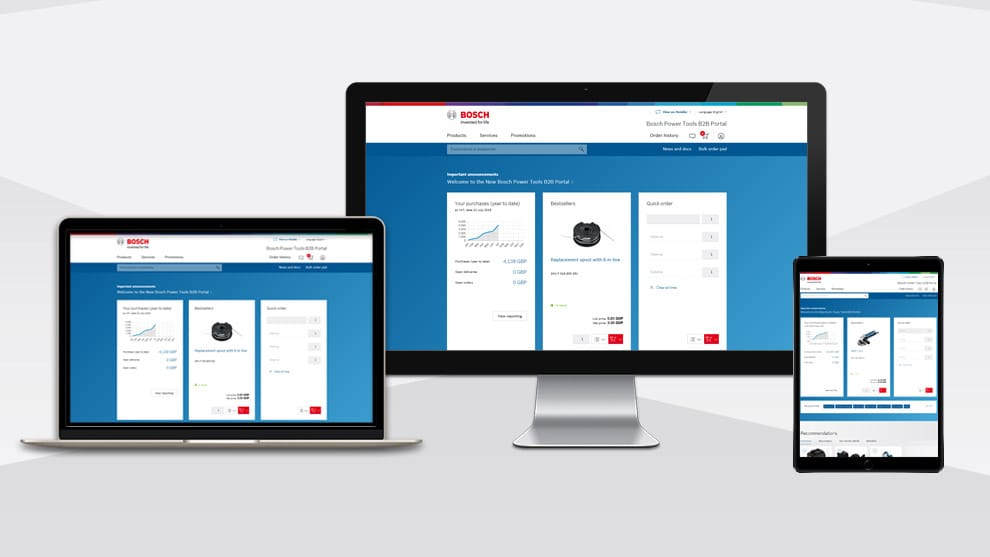
Bosch Thermotechnik deployed a customizable loyalty platform across 25 countries, bridging manufacturer-to-end-customer data gaps.
Architectural pattern: Core commerce logic reused; loyalty modules deployed regionally.
Simple Checklist
What Mid‑Market B2B Leaders Should Do Before 2026
1. Define Your Composable Thesis
Identify which commerce capabilities must remain core IP
Determine which services can be modularized
Align architecture with a 3–5 year growth strategy
“Architecture must serve expansion strategy—not constrain it.”
2. Audit Technical Debt
Map frontend/backend coupling points
Quantify release cycle duration
Assess ERP integration fragility
Present findings in business language: cost of delay, lost experimentation velocity.
3. Prioritize High-Impact Decoupling
Start with search, pricing, or content layers
Deploy APIs before full frontend rebuild
Prove speed improvements within 90 days
Quick wins create executive confidence.
4. Architect for AI-Readiness
Ensure APIs expose structured pricing and catalog data
Implement event-driven order lifecycle tracking
Introduce observability across services
AI cannot operate effectively in opaque systems.
5. Establish Governance Early
Define API versioning standards
Implement role-based access policies
Align Legal, Finance, and IT on data ownership
Composable without governance becomes chaos.