Editor’s Note
Insights from this edition to keep you informed and ahead.
For the last five years, B2B commerce teams have been sold a familiar story: go headless, go composable, adopt microservices—and the outcomes will follow. Mid-January 2026, the mood is different: leaders are tired of paying for “transformations” that ship late, overrun budgets, and deliver complexity instead of agility.
This month’s takeaway is counterintuitive and pragmatic: the next advantage won’t come from adding more tech. It will come from designing systems you can safely remove pieces from. In analyst language, this shows up as stronger requirements around replaceability, interoperability, integration governance, and operating model maturity across categories like Digital Commerce.
Insights from This Edition
By the end of this issue, a CIO/CTO should be able to:
Reframe “headless/composable” into board outcomes: risk reduction, predictable delivery, faster time-to-value
Explain the difference between composable and decomposable systems (and why “swap cost” matters)
Reduce integration churn by formalizing data contracts and treating integration as a governed capability (see iPaaS + API management)
Connect modernization to technical debt economics using board-friendly language like McKinsey’s framing on tech debt traps: Breaking technical debt’s vicious cycle
Make “product not project” operational, anchored in the product operating model
By the end of this issue, a GM / VP Sales / VP Digital should be able to:
Sponsor a platform evaluation with credible benchmarks like The Forrester Wave™: Commerce Solutions for B2B (Q2 2024)
Align investments to outcomes before architecture (stability, predictability, optionality)
Approve an incremental roadmap that reduces risk while improving speed-to-value (vs. big-bang replatforms)
Trend Watch
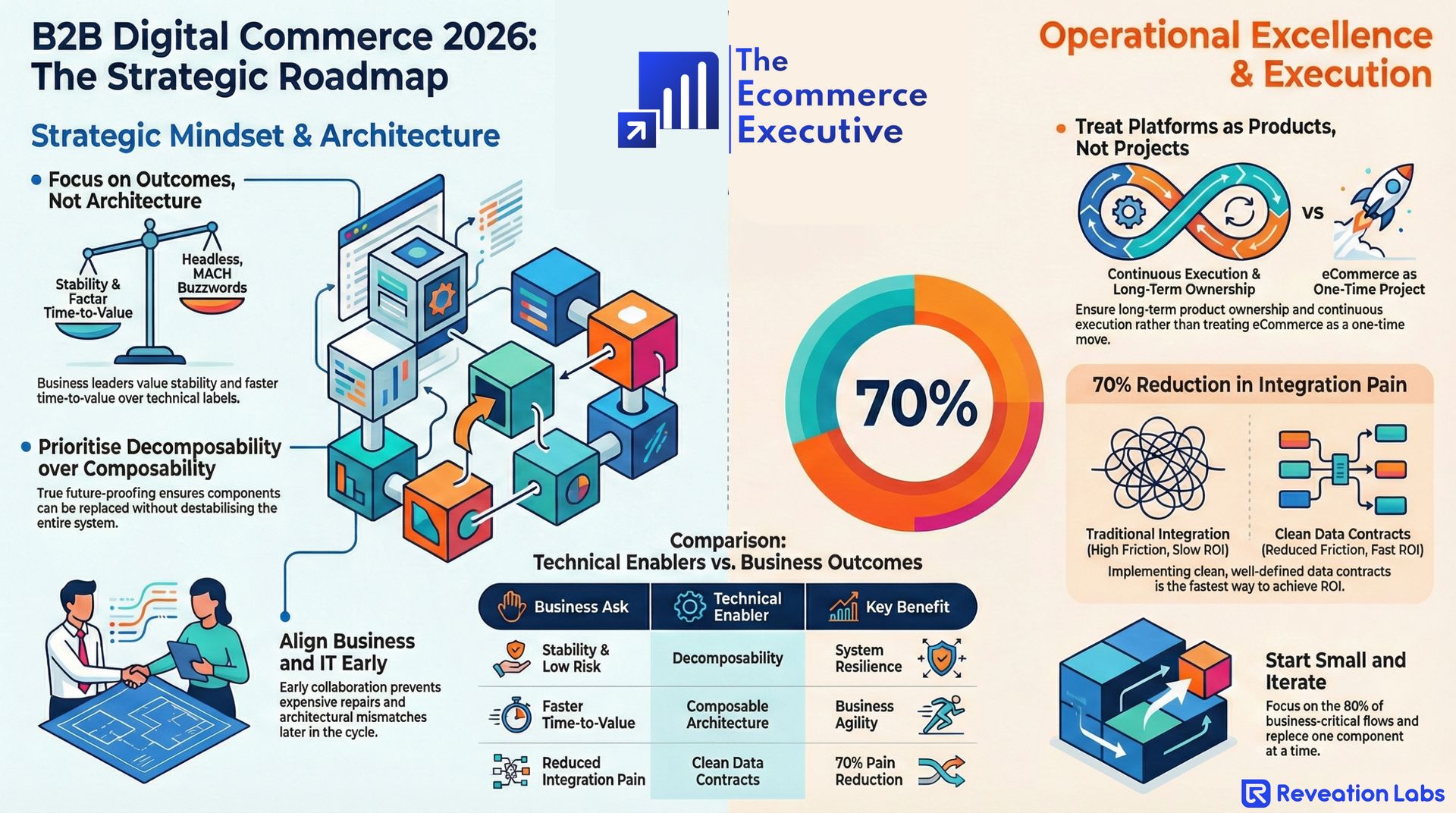
The 2026 Shift From “Composable” to “Decomposable”
1) The Language Barrier That Kills Funding
What’s happening: IT teams pitch architectures. Business leaders buy outcomes. This mismatch shows up repeatedly in how enterprise categories are defined e.g., Gartner’s definition of digital commerce emphasizes interoperability via APIs and the ability to support end-to-end buying experiences, not “headless” as a board requirement.
How to fix it: Translate every architecture decision into one of four executive outcomes:
Reduce operational risk (lower change failure rate, fewer sev-1 incidents)
Increase delivery predictability (on-time roadmap, lead time)
Speed time-to-value (idea → revenue impact)
Preserve optionality (replace vendors/components without replatforming)
2) Composability ≠ Decomposability (and Confusing Them Creates Traps)
Composable thinking (additive): “What can we bolt on next?”
Decomposable thinking (protective): “Can we remove this one piece without collapsing the tower?”
The enterprise failure mode is hidden coupling: the system claims modularity, but critical logic bleeds across boundaries. The result is vendor lock-in by dependency, not contract.
Executive test: Swap cost. How many teams, weeks, and regression surfaces to replace search/tax/pricing without a replatform? If the answer is “we can’t without breaking checkout,” you don’t have flexibility—you have a trap.
3) Integration Pain Is a Governance Problem (Not a Talent Problem)
Integration remains the tax on B2B commerce: ERP ↔ CRM ↔ PIM ↔ tax ↔ pricing ↔ OMS. You reduce churn when you treat integration as a governed product with contracts and enforcement.
Two useful external anchors for executive readers:
Why it’s urgent now: Gartner explicitly ties API demand growth to AI/LLM-driven tooling by 2026—meaning more integrations, more endpoints, more failure surfaces unless you formalize contracts and governance.
4) Data Contracts + Data Governance: The “Unsexy” Advantage
A data contract is a technical treaty: formats, identifiers, required fields, state transitions, versioning rules—agreed before code and enforced continuously.
If you want enterprise-grade justification for why governance is value creation (not bureaucracy), these two links are executive-friendly:
5) The Randy Factor: Tribal Knowledge Is a Revenue Risk
We all have worked with a Randy before, only one who knows how the system works, you have a single point of failure. Mature orgs institutionalize knowledge: runbooks, dependency maps, ownership, and observability tied to business events.
This is also where “tech debt” becomes visible to non-technical leaders: if change is risky because nobody understands the system, you’re paying an interest rate on complexity. McKinsey’s framing is a strong anchor when you need to make the economics legible: Breaking technical debt’s vicious cycle.
6) Product, Not Project: The Missing Capability Isn’t Coding
Most enterprises can hire developers. What they lack is the ability to operate commerce as a product lifecycle: continuous prioritization, funding models, cross-functional ownership, and outcome measurement.
If you want a board-ready reference for this shift:
Key updates from top B2B platforms globally
Pimcore (PIM/MDM/DAM + Experience)
Pimcore 2025.4 is an LTS release (3-year support) and adds Symfony 7 support (with a migration path that can “freeze” on Symfony 6.4 temporarily). Pimcore also signals that Symfony 6.x support will be removed in 2026.1, so teams on older baselines should plan their upgrade runway now.
AI interoperability is getting first-class attention: 2025.4 introduces experimental MCP Server support so AI agents/LLMs can read Pimcore-managed data (via Datahub REST endpoints), positioning Pimcore as a cleaner “system of record” for AI-driven enrichment and personalization.
UI transition is now a roadmap constraint: 2025.4 is described as the final release supporting Admin UI Classic, with Pimcore Studio compatibility intended as the transition path. If your team depends heavily on Classic-era bundles, treat this as a decomposability test: identify what must be replaced/retired before 2026.1.
Licensing changed in 2025.1: Pimcore moved its Community Edition from GPLv3 to the Pimcore Open Core License (POCL). If you’re running Community + Admin UI Classic (ExtJS), Pimcore notes additional licensing implications.
Why this matters for B2B leaders: Pimcore is explicitly optimizing for enterprise stability (LTS), cleaner upgrade paths, and AI-ready data access, all directly aligned with “decomposability” (swap/retire parts without replatforming).
Zurich is positioned as the latest platform release focused on “agentic AI” and building/testing apps with more control—highlighting Build Agent and Developer Sandboxes as part of its AI-powered app dev story.
Major ecosystem update (Jan 20, 2026): ServiceNow + OpenAI collaboration announced, a multi-year agreement intended to provide direct access to frontier model capabilities and accelerate enterprise AI outcomes inside ServiceNow workflows.
Security watch: ServiceNow patched a critical vulnerability (CVE-2025-12420) reported to impact AI-related components (including Now Assist AI Agents / Virtual Agent API). If you’re using those capabilities, confirm your patch level and rollout process.
Why this matters for B2B leaders: decomposability isn’t only architecture, it’s operating discipline. ServiceNow’s trajectory (agentic workflows + AI governance + security expansion) maps to the “product-not-project” reality: change management, auditability, and resilience become the differentiators as stacks get more autonomous.
Simple Checklist
What Mid‑Market B2B Leaders Should Do Before 2026
1) Translate Architecture into Outcomes
Define the top 3 business outcomes (risk, predictability, time-to-value, optionality)
Tie each initiative to KPIs (lead time, change failure rate, conversion, order accuracy)
Use category definitions to keep language business-first: Gartner Digital Commerce
2) Make Decomposability a Requirement (Not a Preference)
For every component: ask “How hard is it to replace you?”
Require explicit boundaries (APIs/events + versioning + deprecation policy)
Measure swap cost per capability (search, tax, pricing, checkout)
3) Stand Up Data Contracts + Enforce Them
Publish canonical schemas (orders, customers, products, prices, inventory)
Add CI checks + contract tests; breaking changes fail the build
Use governance framing to secure executive buy-in: Gartner Data Governance, BCG governance PDF
4) Fix the Integration Operating Model
5) Eliminate Randy Risk
Document runbooks + dependency maps for the top revenue flows
Require two-person knowledge for critical operations (pairing/rotation)
Tie observability to business events (order placed, payment authorized, shipment created)
Book a 1-on-1 Strategy Session with our eCommerce Executive
Fixed-fee engagement $4,500, fully creditable toward a future implementation if you move forward.
You Get:
A clear, engineering-led assessment outlining risks, constraints, and improvement opportunities, with prioritized recommendations.